AI Selloff Over? Nvidia's 31% Surge Lasted Just One Day — Watch These 4 Signals Next


- Core View: The AI trade is shifting from sentiment-driven momentum chasing to a rigorous screening phase. The market's core tension has moved from the ups and downs of a single bellwether to the rate path, supply chain linkages, and the ability to deliver on orders. Capital is rotating from high-volatility themes toward assets with cash flow certainty.
- Key Elements:
- Nvidia rose 31.48% on Monday before falling 5.86% the next day, and SOXX dropped 8.27%, yet the Dow rose 0.85% to a record high and the VIX反而 fell to 26.36, indicating sector rotation rather than broad risk-off.
- South Korea's KOSPI swung from a 6.32% gain to a 4.85% loss within 48 hours, triggering a sell-side circuit breaker, exposing the amplification effect of high beta across the supply chain under crowded trades.
- Hong Kong's Hang Seng Index opened higher but closed down 0.73%, even as southbound funds recorded net buying of HK$6.203 billion, concentrated in core assets such as Tencent, Alibaba, and SMIC.
- Gold fell below $3,560/oz and the dollar index retreated to 103.85, with the market pricing in nearly 96% odds of a 25-basis-point rate hike in December, making rates a common suppressing variable for AI, gold, and BTC.
- Dell's AI server orders reached $60.2 billion with a backlog of $132.3 billion, yet its stock fell 11.83% with limited after-hours reaction, showing that "good earnings" no longer automatically equals "stock goes up."
- HSBC sold a $300 million share of Oracle data center-related loans at about 85 cents on the dollar, reflecting a temperature gap between order enthusiasm and downstream credit pricing.
- Core PCE becomes the key observation window, requiring simultaneous confirmation of four signals: rates peaking, bellwethers stabilizing, supply chain following through, and earnings delivery.
1. Nvidia's 31% Rally Lasted Only One Day
On Monday, Nvidia surged 31.48%, and the market briefly reignited the AI trade. Just one day later, Nvidia fell 5.86% to $155.38, the SOXX ETF dropped 8.27% in a single day, Micron fell 11.01%, Dell fell 11.83%, AMD fell 8.86%, and Texas Instruments fell 11.25%. The AI hardware sector nearly erased all of the previous day's optimism. Meanwhile, the Dow rose 0.85% to close at 50,018.70, indicating that capital has not staged a full-scale retreat from the stock market—the characteristics of sector rotation are quite evident.
The broader market's own price action is also worth noting. QQQ opened about 1.7% lower and then traded in a range of $631.15 to $648 throughout the day, closing at 638.10, down 1.99%—only about a quarter of the Philadelphia Semiconductor ETF's decline. Selling pressure at the index level was largely absorbed by repositioning, which is direct evidence that this pullback has not yet evolved into a broad risk-off move. Secondary indicators send the same signal: the VIX closed at 26.36 that day, edging down about 1% from the previous day and still near the midpoint of its 52-week range. The fear index did not spike on a day when the semiconductor sector plunged 8%.
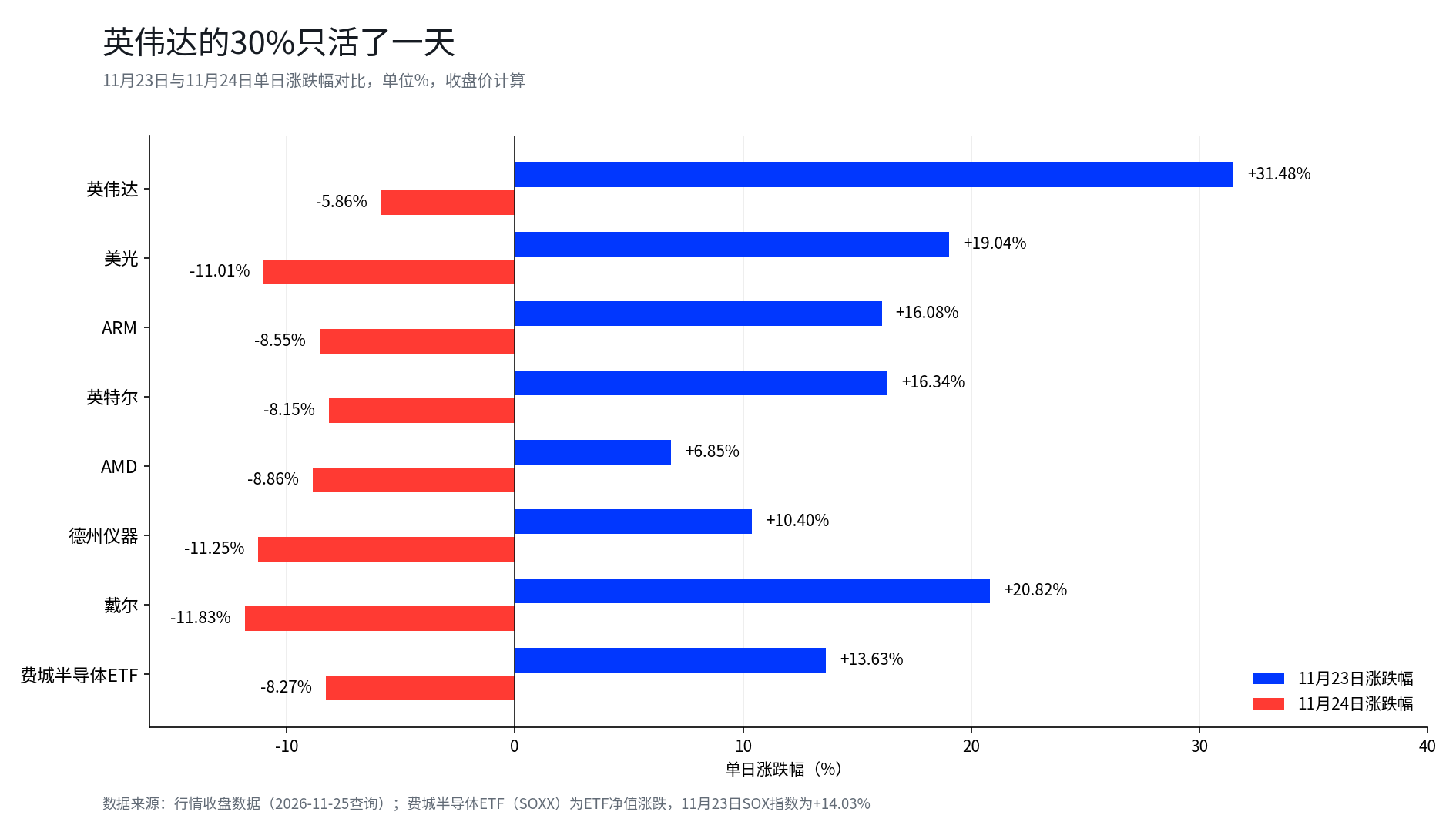
This means the most important question now is no longer "can Nvidia keep rising," but whether this AI selloff has shifted from an emotional pullback into a trend-driven correction. Monday's 31% surge by itself proves nothing about a change in fundamentals, and Tuesday's 5.86% decline likewise proves nothing about the AI rally being over. After this round of violent swings, what deserves closer attention in the coming days is whether capital is willing to rotate back into Nvidia, AMD, Broadcom, TSMC, and the server supply chain, or whether it will continue shifting toward sectors with more stable cash flows such as financials, consumer, and healthcare.
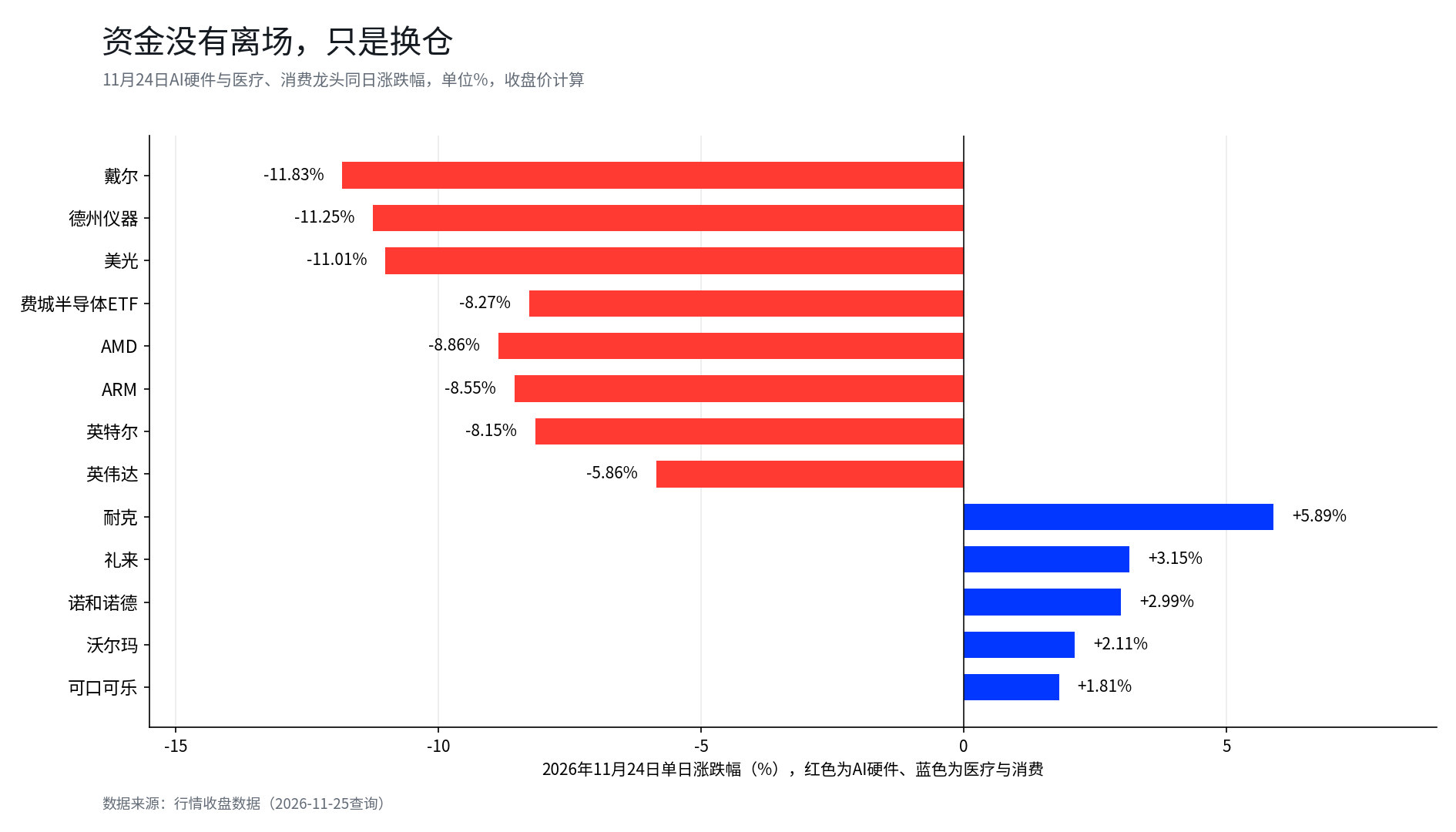
For the market in the coming days, three signals in the AI sector are worth watching: whether the leaders can stop falling, whether the semiconductor index can regain its footing, and whether interest rates continue to move higher. If Nvidia's decline comes with gradually shrinking volume, SOXX stops making new lows, and Treasury yields pull back at the same time, it would suggest capital may be starting to step back in. If Nvidia rebounds but SOXX continues to weaken, or if the rebound is concentrated in just a few leaders, that looks more like a technical repair, and there is not yet enough evidence that the sector is re-entering an uptrend.
2. South Korea Went Through a Full Circuit-Breaker Cycle on Both the Buy and Sell Sides in 48 Hours
The South Korean market has expressed the shift in risk appetite for the AI trade even more directly. On November 24, the KOSPI rose 6.32% to close at 5,006.03, with semiconductor heavyweights such as Samsung Electronics and SK Hynix becoming the core targets of capital flows. Just one day later, the KOSPI fell more than 4% intraday, triggering a sell-side program-trading suspension. According to Korean media reports, Samsung Electronics and SK Hynix both fell sharply at one point during the session. As of press time, the KOSPI stood at 4,763.24, down 4.85%, and had not yet closed.
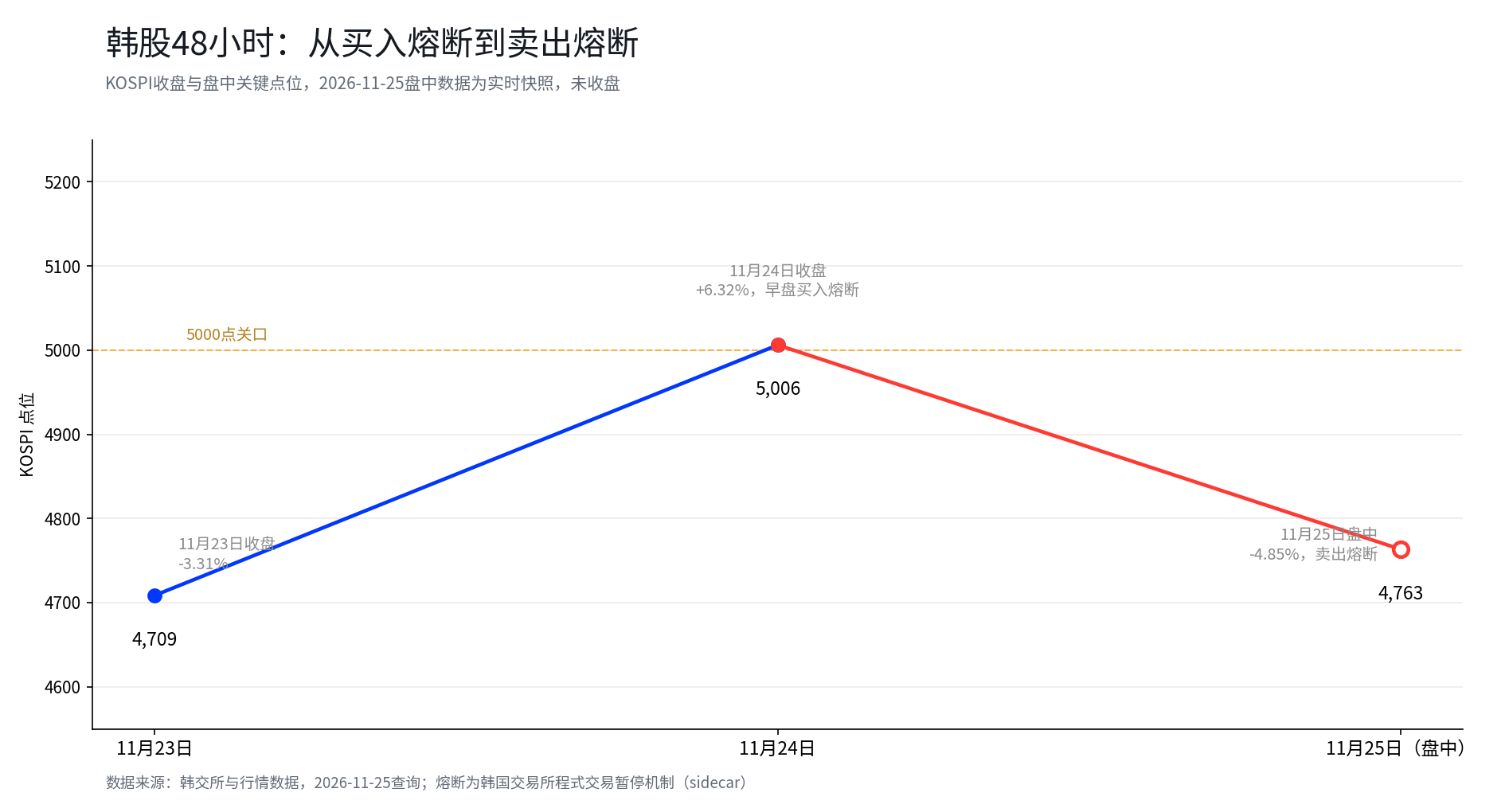
This extreme reversal does not mean the fundamentals of South Korea's semiconductor industry changed within 24 hours. What it shows is that when the market is crowded into the same trading theme, shifts in capital direction get amplified by the supply chain's high beta. Segments such as HBM, DRAM, and AI servers are still benefiting from AI capital expenditure, but after valuations have already priced in a large amount of optimistic expectations, any change in interest rates, the dollar, or leader stock prices can quickly transmit through the supply chain.
The sharp swings in South Korean semiconductors are better treated as a thermometer for risk appetite; standalone fundamental signals are hard to read from them. For the AI trade, if SK Hynix, Samsung Electronics, TSMC, and other core supply chain assets stop falling at the same time Nvidia stabilizes, it would indicate the market is beginning to accept the AI capex logic again. Conversely, if US leaders rebound while Asian semiconductors continue to slide, watch for signs that capital is merely covering back into US leaders and that a broader re-longing of the supply chain has not yet occurred.
3. Hong Kong Stocks Opened Higher Then Fell, Yet Southbound Buying Reached HK$6.2 Billion
Hong Kong stocks also showed a clear divergence. On November 24, the Hang Seng Index opened 243 points higher at 22,627, rose about 263 points at one point during the session, and ultimately closed down 0.73% at 22,219.65. The Hang Seng Tech Index fell 1.17%. At the same time, southbound capital recorded net buying of about HK$6.203 billion, with Xiaomi, Hua Hong, Tencent, Alibaba, and SMIC becoming the main buying targets.
This combination is worth noting: the index did not continue chasing highs, but capital did not fully leave the market either—it is looking for companies with higher certainty in a weak market. This is actually the same market characteristic as the Dow hitting new highs while AI hardware falls: capital is rotating away from a single high-volatility theme toward assets with clearer cash flow, earnings certainty, and industry positioning.
Going forward, Hong Kong stocks should not be judged solely by the Hang Seng Index's moves. More worthy of observation is whether southbound capital can sustain net inflows and which industries the capital is concentrated in. If the index continues to correct but southbound capital keeps flowing in and concentrates on core assets in internet, semiconductors, and consumer sectors, it would suggest capital is still seeking structural opportunities. If the index falls while southbound flows turn to consecutive net outflows, it would mean risk appetite may not yet have recovered.
4. Gold Is Falling Too: The Common Variable Behind AI, Gold, and BTC Is Interest Rates
Another easily overlooked signal in recent days is that gold has not risen in tandem with a weakening dollar. On November 24, spot gold briefly fell below $3,560/oz, with an intraday decline of nearly 2%, while the dollar index retreated to 103.85. Meanwhile, the US 2-year Treasury yield was around 4.68% and the 10-year around 4.91%, with the market pricing in close to a 96% probability of a 25-basis-point Fed rate hike in December.
This shows that the core contradiction in the current market has shifted from "dollar up or down" to a repricing of future interest rates and real funding costs. A high-rate environment, on one hand, raises the holding cost of gold, which generates no cash yield, and on the other hand compresses the valuation space for high-valuation growth stocks, while also putting pressure on highly volatile crypto assets. AI, gold, and BTC appear to be completely different assets, but when funding costs change rapidly, they are all affected by the same macro variable.
Judging whether the AI rally has stabilized cannot rely on watching Nvidia alone. Whether the 10-year US Treasury yield can pull back from near 4.9%, whether the 2-year yield continues to rise, and whether the dollar strengthens again—these variables may be more important than Nvidia's single-day moves. If rates continue to rise while the AI sector only stages a technical rebound, the durability of that rebound should be discounted. If rates peak and pull back while AI leaders regain capital support, this correction would be closer to a "repricing after the drop."
5. Dell's Record Orders: Why Didn't the Stock Rise Much After Hours?
This may be the most important change to understand right now. Dell's latest quarterly revenue was $54.9 billion, up about 103% year over year, AI server orders reached $60.2 billion, and AI server backlog reached $132.3 billion. The company also emphasized that it would rigorously evaluate customer quality, financing capacity, and land and power conditions. Looking at these numbers alone, AI demand remains very strong.
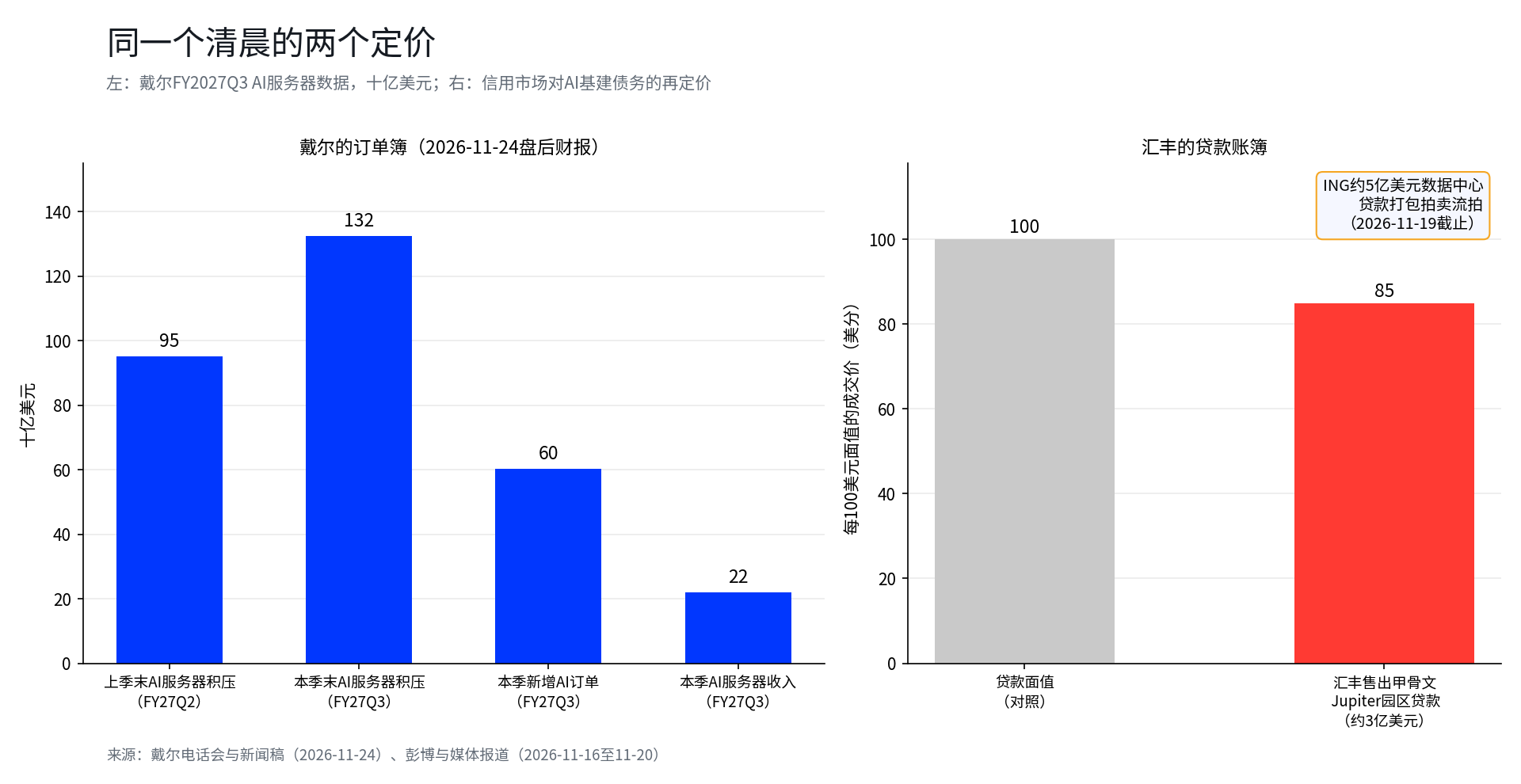
But the market's feedback was not as excited as the earnings numbers. Dell fell 11.83% in regular trading on November 24, and although the stock rose at one point after hours following the earnings release, the gain was limited and did not produce a repricing commensurate with the scale of orders. This is precisely the most important change in the AI trade right now: "good earnings" no longer automatically means "the stock should surge."
The reason is not complicated. The questions the market cares about have moved one step further down the line: when will orders be recognized as revenue, do customers have enough capital to complete projects, do data centers have land and power, what are the margins after servers are delivered, and can massive capital expenditure ultimately convert into free cash flow. Dell's proactive emphasis on customer quality, capital capacity, and land and power conditions on its earnings call itself shows that AI infrastructure is entering a phase that places greater weight on project execution and financing capacity.
Against this backdrop, Bloomberg reported that HSBC sold a loan stake of about $300 million related to Oracle's data center project at around 85 cents on the dollar. This cannot prove that the entire AI financing market is experiencing systemic risk, but it at least shows that a temperature gap has begun to appear between the order heat at the very upstream of the AI supply chain and the credit pricing at the very downstream.
So when researching AI stocks going forward, do not just look at "how much orders grew." Push the chain further: orders → revenue → gross profit → free cash flow → financing cost. Companies like Nvidia, Broadcom, and TSMC, whose earnings and cash flow are already relatively strong, and project-based assets that still require large amounts of external financing to complete data center construction, do not face the same risks in a high-rate environment. What the market is beginning to screen for is who can ultimately turn AI demand into cash.
6. How to Read Tonight's Core PCE: Judging Whether This AI Correction Has the Conditions to End
The US October core PCE to be released tonight (Beijing time) is one of the most important short-term macro variables for the market. The market has already priced in a 25-basis-point rate hike in December to a high degree, so the question PCE needs to answer has shifted from "will the Fed hike in December or not" to whether the rate path in the coming months will become tighter again.
If core PCE comes in above expectations, the market may push 2-year and 10-year Treasury yields higher again, the dollar may strengthen, and AI growth stocks, gold, and BTC may come under pressure. If PCE comes in below expectations, yields and the dollar may pull back, and high-valuation growth assets could see valuation repair. If the data meets expectations, the market reaction may not simply be one up and one down; watch whether Treasury yields and leaders such as Nvidia confirm in sync.
Therefore, whether this AI correction is over can use the market reaction after tonight as an observation window. After the PCE release, if rates pull back, Nvidia and SOXX stop falling, and the semiconductor supply chain repairs in sync, the market may begin shifting from "de-crowding" back to "looking for opportunities." If stronger PCE pushes yields further up while AI leaders rebound weakly, it would suggest valuation digestion may not yet be over.
Right now, more valuable than guessing a bottom is observing whether four signals can appear simultaneously: "rates peaking + leaders stabilizing + supply chain following + earnings delivery." AI demand itself has not disappeared, but the market has moved from the past phase of "give a high valuation as long as there are AI orders" into a stricter phase: whoever can turn orders into revenue, whoever can turn revenue into cash flow, and whoever can execute projects under high financing costs is more likely to become the target of capital repricing in the next stage.
The names mentioned in this article, such as Nvidia and SOXX, as well as industry sectors, heat maps, and Treasury yields, can be tracked on the BIT US Stock Market page.
Disclaimer:
This content is for general informational and market commentary purposes only, based on public information compiled as of the time stated in the article, and relevant market data, expectations, and probabilities may change with market conditions. This article does not constitute investment advice, investment research, an offer, solicitation, or recommendation of any securities, investment products, or trading strategies, and should not be relied upon as the basis for any investment decision. Financial markets involve risk; securities prices and market performance may fluctuate, and historical performance and past market trends do not represent or guarantee future results. Investors should independently assess relevant risks based on their own circumstances and seek professional advice when necessary.