The public-opinion push behind the pressure campaign on Jensen Huang traces back to Anthropic's early backer


- Core view: An investigation reveals that the *Transformer* newsletter, which called for Jensen Huang's resignation, and the follow-up *Machine Gods* podcast are both funded by Tarbell, whose core backer is the philanthropic organization of Dustin Moskovitz, an early Anthropic investor—pointing to a chain of public-opinion operations where AI safety narratives and commercial interests intertwine.
- Key elements:
- *Transformer* was the first to publish an article on November 9 calling for Jensen Huang's resignation; three days later, Jensen Huang resigned. The publication is primarily funded by Coefficient Giving.
- Tarbell granted a total of $730,000 to NPR and the *Machine Gods* podcast, of which 5 of the podcast's 11 episodes focused on the Jensen Huang incident.
- The podcast host predicted Jensen Huang's resignation in advance and characterized it as "the most significant intelligence operation since the Cold War"; 12 days later, the Wall Street Journal retracted its related report.
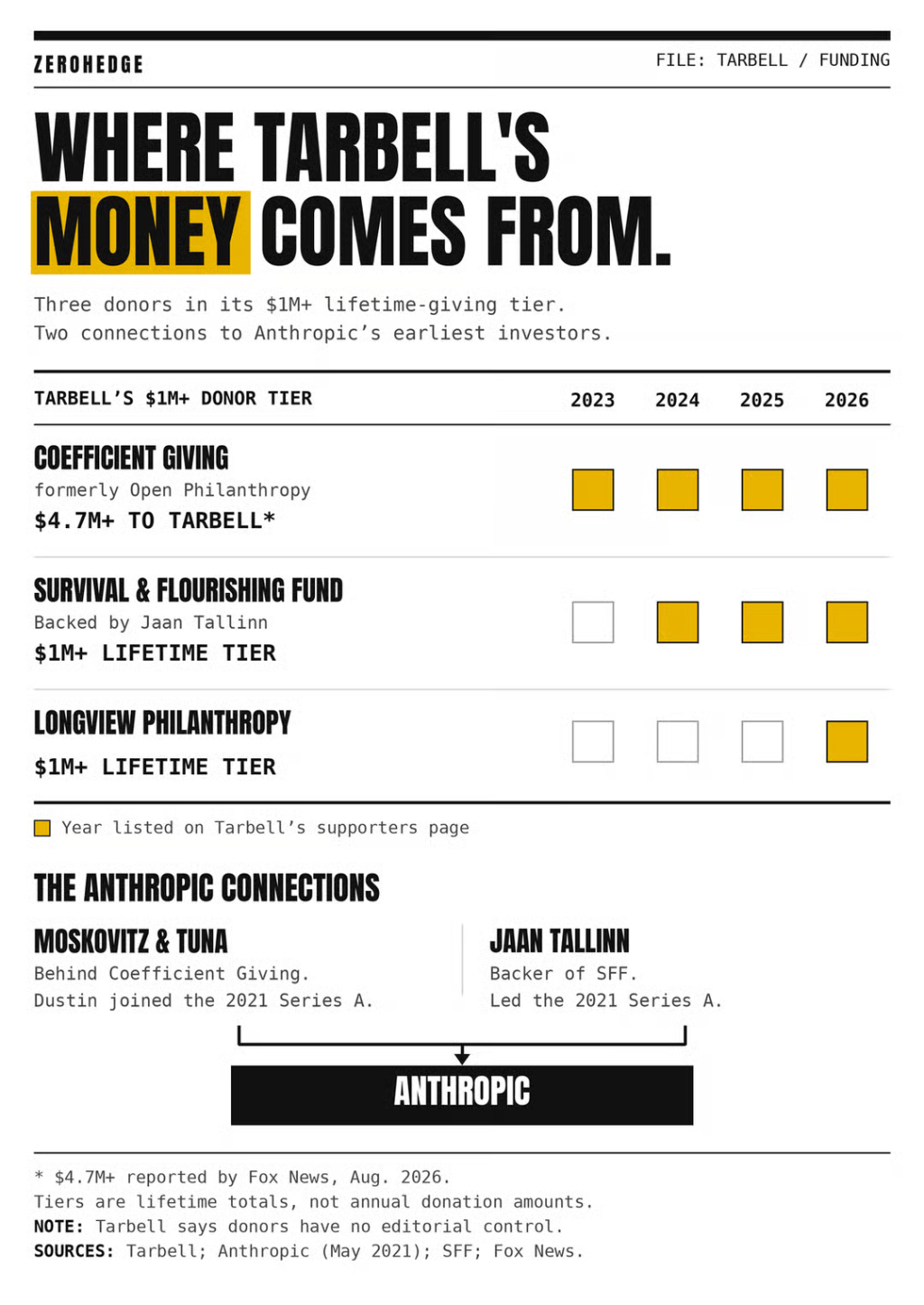
- Coefficient Giving has been Tarbell's top donor tier for four consecutive years, with cumulative donations exceeding $4.7 million.
- The Moskovitz couple transferred Anthropic shares to a nonprofit organization in early 2025; after Anthropic's IPO at $83 per share, those shares were worth billions of dollars.
- Tarbell stated that donors have no editorial control and that there are no records directly linking specific funding to particular coverage.
Original author: Long Yue
Original source: Wallstreetcn
Jensen Huang resigned as NVIDIA CEO on November 12, and the NVIDIA board announced his reinstatement on November 23, citing in a regulatory filing a statement by a senior U.S. government official that he "does not constitute a national security risk."
As public discourse around the incident intensified, researcher Kevin Bass traced a funding trail: the newsletter Transformer, which was the first to publish an article calling for Huang's resignation, and the newly launched podcast Machine Gods, which followed up with extensive coverage, both point to the same funder—the Tarbell Center for AI Journalism—and Tarbell's core backer is none other than the philanthropic organization of Facebook co-founder and early Anthropic investor Dustin Moskovitz.
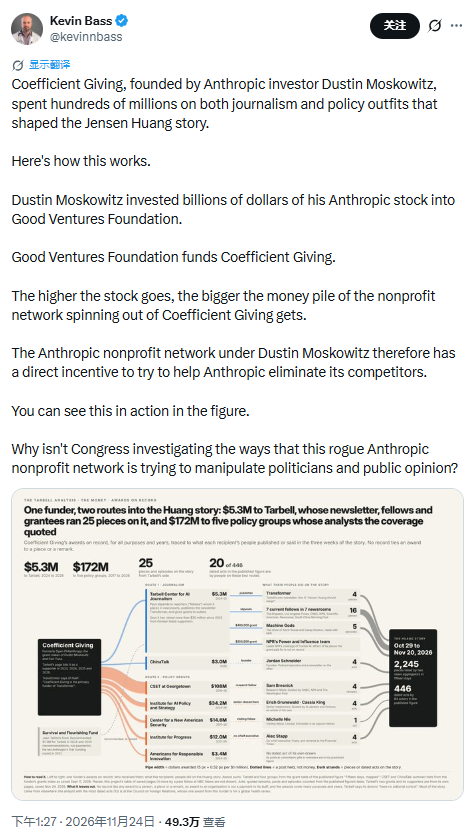
But Tarbell said its donors "have no editorial control over its journalists or the media outlets it funds," and that no funding records currently exist that directly link specific funds to particular coverage.
Three Days Before the Resignation, Transformer Was the First to Call for It
On November 9, the day after Huang acknowledged an extramarital affair with Alice Huang, Transformer editor Shakeel Hashim published an article with a headline that was direct: "Jensen Huang Should Resign."
The article argued that Huang, by describing his dealings with Alice Huang as a "normal relationship," was misleading employees, investors, and the public. Three days later, Huang announced his resignation.
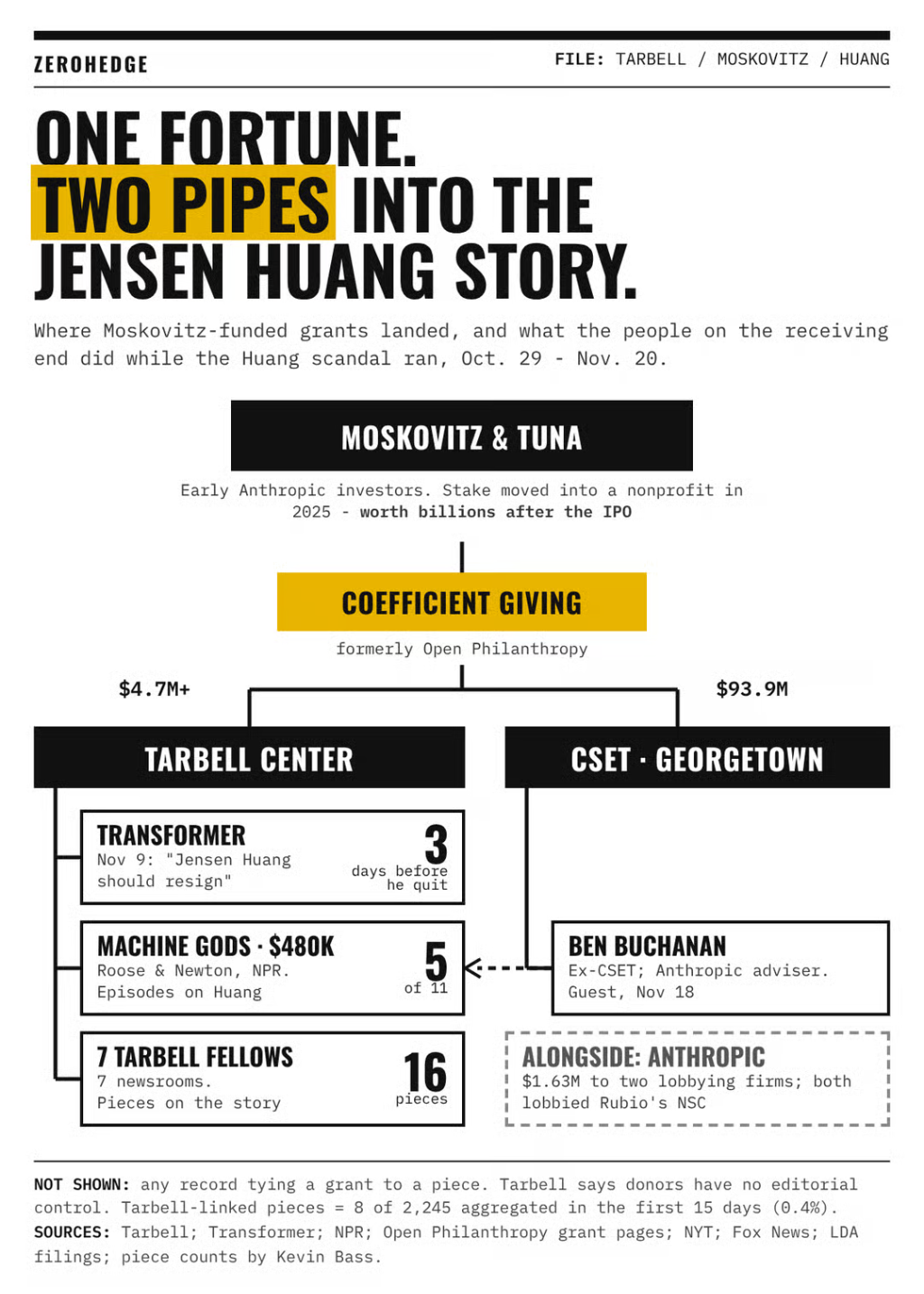
Transformer is Tarbell's own publication. Its website's ethics statement page shows that the publication is "primarily funded by Coefficient Giving (formerly Open Philanthropy)"—the philanthropic organization co-founded by Moskovitz and his wife Cari Tuna. The page promises to disclose when reporting on funders; NVIDIA is not among its funders, and the article calling for resignation carried no funding disclosure.
Newly Launched Podcast Machine Gods: 5 of 11 Episodes Focus on the Huang Incident
On October 5, Tarbell announced a $10 million journalism funding initiative, with the first funds going to NPR: $250,000 allocated to NPR's "Power and Influence" reporting team, and $480,000 to the new podcast Machine Gods, co-produced by former Hard Fork hosts Kevin Roose and Casey Newton.
The program launched on October 21, positioning itself as "AI realism." Of the 11 episodes aired through November 20, 5 focused on the Huang incident, concentrated between November 4 and 18.
The promotional copy for the November 11 episode said the program would discuss "what may be the most significant intelligence leak since the Cold War." On the show, Roose went further: "I think this may be the most significant intelligence operation since the Cold War." He also noted that Huang had long advocated relaxing export controls well before the relationship was exposed.
In the same episode, one host even predicted Huang's fate in advance: "I don't think he'll survive this. I think he'll resign." He also said that a chip policy "maximizing the interests of a certain government" would look very similar to NVIDIA's policy.
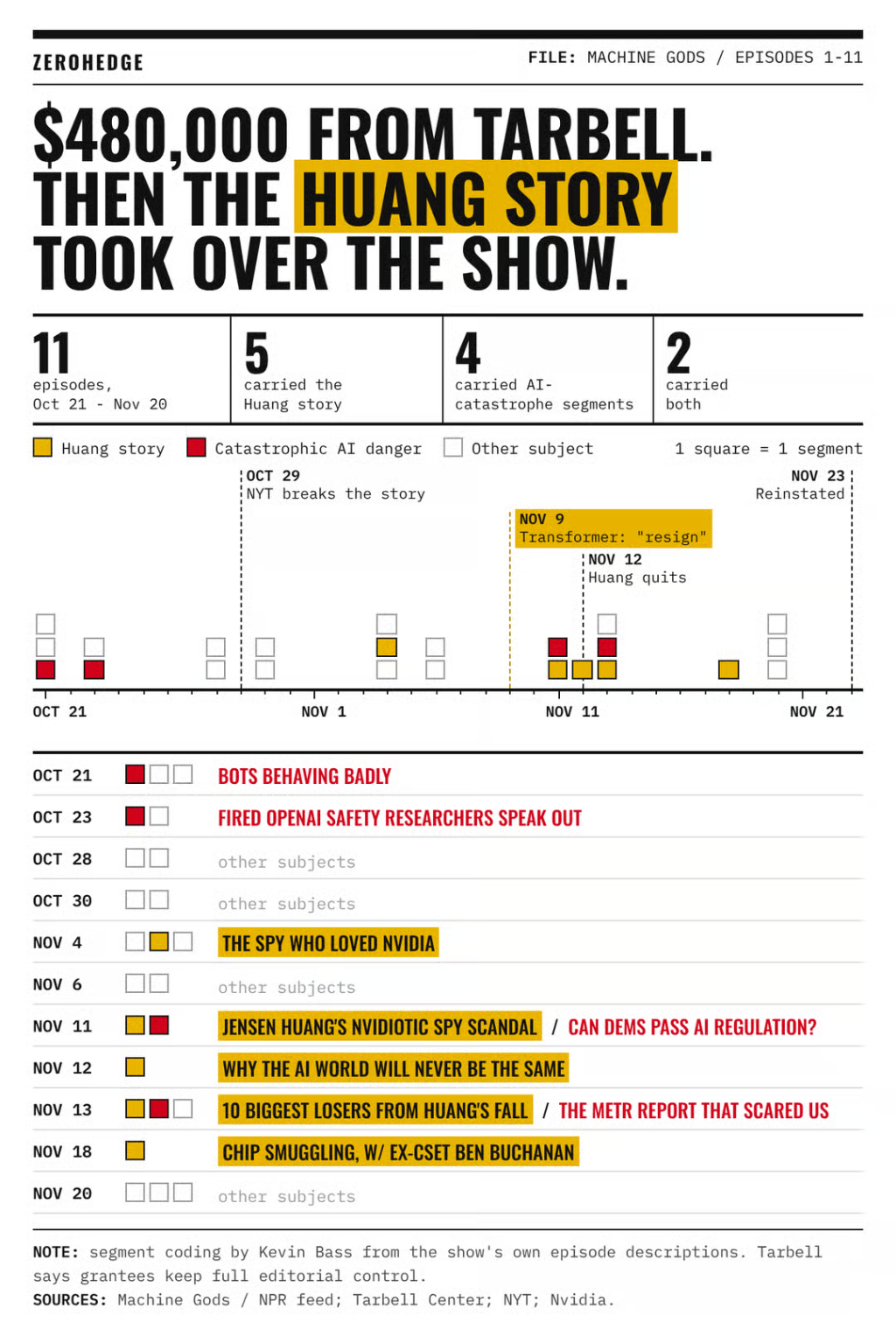
Huang resigned the next day. Hours later, Roose recorded a monologue, opening by calling Huang's rise "one of the greatest self-made stories in the history of American capitalism," then pivoting: "Just hours ago, Jensen Huang resigned in disgrace."
However, just 12 days after that "Cold War" characterization was made, The Wall Street Journal retracted its related reporting, acknowledging that Alice Huang's ties to an intelligence agency might be merely indirect.
Network of Interests: Advisors, Funding, and the Anthropic Intersection
The November 18 episode featured Ben Buchanan, introduced as "the original architect of chip export control policy." Midway through the program, Machine Gods host Newton voluntarily disclosed: "You're an advisor to Anthropic, and my fiancée works there too."
On the funding side, among Tarbell's supporters, Coefficient Giving has ranked at the highest donor level (lifetime donations of $1 million or more) for four consecutive years (2023 to 2026). According to an August report by Fox News citing a donation database, Coefficient has donated more than $4.7 million to Tarbell.
Another major Tarbell supporter is the Survival and Flourishing Fund, founded by Skype co-founder Jaan Tallinn—Tallinn was the lead investor in Anthropic's first funding round in 2021.
The Core Logic of the Funding Chain
Researcher Bass's core argument is that the better Anthropic performs, the larger the funding pools flowing to institutions such as Tarbell.
Moskovitz and Tuna transferred their Anthropic shares to a nonprofit in early 2025. According to The New York Times, after Anthropic completed its IPO last week at $83 per share, those shares are now worth billions of dollars.
At the same time, Huang had previously been one of the most outspoken critics of AI risk theories, and the AI safety narrative is a core pillar of Anthropic founder Dario Amodei's brand building. The two publicly clashed last year over export controls and open-source models.
Although the trail points to Anthropic, no funding records currently exist that directly link specific funds to particular coverage or episodes; Tarbell explicitly claims its donors "have no editorial control over its journalists or the media outlets it funds"; the Huang incident was first disclosed by The New York Times; and the analyst most frequently cited by Bass in related coverage comes from the Council on Foreign Relations.
Huang is expected to appear at a congressional hearing next week. Tarbell says it plans to distribute at least $10 million in total to news organizations by the end of 2027.