How sustainable is this round of US Treasury rebound?


- Core View: On October 22, US Treasury yields posted their largest single-day decline since March 2023. JPMorgan believes this round of "risk-off euphoria" was triggered jointly by the European sovereign bond turmoil and weakness in tech stocks, rather than by an improvement in US fundamentals, while foreign private capital continues to flow into long-end US Treasuries.
- Key Elements:
- US Treasury yields across maturities fell 15 to 21 basis points in a single day, with the 10-year closing at 4.95%, touching the key resistance zone of 4.94%-5.02%.
- The spread between French OATs and German Bunds widened by 15 basis points in a single day, rising to the most severe level since the 2011 European debt crisis.
- Over the past month, the rolling correlation between US Treasury yields and the Nasdaq 100 has risen significantly, with tech stocks having become the dominant variable in rate pricing.
- End-user demand at the 10-year and 30-year US Treasury auctions hit record highs, with average shares of 90.6% and 90.1% respectively, with the incremental demand mainly coming from foreign private investors.
- August TIC data shows foreign investors bought long-term US Treasuries at the fastest pace in over a year, diverging from "de-dollarization" concerns and reflecting actual capital flows.
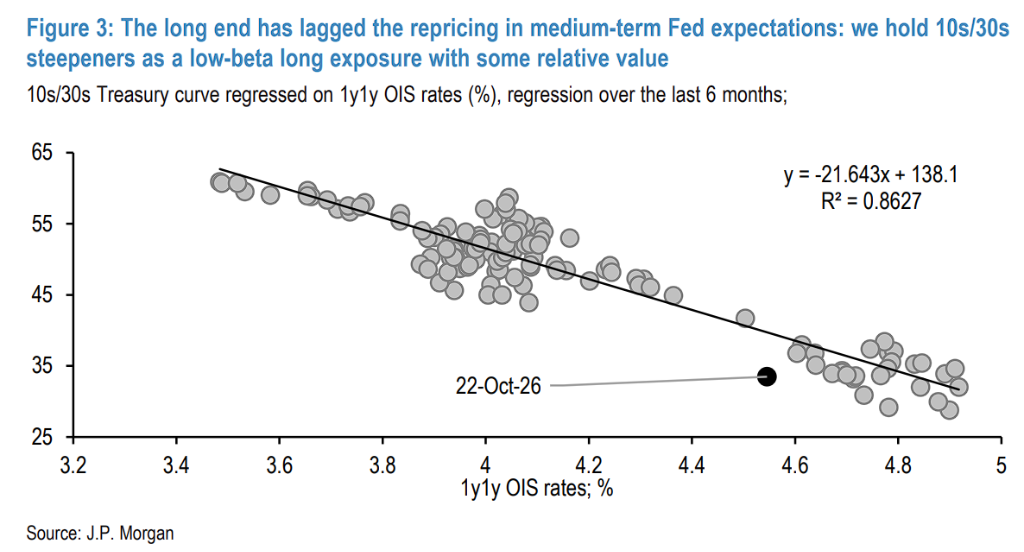
- JPMorgan recommends continuing to hold 10s/30s yield curve steepener positions, believing the curve is roughly 6 basis points too flat.
Author: Dong Jing
Source: Wallstreetcn
On October 22, the U.S. Treasury market saw its largest single-day yield decline since the regional bank crisis in March 2023, with yields across maturities falling 15 to 21 basis points on the day, and the 10-year Treasury yield closing at 4.95%.
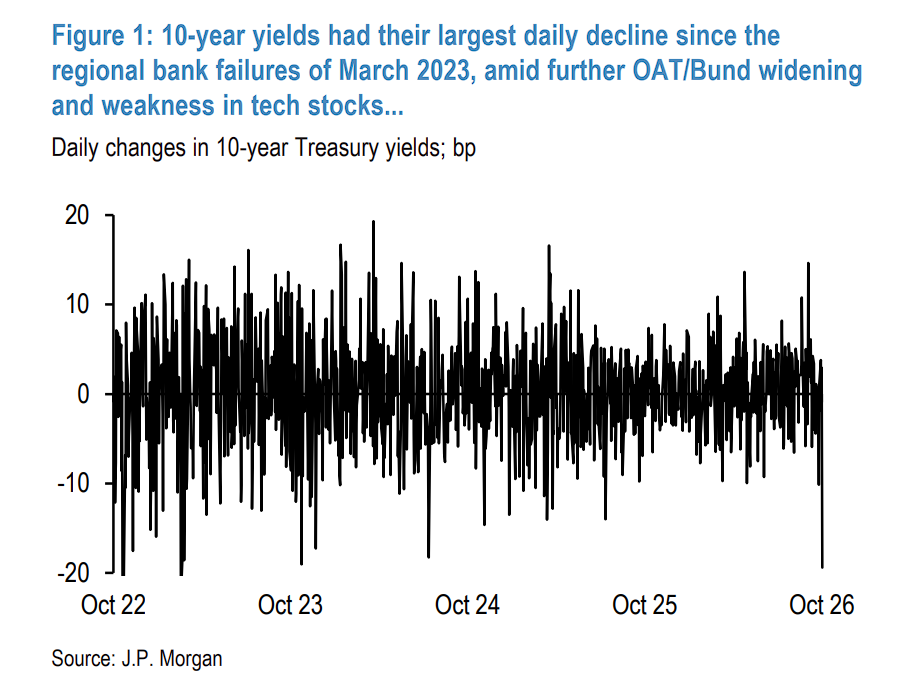
According to the Trading Desk, JPMorgan said in a research note on October 22 that this sudden "risk-off frenzy" was triggered jointly by a European sovereign debt storm and the continued weakness in Nasdaq tech stocks, rather than by any substantive improvement in U.S. fundamentals.
The report said that despite the loud chatter about "de-dollarization" at the macro level, actual data shows overseas private capital is still pouring into the long end of the U.S. Treasury market, treating it as the ultimate safe haven. Looking ahead, the 10-year Treasury yield has reached the key resistance zone of 4.94%-5.02%, but before risk assets clearly stabilize, one should not lightly short this rebound.
Strategically, JPMorgan recommends continuing to hold 10s/30s steepeners, which is currently the best choice for capturing the benefits of falling front-end yields while also offering relative value.
Trigger: European Debt Crisis Spillover Combined with Tech Stock Selloff
The trigger for this sharp decline in U.S. Treasury yields came from across the Atlantic. The spread between French OATs and German Bunds widened again by 15 basis points on the day, rising to levels last seen during the most severe period of the European peripheral debt crisis in 2011. JPMorgan's European team noted that there was no clear catalyst for the widening this week, but the escalation of protests in France over the weekend may have further weighed on market sentiment.
JPMorgan's European team believes that breaking the current cycle of widening French spreads requires one of the following conditions to emerge: an improvement in French fiscal or political dynamics, or a signal from the European Central Bank of potential intervention.
Notably, even after European markets closed, the decline in Treasury yields continued, with the persistent weakness in tech stocks becoming another important driver.
Driving Logic: Tech Stocks Have Become the Dominant Variable for Treasury Yields
JPMorgan data shows that over the past month, the rolling correlation between Treasury yields and the Nasdaq 100 has risen significantly, while showing a negative correlation with Brent crude prices. There is an inherent logic to this relationship: in the early days of the Middle East conflict, when Brent crude broke above $110 per barrel, Treasury yields began to show negative sensitivity to oil prices.
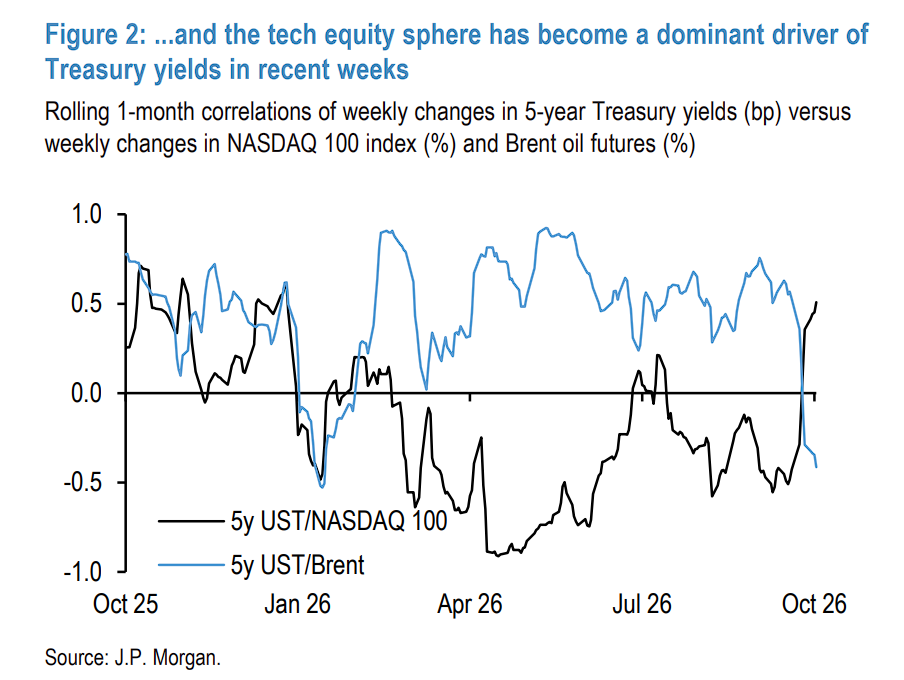
Looking ahead, JPMorgan believes that despite the resilience of the U.S. economy, the equity market has become the dominant force in rate pricing. JPMorgan's equity team previously noted that rising rates would compress equity valuation multiples—as discount rates rise and inflation expectations increase, valuations will be compressed. Depending on different economic growth scenarios, this compression effect begins to appear when the 10-year yield reaches between 5% and 6%.
Against this backdrop, JPMorgan prefers to hold positions that benefit from falling short-end yields while also offering relative value.
Specifically, the 10s/30s yield curve is mainly driven by medium-term Fed policy expectations, but over the past two weeks the curve has lagged noticeably in responding to the repricing of Fed expectations.
Based on this, JPMorgan believes the 10s/30s curve is currently about 6 basis points too flat, and continues to recommend holding 10s/30s steepener positions, positioning them as low-beta long exposure with relative value attributes.
Primary Market Demand: Long-End Demand Hits Record High, Foreign Participation Rises Significantly
Despite heightened market volatility, overall demand in the U.S. Treasury primary market has performed well.
Key data are as follows:
End-user demand for both 10-year and 30-year Treasury auctions hit record highs, with average shares reaching 90.6% and 90.1%, respectively;
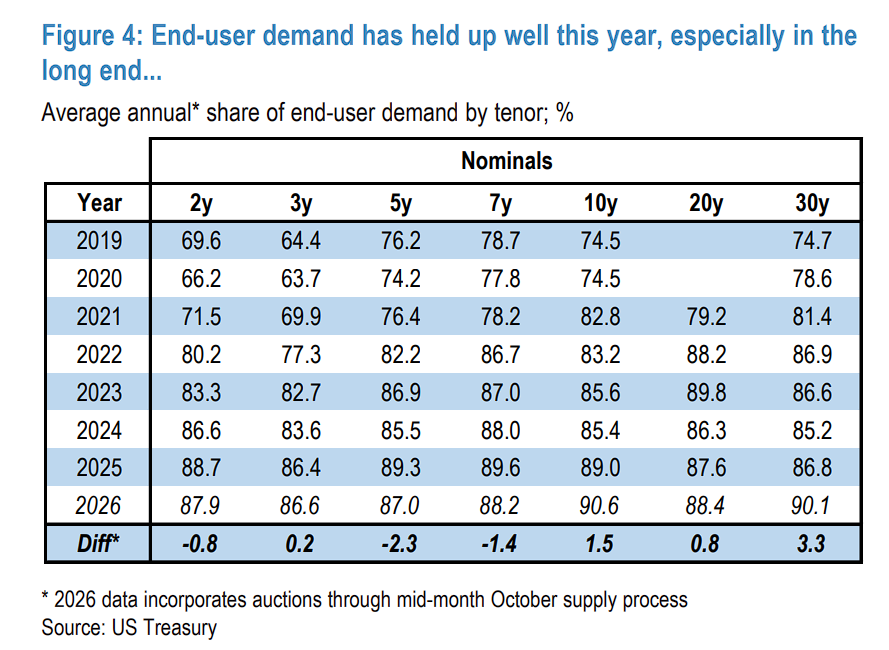
Although intermediate-maturity demand has pulled back from the record highs of 2025, it remains strong from a historical perspective.
A significant increase in foreign participation is the core force supporting demand. Foreign participation surged sharply in March after the outbreak of the Middle East conflict, and jumped again notably in September when yields repriced to multi-decade highs. In the mid-September auction, foreign participation reached one of the highest levels on record.
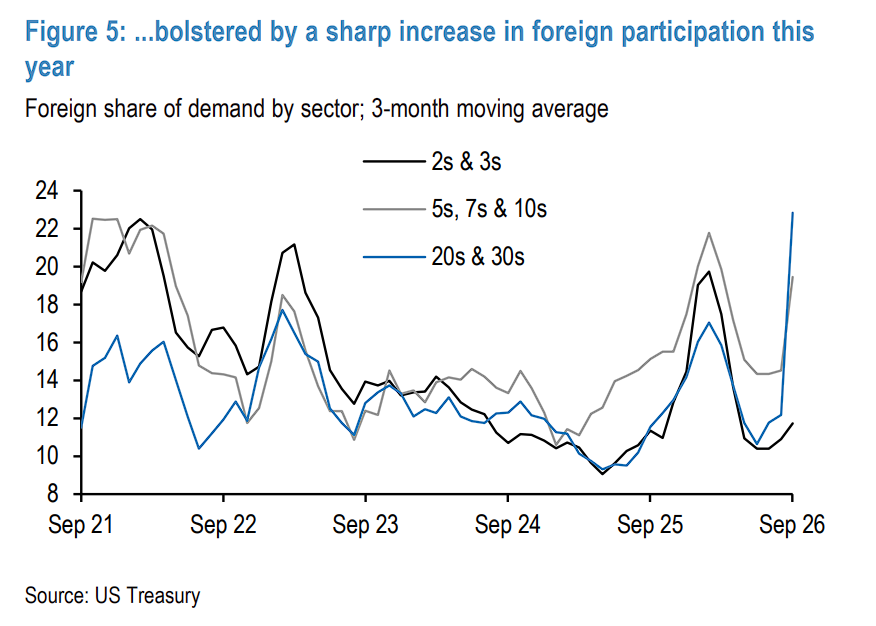
JPMorgan judges that this incremental foreign demand was mainly concentrated in the intermediate and long end, indicating that the source of funds was primarily foreign private investors (official holdings are typically concentrated in the short end for easier liquidation during periods of financial stress). This is corroborated by August TIC data—which showed that foreign investors bought long-term Treasuries in August at the fastest pace in more than a year, driven mainly by foreign private demand.
JPMorgan explicitly stated: despite the rampant "de-dollarization" concerns, the data shows that foreign participation in the Treasury market remains strong. During periods of stress, global investors continue to increase their holdings of Treasuries, which remain the world's deepest and largest sovereign debt market.
Widening Auction Tails: Greater Price Sensitivity or a Volatility Effect?
It is worth noting that strong end-user demand has not translated into smaller auction tails. Since 2026, average auction tails have widened across almost all maturities (with the long end being the exception).
JPMorgan offers two possible explanations:
Foreign private investors are more price-sensitive: as foreign private investors account for a rising share of primary demand, they are more price-sensitive than their less price-sensitive official-sector counterparts, consistent with the broader trend in the Treasury market in recent years;
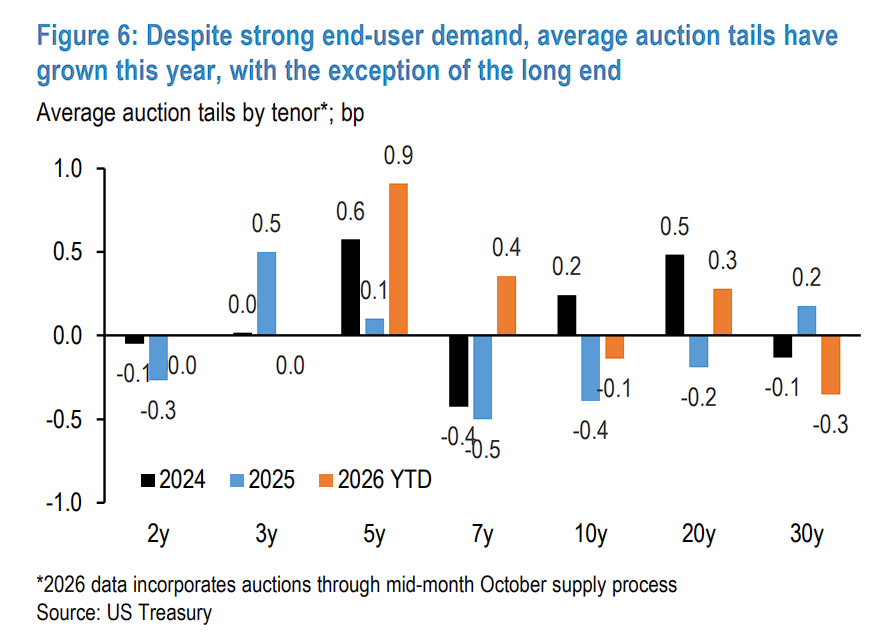
A natural consequence of rising rate volatility: particularly the increase in intraday volatility, which naturally leads to wider tails. Auction tails widened in March when the conflict triggered market volatility, and surged again in September when yields repriced.
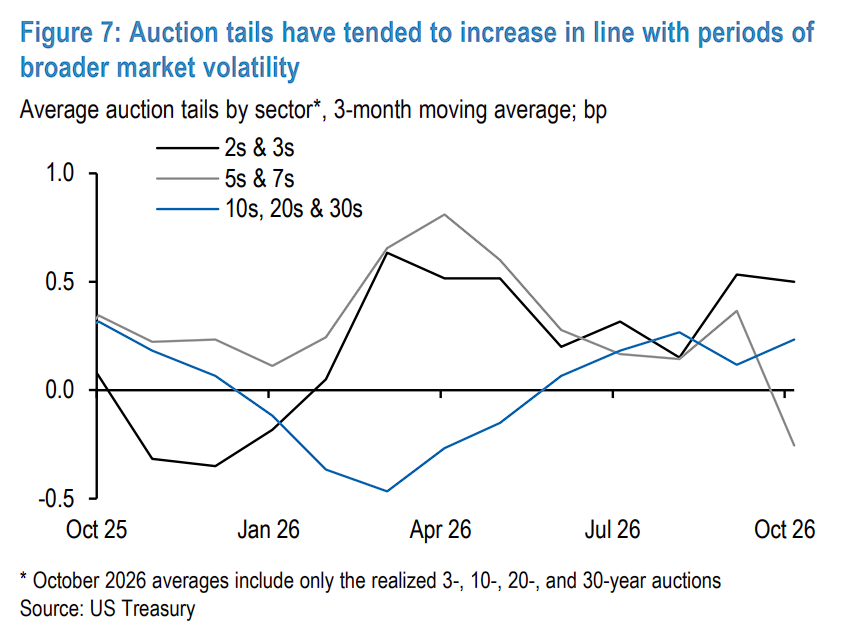
The long end is a notable exception—long-end auction tails have actually narrowed this year. JPMorgan believes that against the backdrop of a persistently widening financing gap over the coming years, reducing long-end issuance would already be an unwise move; and the fact that long-end auctions have performed so strongly further suggests that such adjustments are unnecessary.
Technical Analysis: Rebound Hits Key Resistance Zone, Shorting Against the Trend Not Yet Advisable
From a technical perspective, the rebound in the 10-year Treasury yield has accelerated and reached the first major resistance zone of 4.94%-5.02% previously flagged by JPMorgan. This zone converges multiple technical signals: the October 2023 cyclical yield high; the 38.2% Fibonacci retracement level from June; the 50-day moving average; and the measured move target of the October yield topping pattern.
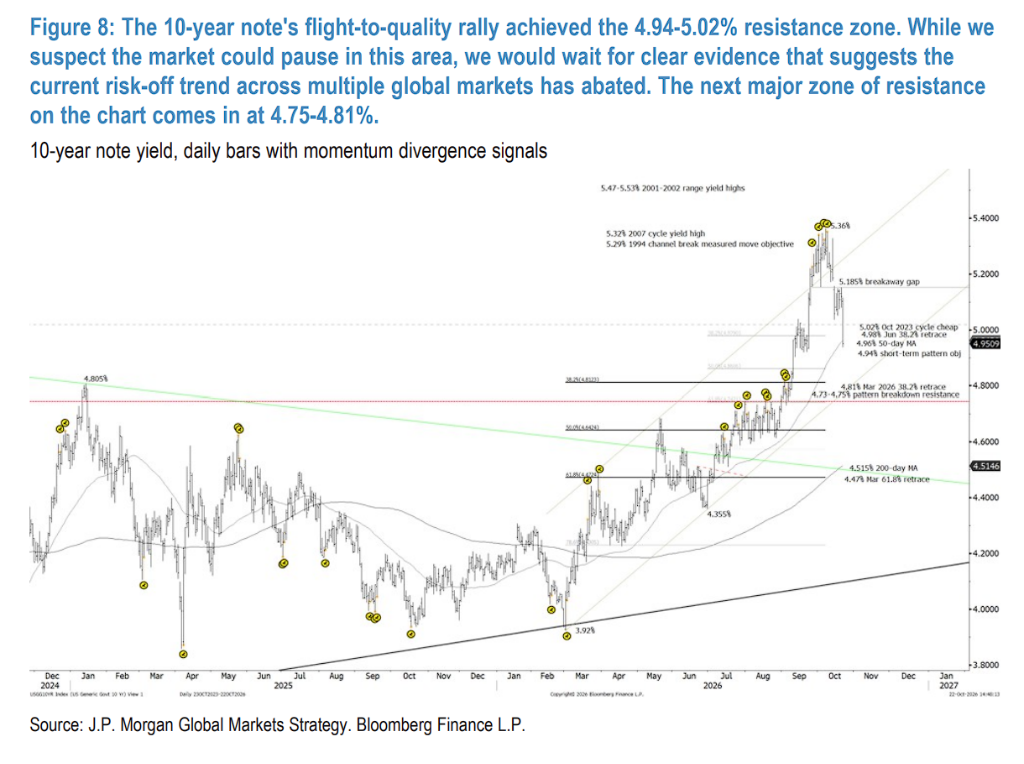
JPMorgan judges that the market may consolidate around this zone in the near term, but before clear stabilization or even bottoming signals emerge in risk asset markets, shorting this rebound against the trend is not recommended. Currently, most risk asset markets are still accelerating downward, with some having broken below key support levels and showing no signs of stabilization.
If the rebound continues, the next major resistance zone is at 4.75%-4.81%, which includes: the 38.2% Fibonacci retracement level from March 2026 (4.81%); the January 2025 yield high (4.805%); and the late-summer breakdown level (4.73%-4.75%).
To the upside, tactical support is at the 5.035%-5.05% hourly pivot level; the 5.15%-5.185% October 15 gap, given the forceful downward move in yields since then, has now become an important support zone.