MSX US Stocks Daily Watch: Dell Q3 Revenue Doubles, AI Backlog Hits $132.3 Billion, Full-Year Revenue Guidance Raised Again


- Key Takeaways: Dell's FY2027 Q3 results comprehensively beat expectations, with AI infrastructure demand shifting from revenue scale expansion to profit amplification, as cost efficiency and product mix together drive a significant improvement in profitability.
- Key Elements:
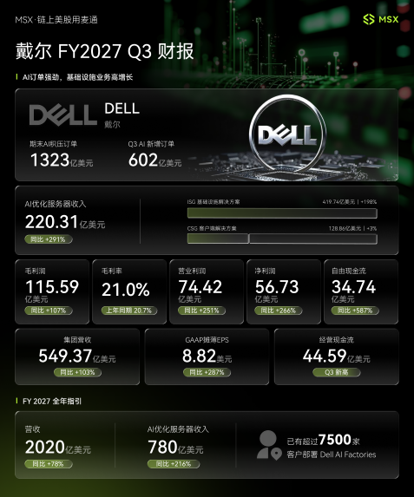
- Q3 revenue of $54.937 billion, up 103% year-over-year, and adjusted EPS of $9.45, up 265% year-over-year, both substantially exceeding market expectations.
- AI server quarterly orders of $60.2 billion, recognized revenue of $22 billion, and backlog of $132.3 billion, further expanding quarter-over-quarter.
- ISG revenue of approximately $42 billion, up 198% year-over-year, operating income of $7.1 billion, up 308% year-over-year, with a segment margin of 17.0%.
- Adjusted operating expenses grew only 20%, with expenses as a percentage of revenue falling from 11.8% to 7.0%, and operating margin rising from 9.3% to 14.2%.
- Full-year revenue guidance raised to $202 billion, AI server revenue target raised to $78 billion, and adjusted EPS guidance lifted to $29.68.
- The AI server business still maintains a mid-single-digit operating margin, and ISG's overall margin cannot be directly applied; memory chip supply pressure is expected to persist through 2027.
[MSX Research Institute · Daily US Stock RWA Observation] is a flagship daily report produced by MSX Maitong, a leading RWA trading platform. Leveraging our strong macro research capabilities, we help you capture the core pulse of global traditional US stocks, liquidity changes, and the RWA tokenization market, enabling you to position ahead for quality assets.
Today's Observation
Dell's latest earnings report shows that AI infrastructure demand is simultaneously driving growth in both the company's revenue scale and profitability, with server and storage businesses becoming the primary growth drivers.
On November 24, US Eastern Time, Dell released its FY2027 third-quarter results for the period ended October 30: revenue reached $54.937 billion, up 103% year-over-year; adjusted EPS was $9.45, up 265% year-over-year. According to data cited by Benzinga, the market had previously expected revenue of approximately $49.24 billion and adjusted EPS of $6.61, with both actual results significantly exceeding expectations.
Order performance continued to provide support. In the quarter, Dell booked $60.2 billion in AI server orders, recognized $22 billion in AI server revenue, and ended the quarter with AI backlog reaching $132.3 billion, further expanding from $95 billion in the previous quarter. The company stated that more than 7,500 customers are deploying Dell AI Factory, with customer scope covering neocloud providers, sovereign projects, and enterprises.
Growth in the quarter also extended to traditional infrastructure. Traditional server and networking revenue grew 235% year-over-year to approximately $15 billion, while storage revenue grew 24% to approximately $4.9 billion. Infrastructure Solutions Group (ISG) overall revenue grew 198% to approximately $42 billion, with operating income reaching approximately $7.1 billion, up 308% year-over-year.
On this basis, Dell raised its full-year revenue guidance from $192 billion to $202 billion, raised its AI server revenue target from $74 billion to $78 billion, and increased its full-year adjusted EPS guidance from $25.50 to $29.68. Dell is currently converting infrastructure demand into more profit through delivery scale, product mix, and expense efficiency.
Data in a Minute
• FY2027 Q3 revenue of $54.937 billion, up 103% year-over-year;
• GAAP net income of $5.673 billion, up 266% year-over-year;
• GAAP diluted EPS of $8.82, adjusted EPS of $9.45;
• Adjusted operating income of $7.826 billion, up 213% year-over-year, corresponding to an operating margin of 14.2%;
• AI server revenue of approximately $22 billion, up 291% year-over-year;
• New AI server orders of $60.2 billion in the quarter, AI backlog of $132.3 billion at quarter-end;
• ISG revenue of approximately $42 billion, up 198% year-over-year, segment operating margin of 17.0%;
• Traditional server and networking revenue of approximately $15 billion, up 235% year-over-year;
• Storage revenue of approximately $4.9 billion, up 24% year-over-year;
• Client Solutions Group (CSG) revenue of $12.886 billion, up 3% year-over-year, operating income of $704 million, down 6% year-over-year;
• Quarterly operating cash flow of $4.459 billion, cumulative operating cash flow of $10.765 billion for the first three quarters;
• Returned approximately $4.9 billion to shareholders through buybacks and dividends in the quarter, board added $25 billion in buyback authorization;
• FY2027 full-year revenue guidance raised to $202 billion, AI server revenue guidance raised to $78 billion;
• Full-year adjusted EPS guidance raised to $29.68;
• Q4 revenue guidance of approximately $56.3 billion, adjusted EPS guidance of $8.40.
MSX View
Dell's revenue growth is now beginning to produce more pronounced profit leverage. A hardware company's sales can increase rapidly with equipment deliveries, but how much return shareholders ultimately receive also depends on procurement costs, product mix, expense efficiency, and cash collection. In the current quarter, these factors collectively drove earnings growth.
From an overall company perspective, revenue grew 103% year-over-year, adjusted operating expenses grew 20%, and expenses as a percentage of revenue declined from 11.8% in the year-ago period to 7.0%. Meanwhile, adjusted gross margin edged up from 21.1% to 21.2%, while adjusted operating margin rose from 9.3% to 14.2%. This indicates that profit improvement in the quarter largely came from expense growth significantly lagging revenue growth after revenue scale expanded.
Business mix also played a role. Traditional server and networking revenue grew 235%, and storage revenue grew 24%, contributing more revenue and profit to ISG. When enterprises procure AI infrastructure, they still need to handle data storage, network connectivity, business system operations, and existing equipment upgrades. Dell's product portfolio covering these areas gives it the opportunity to expand sales scope within the same customer base.
However, it is necessary to distinguish between ISG's overall margin and the AI server business margin. The 17.0% is the operating margin for the entire ISG segment, covering AI servers, traditional servers, networking, and storage. Management stated on the earnings call that the AI server business continues to operate at a mid-single-digit operating margin level. Therefore, analyzing Dell's profit potential requires observing both AI server deliveries and complementary sales of networking, storage, and other products, rather than directly applying ISG margins to AI server revenue.
The high growth in traditional servers also needs to be understood in conjunction with changes in per-unit equipment value. Management stated that customers are purchasing systems with higher configurations and larger memory and storage capacity, while also refreshing aging equipment and freeing up data center power and space. Revenue growth is driven both by procurement demand and by product configuration and pricing. What needs to be observed going forward is whether customers can still achieve sufficiently good efficiency and return on investment after equipment prices increase.
The $132.3 billion backlog increases visibility into future deliveries. Dell stated that before accepting purchase orders and beginning production, the company reviews customer financial capability, end contracts, and conditions such as land and power. These processes help improve order quality, but actual revenue recognition still depends on customer readiness, equipment supply, and delivery acceptance. As backlog continues to expand, the importance of completing deliveries on schedule also increases.
Dell's delivery capability is an important component of its competitive advantage. For customers, after racks arrive, they still need to complete networking, cooling, power, and system commissioning before they can be put into production use. Being able to reduce coordination and waiting during the deployment process helps customers begin providing services earlier, and also improves Dell's chances of securing follow-on orders and complementary product sales. Competition therefore involves product pricing, system integration capability, and delivery efficiency simultaneously.
There are also temporary factors in the quarter's margin performance that warrant continued observation. Management noted that some improvement came from scale and operational efficiency, while a favorable North American sales mix also helped; as this mix normalizes, margins are expected to decline somewhat sequentially going forward. Therefore, when assessing future profitability, focus should be on whether expense efficiency can be maintained, whether storage and other products can continue to increase profit contribution, and whether new pricing can cover procurement costs.
Memory chip supply and pricing is another key variable. Management expects related supply pressure to persist through 2027. Securing supply in advance and adjusting prices can help Dell manage costs, but the number of devices customers can purchase within their budgets, procurement pace, and product mix may also adjust as prices change. The company needs to continuously balance delivery capability, price competitiveness, and profit margins.
Cash flow provides a foundation for further expansion. Operating cash flow reached $4.459 billion in the quarter, and $10.765 billion cumulative for the first three quarters. However, expanding hardware delivery scale also increases inventory, accounts receivable, and supplier settlement needs. Therefore, when observing earnings quality, it is also necessary to track whether revenue growth matches cash collection and whether customer financing arrangements remain stable.
The new $25 billion buyback authorization reflects the company's confidence in its capital return capability, but the authorized amount and actual buyback expenditure still need to be observed separately. Long-term shareholder returns ultimately depend on sustained profitability and cash flow; during a phase of rapid business expansion, the company also needs to retain sufficient capital to support procurement, delivery, and customer service.
The CSG business showed more moderate growth. Revenue grew 3% in the quarter, while operating income declined 6%, forming a clear contrast with the infrastructure business. The PC business still provides customer coverage, supply chain scale, and cash flow, but what currently determines Dell's overall growth rate and profit increment is primarily ISG's operating performance.
Dell has already demonstrated profit improvement from scale expansion in the current quarter; with the full-year revenue target raised to $202 billion, the coordination among delivery, margins, and cash collection will become an important basis for judging growth quality.
About MSX Maitong:
MSX is a leading RWA trading platform dedicated to providing secure, efficient, and transparent access to global financial markets. As one of the world's earliest on-chain US stock trading platforms, MSX has always been at the forefront of the industry, leading market transformation through continuous innovation.
The platform deeply integrates blockchain technology with compliance frameworks, comprehensively offering spot and derivatives trading for nearly 400 tokenized stocks and Pre-IPO assets, perfectly bridging the gap between traditional finance and the digital asset industry.
Around the core mission of "allowing quality assets to circulate freely," MSX has now built a diversified digital financial services system covering US stock spot and perpetual contracts, crypto trading, Pre-IPO, and Maitong Research Institute, aiming to provide global investors with all-hours, high-performance access to quality assets.
Official Website: https://msx.com/
Chinese TG:https://t.me/MSXOfficial
Global TG:https://t.me/MSXGlobal
Risk Disclaimer: Macroeconomic and US stock market conditions are highly volatile. This content is provided solely for academic and research observation reference by Maitong Research Institute and does not constitute any investment advice.