Bank of America Survey: Fund managers slash tech stocks by the largest margin in two decades, but cash levels are too low — "not enough panic"


- Key Takeaways: BofA's November survey shows global fund managers retreating from tech stocks at the fastest pace since 2006, with tech overweight plunging from a net 37% to a net 12%. The "AI bubble" has become the top tail risk, but low cash levels and insufficient panic mean no buy signal has emerged yet.
- Key Elements:
- The single-month decline in tech overweight is the largest in nearly 20 years, exceeding the de-risking seen during the 2008 financial crisis and the 2022 rate-hike cycle.
- "AI bubble" (34%) and "AI hyperscaler credit event" (31%) together account for 65%, making them the biggest threats in fund managers' eyes.
- A record net 38% of respondents believe corporate AI spending is excessive, and 52% expect hyperscalers to cut capex in the next six months.
- Cash holdings fell to 3.6%, below the 4.0% contrarian sell threshold; historically, the median return four weeks after such signals has been -1%.
- The Nasdaq 100 is down more than 4% this month, and the semiconductor index has fallen 27% cumulatively since early October.
- Sentiment on European equities is warming, with a net 67% expecting gains over the next one to three months; France's net preference hit a record low of -60%.
Original authors: Yang Chen, Long Yue
Original source: Wallstreetcn
Bank of America's latest monthly survey shows that global fund managers are exiting tech stocks at the fastest pace since 2006.
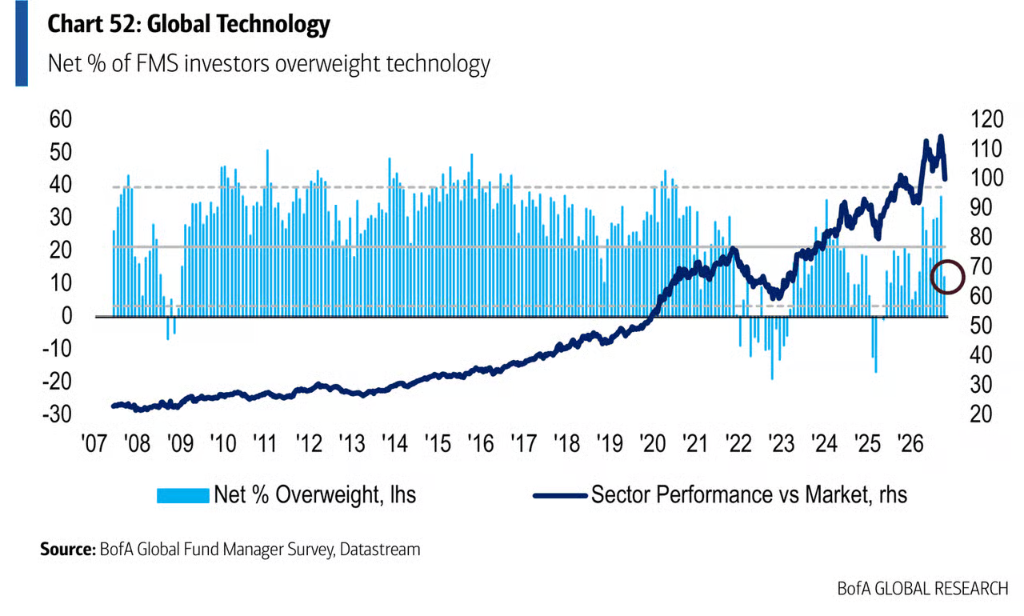
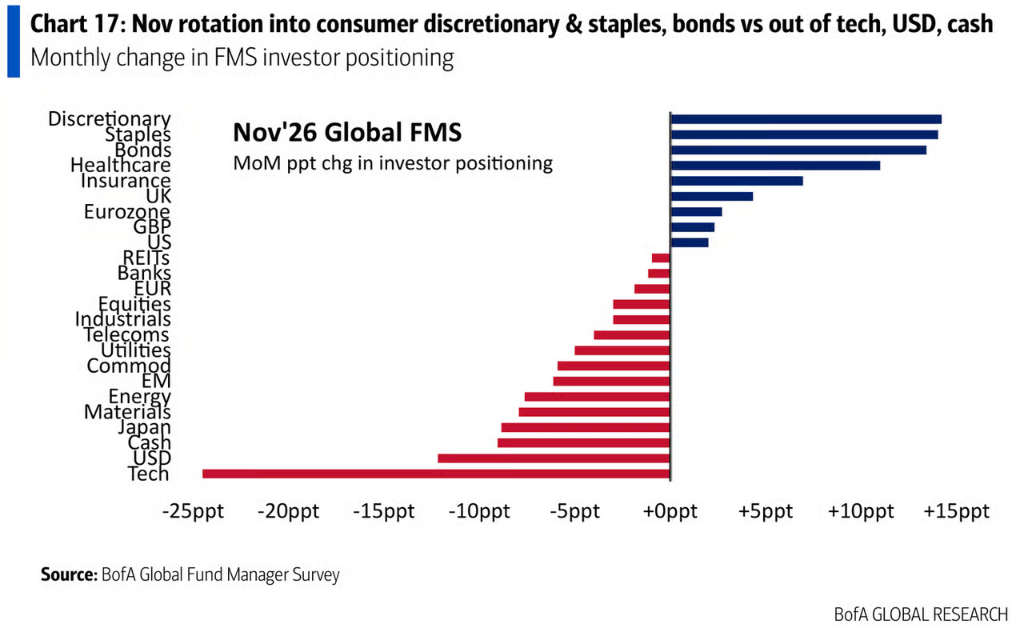
The survey shows that the overweight position in tech stocks plunged from a net 37% in October to a net 12%, the largest single-month drop in nearly 20 years.
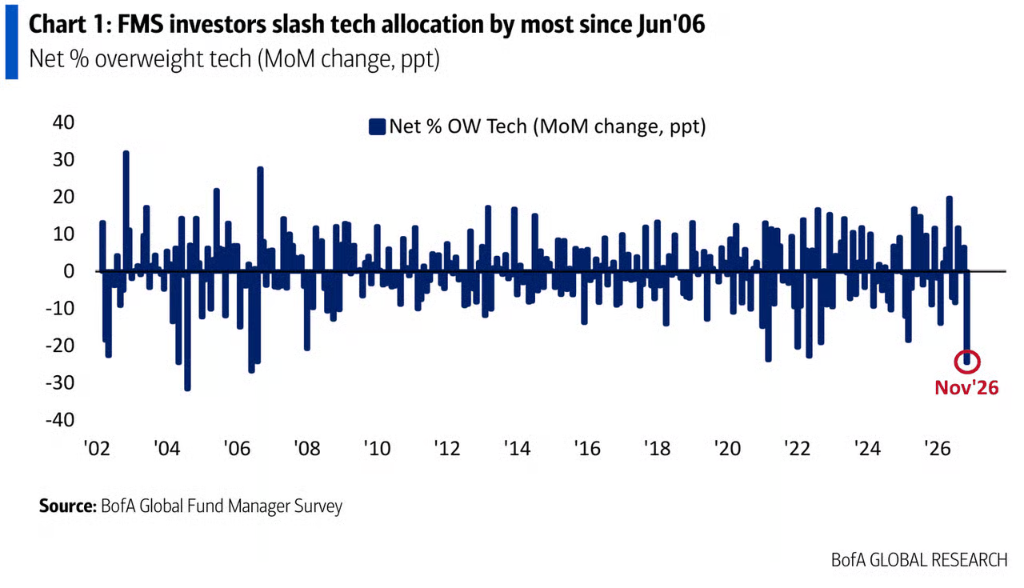
BofA strategist Michael Hartnett stated outright in the report that "the AI boom and euphoria are over," and advised investors to maintain defensive positioning in the coming months.
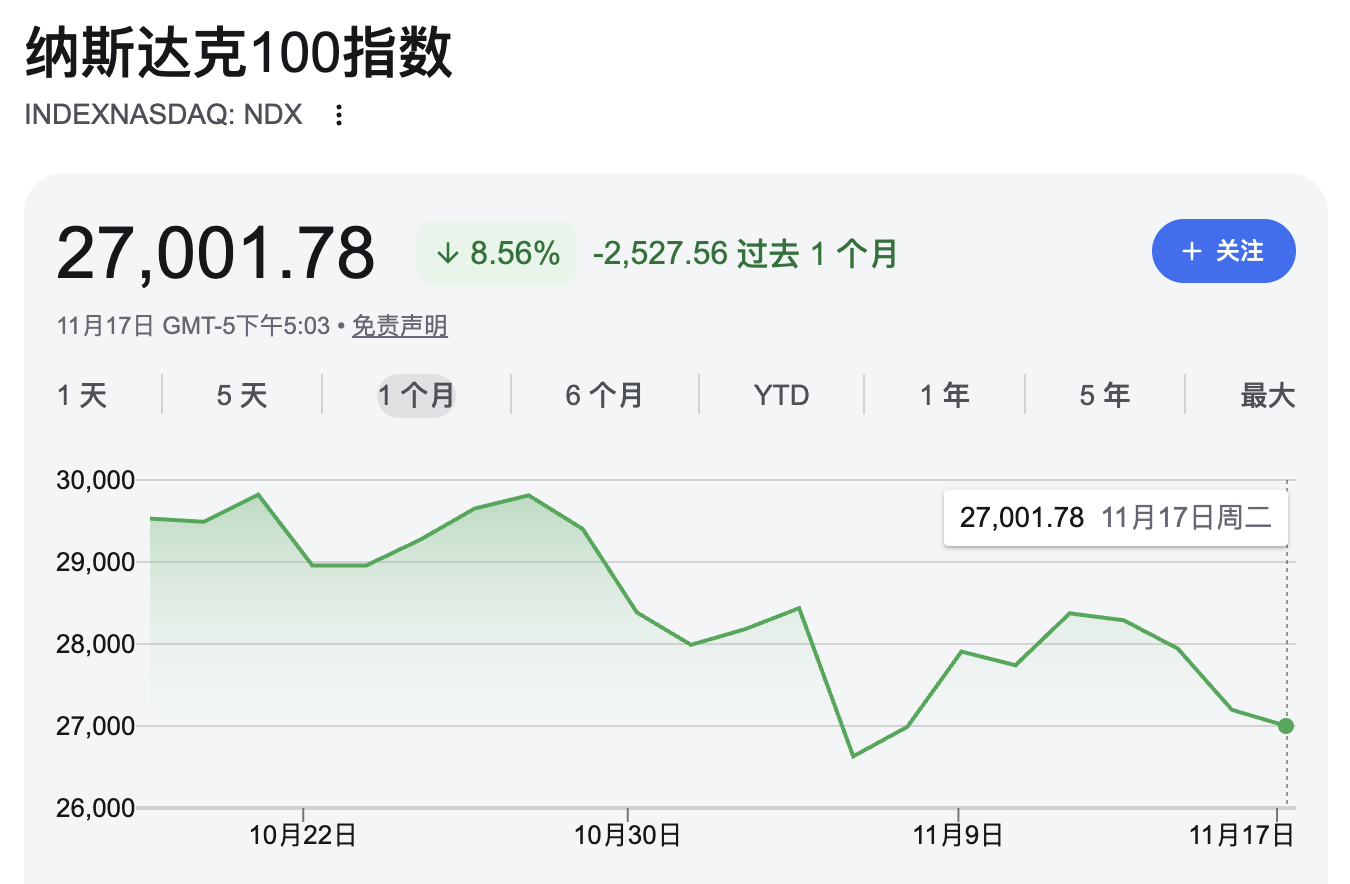
Market performance has confirmed this shift in sentiment. The Nasdaq 100 Index has fallen more than 4% this month, on track for its worst November performance since 2008; the semiconductor-related stock index has cumulatively declined 27% since early October.
The survey was conducted from November 6 to 12, covering 169 participants globally with total assets under management of $461 billion; 94 participants responded to European regional questions, with total assets under management of $241 billion.
Tech Stocks Massively Cut, But Not Yet Time to Buy the Dip
Fund managers' enthusiasm for tech stocks is rapidly fading. The survey shows that the overweight position in tech stocks dropped from a net 37% in October to a net 12%, the largest decline since June 2006, surpassing any during the 2008 financial crisis, the 2022 rate hike cycle, and this year's "reciprocal tariff day on April 2."
Tech stock positioning is now approximately half a standard deviation below its long-term average.
In addition, Goldman Sachs' prime brokerage division recorded the largest single-week leverage reduction by hedge funds since March 2020 two weeks ago; last week the same group of funds sold into the strongest chip rally since April, pushing Goldman's tech long-short ratio to a historical low; 13F filings show that Druckenmiller and others began reducing chip holdings as early as the third quarter. Hedge funds moved first, long-only funds followed.
Hartnett advises that from a historical perspective, the best entry point occurs after fund managers further cut tech stock positions to underweight; the current survey has not yet shown sufficient investor "panic" sentiment, and it is not advisable to rush in.
65% Rank AI as the Number One Risk
Behind fund managers' concentrated flight from tech stocks is a动摇 in confidence in the AI narrative itself.
In the vote for the largest tail risk, "AI bubble" ranked first at 34%, followed closely by "AI hyperscaler credit event" at 31%. The two combined account for 65%, meaning two-thirds of money managers view AI as the greatest threat to both the stock market and credit markets. By comparison, October's top risk was disorderly rises in bond yields.
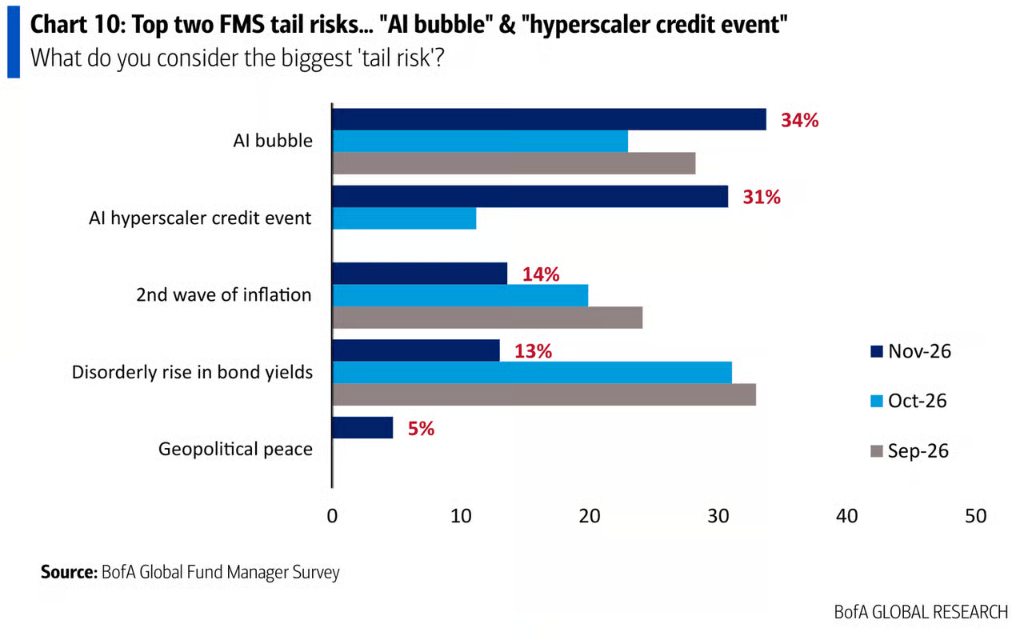
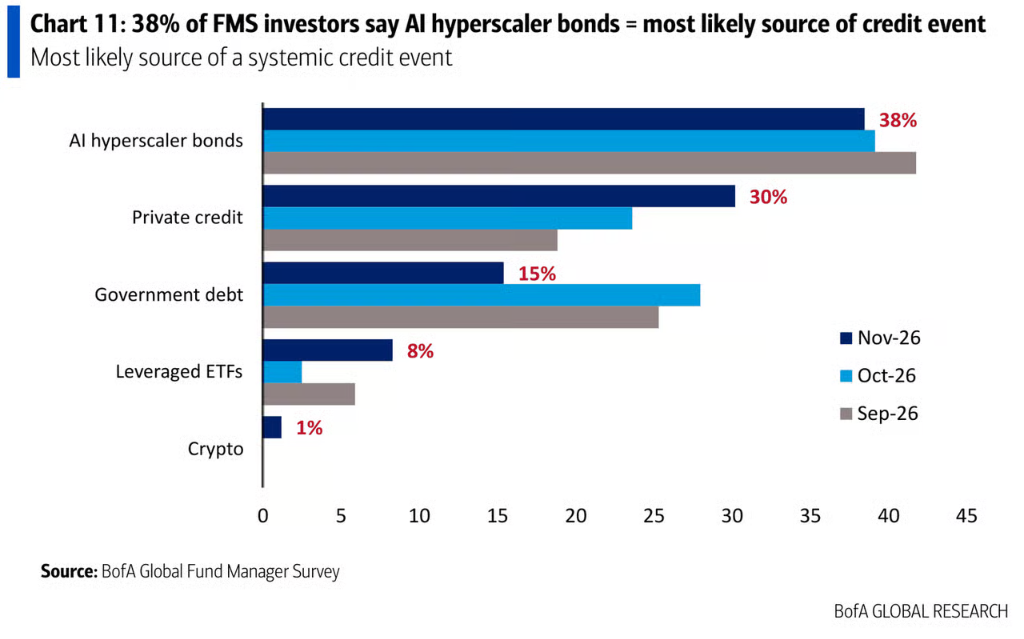
Among the most likely sources of a systemic credit event, 38% of respondents pointed to AI hyperscaler bonds, and 30% to private credit.
Meanwhile, investors' patience with corporate AI spending has been exhausted. A record net 38% of respondents believe companies are overinvesting, a proportion that first crossed above zero at the end of last year and has continued to climb since. On the question of "how corporate cash flow should be used," 42% advocated improving balance sheets, 33% advocated returning capital to shareholders, and only 16% supported increased capital expenditure—the lowest since May 2020, when no one knew whether the economy would still exist. In January of this year, this figure was still 34%.
52% of respondents expect an AI hyperscaler to announce capital expenditure cuts within the next six months, up from 30% in October, while in September 79% believed there would be no cuts this year.
Hartnett described this signal as the loudest "please stop spending" message fund managers have ever sent to corporations, and historically this call has never been so loud.
Cash Low, Panic Insufficient, Hartnett Refuses to Give a Buy Signal
Despite the clear shift in sentiment, the actual movement of capital tells a different story.
Cash allocation fell from 3.9% to 3.6%, the lowest since August, sitting 1.9 standard deviations below the long-term average. According to BofA's "cash rule," when the cash ratio is at or below 4.0%, it constitutes a contrarian sell signal for global equities—according to Bloomberg, since 2011, the median return within four weeks after such signals has been -1%, with the worst reaching -29%.
Despite pressure on tech stocks, fund managers' concerns about the macroeconomic outlook are relatively mild. Only about 3% of respondents expect a recession within the next year. Global equities remain the consensus best asset class for 2027. BofA's composite sentiment indicator edged down from 6.4 to 6.3, the lowest since June.
Hartnett's Bull & Bear Indicator currently stands at 7.4, well below the peak of 9.5 reached in September, but still far from the below-2.0 level that would trigger a contrarian buy signal.
Hartnett wrote:
In the November survey, investors are bullish at the macro level (only 3% predict recession), and positioned bullish at the market level (cash at an ultra-low 3.6%, believing global equities will be the best-performing asset in 2027); but the AI boom and euphoria are over... we maintain a tactical defensive stance; the November survey has not yet shown sufficient investor panic sentiment, and it is not yet time to enter.
Multiple Institutions Remain Bullish on the Outlook
Other institutions remain optimistic about the stock market overall. Morgan Stanley said this week that the AI spending boom will make 2027 a "year of embracing risk"; Goldman Sachs expects the S&P 500 to rise 17% over the next 12 months, with a target of 8,700 points.
On asset allocation, about 36% of fund managers expect international stocks to be the best-performing asset class in 2027, followed by U.S. stocks (24%) and gold (17%).
Optimism on European Stocks Heats Up, Earnings Expectations Improve
Compared with the cooling of global tech stocks, investment sentiment toward European equities is clearly improving.
A net 67% of fund managers expect European stocks to rise over the next one to three months, up from a net 44% last month, the highest level since February. Respondents expect European stocks to gain an average of 5.92% over the next 12 months, up from 4.53% previously; the average EPS growth expectation was also revised up from 6.09% to 6.58%.
From the perspective of earnings drivers, cost control has become the primary driver of European corporate earnings for 43% of fund managers, topping the list for the first time since May; 37% of respondents believe sales or revenue growth is the main driver, and 13% point to margin expansion.
At the macro level, a net 40% of respondents expect European economic growth to improve over the next 12 months, significantly higher than the previous 22%.
At the sector level, Industrials & Services became the most overweight sector for the first time since September 2025, Construction and Healthcare also shifted from underweight to overweight, while Basic Resources and Energy returned to neutral.
The autos sector remains the most neglected, with a net underweight of 47%. Among the most favored sectors over the next 12 months, about 23% of respondents chose Healthcare as their top pick, followed by Consumer Discretionary and Financials at 17% each.
Among country markets, Switzerland became the most favored market with a net preference of 30%, followed by Germany at 27%. France ranked last with a net preference of -60%, a record low.