US Stocks Daily | Nasdaq rises 1.6%, AI trade makes a strong comeback, Nvidia plunges 8% again after hours (November 12)


- Key Takeaways: CoreWeave earnings ease AI debt concerns and drive a tech stock rebound, but Nvidia CEO governance risk erupts after hours as the biggest uncertainty; MSCI removes crypto treasury companies for the first time under its "non-operating company" rule, signaling that the DAT model is facing systematic backlash from mainstream indexes.
- Key Elements:
- CoreWeave Q3 revenue of $3.7 billion (+168% YoY), full-year guidance raised to $13–13.3 billion, shares up 24.71% in a single day, driving Nasdaq up 1.60% and the Philadelphia Semiconductor Index up 5.66%.
- WSJ reports that Nvidia's board is preparing to remove CEO Jensen Huang, having previously launched an independent investigation into an extramarital affair and espionage suspicions; NVDA falls 8.6% after hours, with November 17 earnings compounded by governance risk.
- MSCI confirms it will remove Strategy, Metaplanet and others from global indexes on November 30; JPMorgan estimates only $2.8 billion in passive selling for MSTR, marking the first time the DAT model has been downgraded under index rules.
- October CPI up 0.4% MoM, exceeding expectations for a third consecutive month; December rate hike probability rises to 88%, and the market has shifted from "rate cut trade" to "rate hike trade."
- Democrats win majorities in both chambers, Warren will become Senate Banking Committee chair, multiple referendums restricting data centers pass, and expectations for AI infrastructure and crypto regulation are simultaneously repriced.
- Hyperscale Data liquidates 211.56 BTC and exits its treasury plan to pivot toward AI data centers; mining companies simultaneously "sell coins for hashpower," with listed companies net selling $869 million in BTC in a single week.
- IBIT sees net outflows for 7 consecutive trading days, with U.S. spot BTC ETFs recording total net outflows of $1.28 billion for the week; crypto stock gains show almost zero correlation with BTC price.
1. Top Stories
- CoreWeave earnings dispel the "AI debt panic," tech stocks rally across the board. Q3 revenue of $3.7 billion (+168% YoY), full-year guidance raised to $13–13.3 billion; shares surged 24.71% in a single day, the best single-day performance since April 2025, driving the Nasdaq up 1.60% and the Philadelphia Semiconductor Index up 5.66%.
- After-hours black swan: WSJ reports NVIDIA's board is preparing to oust CEO Jensen Huang. The report follows The New York Times' disclosure that Huang had an extramarital relationship with Kimberly Powell, vice president of the company's healthcare business; he had previously acknowledged an affair with a woman suspected of being a Chinese Ministry of State Security spy, and the board has engaged Wachtell, Lipton to conduct an independent investigation. NVDA fell 8.6% after hours ($158.78 at 20:00 ET), with earnings on November 17 compounded by governance risk.
- MSCI confirms removal of Strategy from its global indexes, effective at the close on November 30. Metaplanet and Yellow Cake were also removed, triggering its new "non-operating company" rule; JPMorgan estimates passive funds will be forced to sell $2.8 billion, marking the first time the crypto treasury (DAT) model has been hit by mainstream index rules.
- October CPI rose 0.4% MoM, exceeding expectations for a third consecutive month, with the probability of a December rate hike rising to 88%. Core CPI rose 0.3% MoM (based on the BLS seasonally adjusted index); due to the government shutdown, the BLS is not publishing October YoY data; Waller called a December hike "likely" and left the door open for 50bp, while Logan advocated two more 25bp hikes.
- The aftermath of the midterm "blue wave" is still being priced in. Democrats won majorities in both chambers, the new Congress takes office in January, and Warren will chair the Senate Banking Committee; multiple ballot measures restricting data centers passed, and expectations for AI infrastructure and crypto regulation are being repriced simultaneously.
2. U.S. Stock Market and Macro
2.1 The Three Major Indexes (Closed 16:00 ET, 11-11)
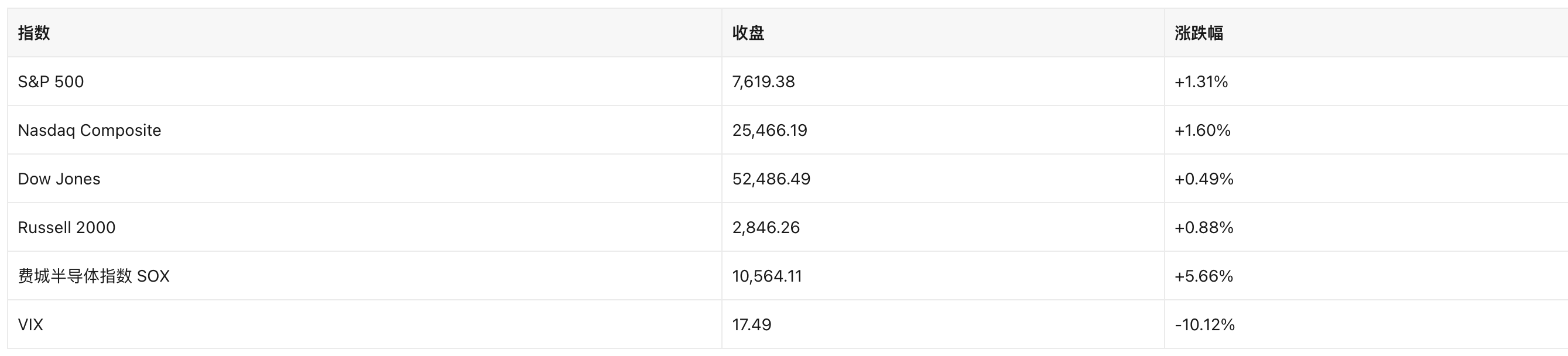
Driving logic: Earlier this week, the AI infrastructure sector was sold off on "blue wave + data center restrictions" expectations (the Nasdaq fell 5.5% in a single day on November 5, briefly entering a technical correction), followed by a short-covering rally on November 11. CoreWeave eased market concerns about its CDS spread breaching 11% with its statement that "asset-level debt financing costs fell to 7%–7.5%," prompting a valuation repair across the AI compute chain. The S&P 500 is currently 2.5% below its all-time high of 7,811.54, while the Nasdaq remains further from its high—this is a rebound of "structural repair without new index highs."
After-hours risk: If the governance risk at heavyweight NVDA materializes at the November 12 open, it could erase a substantial portion of that day's index gains—this is today's biggest directional uncertainty.
2.2 Macro Data
- October CPI (released November 10): +0.4% MoM (seasonally adjusted), above expectations and the third consecutive month of sharp increases; core CPI +0.3% MoM. Due to the data gap caused by the October 2025 government shutdown, the BLS is not releasing 12-month YoY data this time, leaving the market to rely on MoM figures to gauge the trend.
- Component pressures stem from tariff pass-through and services inflation, which Goolsbee described as "uncomfortable, borderline disturbing."
- Fed developments: Waller stated clearly that a December hike is "very likely" and said that if core CPI stays around 0.3%, 50bp "should be considered"; Logan advocated two more 25bp hikes and said "we can move faster in winter"; Schmid warned against treating oil price shocks as temporary. CME FedWatch shows an 88% probability of a December hike (November 11). The market has completely shifted from "rate-cut trades" to "rate-hike trades."
2.3 Rates, the Dollar and Commodities
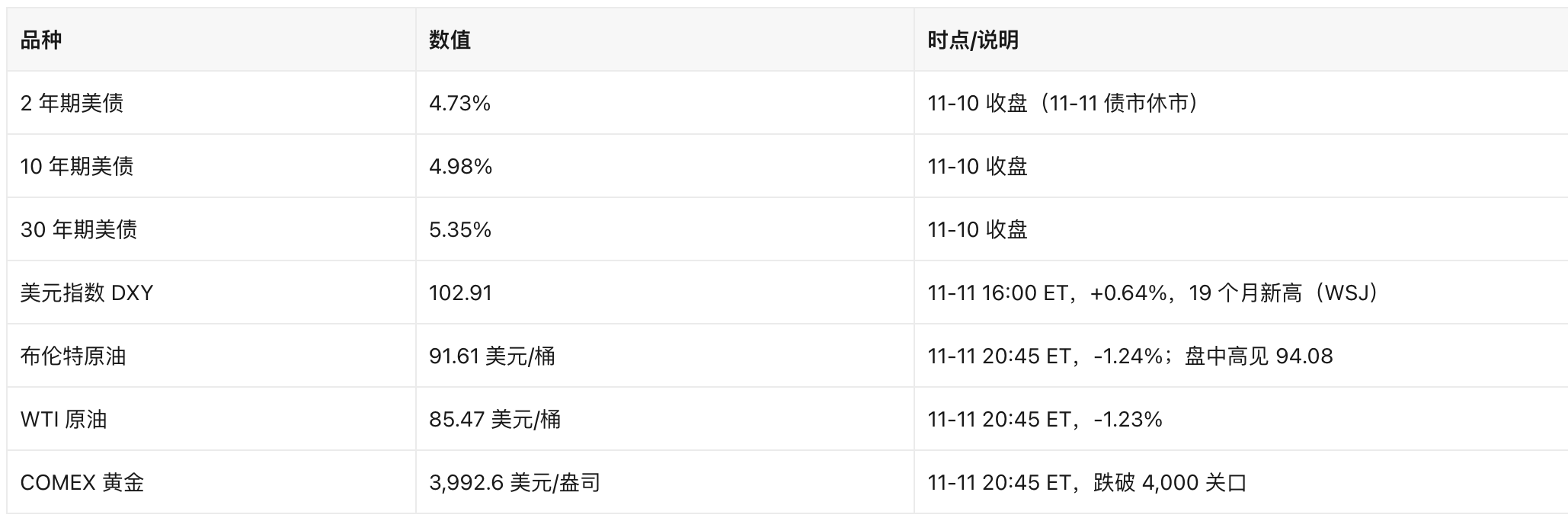
The combination of 5.35% (30Y) and 4.98% (10Y) long-end yields means the triple pressure of "rate hikes + term premium + fiscal supply" persists, which is the main factor suppressing the valuation center of high-valuation assets; yet tech stocks rose against the trend on November 11, indicating that short-term pricing power has returned to the AI fundamentals narrative.
3. Hot Stocks and Sectors
3.1 AI Neoclouds and Compute Infrastructure: CoreWeave Stands Out
- CRWV $60.77, +24.71%: Q3 revenue of $3.7 billion (+168%), full-year revenue guidance of $13–13.3 billion (LSEG expected $12.86 billion), adjusted operating income guidance of $1.275–1.375 billion (Visible Alpha expected $1.07 billion); the CEO said remaining capacity for 2027 is "10x oversubscribed." The company emphasized a shift to asset-level debt (already rated high investment grade, expected pricing of 7%–7.5%) to lower its weighted cost of capital.
- NBIS +15.44%, APLD +7.37%, ORCL +8.82% ($128.38): Oracle's logic as a data center "landlord" was repriced.
- Spillover: The pricing anchor for AI infrastructure has temporarily shifted from "debt sustainability" back to "orders and capacity," but CDS and bond yields remain a sword hanging overhead.
3.2 Semiconductors: The Anthropic Capex Narrative Takes Over
- AMD $552.90, +7.32%: Committed to investing $2.5 billion in Anthropic, combined with Goldman Sachs' "conviction list," driving a significant two-day cumulative gain.
- INTC $62.50, +7.52%, with Marvell and TSMC also surging: Broad gains across the AI chip chain, with SOX up 5.66% in a single day.
- Note: Alibaba announced the spinoff and listing of T-Head to compete with NVIDIA chips; the medium-term competitive landscape remains a variable.
3.3 NVIDIA: Governance Risk Overshadows Fundamentals
- NVDA $173.73, +2.92% (close); $158.78 after hours (20:00 ET), -8.6% from the close, with CNBC reporting "down over 9%."
- Event: WSJ reported that the board was set to meet as early as that day to decide Huang's fate, having launched an independent investigation (law firm Wachtell, Lipton) into the "second extramarital affair" and the earlier spy suspicions; calls for his resignation emerged at the congressional level, along with pushes to tighten chip exports to China.
- Background: NVDA had already fallen 7% earlier this week and faced a sixth consecutive weekly decline, with earnings due November 17. Governance uncertainty > performance uncertainty—this is the most fragile link in the current AI trade.
3.4 Software and Mega-Cap Platforms: Repriced by Anthropic
- MSFT $521.13, -2.26%: Anthropic released Claude Sheets targeting Excel/Office directly, raising market concerns about Copilot's moat; meanwhile, Microsoft's $1 billion investment in Anthropic creates a "partner-as-competitor" valuation contradiction.
- META -1.97%, AMZN -1.74%: Doubts over AI capex returns persist; Meta's infrastructure chief will depart in early 2027.
- By contrast: AAPL +2.04%, GOOGL +2.11%, TSLA +2.91%—capital is rebalancing between "AI spenders" and "AI rent collectors."
3.5 Energy: Geopolitical Premium Persists
- XLE +1.87%, XOM $166.71 (+1.36%), CVX $213.28 (+0.98%).
- Brent briefly spiked to $94.08 intraday before pulling back, reflecting the collision between "Iran refusing to hand over enriched uranium" and "hopes for a diplomatic solution after the midterms"; high oil prices are also an input for Fed rate hikes.
3.6 Brokerages: Volatility Is Revenue
- IBKR $82.49, +6.32%: High volatility and record trading activity directly improved brokerage business expectations—a typical play on the "beneficiary of market turmoil" thesis.
4. Crypto-Related U.S. Stocks
4.1 Key Event: MSCI Removes DAT Companies—Index Rules "Bite Back" for the First Time
- MSCI confirmed that effective at the close on November 30, it will remove Strategy (MSTR), Metaplanet and Yellow Cake from its global indexes, based on its newly created "non-operating company" rule—when a company's assets consist primarily of crypto holdings, it is no longer included as an operating company.
- JPMorgan estimates: For MSTR alone, passive funds will be forced to sell $2.8 billion; some sell-side estimates put the upper limit at $8.8 billion. This is the first time since the DAT model's inception in 2020 that it has been systematically "downgraded" by mainstream index methodology.
- Impact chain: Index removal → passive selling pressure (before November 30) → mNAV discount widens → equity issuance capacity declines → the coin-buying flywheel slows. This is structural, not one-off.
4.2 Strategy (MSTR): Record Holdings, Valuation Discount
- Share price $122.35, +1.06%, market cap $51.68 billion; 52-week range $81.81–239.24.
- Holdings: 850,364 BTC, average cost $75,451/BTC; added 1,036 BTC ($82 million) on November 9 while repurchasing $188 million of STRC preferred stock.
- Valuation: At BTC $73,621, holdings are worth $62.60 billion; market cap/holdings value 0.83x (excluding debt and preferred stock, calculated from public data). BTC's current price is already 2.4% below its average cost, meaning paper losses on "issuing equity at highs to buy coins" have emerged.
- Financing: The index removal window overlaps with the equity issuance window; if it continues to raise capital via ATM or convertible bonds, dilution of per-share BTC content from discount issuance will be amplified.
4.3 The DAT Ecosystem: From "Onboarding Wave" to "Exits and Deleveraging"
- Hyperscale Data (GPUS) liquidates and exits: Sold its last 211.56 BTC, abandoned its originally planned $100 million BTC treasury program, and redirected funds to a Michigan AI data center while reducing debt. This is a clear signal that "AI compute yields > coin-holding yields."
- Miners simultaneously "sell coins for compute": MARA reduced BTC holdings while posting $634 million in Q3 profit, and RIOT and Hut 8 are also converting holdings into cash for AI/HPC infrastructure.
- Statistics: According to industry data, listed companies net sold $869 million of BTC in a single week, a level rarely seen in recent months (data from third-party statistics, not individually verified against company filings; labeled "unconfirmed").
- Watchlist under pressure: Trump Media pledged 11,385 BTC and faces a $1 billion convertible bond put option, creating risk of forced selling (media report, unconfirmed by the company).
4.4 Broad Crypto U.S. Stocks: Rebounded with AI Risk Appetite, Not Coin Prices
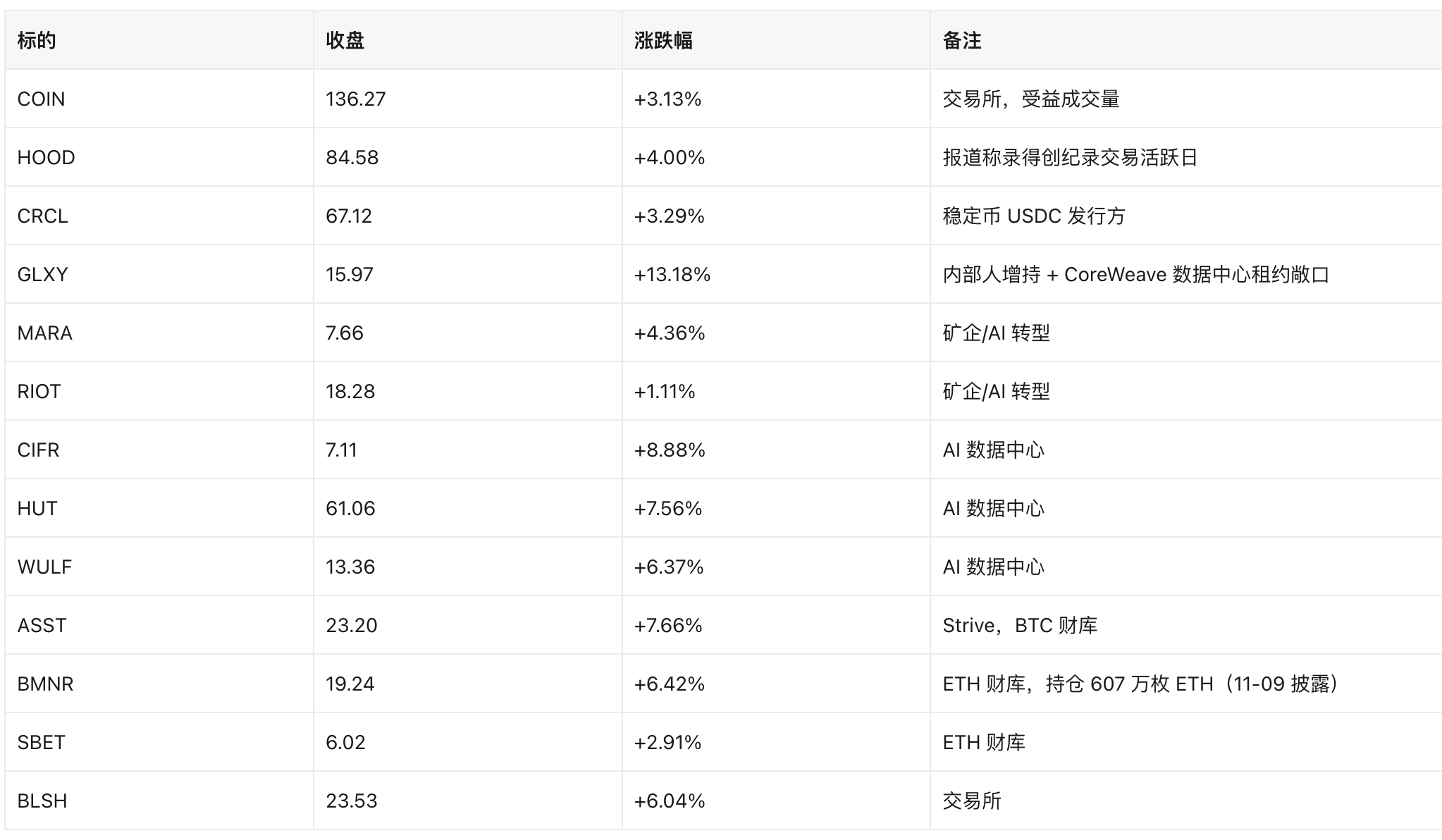
Key observation: This round of crypto stock gains has almost zero correlation with BTC (BTC +0.1% over 24 hours); the pricing factor is "AI infrastructure risk appetite recovery." This means that if the AI narrative weakens again, crypto stocks lack coin-price support and will see greater downside elasticity.
4.5 Spot ETF Fund Flows
- IBIT $42.24 (+1.34%), FBTC $64.88 (+1.30%), with prices edging up alongside BTC.
- Fund flows: IBIT has seen net outflows for 7 consecutive trading days; U.S. spot BTC ETFs saw combined net outflows of $1.28 billion in the week of November 3–7, of which IBIT accounted for $1.21 billion (Farside data, cited by multiple media outlets). Single-day flow data for November 11 has not yet been released; CoinDesk reported that "selling pressure is easing."
- Triggers: Binance's $6.3 billion asset theft (linked to North Korea-affiliated hackers), a CFO change, and a reversal in regulatory expectations after the midterms.
4.6 Regulatory and Accounting Drivers
- Warren will become Senate Banking Committee chair in January, and Blumenthal has set a January 4 response deadline for Binance, Tether and others—DATs and stablecoins face not "friendly regulation" but investigative regulation.
- MSCI's "non-operating company" rule may be referenced by other index providers (FTSE, S&P DJI), constituting systemic risk at the accounting/index methodology level, with broader impact than a single enforcement action.
- The Russian central bank approved exchanges to open BTC trading on November 22 (an overseas regulatory change, provided as background only).
4.7 Changes to the Crypto U.S. Stock Watchlist (This Issue)
- Removed from watchlist: Hyperscale Data (GPUS)—liquidated 211.56 BTC and abandoned its $100 million treasury program.
- New risk watch: Trump Media (11,385 BTC pledged + $1 billion put right), Twenty One Capital (XXI, $5.26, market cap $2.96 billion)—a Tether-affiliated treasury whose market cap is now below its $3.9 billion BTC treasury; the discount status warrants continued monitoring.
5. Geopolitical Impact
5.1 The Iran War and the Strait of Hormuz (Oil Price → Inflation → Fed Chain)
- Latest: Iranian Parliament Speaker Ghalibaf said the Strait of Hormuz "will never return to its pre-war state"; Iran said it has given a clear response to the U.S. proposal and is awaiting Washington's decision; U.S. media reported that Trump is considering a new round of military strikes or tougher sanctions; Iran said it attacked an island in Oman allegedly used for U.S. military operations.
- Transmission: Shipping through the strait has not resumed → Brent holds above $90 (EIA expects near $100 by year-end) → although U.S. gasoline prices have fallen below $4/gallon, the energy component remains the main upside risk for CPI → reinforcing a December hike → long-end rates and the dollar both high → high-valuation tech stocks and crypto assets under pressure.
- Uncertainty: If there is a diplomatic breakthrough, oil prices could quickly fall by more than $10, which would actually benefit risk assets; this is currently the only variable that could reverse the "rate-hike trade."
5.2 The Midterm "Blue Wave" (Policy → Sector Chain)
- Democrats won majorities in both chambers, with Republicans entering minority status (Thune and Jordan as minority leaders); 16 House races remain undecided, but control is settled.
- For U.S. stocks: ① Multiple ballot measures restricting data