US Stocks Daily | Nasdaq fell 3.37% for the week, recording a fourth consecutive weekly decline; nonfarm payrolls rose by 165,000, December rate hike pricing heats up (November 7)


- Key Takeaways: The Democrats' landslide midterm victory has made AI regulation a new valuation variable for tech stocks, compounded by stronger-than-expected nonfarm payroll data reinforcing December rate hike expectations, triggering a single-day Nasdaq plunge of 5.52% and $2.5 trillion in market cap wipeout, with crypto assets and the DAT treasury model coming under simultaneous pressure.
- Key Elements:
- The Democrats secured their largest congressional advantage in nearly 50 years and plan to roll out AI legislation in batches, with Nvidia chip exports targeted; the Nasdaq fell 5.52% on November 5, the Philadelphia Semiconductor Index dropped 12.24% in a single day, and the Nasdaq fell 3.37% for the week, its fourth consecutive weekly decline.
- October nonfarm payrolls added 165,000, nearly three times expectations, with an unemployment rate of 4.1%; December rate hike pricing rose to 80%; the 10-year Treasury yield climbed to 4.86%, and the dollar index rebounded to 102.28.
- Brent crude fell 16.90% for the week to $97.76, mainly on expectations of de-escalation in Iran after the election; gold rose 4.63% for the week to $4,079.50, forming a rare combination of "falling oil prices and rising rate hike expectations."
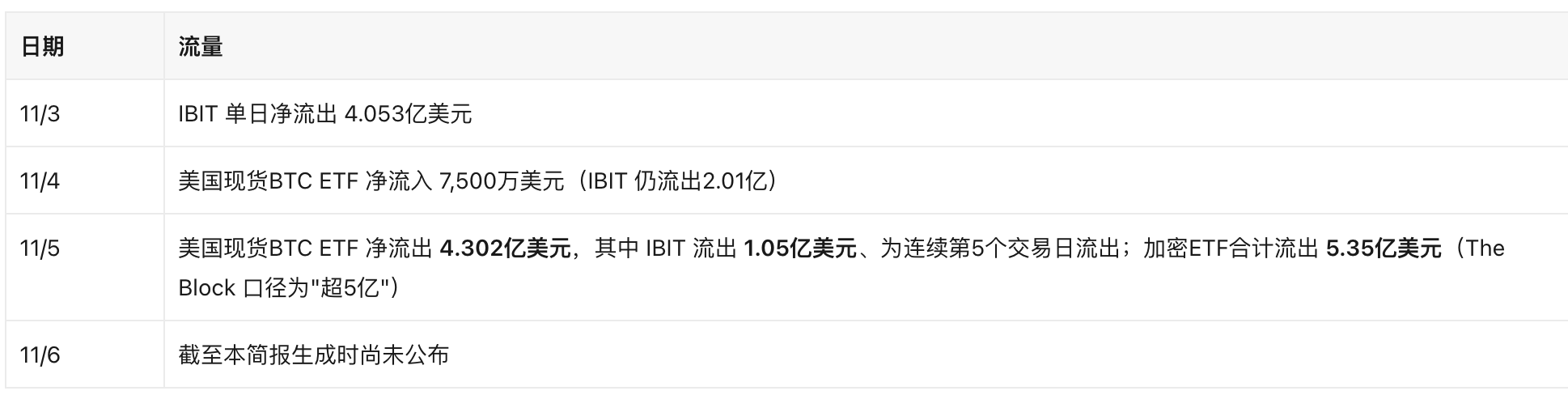
- BTC briefly dipped to an 11-week low, with over $1 billion in liquidations across the market; on November 5, spot Bitcoin ETFs saw net outflows of $430.2 million, with crypto ETFs collectively seeing outflows exceeding $530 million.
- MSTR's market cap-to-holdings value ratio fell to 0.846x; the mNAV discount means issuing common stock dilutes rather than accretes BTC per share, the DAT premium financing flywheel has stalled, constituting a slow-moving bearish factor for BTC.
- The correlation between miners and BTC has shifted from "coin price beta" to "AI capex beta": BTC was flat on the day while miners surged 8%–20%; TeraWulf's mining revenue fell 69% and IREN's fell 58%, with the latter planning to exit mining.
- OFAC cut off MEXC from the US financial system (involving $16 billion in related transactions), raising compliance costs across the industry; the Treasury's withdrawal of the "travel rule" proposal is relatively positive for compliant exchanges.
1. Top Stories
- Democrats Win Landslide Midterm Victory, AI Regulation Becomes a New Valuation Variable: Democrats secured their largest congressional advantage in nearly 50 years, flipped the Senate, and plan to roll out AI legislation in a concentrated push, with Nvidia's AI chip exports listed as a target. Markets are concerned about rising regulatory and political costs of AI capital expenditure, directly triggering Thursday's tech stock selloff.
- Nasdaq Posts Largest Single-Day Drop in 19 Months on Thursday, Only Partially Recovers Friday: On November 5, the Nasdaq Composite fell 5.52% (-1,421.51 points), wiping out $2.5 trillion in market value, while the Philadelphia Semiconductor Index plunged 12.24% in a single day; on November 6, the Nasdaq rebounded 1.09% and the SOX rebounded 4.21%, but the Nasdaq still fell 3.37% for the week, marking its fourth consecutive weekly decline.
- October Nonfarm Payrolls Add 165,000, Nearly Triple Expectations, December Rate Hike Pricing Rises: The unemployment rate stood at 4.1%, with wage growth lagging. The Fed held rates steady in October, while Barkin, Hammack, and Williams all pointed to "inflation still high, need to continue hiking." The 10-year Treasury yield rose to 4.86%, and the dollar index rebounded to 102.28.
- Oil Prices Plunge Nearly 17% in a Week, Inflation Path Shows Two-Way Uncertainty: Brent crude fell from $117.64 on October 30 to $97.76 (down 16.90% for the week), while WTI fell 13.23% to $90.34, mainly due to rising market expectations of de-escalation in the Iran conflict after the midterms; gold rose 4.63% to $4,079.50 over the same period.
- Crypto Assets and Crypto-Linked US Stocks Bleed Simultaneously, ETFs Turn to Net Outflows: BTC briefly dipped to an 11-week low on Thursday, with over $1 billion in liquidations across the market; on November 5, US spot Bitcoin ETFs saw net outflows of $430.2 million, with total crypto ETF outflows exceeding $530 million; the Binance $6.3 billion theft case continues to unfold, with Elliptic stating that $3.1 billion has yet to be laundered.
2. US Stock Market and Macro
2.1 Index Closes (US Eastern Time, November 6, 2026, 16:00 Close)
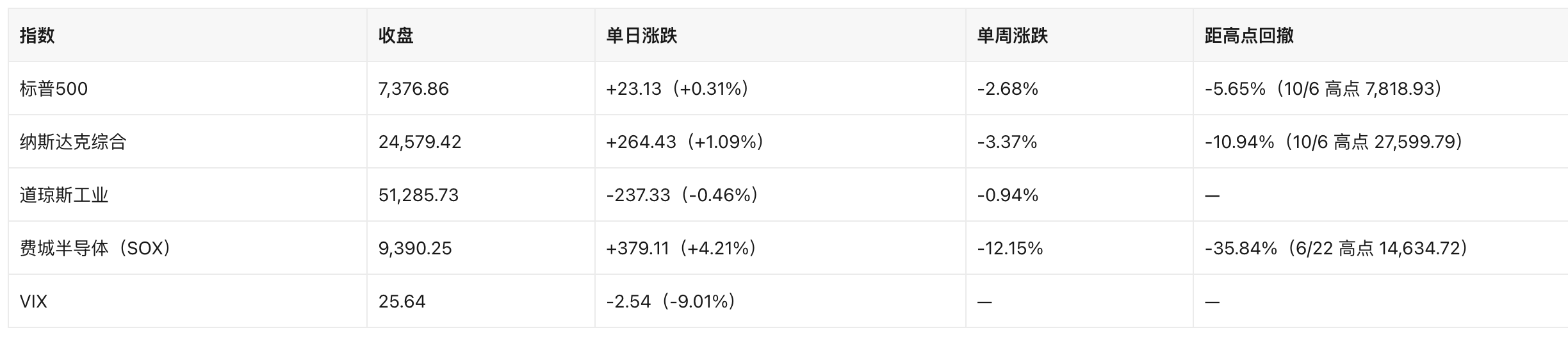
The Nasdaq has entered technical correction territory (-10.94% from its high); the SOX has retraced 35.84% from its June 22 high, sitting in deep drawdown territory.
2.2 Core Drivers
- Politics → Regulation → Valuation: After Democrats swept the midterms, the market is repricing regulatory risk for AI-related companies. Reuters reported that Democrats are preparing to roll out AI bills "in batches"; Bloomberg noted that Nvidia's AI chip exports will become a target of the Democratic Congress. This is the dominant variable in this week's risk asset pricing, rather than earnings themselves.
- Employment Data → Rate Hikes → Discount Rate: October nonfarm payrolls added 165,000, nearly triple market expectations, with the unemployment rate falling to 4.1%. Following the data release, market pricing for a December rate hike rose to 80% (per multiple market aggregators, not CME FedWatch raw data). The Fed held rates steady at its October meeting, with December viewed as the hiking window.
- Fed Officials' Remarks: Barkin (11/5) said "we will hike in the future, but at a gradual pace"; Hammack supported a gradual hiking path; Williams (11/6) stated that "inflation is too high and must return to 2%." The overall tone leaned hawkish.
- Nature of Friday's Rebound: Bloomberg described it as "dip buyers providing support, selling pausing," while Reuters emphasized it was a "relief rally" rather than a trend reversal; the Nasdaq still posted its fourth consecutive weekly decline.
2.3 Rates, Dollar, and Commodities (US Eastern Time, 11/6 Close/Settlement)
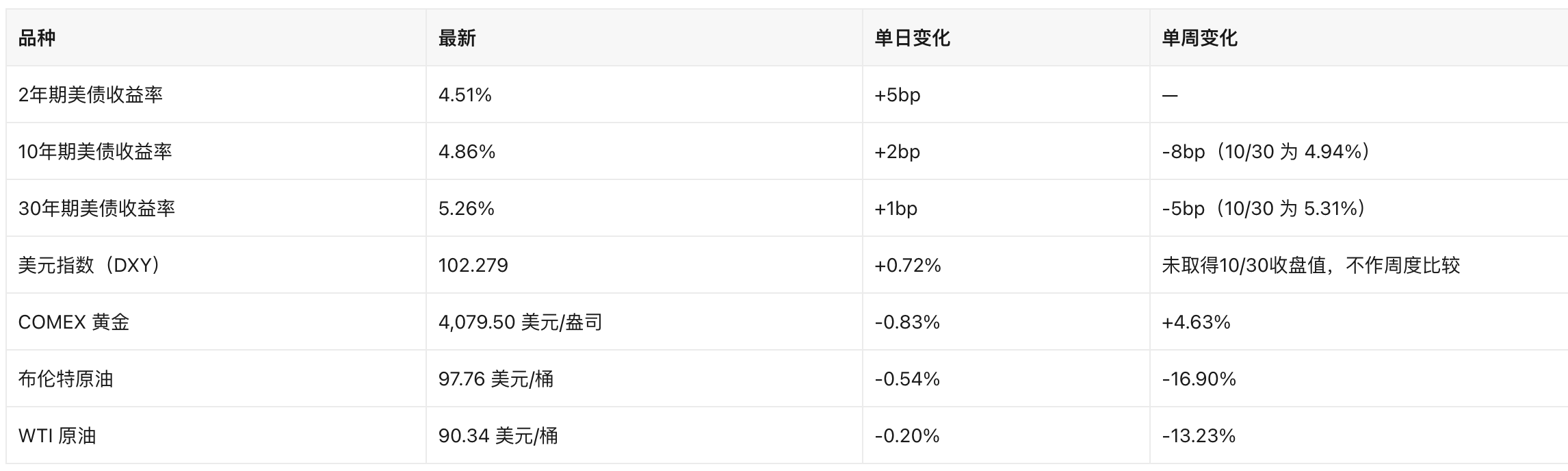
Yield Curve Signal: The 10-year yield rose only 2bp after the strong jobs data, while the 2-year rose 5bp, with the curve flattening slightly—the market is pricing a December hike on one hand while worrying that hikes will suppress 2027 growth on the other. This reinforces the "AI capex slowdown" narrative.
3. Hot Stocks and Sectors
3.1 Semiconductors: Violent Single-Day Rebound, Still the Hardest Hit for the Week
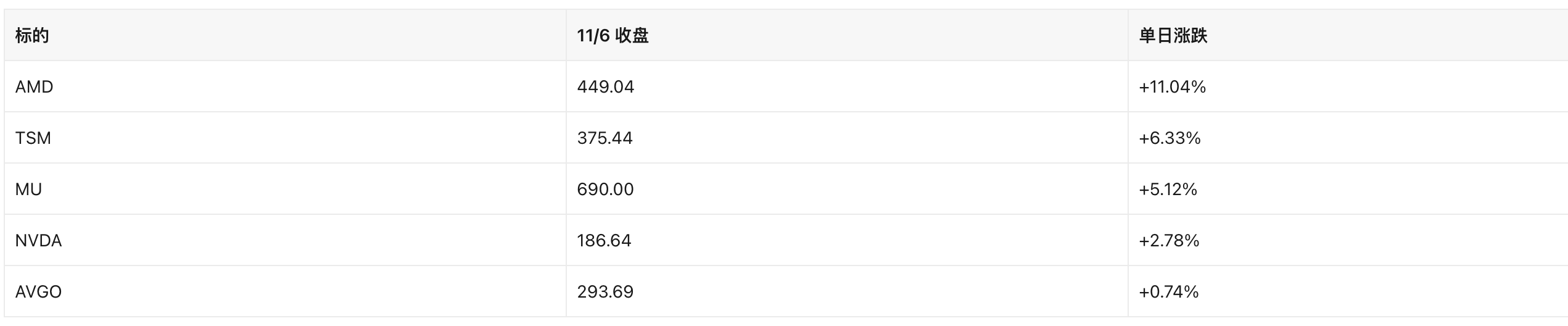
- AMD +11.04%: Q3 EPS of $2.09 massively beat expectations, revenue hit a record, data center business sales nearly doubled, and guidance was stronger than expected. The stock had risen on the 4th after the November 3 after-hours release, then was interrupted by Thursday's market-wide selloff, with gains concentrated on Friday.
- Memory and Foundry Recover in Tandem: Micron and TSMC led gains, which the market interpreted as position rebuilding on the view that "AI capex has not been interrupted." Both Reuters and Barron's noted this looks more like an oversold rebound, with the SOX still down 12.15% for the week.
- Risk Points: The Democratic Congress's chip export control agenda is the sector's biggest policy tail risk; any bill text landing could hit valuations again.
3.2 Tesla: Cybertruck Production Halted, Capacity Shifted to Robotaxi
- TSLA +4.23% to $358.22. Musk confirmed that Cybertruck production will gradually cease (the model's sales fell 48% year-over-year), with Texas factory capacity shifting to Cybercab autonomous taxis. The market read this as "cutting losses + focusing on the AI narrative" rather than deteriorating demand.
3.3 Big Tech: Clear Divergence, Software and Hardware Out of Sync
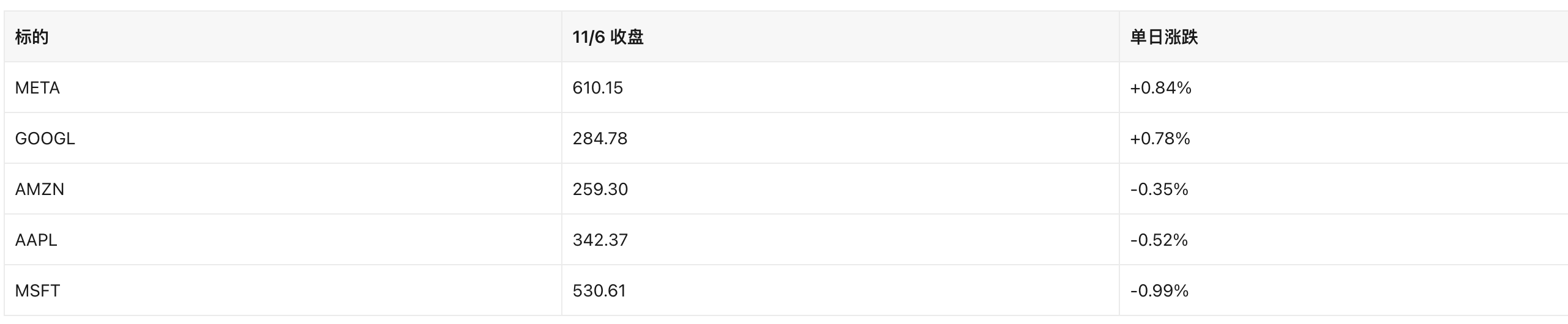
The index rebound was mainly driven by semiconductors and high-beta growth stocks, while heavyweight software stocks failed to follow, indicating that funds are engaging in "oversold rebound" rather than "broad rebuilding."
3.4 AI Infrastructure: Valuation Anchors Loosening
- Anthropic IPO Valuation Reportedly Halved to $1 Trillion: Decrypt cited reports that its primary market valuation faces a downward revision after the AI stock selloff. The news has not been confirmed by the company and is marked as unverified, but it has a direct psychological impact on the valuation anchor of the AI infrastructure chain.
- AI Power Costs Become a Political Issue: A "voter backlash" against data center electricity prices emerged during the midterms, with OpenAI pledging to cover AI power bills (Decrypt, 11/5). This means the external costs of AI capex are being politicized, compounding with regulatory risk.
- CoreWeave (CRWV) Earnings on November 10 After-Hours is the first hard test for the AI infrastructure narrative next week.
3.5 Energy: Fragile Balance After a Weekly Plunge
Brent crude fell 16.90% for the week to $97.76, but dropped only 0.54% on Friday, with news of another attack on ships in the Persian Gulf limiting the decline (CBS News). Falling oil prices benefit airlines, transportation, and consumer sectors but hurt energy stock earnings expectations; at the same time, it is the only variable in the current "inflation—rate hike" chain that could reverse quickly.
4. Crypto-Related US Stocks (Crypto-Equity)
4.1 DAT (Digital Asset Treasury) Companies

Strategy (MSTR) — Accumulation Continues, but the "Premium Flywheel" Has Stalled
- Holdings and Cost: Company disclosures show total holdings of 849,327 BTC; between October 26 and November 1, it added 811 BTC for $65.5 million at an average price of $80,846/BTC (811 × 80,846 = $65,566,106; the discrepancy with the disclosed $65.5 million is due to average price rounding).
- Financing Actions: During the same period, it repurchased $208 million of STRC (Stretch preferred stock) and sold $164 million of common stock through its ATM. STRC price has returned to near its $100 par value, as the company converts "cash burn" into "new ammunition for coin purchases."
- mNAV Discount (Key Signal): Based on Nasdaq market cap, MSTR's market cap is $54.45 billion; based on 849,327 BTC × $75,820, the holdings value is $64.396 billion. Market cap/holdings value is 0.846x ($54.45B ÷ $64.396B, before debt deduction and excluding preferred stock). CoinDesk noted as early as June that its "enterprise-level mNAV had fallen below 1." Implication: In a discount state, issuing common stock dilutes rather than accretes BTC per share, and the core financing logic of DAT fails—this explains why MSTR continued to drift lower even as BTC traded sideways.
- Q3 Results: Operating income of $21 billion, diluted EPS of $44.75 (Business Wire, October 29), mainly contributed by Bitcoin fair value changes and should be viewed separately from cash flow.
Strive (ASST) — The Aggressive Challenger
- Recorded a $509 million profit in Q3 from Bitcoin holdings appreciation while continuing to add leverage to buy coins (The Block, 11/6); on November 2, it added another 124 BTC. Its more aggressive financing pace relative to Strategy has sparked comparative market discussion.
Bitmine (BMNR) — Concentration Risk of the ETH-Version DAT
- Holds 4.9% of total ETH supply (24/7 Wall St., 11/5). Single-asset concentration is approaching the "5% threshold" discussion zone, amplifying the impact of ETH price volatility on its net asset value.
Other DAT-Related
- Twenty One Capital (XXI): Bitcoin treasury of $3.9 billion, with earnings disclosure on November 13.
- Hyperliquid Strategies: Q3 revenue of $13.3 million, but the $620.6 million profit mainly came from mark-to-market revaluation of HYPE holdings; the company has applied to become a CFTC-registered FCM. It belongs to the new subcategory of "exchange token treasuries."
- DDC Enterprise: Issued perpetual preferred stock with a 13.5% coupon and offered SAVOR preferred stock at $20 per share. High-yield preferred stock financing indicates that the common stock financing channel for DAT is narrowing.
4.2 Crypto US Stock Watchlist Additions
No entirely new US-listed targets that first announced BTC/ETH purchases or first transformed into crypto treasury companies were identified in this period.
Changes in the watchlist this period (non-additions):
- HYPE Treasury Subcategory: Hyperliquid Strategies enters "under observation," with trigger conditions being FCM approval and HYPE price correlation;
- DAT Financing Structure: DDC's shift to 13.5% perpetual preferred stock is a leading signal of "common stock ATM failure" and needs to be tracked for replication by other DATs;
- ETH Treasury Concentration: Bitmine approaches 5% of ETH supply; a breach would trigger governance and liquidity discussions.
4.3 Broad Crypto US Stocks
Exchanges and Platforms
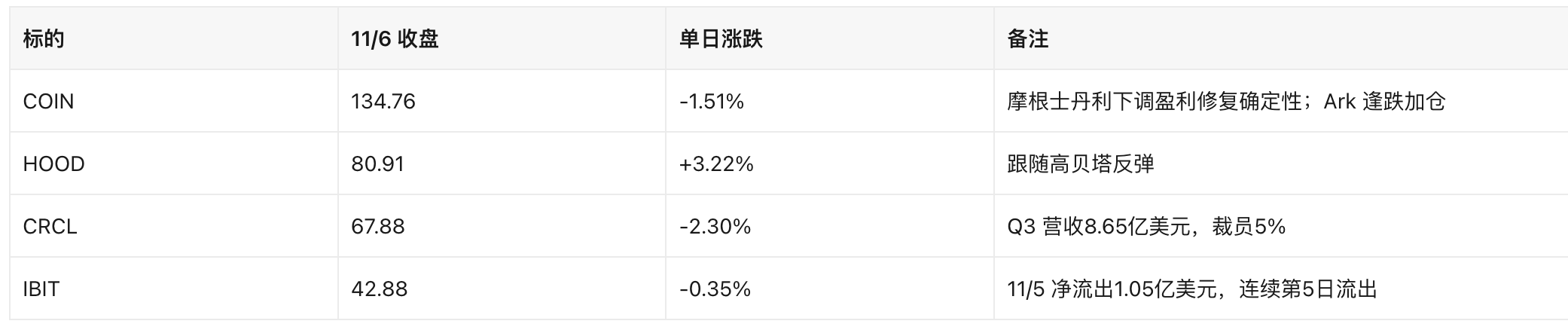
- Coinbase (COIN): Bloomberg reported that Morgan Stanley believes its "certainty of earnings recovery has declined" (11/6); Ark Invest continued to add to its position after the stock's sharp decline. Market cap of $35.68 billion.
- Robinhood (HOOD): +3.22%, with greater elasticity when retail risk appetite recovers.
Stablecoins and Payments
- Circle (CRCL): Q3 revenue and reserve income totaled $865 million, while announcing 5% layoffs. Two ecosystem developments: Samsung Wallet launched USDC on Solana; Citi listed it as its top pick in the stablecoin and digital payments sector. Market cap of $17.41 billion.
- Visa / Mastercard / PayPal: No major on-chain actions disclosed this period; not included in this focus.
Spot ETF Fund Flows (Key)
Miners and Hashrate (AI/HPC Transition Is the Strongest Theme This Week)
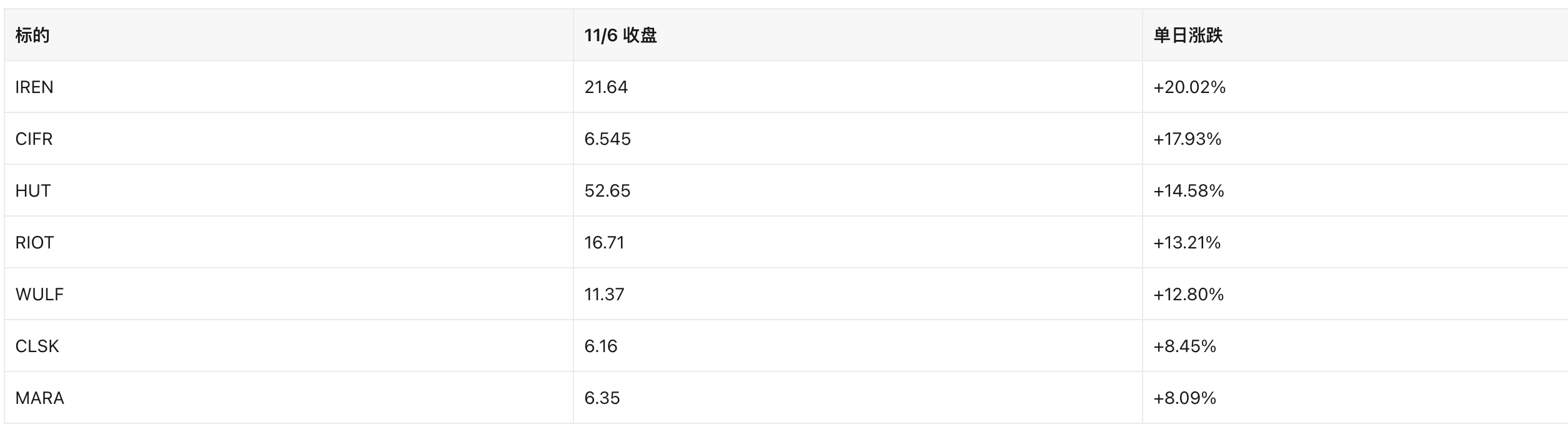
- The Driver Is Not Coin Price but AI Data Centers: BTC was nearly flat on the day (-0.4%), yet miners collectively surged 8%–20%, indicating that buying is pricing the "hashrate → AI/HPC leasing" transition logic rather than mining economics. Riot's previously announced $28 billion AI leasing agreement at its Corsicana campus is the core anchor (24/7 Wall St., 11/4).
- The Cost of Transition Is Already Showing in Earnings: TeraWulf (WULF) saw Bitcoin mining revenue fall 69% year-over-year, but HPC leasing revenue surged with the Anthropic project buildout (The Block, 11/6); IREN's mining revenue fell 58%, and it plans to fully exit Bitcoin mining by year-end (The Block, 11/6).
- Implication: These companies are transforming from "Bitcoin proxies" into "AI infrastructure stocks," with declining correlation to BTC and rising correlation to the AI capex cycle—if AI regulatory risk continues to build, they will face pressure from both sides simultaneously.
4.4 Regulatory and Accounting Drivers
- OFAC Cuts MEXC Off from the US Financial System: The US Treasury alleges it was involved in $16 billion in transactions related to Iran, North Korea, and Russia. This is the toughest enforcement action against a centralized exchange this week, directly raising compliance costs across the industry.
- Treasury Withdraws "Travel Rule" Proposal: AML data reporting requirements are relaxed, which is relatively favorable for compliant exchanges.
- 401(k) Inclusion of Crypto Assets Moves Closer: The Trump administration is advancing rules to allow crypto assets in retirement accounts, a structural demand-side positive.
- Sanctions Expansion: The US sanctioned another 45 targets linked to the "Prince Group" crypto fraud empire.
- State/Overseas: Greece passed a crypto tax law (10% on gains, 15% on staking and DeFi); the Central Bank of Nigeria introduced stablecoin licensing rules and banned algorithmic stablecoins.
- Accounting-Political Cross Risk: The Democratic sweep makes the outlook for market structure legislation (exchange regulatory framework) uncertain. Of the "fair value accounting + light-touch regulation" combination that DAT relies on, the latter is showing cracks.
4.5 Same-Day Stock-Crypto Linkage Signals
- BTC Sideways, Miners Surge → Linkage