US Stocks Daily | U.S. Stocks Diverge on Midterm Election Day, AMD's Data Center Revenue Nearly Doubles, Driving AI Rebound (November 4)

This article is about 7052 words, reading the full article takes about 11 minutes
On November 3, U.S. stocks rebounded after the AI selloff, with the Nasdaq up 0.83% and the S&P 500 up 0.37%; AMD's data center revenue nearly doubled year-over-year and rose 8% after hours, while Apple fell 1.90% on memory cost concerns. The 10-year Treasury yield rose to 4.952%, and Brent settlement fell 1.12% to $103.60. The next day, focus will be on midterm election vote counting, ADP data, and RIOT's earnings report.

AI Summary
Expand


- Core Viewpoint: The AI trade halted its decline and rebounded as AMD's earnings validated the narrative, with market debate shifting from "whether to invest in AI" to "whether spending can translate into revenue"; meanwhile, AI capex financing is shifting from cash flow to debt markets, making long-end rates a new pricing anchor.
- Key Elements:
- AMD's Q3 revenue rose 45%, data center revenue nearly doubled to account for 64% of total revenue, and the stock rose 8% after hours, directly offsetting "AI overinvestment" concerns; the Philadelphia Semiconductor Index rose 2.63%.
- Apple fell 1.90% after issuing 45%–46% gross margin guidance below expectations due to memory price increases; Nvidia's market cap of $4.98 trillion surpassed Apple's, illustrating how the same shortage benefits upstream suppliers while pressuring downstream players.
- Oracle's $20 billion financing, Meta's $20 billion bond offering, and Microsoft's $44.9 billion Anthropic commitment show AI spending shifting toward debt financing; the 10-year yield rose to 4.95% yet tech stocks still rebounded.
- Strategy added 811 BTC worth only $65.5 million while repurchasing $208.2 million in preferred shares—more than triple that amount—signaling a shift in capital focus from BTC expansion to repairing its capital structure, with mNAV at just 0.87x.
- Spot Bitcoin ETFs saw net outflows of $398.6 million on 11-02 and $643 million on 10-30; despite the price rebound, funds continue to flow out, indicating "seller exhaustion" rather than new buying.
- Cipher's revenue fell 63% year-over-year but its stock rose 18.37%; the Barber Lake lease added $5.2 billion with total contract revenue of $9.1 billion, as mining company valuation anchors shift toward the net present value of AI leases.
- U.S.-Iran peace talk expectations pushed oil prices to a four-week low, with Brent at $103.60; Senate control remains undecided in the midterm elections, representing the most fragile assumption behind the rebound.
1. Top Stories
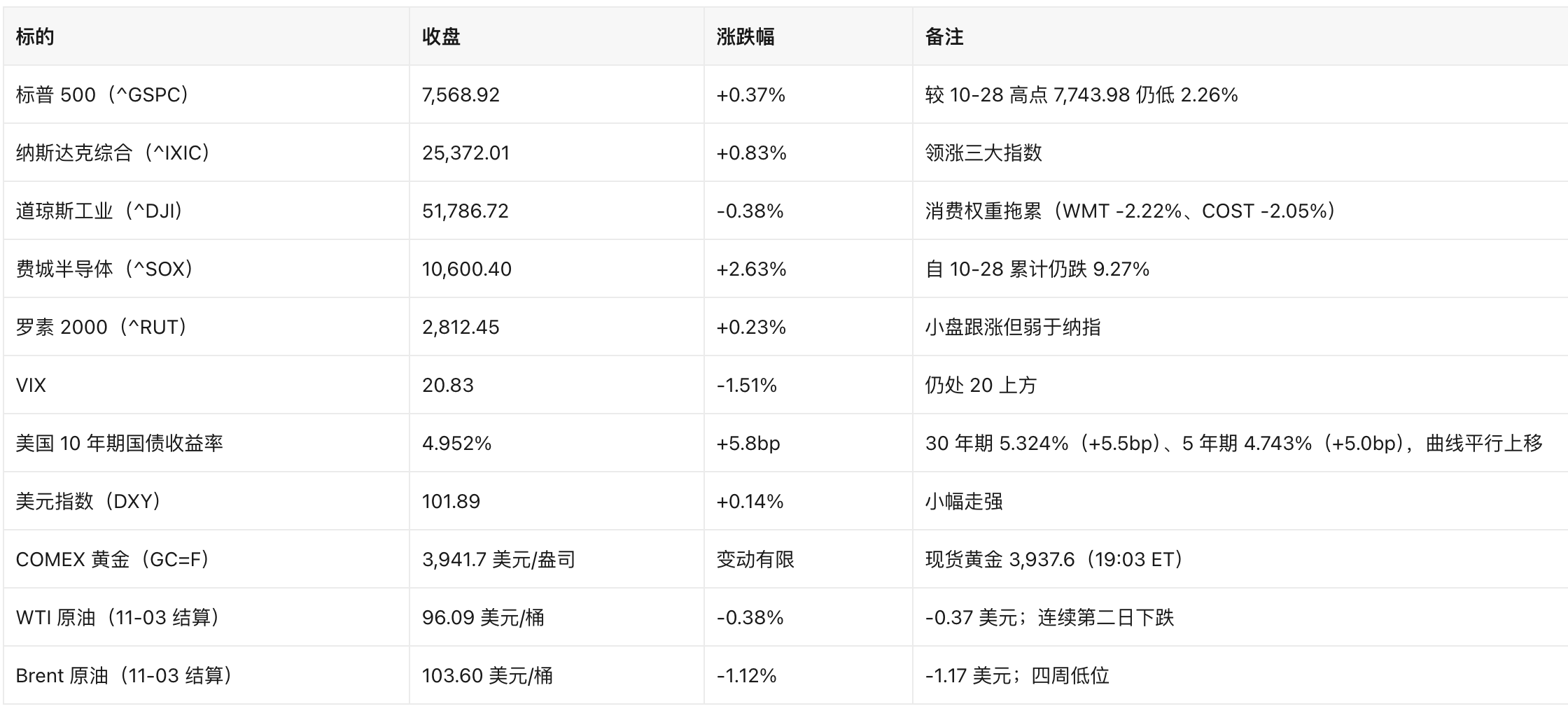
- AI trade halts decline and rebounds; Philadelphia Semiconductor Index leads: The Nasdaq closed up 0.83% at 25,372.01, the Philadelphia Semiconductor Index rose 2.63% to 10,600.40, the S&P 500 gained 0.37% to 7,568.92, while the Dow bucked the trend, falling 0.38% to 51,786.72 (Reuters, CNBC). Takeaway: Last Friday's single-day collapse in Intel shares of 29% (its worst single day since the 1970s), combined with selling triggered by doubts over AI capital expenditure, halted ahead of AMD's earnings, indicating that the market's point of contention is "whether AI investment can translate into revenue," rather than a rejection of the AI narrative itself.
- AMD Q3 revenue up 45%, data center revenue nearly doubled year-over-year, shares up 8% after hours: The data center business now accounts for 64% of total revenue (47% in the year-ago period), and CEO Lisa Su said server revenue will double year-over-year in 2027 (CNBC). Takeaway: This is the most important validation point for the AI hardware chain this week, directly offsetting concerns about "AI overinvestment" and serving as the direct trigger for the semiconductor rebound.
- Apple issues below-expected gross margin guidance due to memory price increases, shares close down 1.90%: December-quarter gross margin guidance of 45%–46% came in below the LSEG consensus of 46.3%; if realized, it would mark the third consecutive quarterly decline in gross margin (50.1% in the June quarter, 47.9% in the September quarter); incoming CEO John Ternus called memory pricing "unprecedented" (CNBC). Takeaway: The global memory shortage is evolving from a component cost issue into a profit problem for end-device makers. Apple and Intel are two sides of the same coin—upstream benefits, downstream bears the pressure.
- Expectations of U.S.-Iran peace talks continue to weigh on oil prices; Brent settlement hits four-week low: Brent settled at $103.60/barrel (-$1.17, -1.12%), WTI settled at $96.09/barrel (-$0.37, -0.38%), marking a second consecutive trading day of declines; Qatar is mediating in Tehran, but Iran's foreign ministry said it would not accept "coercive diplomacy" (CNBC). Takeaway: This is currently the only variable capable of simultaneously lowering inflation and reducing rate-hike bets, but it rests on the premise that "talks have not yet materialized," so directional certainty is low.
- U.S. stocks diverge on midterm election day; results still pending: Voting ended on 11-03, with vote counting ongoing; Polymarket and Kalshi bettors are pricing the possibility that Democrats could win both the House and Senate (The Block), while Stifel expects Democrats to win the House and considers the Senate "too close to call." Takeaway: Senate control will determine Trump's legislative capacity over the next two years, making it the single largest policy variable in the coming days and the most fragile assumption behind this rally.
2. U.S. Stock Market and Macro
2.1 Indexes and Key Assets (U.S. Eastern Time 11-03 Close)
2.2 Core Drivers
(1) AI Capital Expenditure: From "Selling Shovels" to "Borrowing to Buy Shovels"
- Oracle (ORCL) rose 5.85%, with the market focused on its $20 billion financing plan (among the top of TradingView/ChartMill volume rankings); Meta gained 2.36% as its $20 billion bond issuance drew strong demand; Microsoft rose 2.74% as the market digested its disclosed $44.9 billion in Anthropic-related commitments.
- MarketWatch noted the same day that "AI's influence on the bond market is rising, even comparable to war and elections." Transmission logic: AI capital expenditure is shifting from operating cash flow to debt financing, making long-end rates a more direct constraint on tech stock valuations than before—which also explains why the 10-year yield rose to 4.95% yet tech stocks could still rally: the rebound was driven by earnings (AMD), not valuation expansion.
(2) Macro Data: Manufacturing Prices Subindex Remains "Hawkish Evidence"
- Released on 11-03: ISM Manufacturing at 55.5 (expected 54.5, prior 54.5), New Orders at 55.5 (expected 54.5), Prices subindex at 75.2 (prior 77.9), still at an extremely high level; JOLTS job openings at 7.523M (expected 7.15M, prior 7.19M); factory orders +1.8% (expected +1.2%); durable goods orders (excluding transportation) +0.5%, in line with expectations; construction spending -1.9% (expected +0.4%), the only clearly weak item; Atlanta Fed GDPNow at 3.7% (prior 3.2%).
- Why it matters: The prices subindex at 75.2 indicates that inflationary pressure has not disappeared with the decline in oil prices, which corroborates the Fed's current hawkish tilt.
(3) Fed: Restarted Rate Hikes in September, Held Steady in October, Officials Hint at Possible Further Hikes
- The Fed raised rates in September for the first time in three years; the 10-28 meeting kept rates unchanged (Bloomberg described it as "the Fed in the AI era voting to hold steady"); Chair Kevin Warsh said politics did not influence decisions; CNBC reported on 10-30 that "Fed officials have signaled the need to resume rate hikes"; Treasury Secretary Bessent said another Fed hike "would not necessarily be a mistake."
- Implications for the market: The tail risk in policy direction lies on the "further hikes" side, not rate cuts. The 10-year at 4.952% and 30-year at 5.324% are the priced outcome of this expectation.
3. Hot Stocks and Sectors
3.1 AMD (+3.65%, +8% After Hours): Key Validation for the AI Hardware Chain This Week
- Q3 revenue grew 45% year-over-year, data center revenue nearly doubled year-over-year, accounting for 64% of total revenue (47% in the year-ago period); PC/gaming segment revenue was $3.7 billion, down 8% year-over-year, with gaming down 40%.
- Management said server revenue will double year-over-year in 2027 and that supply of wafers, substrates, advanced packaging, and memory has been secured.
- Market implications: Agentic AI is driving a recovery in server CPU demand, shifting AMD's benefit from "catching up to GPUs" to a "CPU renaissance." However, PC weakness and memory costs are clear drags.
3.2 Nvidia (+2.29%) Surpasses Apple in Market Cap; Apple (-1.90%) is the Day's Biggest Weighted Drag
- Nvidia's market cap is $4.98 trillion versus Apple's $4.84 trillion, with Nvidia reclaiming the top spot globally by market cap (Benzinga, Nasdaq data).
- Apple's September-quarter revenue and EPS beat expectations, and its iPhone business also beat, but December-quarter gross margin guidance of 45%–46% came in below the 46.3% consensus, the lowest since Q4 of fiscal 2023. The CFO explicitly attributed this to "rising memory costs + Siri AI investment."
- Market implications: The same memory shortage is evidence of demand for Nvidia and evidence of cost for Apple. This divergence will persist until memory supply eases.
3.3 Memory and AI Server Chain: The Beneficiaries of the Shortage
- Micron (MU) rose 2.58% to 855.10; Super Micro (SMCI) gained 3.12% and moved further higher after hours on strong AI server demand (MarketWatch).
- Background: AI servers and hyperscale cloud providers are aggressively buying up RAM, squeezing supply for phones and PCs; global PC shipments fell 4% year-over-year in Q2 (Counterpoint, cited by CNBC).
- Market implications: This is a redistribution trade of "upstream price increases—downstream margin concessions," and the long/short implications are asymmetric; it is necessary to distinguish each company's position in the chain.
3.4 AI Financing Chain: Oracle, Meta, Microsoft
- Oracle +5.85% ($20 billion financing plan), Meta +2.36% ($20 billion bond issuance drew strong demand), Microsoft +2.74% ($44.9 billion in Anthropic commitments).
- Market implications: The financing structure of AI capital expenditure is shifting from internal cash to public debt markets, and credit spreads and long-end rates will become the new pricing anchors for the AI trade. This is the most noteworthy structural change this period.
3.5 Under Pressure: Consumer and E-commerce
- Walmart -2.22%, Costco -2.05%, Shopify -8.74% (declined after earnings; MarketWatch said the market is concerned about the quality of its growth); Tesla -1.32%, Palantir -1.65%.
- Market implications: The Dow's underperformance stems from its consumer weighting, not industrials or financials (JPM -0.76%, XOM -1.23%). With falling oil prices and rising real rates, consumer stocks are under pressure from both costs and demand.
4. Crypto-Related U.S. Stocks
4.1 DAT Companies: "Small Additions + Buyback Priority" Amid Discounts

Strategy (MSTR) 8-K Highlights (Filed 11-02, Data as of 11-01)
- Added 811 BTC for $65.5 million at an average price of $80,846 (including fees); cumulative holdings 849,327 BTC with a total cost of $64.08 billion and an average price of $75,451.
- On the financing side: sold 1,178,552 MSTR shares via ATM for net proceeds of $164.0 million, of which $65.5 million was used to buy bitcoin and $98.5 million was allocated to USD Cash.
- On the buyback side: repurchased 2,092,035 STRC shares (Variable Rate preferred stock) for $208.2 million; remaining preferred stock buyback capacity is $748.6 million and MSTR buyback capacity is $1.0 billion.
- On the distribution side: shareholders approved a daily dividend plan on 10-28, with STRC paying daily dividends starting 11-01; the SEC filing explicitly states it "does not change the dividend rate or total dividend amount for each series."
- Takeaway: The scale of bitcoin purchases ($65.5 million) has dropped to a "symbolic" level, while preferred stock buybacks ($208.2 million) over the same period were more than three times that size. The focus of capital allocation has shifted from "expanding BTC holdings" to "repairing the capital structure," which is mutually causal with the market cap trading below the value of its bitcoin holdings (0.87x)—once the premium disappeared, the cycle of issuing shares to buy bitcoin was cut off.
Strive (ASST) 8-K Highlights (Filed 11-02, Data as of 10-30)
- Added 124 BTC at an average price of $80,526 from 10-24 to 10-30; holdings rose to 43,124 BTC; cash and equivalents of $490.4 million; also holds 505,000 STRC shares (fair value $50.06 million), i.e., a dual structure of "holding bitcoin + holding peer preferred stock."
- Takeaway: Holdings are now approaching Metaplanet's scale, but financing relies on preferred stock and ATM, making the share price highly sensitive to mNAV changes.
Bitmine (BMNR): Added 8,573 ETH last week, bringing holdings to 6.06 million ETH; Chairman Tom Lee said the market's reaction to the Binance incident was "muted" (The Block).
4.2 Broad Crypto U.S. Stocks: Exchange and ETF Flows
- Coinbase (COIN) +5.53% to 145.45: Q3 net income grew 66% year-over-year, boosted by fair value gains on bitcoin holdings (CNBC, 10-29 earnings). Ark Invest bought $3.4 million of COIN on 11-02 and added to Circle and Robinhood (The Block).
- Robinhood (HOOD) +2.20% to 85.68.
- Circle (CRCL): Released Q3 results before the bell on 11-04; the market is focused on slowing USDC growth and the share of distribution costs (Investing.com).
- Spot ETF Flows:
- 11-02 (Monday): U.S. spot bitcoin ETFs saw net outflows of $398.6 million, with BlackRock's IBIT the largest outflow product (media citing Farside data);
- 10-30 (last Friday): net outflows of $643 million, the largest single-day outflow in four months (The Block).
- 11-03: products rebounded with the bitcoin price: IBIT +1.62%, FBTC +1.62%, BITB +1.61%, ETHA +2.05%.
- Takeaway: The direction of fund flows is more noteworthy than price—bitcoin rose on 11-03, but funds were still flowing out, indicating this rally is "selling exhaustion" rather than "new buying," and the ETF channel has yet to turn to net inflows.
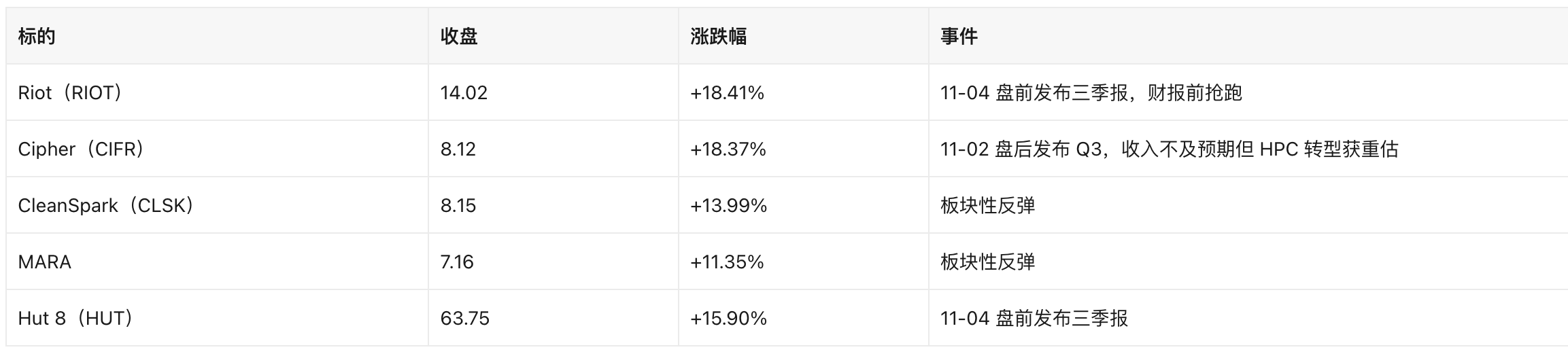
4.3 Miners: Valuation Anchor Shifts from "Mining Revenue" to "AI Leases"
Cipher (CIFR) Q3 Earnings (SEC 8-K, 11-02)
- Revenue of $26.7 million (versus $71.7 million in the year-ago period), of which bitcoin mining was $20.85 million and HPC leasing recognized revenue for the first time at $5.86 million; adjusted EBITDA was -$10 million; net income was $31.6 million.
- On the contracting side: the Barber Lake lease was extended for a second 10-year term, adding $5.2 billion in rent and raising total contracted revenue to $9.1 billion (the company used "approximately," which is non-precise disclosure); development pipeline of 5.9 GW.
- Sell-side views diverge markedly: JPMorgan cut its target price from $22 to $18 but called it "significantly undervalued"; Northland cut from $27.50 to $14; Wells Fargo lowered its target price due to campus delivery timelines.
- Takeaway: Revenue fell 63% year-over-year, yet the stock rose 18.37%, indicating that pricing power has shifted from "current mining cash flow" to "the net present value of long-term AI leases." This is key to understanding volatility in the miner sector—their beta now comes more from AI capital expenditure expectations than from bitcoin prices.
4.4 Regulatory and Accounting Drivers
- SEC Division of Corporation Finance issues a no-action letter treating Canton Coin as a digital commodity: The regulatory boundary for "non-security tokens" is further clarified, providing positive accounting and compliance guidance for listed companies holding token assets.
- CFTC approves single-stock perpetual contracts for trading within the U.S. for the first time: The derivatives boundary expands, representing incremental business for exchanges and market makers, but it also means the regulatory frameworks for equities and crypto derivatives are accelerating toward convergence.
- On the accounting front: According to The Defiant, Strategy recorded $20.9 billion in operating profit in Q3 due to bitcoin price increases (driven by fair value changes); fair value accounting standards make DAT companies' income statements highly synchronized with bitcoin prices—which is also why profit volatility has been amplified during this pullback.
4.5 Crypto U
US stocks
Welcome to Join Odaily Official Community


Recommended Articles