$2.8 Billion Sell-Off Warning: How Much Pressure Would a Strategy Removal from MSCI Put on Bitcoin?


- Key Takeaways: MSCI's new rules propose excluding Strategy and other digital asset treasury companies from its global investable market indexes. If confirmed, this would trigger $1.57 billion to $2.8 billion in passive selling, dealing a blow to its arbitrage loop of relying on stock premiums to raise capital for bitcoin purchases.
- Key Elements:
- Strategy holds 850,364 bitcoin, with a cumulative purchase cost of approximately $64.16 billion. It is on MSCI's potential exclusion list, with the final result to be announced on November 12.
- MSCI's new rules screen for "non-operating companies" based on the proportion of operating assets and five financial indicators. Of the 22 affected companies, 14 are directly related to crypto, and 3 treasury companies are slated for removal.
- JPMorgan estimates that passive fund outflows could reach up to $2.8 billion; Strategy estimates that passive funds hold approximately 13 million shares, or 3.1% of its share capital, corresponding to a market value of $1.57 billion.
- Strategy's bitcoin-buying model relies on MSTR's high premium relative to bitcoin net asset value, channeling capital into the spot market through at-the-market offerings and convertible bond financing. From November 2 to 8, it had just sold 2.05 million shares for $283.8 million and bought 1,036 bitcoin.
- Exclusion would depress its valuation and financing capacity, potentially forcing it to issue more shares and raising its cost of capital, but this does not directly lead to the conclusion that it must sell bitcoin; the company has already sold some bitcoin this year for $431.8 million to fund dividends and buybacks.
- If institutions such as S&P and FTSE follow with similar rules, the channel through which listed companies use equity leverage to accumulate crypto assets on a large scale will face comprehensive constraints at the level of traditional financial systems.
Author: ChandlerZ, Foresight News
Strategy, which holds more than 850,000 bitcoin, is waiting for MSCI to publish a list that could change its shareholder structure.
Index provider MSCI has confirmed that it is using a new methodology to screen out non-operating companies that do not meet the requirements of its global investable market indexes. Strategy appeared on the previously published list of potential deletions, with the final result expected to be announced after 6 a.m. Beijing time on November 12.
Strategy, which holds more than 850,000 bitcoin with a cumulative purchase cost of over $64.1 billion, had previously been placed on the candidate deletion list. If the final list confirms its removal, globally passive tracking funds will be forced to rebalance before the close on November 30, triggering $1.57 billion to $2.8 billion in mandatory selling. The event would directly suppress Strategy's equity premium and cut off its core channel for channeling incremental buy orders into the crypto spot market.
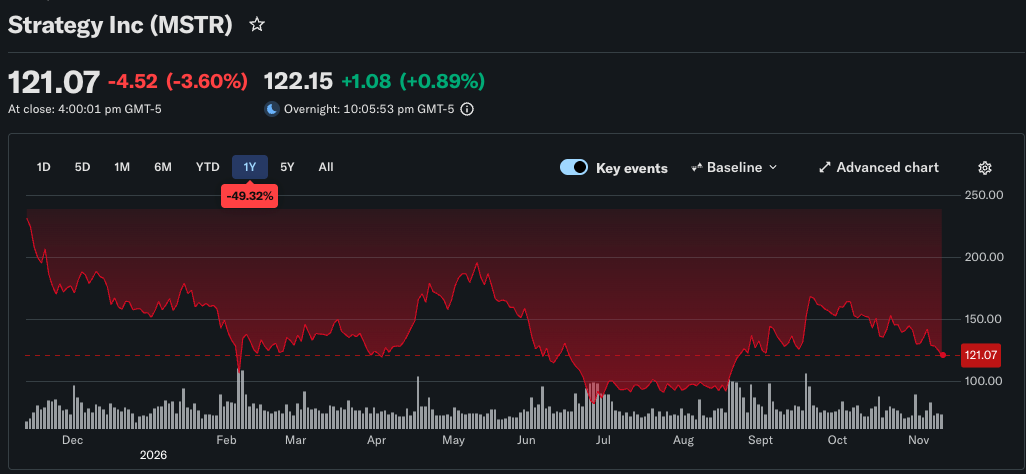
As of the U.S. stock market close on November 11 Beijing time, Strategy's common stock MSTR closed at $121.07, down 3.60% on the day and about 6.4% lower than the November 5 closing price of $129.30. The company disclosed on November 9 that as of November 8 it held a total of 850,364 bitcoin, with a cumulative purchase cost of approximately $64.16 billion.
Why would Strategy be kicked out of the index?
MSCI's global indexes are used by a large number of funds to build equity portfolios, and whether a company can remain in an index affects passive tracking funds' holdings of that company.
Last October, MSCI proposed a removal plan targeting treasury companies whose digital assets accounted for 50% or more of total assets. In January this year, it decided not to implement the plan in the February review and shifted to a broader review of non-operating companies.
On October 16, MSCI finalized a new index eligibility rule. Starting with the November index review, listed companies that derive value mainly from holding assets and lack actual operating activities may be classified as "non-operating companies" and no longer qualify for inclusion in MSCI's global investable market indexes. In other words, companies such as Strategy, Metaplanet and Upexi, which rely on capital market financing to buy tokens, may no longer be regarded by MSCI as ordinary operating enterprises.
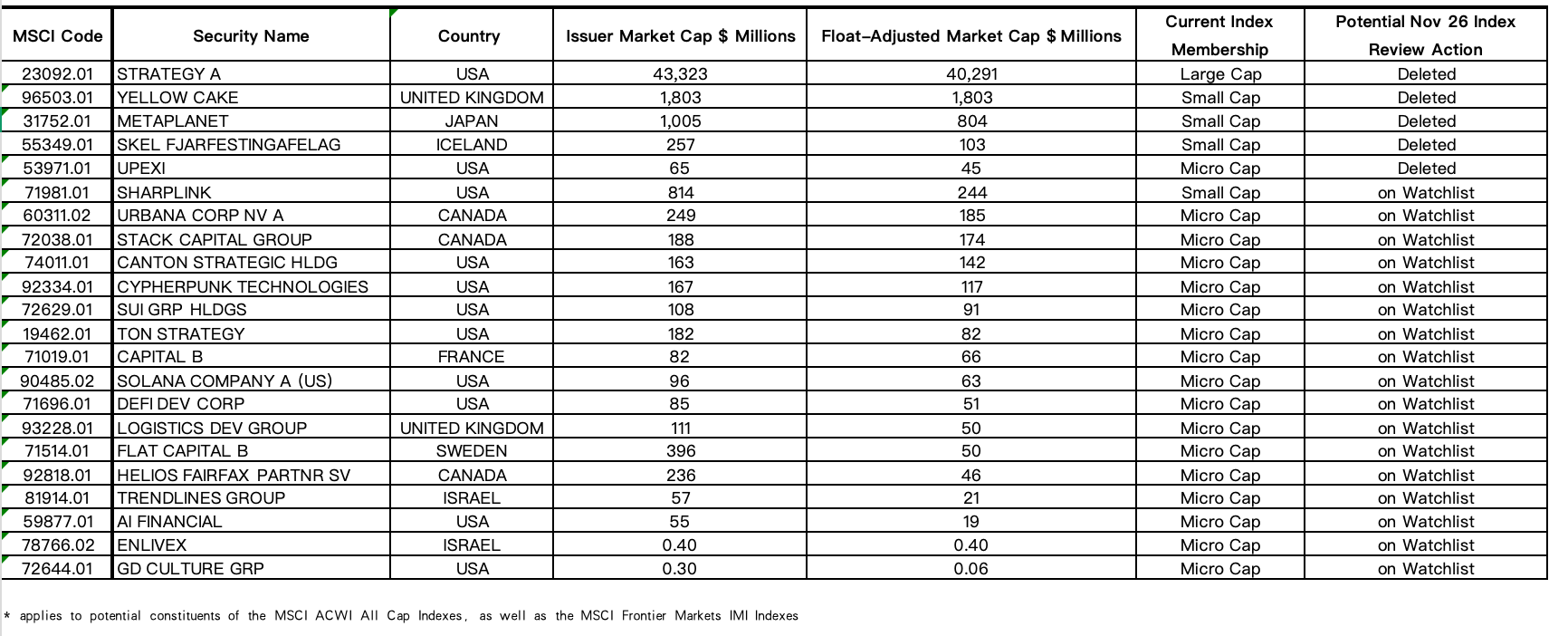
MSCI also published a list of potentially affected companies. Of the 22 companies, 14 are directly related to cryptocurrency: Strategy, Metaplanet and SOL treasury company Upexi were listed for proposed deletion, while 11 other companies including SharpLink and Solana Company were placed on the watch list.
The new rule first determines whether a company's asset structure contains enough operating assets. Companies that fail this test must then undergo checks against five financial indicators, including operating expenses, operating cash flow, changes in fair value and reliance on external financing. If four or more are triggered, the company may lose index eligibility. For companies already in the index, MSCI requires that they fail the screening in both of the most recent two annual reporting periods before they are deleted.
Of the 5 companies proposed for deletion, 3 are digital asset treasury companies:
- Bitcoin treasury company Strategy;
- Bitcoin treasury company Metaplanet;
- SOL treasury company Upexi.
The other two are British uranium investment company Yellow Cake and Icelandic investment holding company SKEL, which shows that the rule is not formally aimed only at crypto assets.
Another 11 crypto-related companies were placed on the watch list, including:
- ETH treasury company SharpLink;
- CC (Canton) treasury company Canton Strategic Holdings;
- ZEC treasury company Cypherpunk Technologies;
- SUI treasury company SUI Group;
- TON treasury company TON Strategy;
- BTC treasury company Capital B;
- SOL treasury company Solana Compan;
- SOL treasury company DeFi Development;
- WLFI treasury company AI Financial;
- RAIN treasury company Enlivex;
- GD Culture, which holds BTC and has announced plans to allocate to TRUMP.
Strategy has objected to the new methodology, arguing that it still operates a software business and reports its bitcoin business as an operating segment in its financial reports, and that MSCI's new rule is in effect once again targeting digital asset treasury companies. MSCI said the new screening methodology targets companies whose financial characteristics resemble investment vehicles and that its scope is not limited to companies holding crypto assets.
Rebalancing countdown: billions of dollars in mechanical liquidation
Once Strategy is removed, its stock MSTR will be directly exposed to selling. Funds that fully replicate the relevant index typically need to sell the constituent stocks they hold; funds using sampling replication and other methods can adjust according to their investment strategies, and the timing and volume of trading will vary across products.
A scenario model previously published by JPMorgan concluded that if all sources of capital, including co-benched funds, exit fully, passive outflows could reach a ceiling of $2.8 billion. Strategy's own quantified floor is relatively more conservative: its estimates show that passive funds tracking the index hold about 13 million MSTR shares, or 3.1% of its total share capital, worth about $1.57 billion at current prices.
Based on a simple calculation using the November 11 closing price of $121.07, these shares are worth about $1.57 billion. The company believes this amount is below its average daily trading volume at the time and that the impact on its business is limited.
But high trading volume does not mean that new selling pressure will necessarily be absorbed by buyers near the original price. Some investors may trade ahead of expectations for the list, and the actual rebalancing price will also depend on whether other buyers are willing to take on the shares. Passive funds selling MSTR will not directly sell the bitcoin on Strategy's balance sheet, which remains held by the company.
Will the stock price decline transmit to bitcoin?
The real damage that passive fund outflows inflict on the crypto market lies in breaking the arbitrage loop that Michael Saylor built on U.S. equity market liquidity.
Strategy's bitcoin-buying model over the past four years has depended entirely on its stock trading at a sustained, large premium to the net asset value of the underlying bitcoin (mNAV). As long as the premium exists, the company can use at-the-market (ATM) offerings to sell common stock at elevated prices in the U.S. equity market, or even issue low-interest convertible bonds in exchange for U.S. dollar cash. The fiat currency raised is injected one-way by management into the crypto spot market to buy coins. The rapid expansion of its bitcoin reserves further fuels speculative sentiment among retail investors and hedge funds, pushing the stock premium higher and enabling the next, larger round of equity financing.
During the period from November 2 to 8 alone, Strategy had just sold 2.05 million MSTR shares through this mechanism, raising $283.8 million, and immediately converted $81.9 million of that into 1,036 bitcoin in the spot market.
If removal brings sustained selling pressure, MSTR's share price and valuation could be affected, and the amount the company can raise per share sold in future equity issuances would also decrease. To raise the same amount of money, Strategy may need to issue more shares, diluting existing shareholders. If investors also demand higher returns, the company's cost of financing through preferred stock or debt could also rise.
Financing pressure would then transmit to bitcoin through links such as the company reducing future purchases, selling existing assets, or other investors adjusting positions in tandem. Index removal alone cannot lead to the conclusion that Strategy must sell bitcoin, nor can it be used to calculate how much bitcoin would fall as a result.
However, Strategy has already sold bitcoin this year. The company disclosed that about $431.8 million of proceeds from some bitcoin sales this year was used to support preferred stock dividends and STRC buybacks, while the company continued to buy bitcoin. As of November 8, its U.S. dollar reserve specifically designated to support preferred stock dividends and debt interest was about $4.77 billion, with another $146.2 million in cash available for broader corporate purposes.
Even Metaplanet, Upexi and SharpLink have all copied the financial engineering playbook of issuing stock to hoard tokens. The core weakness of these companies is highly consistent: their main businesses generate little cash, and they rely heavily on asset premiums in the public capital markets to sustain operations.
MSCI's classification criteria have set a clear dividing line for traditional financial markets, and the mainstream index system has formally cut off the unconscious flow of passive capital to shell entities that hoard tokens. If index providers such as S&P and FTSE follow with similar rules, the golden window for listed companies worldwide to absorb crypto assets at scale through secondary-market equity leverage will face comprehensive constraints from the very foundations of the traditional financial system.