BTC Drops to $62,000 — What Exactly Happened?


- Core View: The crypto market has experienced a cascading sell-off, with BTC hitting a multi-month low and total market capitalization halving from its peak. This correction was driven by a confluence of multiple bearish factors: anomalous micro-level selling pressure, macro capital outflows, and dwindling on-chain liquidity. The market remains sharply divided on the outlook going forward.
- Key Elements:
- BTC fell to as low as 62,000 USDT, a new low since July. Total liquidations across the network reached $2.021 billion in 24 hours, with longs accounting for 86.7%, and over 318,000 traders liquidated.
- Since October 6, total crypto market capitalization has shed over $800 billion, erasing more than half from its all-time high.
- Market anomaly: The core selling pressure was concentrated on Coinbase and released during the weekend when liquidity is thinnest, described by traders as an "unprecedented" indiscriminate dump at any cost.
- Macro pressure: A rebound in US CPI has fueled rate hike expectations, with an 88.5% probability of a 25 basis point hike in December. The AI sector pullback and the Anthropic IPO are siphoning capital, as investors sell crypto assets to raise subscription funds.
- Stablecoin supply has shrunk by $17 billion over the past month, the largest single-month outflow since the 2022 bear market, signaling exhaustion of on-chain buying demand.
- Risk warning: A dense long liquidation zone exists in the $59,500–$62,600 range for BTC, which could trigger cascading forced liquidations once hit.
- Outlook divergence: The cautious camp believes a prolonged bottoming process similar to 2018 is needed; the optimistic camp sees reversal potential from technical analysis and IPO path comparisons.
Original | Odaily (@OdailyChina)
Author | Azuma (@azuma_eth)

Open your eyes, and there's another crash, another new low... Over the past few days, this has become almost a fixed morning experience for crypto investors.
On November 15, the crypto market saw another sharp decline. OKX market data shows that BTC touched a low of 62000 USDT this morning, hitting its lowest level since July this year and wiping out all gains from the past few months; as of press time, BTC has rebounded to 65163 USDT, down 3.45% in 24 hours; ETH touched a low of 1711 USDT, currently at 1828 USDT, down 4.29% in 24 hours; altcoins performed even worse, with SOL, HYPE, UNI and multiple other mainstream altcoins all posting double-digit declines before rebounding.
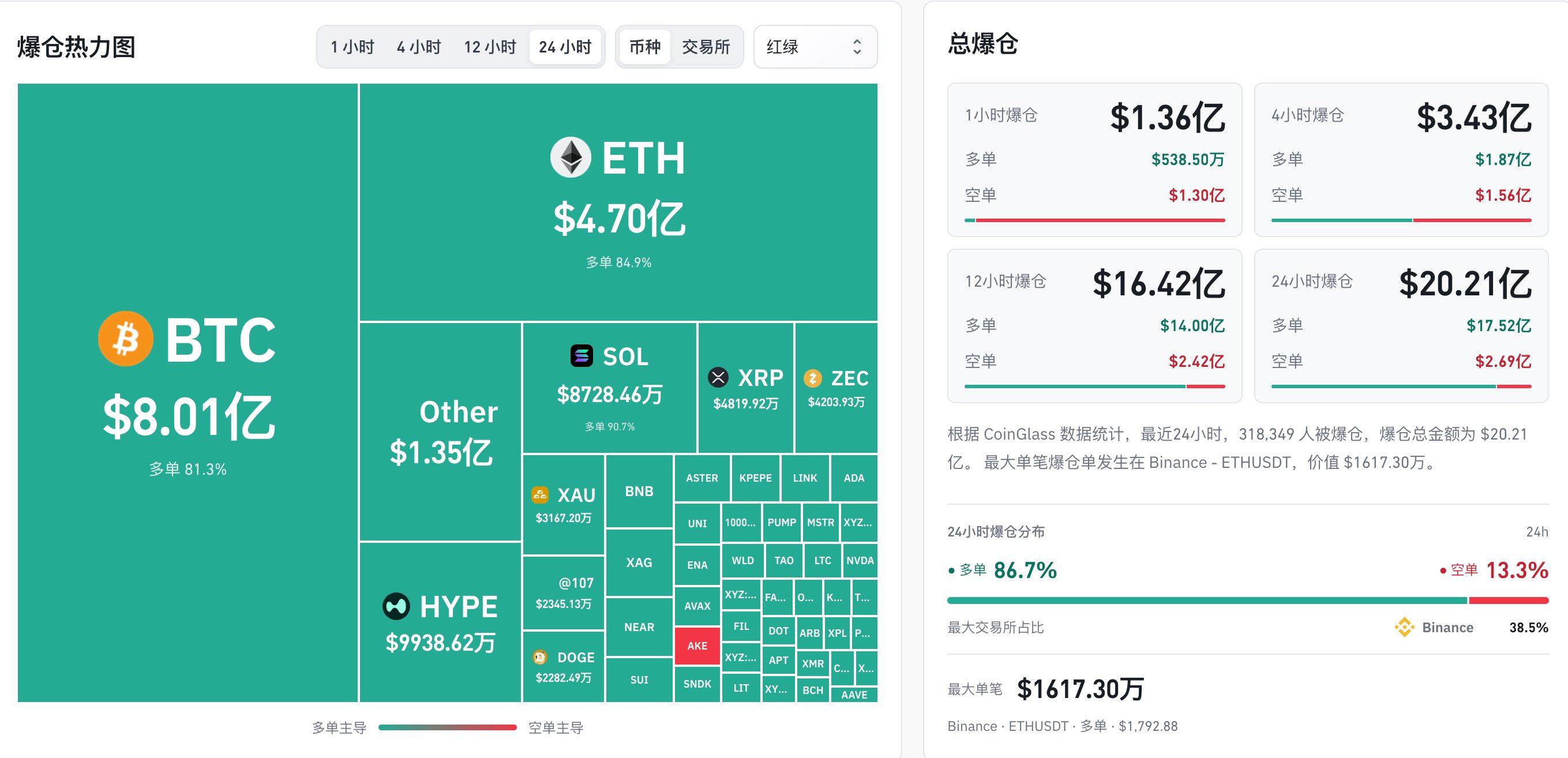
CoinGlass data shows that in the past 24 hours, total liquidations across the network reached $2.021 billion, with long positions accounting for 86.7% of liquidations, and a total of 318,349 traders were liquidated.
Since October 6 this year, the total market cap of the crypto market has evaporated by over $800 billion; if calculated from the all-time high set in October 2025 (BTC around $126,000), the total market cap of the entire crypto market has shrunk by more than half, and Bitcoin has also fallen back to near its yearly low ($57,742).
How did such a fierce cascading crash happen?
Cause Analysis: Whales Dumping? AI "Sucking Blood"? On-Chain Liquidity Drying Up?
Reviewing this round of decline, it is difficult to attribute it precisely to any single trigger. Odaily's comprehensive analysis of market views from all sides suggests that this correction is more likely the result of a resonance of multiple bearish factors, including abnormal micro-level selling pressure, cross-market capital withdrawal, and shrinking liquidity within the industry.
Market Anomaly: Suspected Cost-Insensitive Dumping
Multiple traders have noticed the bizarre micro-structure of the market during this decline.
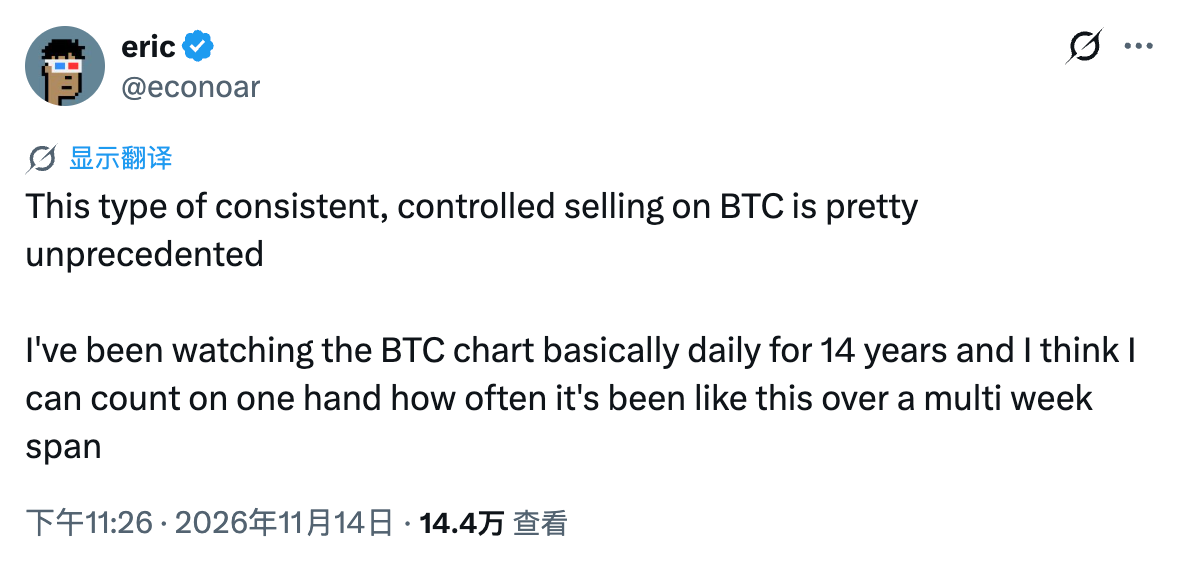
Ethereum developer and angel investor Eric (@econoar) stated bluntly that he has been following Bitcoin price movements for 14 years, and this kind of sustained, controlled, and continuous selling over several weeks is "unprecedented" — rare in his trading career.
Another well-known trader, Fullstack founder Flood (@ThinkingUSD), also pointed out that this is the "most aggressive, price-insensitive" selling behavior he has ever seen. Flood also identified more key clues — almost all core selling pressure was concentrated on the regulated exchange Coinbase, and was deliberately released during the weekend when liquidity is thinnest.

This abnormal institutional-grade order flow has sparked much speculation in the market — has some large capital obtained insider bearish information such as geopolitical developments and is rushing to safe-haven through the most liquid BTC over the weekend? Or is some institution front-running an impending forced liquidation of a major player about to blow up?
Macro Perspective: Rate Hike Expectations, AI Blood-Sucking, Massive Payout Redemptions
Beyond the micro-level market anomalies, the market is also looking for reasons for the crash from a macro perspective.
Due to the stronger-than-expected rebound in US October CPI inflation data, the 10-year Treasury yield surged again and broke through 5%. According to CME FedWatch data from November 14, the market currently expects an 88.5% probability that the Federal Reserve will raise rates by 25 basis points at its December 8-9 meeting, and even an 11.5% probability of a 50 basis point hike. The renewed tightening of macro monetary policy is like a Sword of Damocles hanging over all risk assets.
Fundstrat co-founder Tom Lee turned his attention to cross-market spillover effects. He pointed out that the pullback in the "AI boom" and the siphon effect of the Anthropic IPO may be the core external drivers that have crushed crypto market buying pressure recently.
In US equities, the recent heavy selling in AI and semiconductor sectors (especially Nvidia), as well as the US Department of Justice's review of chip sales, further exacerbated market panic, forcing some cross-asset investors to sell crypto assets to replenish US equity margin.
Additionally, leading AI giant Anthropic plans to officially go public next week, potentially becoming one of the largest IPOs by market size. Anthropic's roadshow comments about "AI disrupting various industries" have already stirred capital markets, and various media outlets have disclosed that the IPO received multiple times over-subscription. A large number of venture capital firms and high-net-worth investors, in order to grab allocations, have chosen to sell highly liquid assets such as Bitcoin in advance to raise subscription funds.
Tom Lee also mentioned the Binance hacking incident at the end of October, believing that after the relevant funds are returned, holders may convert their assets into cash or stablecoins, further amplifying market selling pressure.
Market Structure: Record Stablecoin Outflows, On-Chain Buying Exhaustion
If the above factors explain the "source of selling pressure," then the withdrawal of on-chain capital has deprived the market of its supporting base.
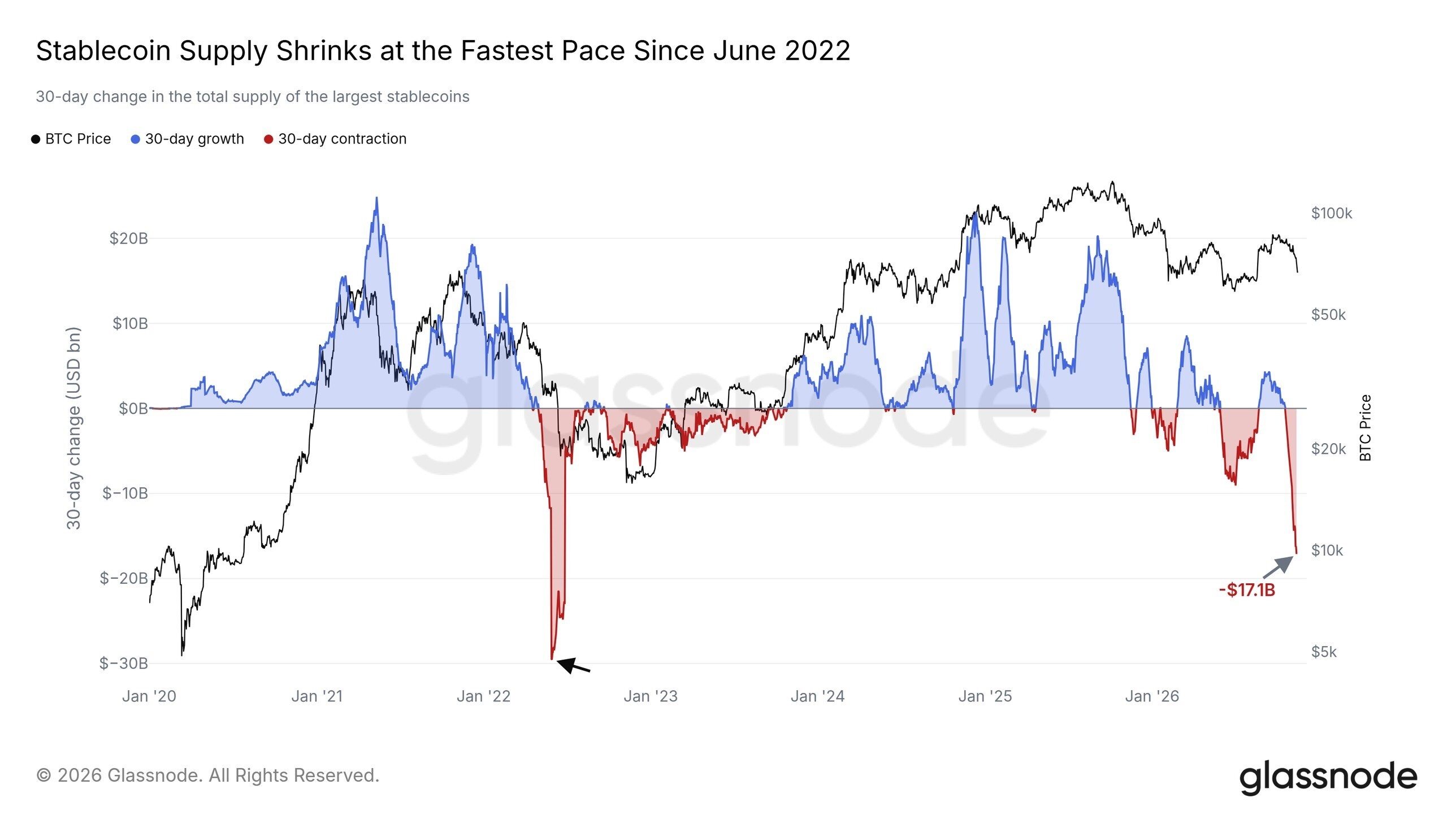
On-chain analytics firm Glassnode data shows that over the past month, total stablecoin supply has plummeted by $17 billion, recording the largest single-month outflow since the 2022 bear market. It appears that crypto holders are converting stablecoins directly back to fiat and leaving the market, which means the purchasing power needed to absorb market declines is draining away.
Glassnode commented: "For a real bull market to arrive, capital must flow into the crypto ecosystem, not continuously flow out."
Greater Risks Lie Ahead
As the market continues to decline, the potential negative feedback loop between spot selling and derivatives liquidations has begun to raise market alarm — when prices keep falling, leveraged longs first face liquidation risk; and the forced sell orders from liquidations further depress prices, triggering the next round of liquidations.
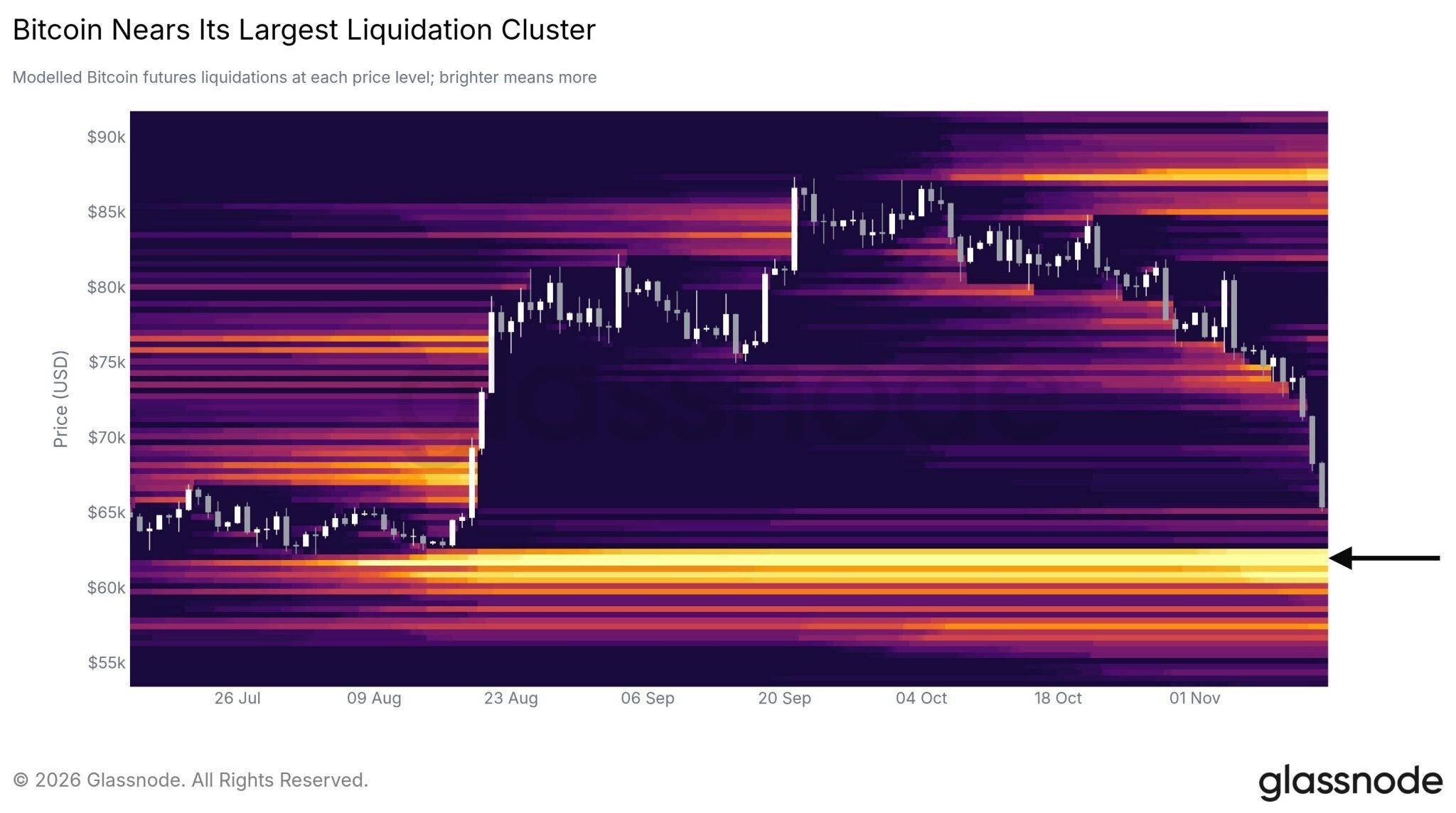
Glassnode's six-month liquidation heatmap shows that Bitcoin has a large long liquidation cluster near $59,500 to $62,600. This range has not been touched since the August low this year, accumulating a massive amount of dormant long positions established during the August breakout. BTC price is currently just one step away from this zone; once bears push prices into this area, it could easily trigger a domino-style cascade of forced liquidations, repeating the "longs killing longs" stampede tragedy.
Will It Keep Falling? Divergence in Despair
Facing the "endless decline," when will the market finally bottom? In this regard, industry leaders and analytics firms show clear divergence in their time horizons.
The cautious camp believes the market has entered a "garbage time" similar to 2018 and needs a long bottoming process.
Bitwise Chief Investment Officer Matt Hougan admitted that the current crypto market gives a strong "mid-2018 déjà vu" — the entire industry is in deep fatigue, and many people are starting to give up. Considering the long-term impact of factors such as the US midterm elections, the Binance hacking incident, and monetary policy tightening, the market may linger in the doldrums for quite a long time.
Matt Hougan also said that at some point in the future, an excellent buying opportunity will definitely emerge, but it's hard to judge exactly when. What broke the market's malaise in 2018 was an innovation breakthrough that could not be predicted in advance (DeFi), and this time the market similarly needs to wait for the arrival of the next new narrative.
The optimistic camp sees the dawn of a reversal from technical support and historical cycle patterns.
GSR co-founder Rich Rosenblum believes that although bears are still pressing, Bitcoin may be approaching a "technical bottom." He noted that Bitcoin has now approached the bottom of its long-term trend channel, and over the past year, the current price level and slightly below have repeatedly provided strong support for the market.
Strive Chairman and CEO Matt Cole offered a more specific rebound playbook — replicating the post-SpaceX IPO trajectory. Data shows that Bitcoin fell 19% in the 50 days before the June 12 SpaceX IPO, and in the run-up to Anthropic's listing next week, Bitcoin similarly fell about 18% — the two trajectories are highly consistent. On the 18th day after the SpaceX listing, Bitcoin successfully bottomed (maximum drawdown 25%), and by the 100th day after listing, it had strongly rebounded 39% from its lowest point.
Matt Cole also said that Bitcoin is currently near its 200-week moving average, and if a similar path repeats this time, it means most of the decline caused by IPO capital siphoning may have already played out. If the post-SpaceX IPO trajectory is mapped to current prices, with the Anthropic listing set to land next week, Bitcoin could reach around $90,000 by late February next year.
The night is often darkest before dawn. In the short term, the dense long liquidation zone not far below current prices and the Fed's early December policy meeting remain two hurdles the market must face directly; but after panic sentiment is fully vented and the external capital siphoning effect gradually fades, the deep pit dug by the sell-off may also be brewing the turning point of the next cycle.