From JPMorgan to MetaMask, and Now to AI Agents: X-Agent CTO Ye Xinnan on the Next Generation of Personal Agents


- Core Thesis: The next phase of AI is not about how intelligent the model is, but about Personal Agents that can execute tasks safely and reliably. Trust mechanisms and financial-grade security will become the key competitive differentiators.
- Key Elements:
- X-Agent CTO Ye Xinnan proposes that AI is shifting from "answering questions" to "executing tasks," and that reliability matters more than how smart the model is.
- X-Agent is building a Build→Act→Pay→Earn framework that integrates natural language-based creation, an SRE secure execution environment, Agentic Wallet, and x402 payments.
- The core challenges of Personal Agents lie in verifying execution results, controlling permission boundaries, and protecting sensitive data—requiring explicit authorization and budget limits.
- Agents need wallets and payment capabilities to access paid services and purchase computing power, forming a sustainable business loop and Agent Economy.
- Trust should be built on identity, reputation, authorization, and verifiable records. X-Agent is focused on Agent identity standards such as ERC-8004.
- Developers can package their professional capabilities as Agents or MCP services for others to call upon, earning revenue through usage fees and lowering the barrier to application development.
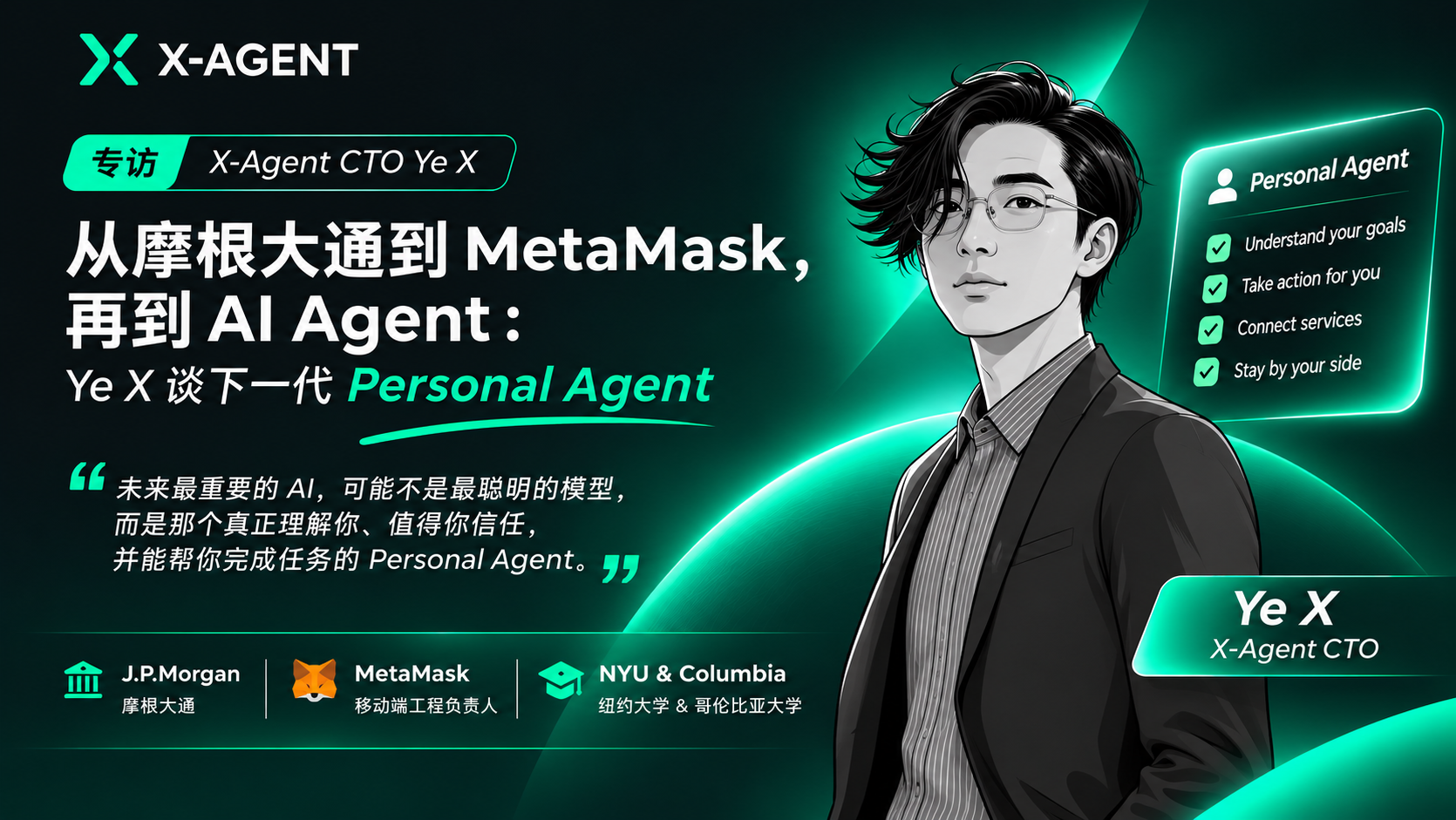
"The most important AI of the future may not be the smartest model, but the Personal Agent that truly understands you, earns your trust, and can complete tasks on your behalf."
Over the past few years, artificial intelligence has been undergoing rapid evolution. From ChatGPT igniting the large model wave to AI Agents beginning to call tools and execute tasks, AI is gradually transforming from a tool that answers questions into a digital collaboration partner capable of participating in real work.
But when AI begins to execute tasks on behalf of users, manage information, and even initiate payments, a new question emerges: how do we ensure it is secure, reliable, and truly trustworthy?
In the view of X-Agent CTO Ye Xinnan, the answer lies not only in more powerful AI models, but also in combining financial-grade security, Web3 infrastructure, and AI execution capabilities.
With an educational background from New York University (NYU) and Columbia University, prior experience at J.P. Morgan, and having served as Head of Mobile Engineering at MetaMask, Ye's career spans traditional finance, Web3, and artificial intelligence.
Today, he is leading the X-Agent technical team to explore a more imaginative future: enabling everyone to have their own Personal Agent.
In this exclusive interview, we spoke with Ye about the technological evolution of AI Agents, X-Agent's product direction, and how Personal Agents will change future digital life.
Q1: First, please introduce yourself. From J.P. Morgan to MetaMask, and now to X-Agent, what impact have these experiences had on you?
Ye Xinnan: Hello everyone, I'm Ye Xinnan, currently serving as CTO of X-Agent, primarily responsible for technical architecture, product development, and AI Agent infrastructure.
I studied at New York University and Columbia University, and my career has spanned traditional fintech, internet, and Web3 sectors.
During my time at J.P. Morgan, I encountered the strict requirements financial systems place on security, stability, and reliability. Fintech has a very important principle: a system must not only be able to run, but must ensure every operation is accurate and controllable.
Later, I joined MetaMask as Head of Mobile Engineering, participating in the technical development of Web3 wallet products. This experience gave me a deeper understanding of digital assets, wallet security, user authorization, and the interaction patterns of decentralized applications.
Looking back on these experiences, I find that I have always been focused on the same question: how can complex technology be made secure and simple, and truly serve ordinary users?
Today, AI Agents have given us a new opportunity.
We hope to bring the technical philosophies accumulated in financial systems and Web3 into AI, enabling Agents to not only understand user needs but also truly complete tasks in a secure, controllable environment.
Q2: Why do you believe AI Agents will become the next stage of artificial intelligence?
Ye Xinnan: Over the past few years, the most important breakthrough of large models has been enabling machines to understand and generate natural language.
But I believe that understanding problems is only the first step; truly solving problems is the next stage.
For example, if you ask AI to help you plan a trip. A traditional chatbot can give you a detailed guide, but a true Agent should be able to further call tools, compare options, and assist with bookings after obtaining authorization.
This represents AI moving from "answering questions" to "executing tasks."
In the future, users won't just care about how smart a model is; they'll care more about whether it can reliably complete work.
This is also the starting point for building X-Agent.
Q3: What problem does X-Agent aim to solve? How is it different from ordinary AI Agent platforms?
Ye Xinnan: We want to lower the barrier to creating and using AI Agents, while also solving the execution, security, and commercialization challenges that Agents face when truly being deployed.
At X-Agent, we want users to be able to create their own Agents through natural language, without needing to master complex programming knowledge.
But creating an Agent is only the starting point.
A truly useful Agent also needs to be able to securely execute tasks, call external services, manage necessary payments, and collaborate with other Agents.
Therefore, we connect natural language creation, Secure Runtime Environment (SRE), Agentic Wallet, x402 payments, and the Agent service ecosystem.
We summarize this direction in four words: Build → Act → Pay → Earn.
Our goal is not just to enable more people to create Agents, but to enable Agents to truly create value.
Q4: You've mentioned Personal Agent multiple times. Why is it so important?
Ye Xinnan: I believe Personal Agent may be one of the most important application forms of AI in the future.
Today, most AI products are still passive. You ask a question, it answers a question.
But a true Personal Agent should be able to continuously understand user goals and preferences, providing assistance across different times and scenarios.
For example, if you've long been following a certain industry, your Personal Agent can continuously organize information within authorized scope and proactively alert you when important changes occur.
If you're managing a project, it can help track progress, organize to-do items, and assist in advancing follow-up work.
It is no longer just a chat window, but an intelligent companion that accompanies users long-term and assists with digital affairs.
Of course, this capability requires reliable memory, tool invocation, permission control, and task execution mechanisms.
The core of Personal Agent is not to replace users in making decisions, but to give users stronger action capabilities.
Q5: From a technical perspective, what is the biggest challenge in realizing a true Personal Agent?
Ye Xinnan: The biggest challenge is reliability and security.
Today's AI can already generate very complex answers, but an Agent replying "task completed" doesn't mean the task is truly completed.
If it needs to operate external systems, access user data, or handle payments, it must be able to verify execution results and promptly stop or recover when anomalies occur.
Additionally, a Personal Agent may have long-term access to important user information, so it must be clear which data can be accessed, which tools can be called, and which operations require re-confirmation.
I believe future competition is not just about model capabilities, but about secure execution, task verification, and user trust.
Q6: How do your experiences at J.P. Morgan and MetaMask influence X-Agent's security design?
Ye Xinnan: In finance, security and risk control are the foundation of system design; in Web3, wallets and asset management make user authorization even more important.
These experiences have led me to believe: when AI begins to have action capabilities, permission boundaries must be clearer than model capabilities.
X-Agent's Secure Runtime Environment (SRE) is built around this philosophy.
We hope to use controlled execution environments to enable Agents to run tasks while reducing the risk of impact on sensitive data and other systems.
Additionally, when it comes to wallets, payments, or important operations, clear authorization, budget limits, and necessary confirmation mechanisms are required.
A trustworthy Personal Agent should not have unlimited permissions.
It should know what it can do, what it cannot do, and when it must seek user consent.
Q7: Why do AI Agents need wallet and payment capabilities?
Ye Xinnan: Because future Agents won't just use information; they may also become service consumers and service providers in the digital economy.
Suppose an Agent needs to call paid data APIs, purchase computing resources, or request professional services from another Agent.
If every interaction requires manual payment processing, automation would be greatly limited.
Payment technologies like Agentic Wallet and x402 provide new possibilities for such interactions.
We want to enable Agents to more conveniently use external services under user authorization and budget constraints, gradually forming a sustainable business model.
From a longer-term perspective, Personal Agent is not only a user's intelligent assistant but may also become an important entry point for users to participate in the digital economy.
But we always emphasize that automated payments must be built on a foundation of security, transparency, and controllability.
Q8: How does X-Agent help developers participate in the Agent Economy?
Ye Xinnan: I believe the development of AI Agents will bring a new application ecosystem.
In the future, a developer may not necessarily need to build a complete App. They may only need to provide a professional capability, such as data analysis, market research, content processing, or some kind of automated workflow.
These capabilities can be encapsulated as Agents or MCP services for other users and Agents to call.
If the service truly creates value, developers have the opportunity to earn revenue through usage fees or other commercial mechanisms.
This is also the Agent Economy we hope to promote.
Users can create Agents, developers can provide services, Agents can collaborate with each other, and value can flow through the network.
X-Agent hopes to gradually become the platform connecting these participants.
Q9: Why should users trust their Personal Agent in the future?
Ye Xinnan: I believe trust must be built on verifiable mechanisms, not merely on AI's answers.
First is identity. Users need to know who created an Agent and who maintains it.
Second is reputation. Whether an Agent is reliable should be judged through actual execution performance and verifiable records.
Finally is authorization. Users must be able to clearly control the scope of an Agent's operations, especially behaviors involving data, assets, and payments.
We are also following technical directions related to Agent identity and reputation, such as ERC-8004.
But I believe that true trust cannot be achieved by relying on any single protocol.
It requires identity, execution environment, permission management, result verification, and user control working together.
The most valuable Agent in the future may not be the one with the most features, but the one users are most willing to trust long-term.
Q10: Looking ahead three years, what do you hope X-Agent and Personal Agent will become?
Ye Xinnan: I hope that in the future everyone can have their own Personal Agent, as natural as everyone having a smartphone today.
This Agent can understand your goals, help you handle daily affairs, and connect to different tools and services after obtaining authorization.
For ordinary users, it is a digital partner that can truly get things done.
For developers, it is a new application entry point and commercialization opportunity.
For enterprises, it may become an intelligent collaboration layer connecting business processes, data, and external services.
Of course, realizing this vision still requires solving many technical problems, including security, privacy, reliability, and long-term memory.
But I believe the direction is becoming increasingly clear.
The future of AI is not just about making machines smarter, but about enabling everyone to have their own intelligent action capabilities.
This is exactly the future we hope to realize through X-Agent.
Conclusion: From Financial-Grade Security to Personal Agent, AI Is Entering the Age of Action
From J.P. Morgan's financial systems to MetaMask's Web3 wallet, and now to X-Agent's AI Agent infrastructure, Ye Xinnan's technical journey presents a clear evolutionary path: secure and reliable systems → user-controlled digital assets → Personal Agents capable of executing tasks on behalf of users.
As AI moves from answering questions to taking real action, security, identity, payments, and trust will no longer be mere add-on features but will become the foundation of next-generation intelligent applications.
What X-Agent is exploring is precisely how to connect these capabilities, enabling more users and developers to participate in the Agent Economy and gradually move toward the Personal Agent era.
In the future, everyone may have their own AI Agent. And the real transformation will begin when AI reliably completes a task for you for the first time.
About X-Agent
X-Agent is a platform for AI Agent applications and economic ecosystems, dedicated to connecting natural language creation, secure execution, Agentic Wallet, payment capabilities, and developer service ecosystems, driving AI Agents from conversational tools toward practical applications.
Website: https://xagt.ai
X: https://x.com/XAgent_official
Medium: https://xagentai.medium.com