Huang Renxun Considering a Comeback? AI Braces for a Busy Week: Nvidia Delivers Earnings, Anthropic Goes Public, Who Sets the Tone?


- Core View:The AI trading logic is shifting from "watching demand growth" to "growth multiplied by interest rates," with the market demanding that AI assets prove prior valuations were reasonable through faster profit realization. Nvidia's earnings, Anthropic's IPO, and the Fed minutes respectively test three links: earnings, valuation, and discount rate.
- Key Elements:
- Nvidia fell 12.75% last week, down 31.9% from its October high, with market capitalization shrinking by about $1.84 trillion; Bitcoin dropped below $64,000, down more than 20% from its late-October high; the 10-year Treasury yield briefly broke above 5.1%.
- The market expects Nvidia's revenue at about $109 billion, up roughly 90% year over year; Goldman Sachs forecasts a corresponding forward P/E of about 9.6x, significantly below the valuation center of the past five years.
- Anthropic's offering price range is $70–78, with 825 million shares planned for issuance; the upper limit corresponds to a fully diluted valuation of about $1.405 trillion. It will list on Nasdaq on November 19, marking the first time a high primary-market valuation will be tested by daily secondary-market pricing.
- The market at one point priced in more than a 95% probability of a 25-basis-point rate hike in December; October core CPI rose 0.3% month over month, PPI rose 6.5% year over year, and the dollar index touched 103.28.
- Gold fell below $3,900 and the dollar strengthened, indicating that rising real rates are pushing up the cost of holding non-yielding assets, with high-beta risk assets under pressure first.
- Second-tier chipmakers are diverging: Cerebras' Q3 cloud business revenue grew 272% year over year and its full-year guidance was raised, but hardware revenue fell nearly 30% year over year, reflecting uneven diffusion of computing demand.
- Three scenarios: strong earnings, strong IPO, and falling yields form a favorable combination; strong earnings but continued rising yields could evolve into a structural market; if all three weaken simultaneously, pressure on highly valued assets will escalate.
The Week the AI Market Truly Entered "Price Validation"
Over the past few months, the easiest logic for AI trades to gain market recognition has been "demand is still there." As long as cloud providers continue to expand capital expenditure, GPU orders continue to grow, and AI applications continue to seek commercialization paths, the market has been willing to assign higher valuations to forward growth.
But after entering November, the trading environment began to change.
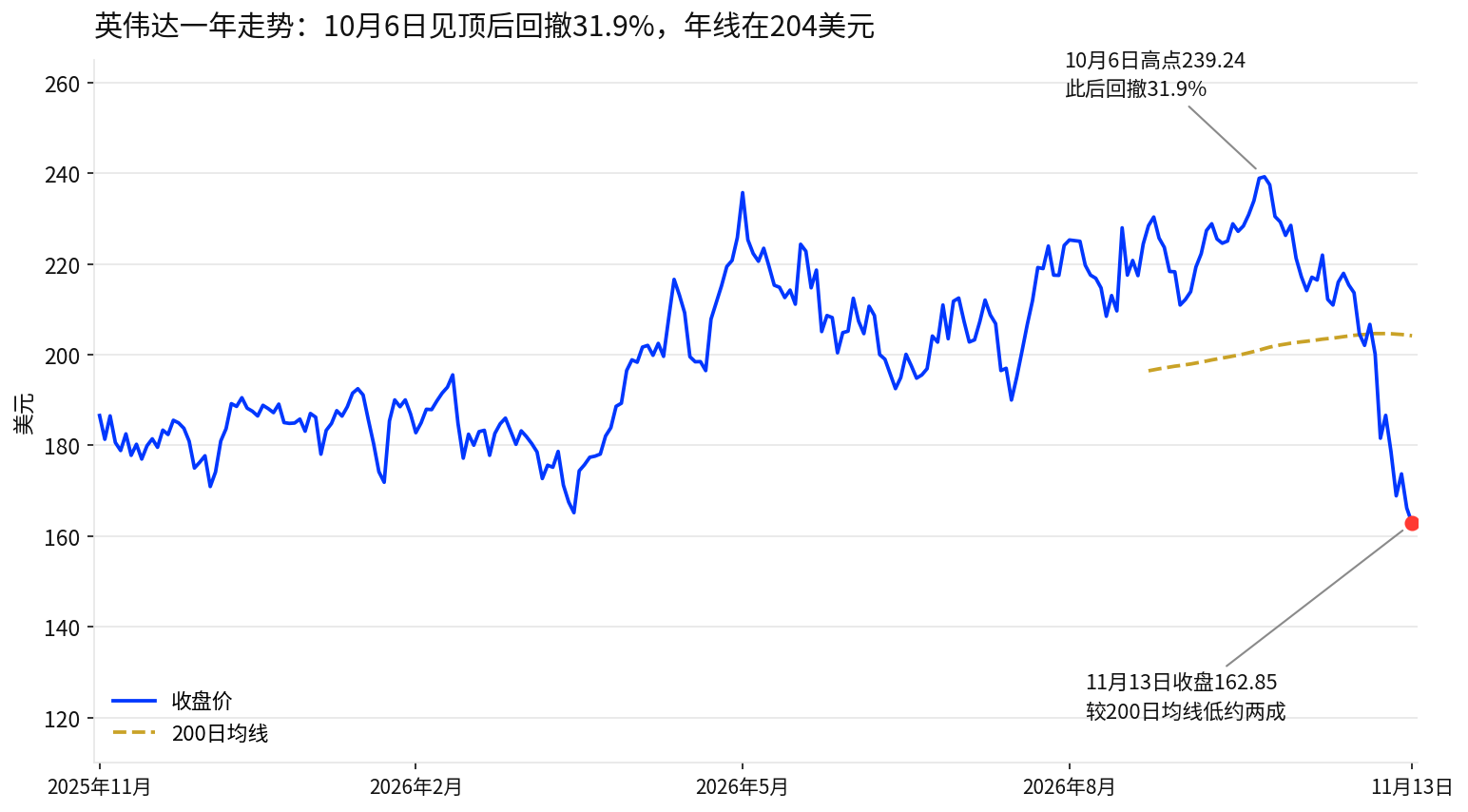
Nvidia fell 12.75% cumulatively last week, down 31.9% from its October 6 high, with market capitalization shrinking by approximately $1.84 trillion; Bitcoin dropped below $64,000, down more than 20% from its late-October high; gold fell below $3,900; the dollar index rose to around 103.28, and the 10-year U.S. Treasury yield briefly broke through 5.1% (see Figure 1 for Nvidia's one-year trend).
These price movements cannot simply be interpreted as "AI demand suddenly disappearing" or "safe-haven assets losing effectiveness." More noteworthy is that the market is recalculating a single equation: once interest rates re-emerge as the cost of capital, how fast does AI assets' earnings realization need to be to sustain previous valuations?
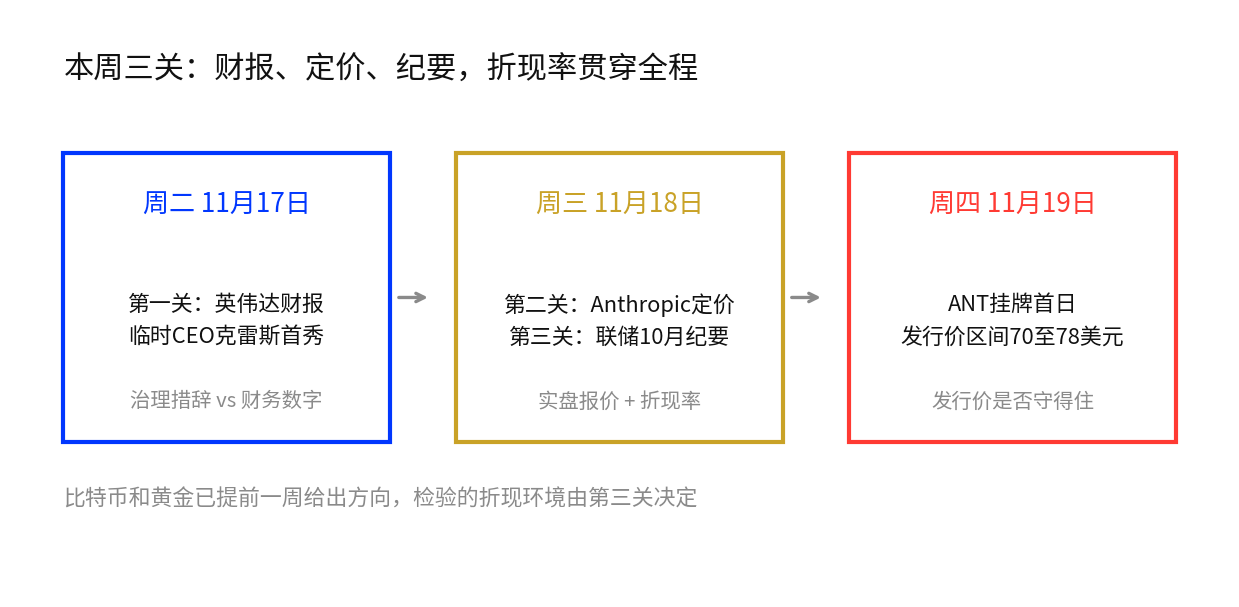
Therefore, this week's Nvidia earnings, Anthropic IPO, and Fed minutes happen to correspond to three parts of this equation: Nvidia for the numerator, Anthropic for valuation, and the Fed for the denominator (see Figure 2 for the calendar of the three events).
If all three move in a favorable direction simultaneously, AI assets could see a round of valuation repair; if only earnings grow while the rate and valuation environment continues to deteriorate, then "good earnings but no stock price increase" may become a more common trade going forward.
1. Nvidia Earnings: The Market Is No Longer Satisfied with "AI Demand Is Still There"
After the U.S. market close on Tuesday, Nvidia will release its fiscal 2027 third-quarter earnings. After last week's rapid decline, the importance of this earnings report has surpassed that of an ordinary quarterly disclosure.
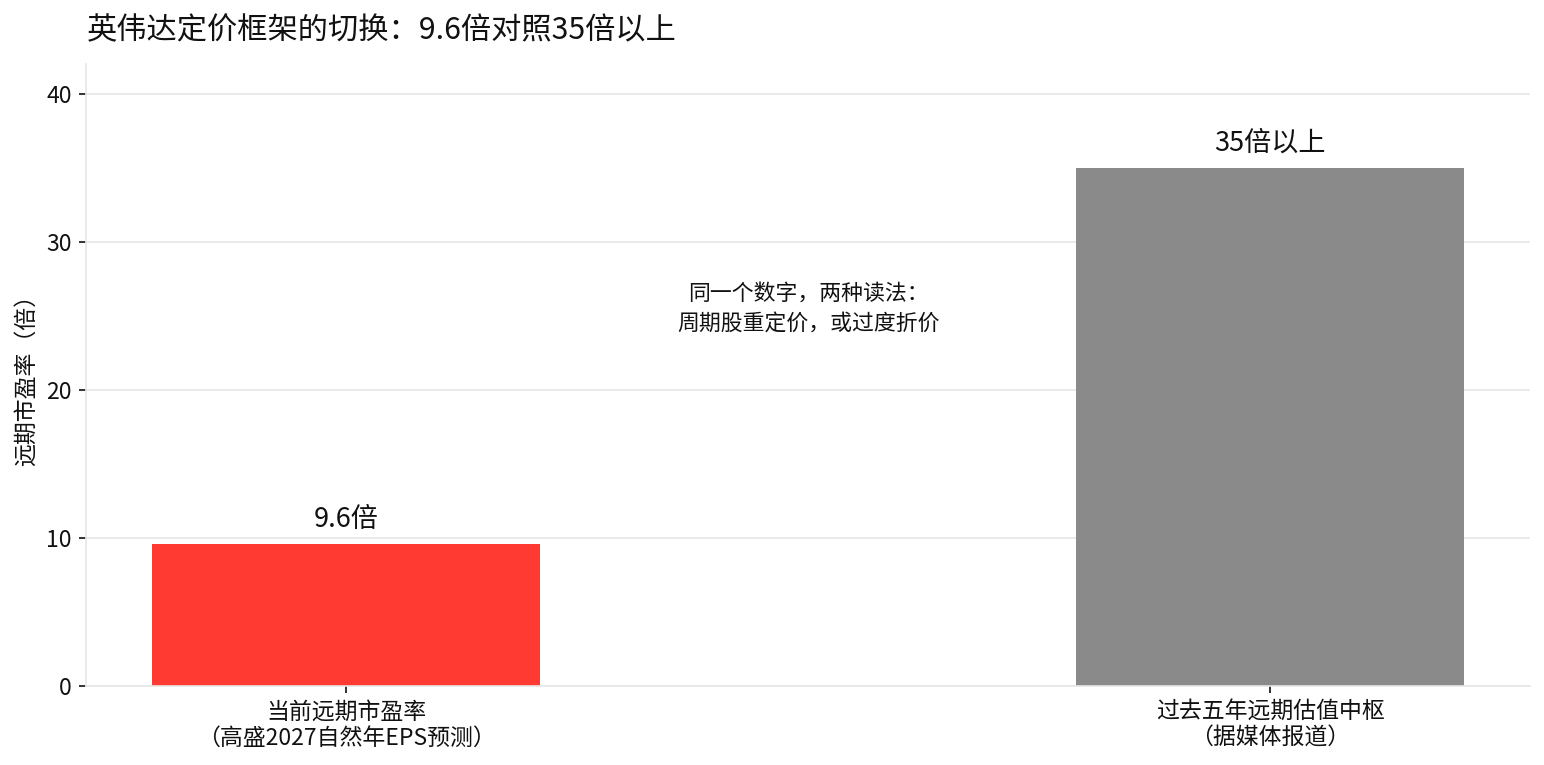
The market expects revenue of approximately $109 billion, representing year-over-year growth of about 90%. According to media reports, Goldman Sachs' forecast for Nvidia's 2027 calendar-year earnings per share implies a forward P/E ratio of approximately 9.6 times at the current stock price, significantly below its five-year forward valuation midpoint (see Figure 3).
This means the market's pricing logic for Nvidia is changing: the question is no longer just "does AI have demand," but how long these demands can sustain current earnings levels.
Some argue that if earnings growth continues at a high level, a 9.6x forward P/E suggests the market may have already priced in a considerable portion of cyclical risk; but if the market begins to worry that AI capital expenditure is entering a high-base phase, then even if earnings continue to grow, the valuation midpoint could continue to shift lower. The same 9.6x has another interpretation from Goldman Sachs itself: in their report, they drew an analogy to Apple after Steve Jobs' passing, arguing that the current risk-reward is "quite attractive." The two interpretations will collide head-on on Tuesday evening.
Therefore, what is most worth watching in this earnings report is not a single revenue figure, but whether orders, customer capital expenditure, product roadmap, and management's commentary on the coming quarters mutually corroborate each other. If financial data remains strong while management confirms high visibility for customer demand and compute expansion, then the previous valuation compression could see repair; conversely, if results meet expectations but order growth slows, customer concentration risk rises, or forward guidance becomes more cautious, the market may continue to price it as a "cyclical stock" rather than a "high-growth tech stock."
Why did governance factors suddenly become important? In the past AI rally, Nvidia enjoyed not only earnings growth but also the long-term credibility premium from its founder and management regarding technology roadmap, product iteration, and customer ecosystem. Governance changes themselves do not mean business deterioration, but they raise the market's requirements for strategic continuity.
Therefore, what is truly worth watching on the earnings call is: succession arrangements, compute expansion strategy, customer commitments, and whether the product roadmap shows any changes requiring repricing. More noteworthy is that a new catalyst for the governance variable suddenly appeared over the weekend. According to a Financial Times report on November 15, Jensen Huang is discussing with close associates the possibility of returning to the CEO position at Nvidia, with his Silicon Valley allies pushing the board to consider his return; tech figures including Musk have also publicly supported related petitions. But this is not a certainty—U.S. Treasury Secretary Bessent has publicly advocated that Nvidia look externally for a new CEO, and the board's investigation and succession process on related matters is still ongoing.
This adds a variable to Tuesday's earnings that the market had not previously anticipated: if results remain strong and the possibility of Huang's return further heats up, the market could simultaneously trade both "AI demand has not cooled" and "governance discount is expected to repair"; conversely, if earnings miss expectations or the return battle further intensifies governance uncertainty, low valuations may not immediately translate into stock price support. Therefore, what is truly worth watching on Tuesday is not just how much money Nvidia made, but whether earnings, management commentary, and governance progress simultaneously send positive signals.
2. Anthropic IPO: AI's Trillion-Dollar Valuation Faces Secondary Market Test for the First Time
If Nvidia's earnings test the "earnings side" of the AI supply chain, the Anthropic IPO tests the furthest "valuation end" of AI assets. According to disclosures, Anthropic's offering price range is $70 to $78 per share, with 825 million shares planned for issuance, implying a fully diluted valuation of approximately $1.405 trillion at the upper end of the range, with a Nasdaq listing on November 19.
What is truly noteworthy about this figure is not just the words "trillion dollars," but that a frontier AI lab will for the first time directly hand over the high valuation formed in the primary market to the public market for daily repricing.
Previously, AI company valuations were mainly determined by primary market investors. Investors could accept longer commercialization cycles and justify high valuations through strategic value, technical barriers, or future market space; after an IPO, this pricing system must face publicly traded prices every day.
This will produce a very important market signal: if Anthropic can complete its offering at a price near the upper end of the range and maintain that price after listing, it may indicate that the public market is still willing to pay a high premium for AI's long-term growth; if the final pricing is notably conservative, or if it quickly breaks below the offering price after listing, it may mean the valuation gap between the primary and secondary markets is being reopened.
Particularly noteworthy is that Anthropic is not facing a low-interest-rate environment. When the 10-year U.S. Treasury yield approaches or even breaks through 5%, investors paying a $1.4 trillion valuation for an AI company still in a high-investment phase are effectively betting on two things simultaneously: future revenue growth will be fast enough, and interest rates will not remain elevated long enough to compress forward valuations.
This is also why the Anthropic IPO cannot be viewed in isolation. It is both a company listing and a public vote by the market on the entire AI primary market valuation system.
3. Fed Minutes: What AI Assets Truly Face Is More Expensive Capital
If Nvidia represents the "earnings numerator" and Anthropic represents "valuation," then the Fed minutes determine the "denominator" both face together.
As of market pricing on November 13, the probability of a 25-basis-point rate hike in December was approximately 85%, and 50 basis points approximately 15%; by November 14, CME tools showed the probability of 25 basis points briefly rising above 95%. Meanwhile, October core CPI rose 0.3% month-over-month, PPI rose 6.5% year-over-year, the dollar index touched 103.28, and the 10-year U.S. Treasury yield briefly rose to around 5.1% (see Figure 4 for rate hike pricing).
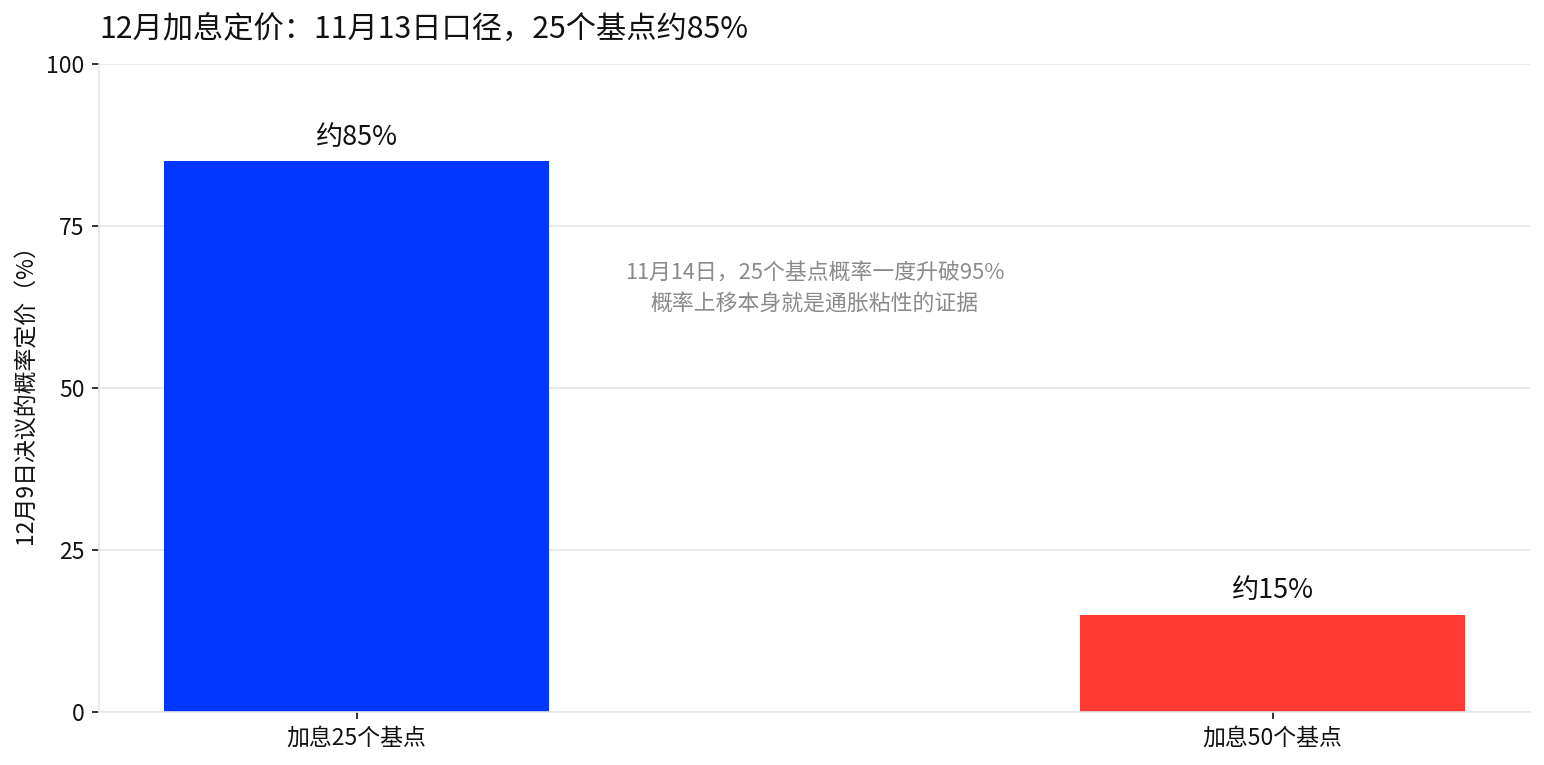
Therefore, what the market truly needs to look for in this week's minutes is not a simple "hike or no hike." More important is whether the Fed believes the current inflation environment requires rates to remain elevated for longer, and how high the committee's tolerance is for further policy tightening.
This is especially important for AI assets. Much of an AI company's value comes from revenue and profits in future years. If the risk-free rate continues to rise, the present value of future cash flows naturally declines. This produces a market phenomenon that appears counterintuitive but is actually very typical: company earnings continue to grow, yet the stock price may not rise. The reason is not that the market has rejected the company's business, but that investors are demanding a higher rate of return.
This is also the key to the current AI trade's shift from "looking at growth" to "growth multiplied by interest rates." If Nvidia delivers strong results this week while the Fed simultaneously releases hawkish signals, the market will face a typical divergence: AI demand is strong, but the cost of capital is also high. What truly determines the stock price will be which of the two changes faster.
4. BTC and Gold Fell First: The Market Is Already Repricing for Higher Rates
Before the three major events of this week landed, Bitcoin and gold had already given the market's answer first.
Bitcoin fell below $64,000, down more than 20% from late October; gold fell below $3,900; the dollar index rose to around 103.28. Meanwhile, the 10-year U.S. Treasury yield stood above 5% (see Figure 5 for weekly performance across the three markets).
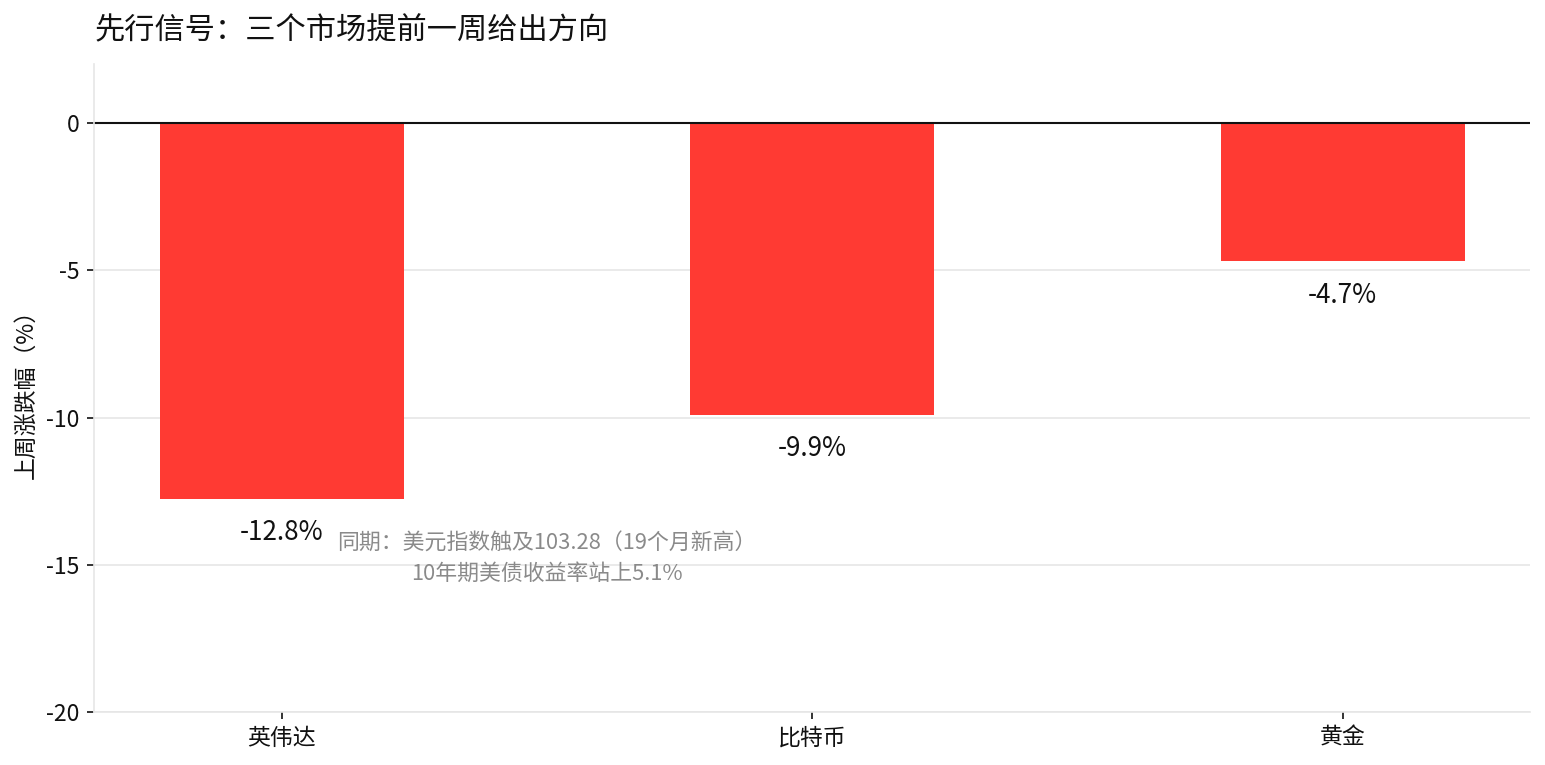
Looking at these asset classes together is more meaningful than observing any single price in isolation. Bitcoin is a high-beta risk asset and is often hit first during liquidity tightening and leverage deleveraging; while gold has safe-haven properties, when real rates and the dollar strengthen simultaneously, the holding cost of non-yielding assets also rises.
Therefore, gold's decline does not mean the market has suddenly lost safe-haven demand, nor does Bitcoin's decline necessarily mean the long-term logic of crypto assets has changed. A more direct explanation is: when capital begins to re-emphasize the weight of risk-free yields, the price the market is willing to pay for high-risk, long-duration assets naturally declines.
This is also the background that the AI trade needs to pay special attention to this week. If U.S. Treasury yields remain elevated while BTC, gold, and other assets continue to face pressure, then even if Nvidia's earnings beat expectations, the valuation repair space for AI assets may be limited. Conversely, if rate expectations ease, the dollar retreats, and Nvidia and Anthropic simultaneously deliver strong fundamental signals, AI assets could see a more complete "numerator improvement plus denominator easing."
5. Retail, Chinese ADRs, and Second-Tier Chips: Don't Just Watch Nvidia
There are several other earnings reports this week worth observing on the same map. Retail companies including Walmart, Home Depot, Target, Ross Stores, and Disney will report results in succession. They provide a different kind of macro evidence: whether American consumers can continue to withstand a high-rate environment. If consumption remains strong, inflation and economic resilience will be harder to cool quickly, and the Fed will have more reason to keep rates high; if consumption cools notably, the market may re-trade rate cut expectations. For AI assets, this thread is not direct, but it will affect valuations through interest rates and the dollar.
On Chinese ADRs, for companies including Alibaba, Baidu, Pinduoduo, and Tencent Music, the focus can be on profit margins and forward guidance rather than simply chasing revenue growth. After the earlier valuation repair, what the market needs to see more is whether growth can translate into profit, and whether profit can further translate into cash flow.
Second-tier AI chips are also worth watching. Cerebras' third-quarter cloud business revenue grew 272% year-over-year, with full-year guidance raised, but hardware revenue fell nearly 30% year-over-year. This combination is very interesting: on one hand, cloud AI demand remains strong; on the other hand, the process of demand spreading to different compute suppliers is uneven. Therefore, earnings from companies like Cerebras cannot simply be interpreted as "Nvidia competitors rising"—it is better suited as an auxiliary indicator: whether AI compute demand continues to spread, and whether growth is beginning to transmit from a single GPU supplier to a broader infrastructure ecosystem.
6. What Truly Matters This Week Is Not Any Single Number, but Whether Three Sets of Signals Resonate
At this stage, the market no longer lacks the story that "AI demand is huge," nor does it lack discussion that "AI valuations are very high." What truly has market value is whether several key variables are simultaneously moving in the same direction.
Nvidia's earnings show demand and profitability. If revenue, orders, customer capital expenditure, product roadmap, and next-quarter guidance remain strong, it indicates the AI investment cycle has not notably stalled; if earnings grow but forward guidance weakens, watch for the market shifting from trading "insufficient growth" to trading "peak growth."
The Anthropic IPO shows valuation tolerance. Pricing near the upper limit and maintaining strength after listing would be a signal that AI's high valuations have gained public market recognition; a significant discount or a post-listing break below the offering price would mean primary market valuations need to converge toward the secondary market.
The Fed minutes and the 10-year U.S. Treasury show the discount rate. If inflation and rate hike expectations continue to push long-end yields higher, then even if AI assets' fundamentals have not deteriorated, they may face valuation compression; if long-end yields decline, there is room for repair in the previously compressed growth stock valuations.
Therefore, what truly deserves attention is not a single event but the combination of the three: strong earnings plus strong IPO plus falling yields is a relatively favorable combination for AI assets; strong earnings but yields continuing to rise is more likely to evolve into a structural market; weak earnings, weak IPO, and rising yields all appearing simultaneously is when the pressure on high-valuation AI assets would truly escalate. If any variable moves in the opposite direction from the above, the corresponding judgment needs to be revised.
Final Thoughts: AI Has Not Restarted; the Market Is Just Beginning to Demand That It Prove Itself
What truly matters this week is not whether Nvidia can continue to tell a bigger AI story, nor whether Anthropic can list at a $1.4 trillion valuation.
The market is entering a more realistic phase: AI demand must be realized through earnings, AI valuations must accept public market quotes, and future earnings must also be discounted through higher interest rates.
Nvidia needs to prove that compute demand can still support high growth; Anthropic needs to prove that trillion-dollar AI valuations can be accepted by the secondary market; and the Fed determines how high a cost of capital this growth story must face.
BTC and gold have already told the market in advance that capital is re-emphasizing interest rates and the dollar.
So what truly deserves attention this week is not "has the AI bull market ended," but a more specific question: in an environment where the 10-year U.S. Treasury yield stands above 5%, how fast can AI companies' earnings growth offset a higher valuation discount rate?
The answer to this question may be more important than any single company's quarterly revenue figure.
Disclaimer:
This content is for general informational and market commentary purposes only, based on public materials as of the time described herein, and relevant market data, expectations, and probabilities may change as market conditions evolve. The views and investment strategies of third-party institutions, analysts, or other individuals cited herein represent only those third parties' views at specific times and do not represent BIT's views or recommendations. This article does not constitute investment advice, investment research, an offer, solicitation, or recommendation of any securities, investment products, or trading strategies, nor should it serve as the basis for any investment decision. Financial markets involve risk; securities prices and market performance may fluctuate, and historical performance and past market trends do not represent or guarantee future results. Investors should independently assess relevant risks based on their own circumstances and seek professional advice when needed.