IRS December New Rules Countdown: "Bitcoin Jesus" Renounces Citizenship, Pays $49.9 Million in Back Taxes a Decade Later


- Core Viewpoint: "Bitcoin Jesus" Roger Ver deliberately underreported his Bitcoin holdings when renouncing his citizenship in 2014, and a decade later the IRS is pursuing approximately $49.9 million from him; the IRS also plans to introduce new voluntary disclosure rules to reduce penalties, highlighting the continued tightening of U.S. tax compliance on crypto assets.
- Key Elements:
- When Ver renounced his citizenship in 2014, he held approximately 131,000 BTC (priced at about $871 per coin at the time) and undervalued his assets through false information, causing a tax loss of approximately $16.86 million, ultimately resulting in back taxes, penalties, and interest totaling approximately $49.9 million.
- The expatriation tax treats global assets as sold on the day before renunciation and taxes them accordingly; triggering conditions include net worth exceeding $2 million or average income tax over the past five years exceeding the threshold ($206,000 in 2025).
- The general assessment period is 3 years, extended to 6 years if gross income is underreported by more than 25%; however, if false filing or fraud is involved, there is no time limit on assessment, and this provision applies to the Ver case.
- The IRS plans to introduce new voluntary disclosure rules before December, with penalties to be "substantially lower" than the current maximum 75% civil fraud penalty level, targeting case resolution within 120 days of material submission.
- Digital assets are treated as property, and every sale, exchange, or payment must be reported on Form 8949 and Schedule D; staking, mining, and airdrop proceeds are counted as ordinary income at fair market value at the time of receipt.
- Form 1099-DA applies only to centralized custodial platforms; DeFi swaps, NFT transactions, and wallet-to-wallet transfers will not appear on the form, but taxpayers must still self-report and retain cost basis records.
Original | Odaily (@OdailyChina)
Author | jk

This month, the head of the IRS Criminal Investigation Division revealed that new regulations on voluntary disclosure of unpaid taxes will be introduced before December, and that those who proactively file back taxes will face lower penalties. "Bitcoin Jesus" Roger Ver underreported his Bitcoin holdings when he renounced his citizenship in 2014, and was still pursued a decade later; he has now paid the U.S. Internal Revenue Service (IRS) approximately $49.9 million in taxes, penalties, and interest combined.
How should U.S. taxpayers holding crypto assets view this? This article starts with the Ver case and explains in turn the new IRS rules, why expatriation tax can reach back ten years, and how on-chain assets should be reported to the IRS.
The Roger Ver Case: A 2014 Bitcoin Tax Bill
Roger Ver began buying Bitcoin in 2011 and earned the nickname "Bitcoin Jesus" for his active promotion of it. In March 2014, he renounced his U.S. citizenship after obtaining citizenship of Saint Kitts and Nevis through an investment immigration program. According to a Department of Justice announcement, because of his high net worth, he was required to file expatriation-related tax returns and pay tax on capital gains from worldwide assets (including Bitcoin).
A indictment from April 2024 alleged that Ver and two U.S. companies he controlled held approximately 131,000 Bitcoin in February 2014, then worth about $871 each. Two of the companies, MemoryDealers and Agilestar, held about 73,000 of them. Prosecutors alleged that he provided false information to law firms and valuation firms, causing the two companies and their Bitcoin to be substantially undervalued, and claimed that he personally held no Bitcoin. The indictment at the time estimated a tax loss of at least $48 million, and Ver was subsequently arrested in Spain.

Roger Ver, source: Instagram
In the agreement, Ver admitted that when he filed his expatriation return in May 2016, he failed to report all of his Bitcoin and did not pay capital gains tax on the "deemed sale" of those coins, resulting in a tax loss of $16,864,105. He also admitted that the underreporting was "willful," which triggered the maximum civil fraud penalty (over $12 million), plus interest.
He has paid the amount in full, after which prosecutors moved to dismiss the indictment.
The 2026 IRS New Rules: Penalties Can Be Reduced If Unpaid Taxes Are Voluntarily Disclosed
According to Forbes, Jarod Koopman, head of IRS Criminal Investigation, said at the UCLA Extension tax controversy conference that the IRS is revising its voluntary disclosure program, with plans to launch it before December, aiming to close cases within 120 days after taxpayers complete the required filings.
The so-called "case closure" refers to the IRS reviewing the materials, determining the taxes, penalties, and interest owed, and confirming the final amount with the taxpayer. Reports say taxpayers need to show up with all their completed back-filed returns (i.e., returns for past years in which they underreported or failed to report) in hand. For those holding on-chain assets, this means they must dig up every trade over the years and calculate the original purchase price of each coin (known in tax terms as the "cost basis") in order to determine how much tax they owe. This preparation time does not fall within the 120 days.
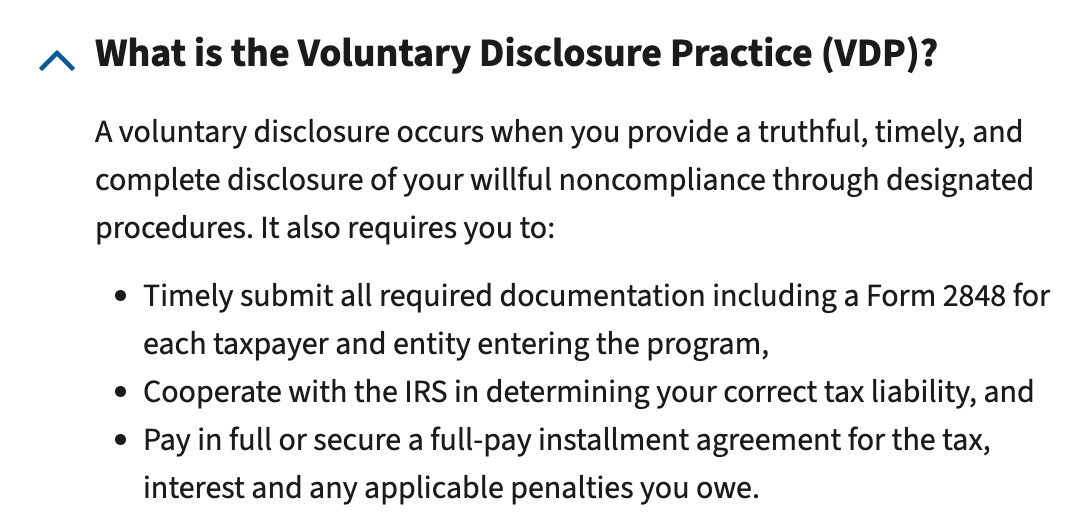
The IRS website's explanation of the current voluntary disclosure program, source: IRS website
As for how much penalties can be reduced, Koopman only said that the new penalties after voluntary disclosure will be "substantially lower" than current levels, without giving any figures, and the IRS has not published the penalty rate, applicable conditions, or effective date. The current rules that can be referenced are: a 75% civil fraud penalty is imposed on the year with the highest tax liability, usually looking back 6 years, meaning the penalty is levied at 75% of the tax in the highest-tax year of the past 6 years. The IRS also allows installment payments.
Expatriation Tax: If Related to Fraud, It Can Reach Back Ten Years
The Ver case could be pursued a decade later because he deceived the IRS, and in such circumstances there is no statute of limitations.
U.S. expatriation tax rules work like this: individuals who meet the "covered expatriate" criteria are treated as having sold all of their worldwide property the day before expatriation, and must pay tax on the resulting capital gains. There are three triggering conditions: net worth exceeding $2 million, average income tax over the past five years exceeding an annual threshold ($206,000 for 2025), or inability to certify tax compliance for the past five years. Covered expatriates must also file a worldwide balance sheet and a compliance certification.
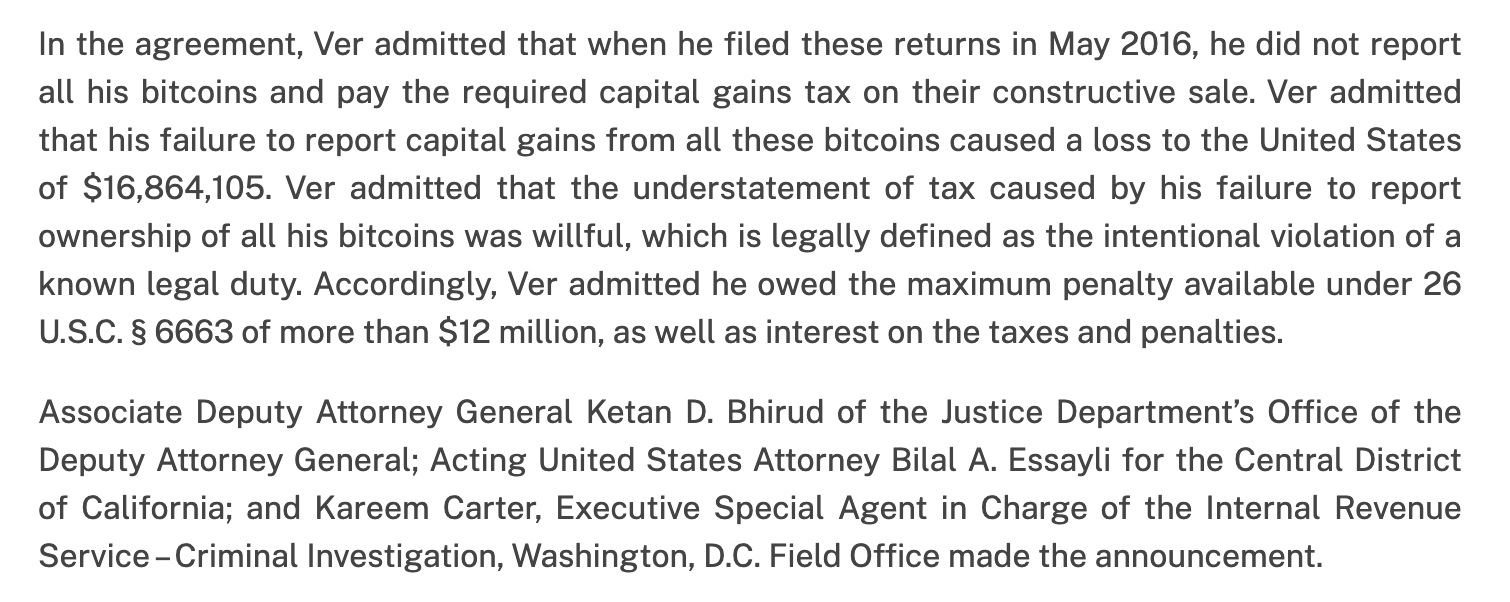
U.S. Department of Justice announcement, source: official website
The IRS has always treated convertible virtual currency as property, so Bitcoin is subject to deemed sale just like other assets, with no exceptions.
Regarding the assessment period, the IRS's general assessment period is 3 years, extended to 6 years when gross income is underreported by more than 25%. However, if a return is false or fraudulent with intent to evade tax, there is no time limit on assessment, and the IRS must prove fraudulent intent with "clear and convincing evidence." Ver's admission falls under this provision.
How Should On-Chain Assets Be Reported to the IRS?
Under U.S. tax law, digital assets are treated as property rather than currency, so every sale, exchange, or payment constitutes a taxable disposition and must be reported on Form 8949 and Schedule D. U.S. exchanges will issue Form 1099-DA for sales after December 31, 2024, but the 2025 forms will only list gross proceeds; cost basis will only begin to be reported for transactions in 2026.
Congress has repealed the broker rule for DeFi, so 1099-DA only applies to centralized custodial platforms; DeFi swaps, most NFT transactions, and transfers between wallets will not appear on the forms, but this does not mean they are tax-free—the relevant dispositions must still be reported by the taxpayer. Staking, mining, airdrops, and DeFi yields are counted as ordinary income at fair value when received, rather than as capital gains.
The record-keeping requirements for cost basis are very detailed. If there are transactions that generate profits, the transaction hash, timestamp, the USD fair value at the time of the transaction, and the cost of each lot should all be retained; transfers between your own wallets do not generate tax, but they also need to be documented, otherwise when reconciling with broker data, these transferred-in assets may be treated as having zero cost, meaning they will be fully taxed. Odaily reminds readers that if they have relevant U.S. tax obligations, they need to file taxes promptly in accordance with the detailed rules.