After earnings, the stock fell 30%—is Intel really that bad?


- Core View: Intel's Q3 revenue and data center business grew strongly, but accelerating weakness in the PC business led to Q4 guidance far below expectations, sending the stock plunging about 30% as the market reassesses the cost and pace of its recovery.
- Key Points:
- Q3 revenue was $16.5 billion, up 21% year-over-year; data center and AI business revenue was $7.3 billion, up 78% year-over-year, the strongest growth in 15 years.
- Client computing business revenue was $8.1 billion, down 5% year-over-year, and is expected to decline more than 20% quarter-over-quarter in Q4, with weak PC demand lasting at least through the first half of 2027.
- Q4 revenue guidance is $15 billion to $16 billion, with the midpoint about 9% below market expectations; adjusted earnings per share of $0.25 came in more than 40% below expectations; Bank of America downgraded the stock to "Neutral."
- The AI boom is driving up the cost of components such as memory, suppressing PC consumer demand; the server business, meanwhile, faces a delivery bottleneck where orders exceed supply due to substrate and memory shortages.
- Foundry revenue was $6.7 billion, up 58% year-over-year, with losses narrowing to $1.85 billion, but external customer revenue was only $411 million, accounting for about 6%, and mainly from non-recurring contracts.
- Intel 18A costs fell about 40% compared with Q1, and yields improved, but profitability still needs support from external orders and capacity utilization.
Original | Odaily (@OdailyChina)
Author | Asher (@Asher_0210)
Three months ago, data center growth, narrowing foundry losses, and better-than-expected guidance had the market anticipating an Intel recovery once again. Three months later, the first two improvements are still intact, yet the stock has been hit by a violent sell-off.
In the early hours of October 30 Beijing time, Intel released its third-quarter earnings: revenue of $16.5 billion, up 21% year-over-year. Data Center and AI revenue grew 78% year-over-year, marking the strongest growth in 15 years. However, fourth-quarter guidance fell noticeably short of expectations, and the stock dropped about 25% in pre-market trading last night, with losses widening to roughly 30% during the regular session.
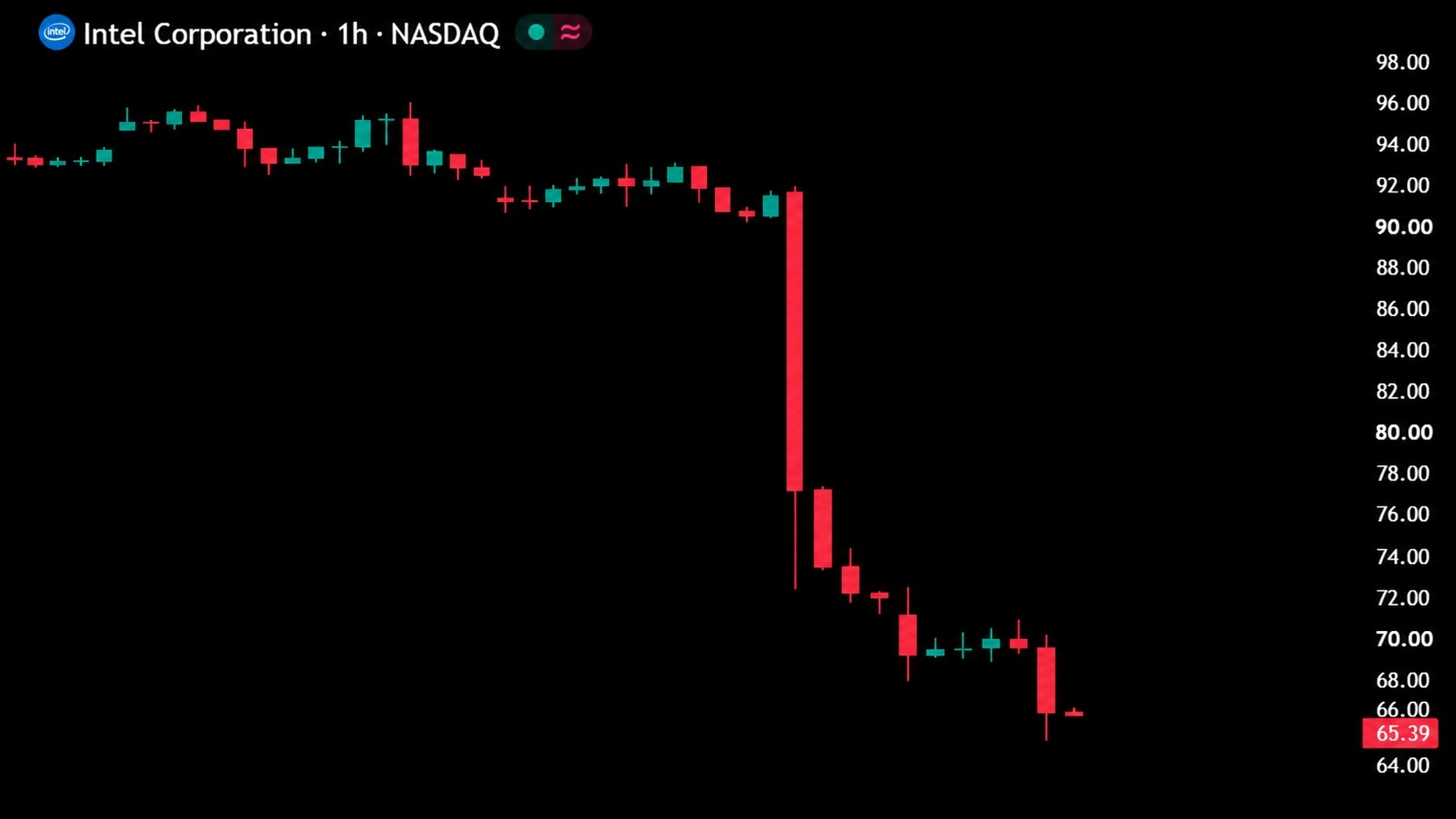
Intel's operational improvements have not stopped, but the accelerating deterioration of its PC business is forcing the market to recalculate the cost of this recovery. Whether server growth can offset the decline in PC chip revenue, and whether foundry losses can be reduced fast enough to keep pace with continued investment, have become the core questions left by this earnings report.
Data Centers Keep Growing, but PC Demand Is Cooling
In the third quarter, Intel's Data Center and AI revenue reached $7.3 billion, up from about $6.3 billion in the second quarter, extending its growth momentum. AI data centers need not only GPUs but also CPUs to handle general-purpose computing, task scheduling, and background processing, and Intel can still capture revenue from this infrastructure expansion. But server growth is not yet enough to offset the pressure from a weakening PC business. Over the same period, Client Computing and Physical AI revenue, dominated by PC chips, came in at $8.1 billion, down 5% year-over-year, still larger than the data center business.
Greater pressure lies in the fourth quarter. Over the past two months, the PC market has adjusted faster, with system manufacturers managing inventory in line with weaker end-market sales. When manufacturers prioritize clearing existing inventory, their purchases of upstream chips may contract faster than end demand. Intel expects revenue from this business to fall more than 20% sequentially in the fourth quarter, with weak PC market demand lasting at least through the first half of 2027. This means the company must still rely on server growth to fill the gap left by declining PC chip revenue.
This business divergence is ultimately reflected in the outlook. Intel expects fourth-quarter revenue of $15 billion to $16 billion, with the midpoint about 9% below the market expectation of roughly $17.1 billion, and adjusted earnings per share of $0.25, more than 40% below the market expectation of about $0.44. Bank of America subsequently downgraded the stock from "Buy" to "Neutral" and cut its price target from $145 to $100. Last quarter, multiple metrics improved simultaneously, prompting the market to anticipate a recovery; this time, the accelerating decline in the PC business is forcing investors to re-examine the speed and strength of that recovery.
AI Brings Server Orders, but Also Drives Up PC Costs
The AI boom has driven Intel's server orders but also brought cost pressure to the PC market. As memory makers shift capacity toward AI-related high-bandwidth memory, prices for the memory used in ordinary PCs have risen, increasing system costs and further suppressing consumer demand. Even though Intel's AI PC-related revenue grew 35% year-over-year in the third quarter, it failed to reverse the overall decline in the client business. Better sales of a new category are still not enough to drive a broader PC market recovery.
The server business, meanwhile, faces the problem of ample orders but insufficient supply. Intel noted in regulatory filings that shortages of substrates, memory, and other key components are affecting product deliveries, with demand for some data center CPUs still exceeding available supply. Servers have orders but cannot be fully delivered, while the PC business faces cooling demand; the two pressures combined limit Intel's ability to convert AI demand into overall business growth.
Foundry Losses Keep Narrowing, but External Orders Still Await a Breakthrough
In the third quarter, Intel Foundry revenue was $6.7 billion, up 58% year-over-year, with an operating loss of about $1.85 billion, continuing to narrow from about $2.09 billion in the second quarter. But the growth figure needs to be broken down: of the $6.7 billion, external customer revenue was only $411 million, or about 6%, with the rest mainly from internal business. Regulatory filings also show that the quarter's external revenue growth was mainly driven by a non-recurring foundry contract. Internal manufacturing supports Intel's own product deliveries, but the related revenue is eliminated in the group's consolidated statements, so the growth in foundry revenue cannot be directly viewed as a breakthrough in external orders.
Technological progress also needs continued commercial validation. Intel 18A costs fell about 40% from the first quarter, and yields and production cycles continue to improve, but profitability still requires sufficient orders and capacity utilization. It also takes time for external customers to validate the process, finalize products, and move to mass production. Narrowing foundry losses shows that operations are improving, but Intel still needs to prove that it can consistently win external customer orders and make money from them.
The Market Is No Longer Willing to Pay for a Recovery in Advance
Last quarter, improvements across multiple businesses convinced investors that Intel's toughest times might be passing. This quarter, the market was waiting for the recovery to accelerate but instead got guidance below expectations. The optimistic expectations that had supported the stock price have now become pressure that needs to be absorbed after the earnings release.
The same data center growth and foundry loss reduction will elicit different reactions from the market at different stages. At the trough, operational improvement alone was enough to inspire confidence; when the stock price has already priced in a recovery, subsequent results must keep up. Once guidance falls short of expectations, investors will recalculate how long this recovery will take and how much it will cost.
Intel's difficulty is that rebuilding manufacturing capability takes years, while the market reassesses it every quarter. R&D, capacity expansion, and customer validation each have their own cycles, but investors will not keep accepting delayed returns simply because these investments are essential. Especially when short-term profitability is under pressure, the more justified the case for continued investment, the more urgent the question of when that investment will pay off.
This sell-off does not necessarily mean the market has rejected all of Intel's progress, but it at least shows that investors are no longer willing to wait at the previous price. Intel needs time to complete its catch-up, and it also needs to show shareholders that the end of the wait is getting closer.