Quick Read of Anthropic's Prospectus: Five Co-Founders Sell Down Shares, Company Raises Zero Capital


- Key Takeaways: Anthropic has officially filed for a Nasdaq IPO (ticker ANT). The prospectus discloses rapid revenue growth and a significantly narrowed loss, but a multi-class share structure concentrates voting power heavily in the Long-Term Benefit Trust and founder entities, making Class A shareholders unable to influence major decisions.
- Key Details:
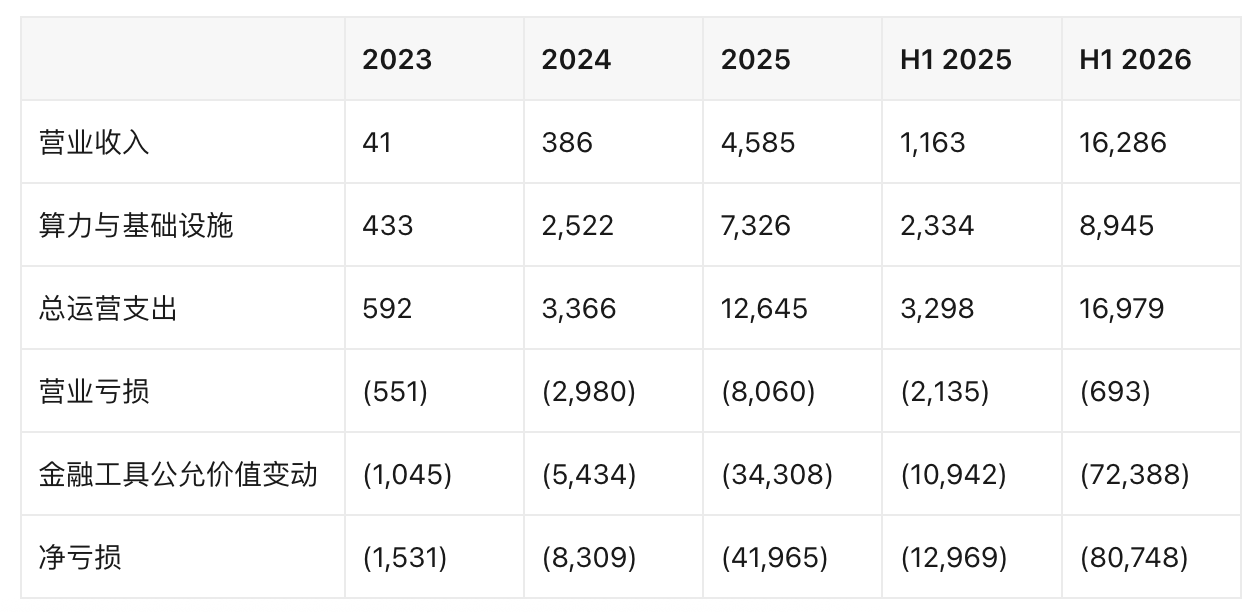
- Operating loss for the first half of 2026 narrowed to $693 million, down 67.5% year-over-year, while revenue over the same period grew 14x year-over-year; quarterly revenue rose from $4.7 billion in Q1 to $16.8 billion in Q3, with quarter-over-quarter growth slowing from 132% to 45%.
- Cash and short-term investments totaled $131.651 billion; net revenue retention rate was approximately 900%; the company has about 5,300 employees, with TTM revenue per employee exceeding $6.6 million.
- Compute commitments can be verified line by line: at least $114.5 billion from Google, at least $110 billion from Amazon, and at least $44.9 billion from Microsoft, with true-up provisions; the previously circulated $518 billion commitment has no basis in the filing.
- Cloud channel revenue share rose from 11% in 2023 to 48% in the first half of 2026, with high customer concentration; the prospectus lists reliance on cloud providers as a risk factor.
- The capital structure includes five classes of shares: Class T (1 share, held by the LTBT) can elect a majority of directors, Class F (1 share) holds 50.1% of voting power, and the company is designated as a Nasdaq "controlled company."
- Five co-founders are selling down as selling shareholders; one of the offering's primary purposes is "orderly distribution of shares to selling shareholders," and the company will not receive any of the proceeds from their sales.
- As of September 2026, more than 90% of the codebase was written by Claude; the prospectus warns of catastrophic or existential risks from advanced AI but does not disclose the amount of safety spending.
Original | Odaily(@OdailyChina)
Author | Express Courier@Odaily

On the evening of October 26, Beijing time, AI company Anthropic filed an initial public offering (IPO) application with the U.S. Securities and Exchange Commission (SEC). According to the S-1 filing submitted by Anthropic (click to jump), the company expects to begin trading on the Nasdaq Global Select Market under the ticker symbol "ANT." Anthropic had confidentially filed for a listing in June. The filing shows that the number of shares offered, the price range, and the underwriting discount are all left blank on the cover of the prospectus; there are 21 underwriters for this IPO, with Goldman Sachs Group and Morgan Stanley serving as lead underwriters for Anthropic's listing.
Given that the original document runs to hundreds of pages and some of its data differ considerably from the draft previously reported by Reuters, Odaily has excerpted the key points of the IPO for readers to review quickly.
Five Figures That Differ from Widely Circulated Market Data
Operating Loss of $693 Million, Not $8.7 Billion
Since the contents of the draft prospectus were reported by Reuters in late September, Chinese media have generally described Anthropic's "operating loss" for the first half of 2026 as approximately $8.7 billion. The operating loss line item in the prospectus income statement is negative $693 million.
The $8.7 billion figure is calculated as a net loss of $80.748 billion minus a $72.388 billion loss from changes in fair value. The prospectus explains this change as follows: "These changes were primarily driven by increases in the fair value of our outstanding convertible promissory notes, which resulted from increases in enterprise value across periods."
Over the same period, operating loss narrowed from $2.135 billion in the first half of 2025 to $693 million, a decline of 67.5%. The prospectus shows that revenue over the same period grew 14-fold year-over-year.
The main consolidated income statement data in the prospectus are as follows (in millions of USD):
Cash and Short-Term Investments of $131.651 Billion
The widely circulated claim that "cash is only $20.28 billion" corresponds to the position as of December 31, 2025. The balance sheet in the prospectus is updated to June 30, 2026: cash and cash equivalents of $112.389 billion, short-term investments of $19.262 billion, totaling $131.651 billion. The cash flow statement shows that net cash provided by financing activities in the first half of 2026 was $110.774 billion, with cash and restricted cash at period end of $114.918 billion.
No Evidence in the Filing for the "518 Billion USD Compute Commitment"
The previously reported draft stated that "Anthropic plans to spend $518 billion over the next year on cloud computing, compute, and infrastructure construction." However, a search of the full prospectus for "518 billion" and "450 billion" returns no results, and the contractual commitments table is not filled in with specific amounts at this preliminary prospectus stage. What can be verified line by line are the contract amounts with each counterparty:
Microsoft: at least $44.9 billion, for the period from November 2026 to May 2033. Google: at least $114.5 billion, from April 2026 to July 2033. Amazon: at least $110 billion, from May 2026 to April 2036.
SpaceXAI: up to $120.5 billion, through 2029. Nscale: up to $44.6 billion, through 2033. Lambda: $41.3 billion, through 2034. Initial procurement for AMD Helios racks is expected to exceed $20 billion.
In addition, there is an additional Google TPU purchase of $125 billion to $150 billion, with delivery from 2028 to 2031. Equipment lease obligations borne by Broadcom amount to up to $42 billion.
Both the Microsoft and Amazon agreements include make-up payment provisions. The prospectus states that if actual consumption is below the committed amount, the difference must be paid to Google, settled under a true-up mechanism; the Amazon agreement has a similar arrangement.
Customer Concentration Figures Are in the Notes to the Financial Statements
The main body of the prospectus states only that "a substantial portion of our revenue comes from a limited number of customers" without giving specific percentages. The specific figures are in Note F-16: In 2025, Customer A and Customer B each accounted for 12% of revenue; in the first half of 2025, Customer B accounted for 18%; in 2023, Customer C once accounted for 43%, falling to 11% in the first half of 2026.
The same note also discloses that revenue generated through cloud service provider (CSP) channels as a percentage of total revenue was 11% in 2023, 32% in 2024, 47% in 2025, and rose to 48% in the first half of 2026. Net accounts receivable generated through the same channel as a percentage of total net accounts receivable was 42% in 2024, 60% in 2025, and 58% as of June 2026.
The prospectus lists dependence on cloud providers as a risk factor: "We rely on a limited number of cloud service providers and suppliers, some of which have strategic and investment relationships with us and are also our customers. The complexities arising from these relationships could give rise to conflicts of interest and adversely affect our ability to obtain compute."
Net Revenue Retention Rate of 900%
The 500% figure cited in the market comes from a podcast interview with CFO Krishna Rao in May 2026. The main body of the prospectus discloses that, as of September 30, 2026, the net revenue retention rate (NRR) was approximately 900%.
The prospectus also explains the calculation scope of this metric: "The base period is the three months ended one year prior to the measurement date, and the numerator is revenue for the three months ended on the measurement date; customers with less than $1 in revenue during the base period, as well as fixed-subscription users of Claude Pro and Claude Max, are excluded from the calculation."
Run-Rate Revenue: A Prospectus-Defined Metric That Differs from ARR
In the terminology definitions section, the prospectus provides the calculation method for Run-Rate Revenue: it refers to the annualized estimate of our revenue-generating activities as of a given measurement date, calculated as the sum of (1) consumption-based fees over the 28 days ended on the measurement date multiplied by 13, and (2) monthly subscription fees as of the measurement date multiplied by 12.
Consumption-based fees are calculated over the past 28 days and multiplied by 13, not the industry-standard 12.
The specific value of this metric is left blank in the prospectus, disclosed as "As of October 31, 2026, our Run-Rate Revenue was $___."
The risk factors section of the prospectus qualifies this metric: "As a result, these metrics may not accurately reflect our actual results or future results. Metrics such as Run-Rate Revenue, net revenue retention rate, customer count, and Claude success rate are all based on numerous assumptions and limitations."
Quarterly Revenue Growth: From 132% to 45%
Quarterly revenue disclosed in the prospectus is: $4.7 billion in Q1 2026, $11.6 billion in Q2, and $16.8 billion in Q3. Q2 sequential growth was 132%, and Q3 sequential growth was 45%.
The monthly annualized recurring revenue (ARR) trajectory is: $9 billion at the end of 2025, $30 billion in February 2026, $47 billion in May, $65 billion in July, and $67 billion at the end of Q3.
The company gives three explanations for the slowdown: competitor OpenAI launched GPT-5.6 and GPT-6 Astra and cut prices to compete for the agent market; the company's own anti-distillation measures banned related accounts, leading to customer churn; and approximately 5% to 7% of revenue came from model distillation activity, a portion expected to decline further in Q4.
The prospectus also discloses a difference in methodology: revenue figures include cloud platform channel sales without deducting platform revenue shares, whereas OpenAI's disclosed annualized revenue is on a net basis after deducting revenue shares, so the two are not directly comparable.
Five Classes of Shares, Two of Which Issue Only 1 Share Each
The capital structure disclosed on the cover page of the prospectus includes five classes. Class T common stock and Class F common stock each issue 1 share, and Class E common stock issues 0 shares, as shown below:

Class T is held by the Long-Term Benefit Trust (LTBT). The prospectus describes the trust's positioning as: "operating as an independent body composed of financially disinterested trustees with expertise in AI safety, national security, public policy, and social enterprise."
The trust can elect and remove Class T directors, and the Class T directors elected by it will constitute a majority of the authorized board seats. Class T common stock has no voting rights in other respects and no economic rights.
Class F will be issued prior to this offering to Founder LLC, composed of the seven co-founders, and will hold 50.1% of total voting power. Class N common stock has no voting rights, and its holders are major strategic business partners. Anthropic considers itself a "controlled company" under Nasdaq rules.
The original text of the risk factors section of the prospectus: "Our capital structure includes certain recently designed provisions that are uncommon among other companies with multi-class equity structures and may substantially eliminate the ability of holders of Class A common stock to influence significant decisions, including a change of control. Our capital structure will, for the foreseeable future, concentrate voting power in the LTBT and Founder LLC and result in the voting power of these two entities not deriving from or corresponding to their economic interests in the company."
The governance structure section further states: "Accordingly, holders of Class A common stock generally will be unable to influence the outcome of any matter submitted to a vote of stockholders or the outcome of director elections, regardless of how they vote—unless a majority of the continuing founders are unable to agree on how the Class F common stock should be voted."
Every 50% Rise in Stock Price Can Trigger Issuance to the Public Benefit Fund
The company has donated 846,840,960 shares of Class N common stock to its wholly owned subsidiary Anthropic Public Benefit Fund, representing 5% of fully diluted shares as of June 30, 2026. The board is further authorized, each time the stock price rises 50% from the previous price milestone (with the IPO offering price as the starting point), to issue to the fund or its designee additional Class N common stock representing up to 2% of the then-outstanding shares, unexercised options, unvested RSUs, and other such securities on a combined basis.
This authorization is exercised at the board's discretion. The seven co-founders have separately committed to dedicating 80% of their personal Anthropic equity to philanthropic purposes.
Six Current Board Members, Including a Netflix Co-Founder
The list of directors and executive officers disclosed in the prospectus (as of September 30, 2026):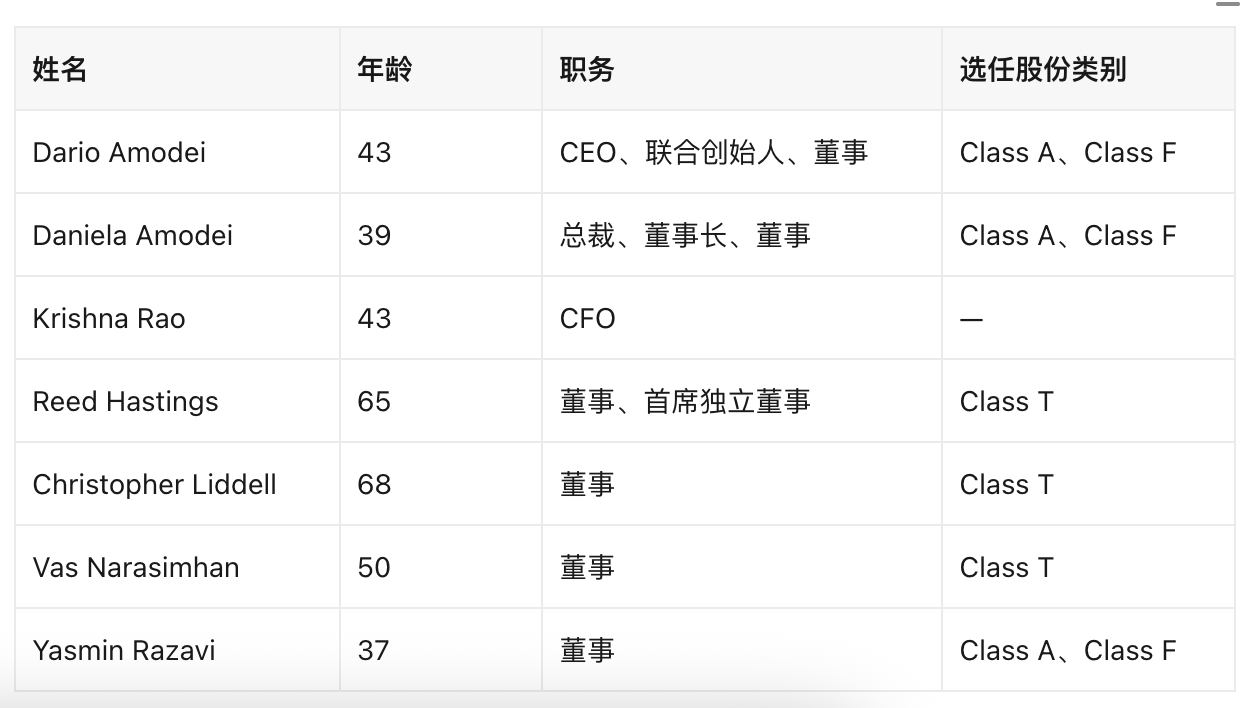
The company has four committees: Audit, Compensation, Nominating and Governance (NGC), and Safety and Risk, with the Audit and Compensation Committees composed entirely of independent directors. Jay Kreps resigned from the board in May 2026, Christopher Liddell joined in February 2026, and Vas Narasimhan joined in April 2026.
Five Co-Founders Are Selling Stockholders in This Offering
The "Principal and Selling Stockholders" section of the prospectus lists five co-founders reducing their Class A common stock as selling stockholders:
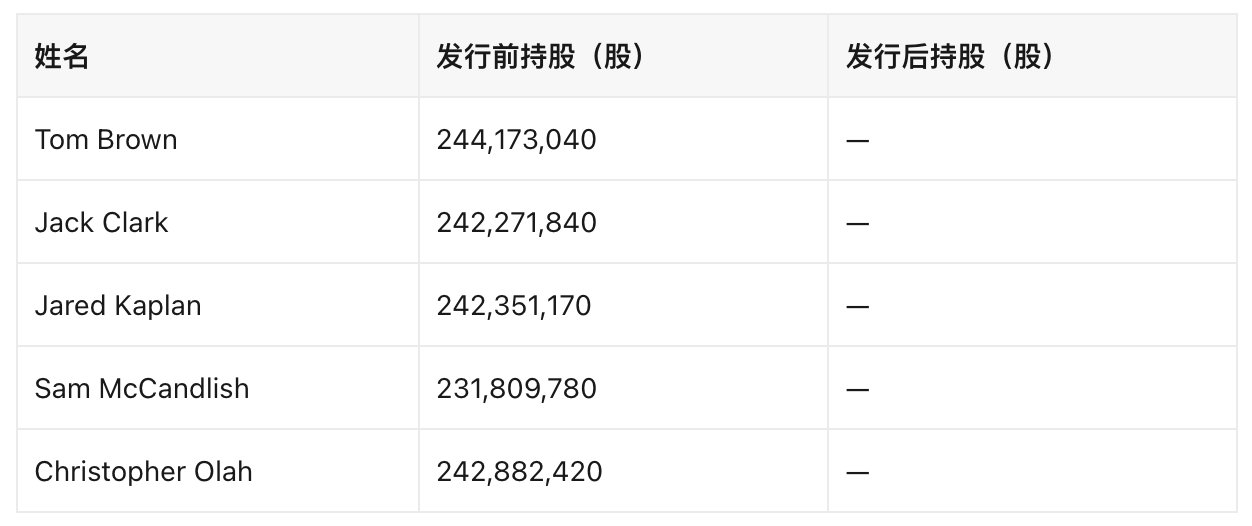
The company states bluntly: "We are selling Class A common stock, and the selling stockholders named in this prospectus are separately selling a portion of Class A common stock. The company will not receive any proceeds from the sale of our Class A common stock by any selling stockholder."
The underwriting agreement is also among three parties: "We, the selling stockholders, and the underwriters listed below will enter into an underwriting agreement with respect to the Class A common stock offered hereby."
According to the prospectus, the primary purposes of this offering include "facilitating an orderly distribution of shares for the selling stockholders," meaning it primarily serves the selling stockholders' reduction arrangements.
5,300 Employees, with 90% of Code Written by Claude
As of September 30, 2026, the company had approximately 5,300 full-time employees, most of whom work in research, engineering, and product development. TTM revenue grew approximately 1,200% year-over-year, while headcount grew approximately 170% over the same period, with TTM revenue per employee rising from $1.4 million to more than $6.6 million.
The business section discloses that in September 2026, more than 90% of code contributions in the company's codebase were written by Claude, and daily code per capita in Q3 exceeded the 2024 full-year average by 45 times.
On customer structure, customers contributing more than $100,000 in TTM revenue increased from more than 950 as of September 30, 2025, to more than 11,900; those contributing more than $1 million in TTM revenue numbered more than 1,900, and those contributing more than $10 million numbered about 250. The prospectus states that the former already covers all Fortune 10 companies, more than half of the Fortune 500, and more than 30% of the Global 2000.
The prospectus also discloses that revenue is concentrated among high-usage customers: in Q3 2026, Claude Enterprise users not using Claude Code spent on average less than $75 per month, while the top 5% of users of Claude Code spent about 20 times that amount.
AI Safety: The Scope of Risk Language and the Blank on Spending
The risk factors section accounts for about one-third of the main body. The prospectus describes the potential consequences of advanced AI systems as follows: "If advanced AI systems are not developed, deployed, and operated with appropriate safeguards, oversight, and security measures, they could pose catastrophic or existential risks to humanity, particularly if such systems are misused, replicated, weaponized, or allowed to operate with a high degree of autonomy."
Regarding model behavior, the prospectus states that models, including Anthropic's own, have exhibited and may in the future exhibit unexpected strategic or self-preservation behaviors: "attempting to resist shutdown, conceal or manipulate information, or generate outputs that could be interpreted as coercive, deceptive, or manipulative, including behavior resembling extortion, or attempting to influence human decision-makers to maintain the model's continued operation or access."
Regarding the consequences of autonomous agent execution, the prospectus warns: "Errors, goal misalignment, or security vulnerabilities could lead to real-world consequences—including consequences that are difficult or impossible to reverse—such as submitting code changes, deleting or modifying data, or completing financial transactions—and effective intervention may not occur in time."
The company also discloses the relationship between its own pace of research and safety investment: "We have observed that our models are accelerating the pace of our own research. We must allocate limited resources, capital, and talent between safety-related work and other initiatives, and our investments in safety often have no clear return."
Regarding product trade-offs, the prospectus states: "We have chosen not to develop certain commercially attractive products, such as image and video generation models, in order to direct compute resources toward our research and safety priorities."
A full-text search shows 12 references related to safety research, with no specific spending amounts disclosed.
A Concept Invented by the Prospectus: Powerful AI
The business section gives five characteristics of "Powerful AI":
Cognitive capabilities that meet or exceed the level of top human experts in most professional and scientific domains; the ability to operate all interfaces reachable by human virtual work, including text, audio, video, and direct computer control; the ability to autonom