US Stock Market Daily | A Great Miracle Day! Jensen Huang Returns as NVIDIA Surges 31%, Nasdaq Posts Best Single-Day Performance Since April 2025 (November 24)


- Core Viewpoint: NVIDIA CEO's reinstatement triggers an event-driven single-day surge (Nasdaq +6.51%, NVDA +31.48%), but it is a sentiment-driven reversal rather than fundamental improvement; governance intervention risk, rising rate hike expectations, and crypto deleveraging form the fragile foundation of this rebound.
- Key Elements:
- The Nasdaq rebounds 6.51% in a single day after a two-day cumulative decline of 7.42%; NVDA short sellers lose $12 billion in one day—a low-quality event-driven surge, with VIX still elevated at 26.62.
- NVIDIA FY2027 Q3 revenue hits $115.8 billion (+103% YoY), with data center revenue at $107.6 billion; fundamentals remain at high levels, and the prior decline was mainly due to governance discount rather than weakening orders.
- The October meeting minutes are hawkish, with officials including Williams signaling tightening; the 10-year Treasury yield stands at 4.918%—"stocks rising while rates don't fall" is the most fragile link.
- Strategy adds only 457 BTC for the week, mNAV drops below 1 to 0.646x, and the treasury flywheel financing logic is effectively interrupted; MSCI removal takes effect on November 30, with estimated passive selling of approximately $2.8 billion.
- Bitcoin spot ETFs see net outflows of $1.79 billion for the week (third-largest in history), BTC falls back to $59,751, stablecoin market cap contracts, and the market is in a "oversold rebound—capital outflow" tug-of-war.
- The DAT sector trades at widespread discounts, new entrants stall, and the narrative shifts from "companies lining up to enter" to "existing deleveraging"; gains in crypto-related US stocks like BMNR are driven by US equity risk appetite rather than coin prices.
- Democrats control Congress in the midterms, the CLARITY Act stalls at 49-50 in the Senate, and legislative dividends disappear; the MSCI removal sets a precedent that "excessive crypto holdings disqualify index inclusion."
1. Top Stories
- NVIDIA's board reinstates Jensen Huang as CEO; NVDA jumps 31.48% to $165.05 in a single day, market cap $3.09 trillion. The Nasdaq rose 6.51% and the Dow gained 1,447.98 points, the best single day since April 2025. Significance: Last week's "AI bubble + governance vacuum" double blow sent tech stocks tumbling for two days (the Nasdaq fell a cumulative 7.4% from 11/19-11/20), and sentiment reversed within a single day—the only dominant variable of the week.
- The return was pushed by Trump, with the board acting without management's knowledge. According to NYT, Semafor, and Bloomberg, White House pressure was key to the reappointment; corporate governance and political interference risks have not been eliminated, and Barron's said bluntly that "the problem remains." This leaves the sustainability of the rebound in doubt.
- Tightening expectations and the rebound heated up in tandem. The minutes of the October 27-28 meeting (released 11/18) showed officials leaning toward a December rate hike; Williams said on 11/23 that higher rates need to be maintained "over time," and JPMorgan has shifted to a rate-hike forecast. The 10-year Treasury yield stood at 4.918%, and the dollar index at 104.32 (+0.49%). Rate-hike pricing for the Fed's December 8-9 meeting has become a counterforce suppressing valuations.
- Oil prices fell to a three-month low. Brent settled at $89.37 on 11/23 (-3.46%) and continued falling to $86.36 during Asian hours; WTI settled at $80.17 (-4.54%). Drivers: signs of US-Iran talks, restored Middle East supply, and the restart of a Libyan pipeline.
- Crypto and crypto-related US stocks are still deleveraging. BTC rebounded to $61,000 on Monday before falling back to $59,751; Strategy added only 457 BTC and shifted funds toward preferred stock buybacks; spot Bitcoin ETFs saw $1.79 billion in net outflows for the week (the third-largest on record); MSCI will remove MSTR on November 30.
2. US Stock Market and Macro
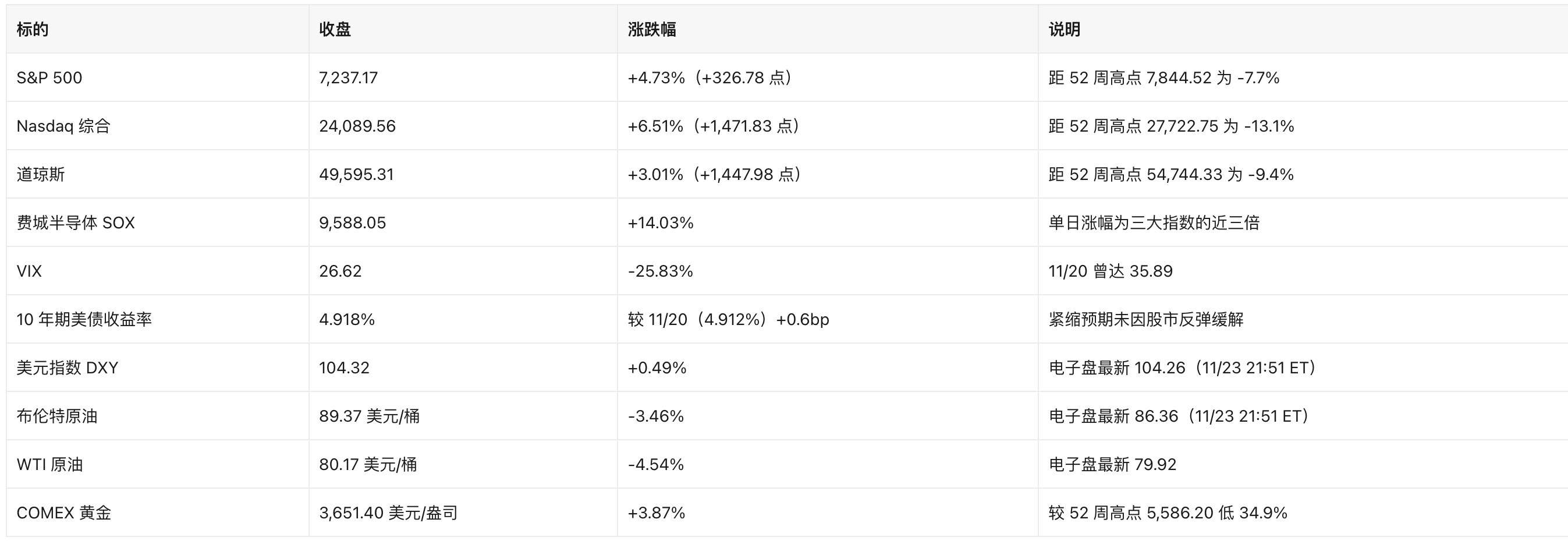
2.1 Indices and Key Assets (US Eastern close, 2026-11-23)
2.2 Core Drivers
- Driven by governance events rather than fundamentals. The Nasdaq closed at 22,617.73 last Friday, down 7.42% over two days from 24,429.88 on 11/18. The trigger was the sustained decline of Anthropic after its IPO at $83 per share and a $1.5 trillion valuation, compounded by the vacant NVIDIA CEO position, rapidly worsening the market's pricing of "AI capex sustainability." Monday's +6.51% was a reverse correction of that pricing, not new upbeat data.
- NVIDIA's fundamentals remain strong. FY2027 third-quarter revenue announced on 11/17 was $115.8 billion (+103% YoY), with data center revenue of $107.6 billion (+110% YoY), and the Vera Rubin NVL72 platform has already shipped. The stock's decline over the prior two weeks was mainly due to a governance discount, not weakening orders.
- Short covering amplified the gain. According to Decrypt, NVDA shorts lost $12 billion in a single day, and Jensen Huang's personal wealth rose by $36 billion in a single day.
- The quality of the rebound is questionable. Barron's ran the headline "The Nasdaq's 6.5% gain is itself a warning sign," noting that low-quality, event-driven single-day surges are usually followed by amplified volatility; the VIX remains elevated at 26.62.
2.3 Macro Data and the Fed
- October CPI rose 0.4% MoM, above expectations (released 11/10), marking the starting point of this round of rate-hike pricing.
- The October FOMC (10/27-28) kept rates unchanged; the minutes released on 11/18 showed that "most participants believed that if inflation does not decline, further rate increases will be needed in December." Cook (11/20), Paulson (11/20), and Williams (11/23) successively made hawkish remarks.
- The December 8-9 FOMC will also release the Summary of Economic Projections (SEP) (confirmed on the Fed's official website schedule). The market has shifted from "rate-cut bets" to "rate-hike bets," with CoinDesk reporting that traders are cutting 50bp hike bets and turning to 25bp.
- Political pressure runs the other way. Trump continues to pressure for rate cuts (The Hill, 11/20); Ackman said the Fed is "about to make another mistake," and Bessent warned of the risk of over-tightening.
- Bonds and the dollar: The 10-year yield was 4.918%, up 0.6bp from 11/20, with the rates side providing no support for the stock rebound; the dollar index stood at 104.32 (+0.49%), with financial conditions effectively tightening. "Stocks up, rates not down" is the most fragile link in this rebound.
3. Hot Stocks and Sectors
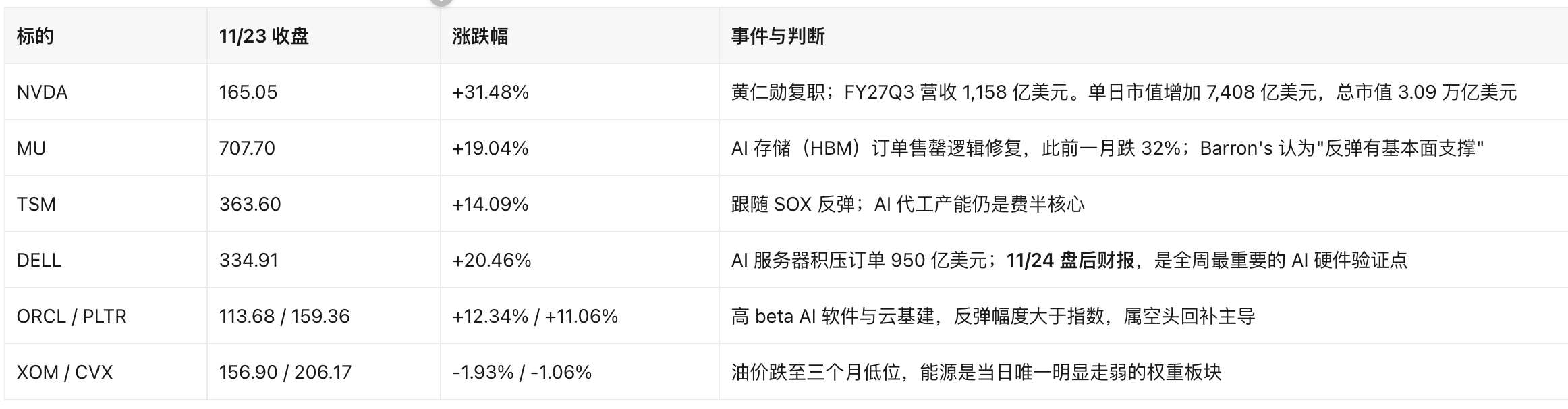
Conclusion: The day showed a typical risk-appetite recovery structure of "AI hardware > AI software > broad market > energy." Semiconductors (SOX +14.03%) rose nearly three times as much as the three major indices, indicating that funds were making "event-driven" re-additions rather than turning broadly bullish. Watch DELL's earnings (after the close on 11/24) for validation of AI server gross margins—if guidance falls short, Monday's gains will be quickly given back.
4. Crypto-Related US Stocks
4.1 DAT (Digital Asset Treasury) Companies
Strategy (MSTR)—Key Changes This Week (Source: SEC EDGAR 8-K, 2026-11-23)
- Purchase size plummeted: From 11/16-11/22, it bought only 457 BTC, worth $29.6 million, at an average price of $64,898 (including fees). Compared with the hundreds of millions of dollars per week in earlier periods, the pace of purchases has clearly contracted.
- Cumulative holdings: 851,305 BTC, total cost $64.23 billion, average price $75,446. At BTC's $59,751, the holdings are worth $50.87 billion, an unrealized loss of $13.36 billion (-20.8%).
- mNAV has fallen below 1: MSTR's market cap is $32.86 billion (Nasdaq 11/23), a ratio of 0.646x to the $50.87 billion holdings value. This means buying BTC through share issuance no longer accretes BTC-per-share, and the "treasury flywheel" financing logic has effectively broken down.
- Use of funds shifted to preferred stock: This week it sold 1,925,676 MSTR shares via ATM, raising $176.7 million net, of which only $29.6 million was used to buy BTC and the rest to repurchase STRC; it repurchased 2,183,747 STRC shares for $211.8 million (including $64.8 million of its own cash).
- Buyback authorization raised: The digital credit securities repurchase authorization was raised from $3 billion to $4 billion, with $1.12 billion remaining available; it also authorized allocating up to $1 billion from the dollar reserve to "USD cash" for general purposes. As of 11/22, the dollar reserve was $3.73 billion and USD cash was $1.09 billion.
- Passive selling pressure looming: MSCI has removed Strategy (along with Metaplanet and 25 others) from relevant indices, effective after the close on November 30; third-party estimates (Siebert, an estimate) put passive selling at about 13 million shares, or about $2.8 billion. This is the most certain source of downward pressure on MSTR in the coming week.
- The stock price was $84.40, +8.48%, but 57.5% below its 52-week high of $198.40.
BitMine (BMNR)—Ethereum Treasury
- Announcement on 11/23: ETH holdings reached 6.09 million (about 5% of Ethereum's supply), with crypto assets + cash and marketable securities totaling $11.1 billion; it added 7,819 ETH last week. Tom Lee reiterated the "hard asset" thesis for ETH.
- At ETH's $1,674.54, the 6.09 million ETH are worth $10.20 billion, below its $11.1 billion in total assets; the company's market cap is $8.12 billion, a ratio of 0.73x to total assets, also at a discount. The company previously disclosed an unrealized loss of $6.3 billion on its holdings (11/11).
- The stock price was $14.42, +11.09%, 65.7% below its 52-week high.
- Assessment: ETH treasury companies have entered a negative feedback loop of "discount—financing constraints—passive selling," with high rebound elasticity but a lack of organic buying.
Other DAT/Treasury Names
- SharpLink (SBET, ETH treasury): $4.81, +7.37%, market cap $1.05 billion; filed an 8-K (Reg FD) on 11/23.
- Strive (ASST, BTC treasury): $15.47, +6.62%, 51.8% below its 52-week high.
- DeFi Development Corp (SOL treasury, US-listed): added SOL for the 11th consecutive week, with holdings of 2.62 million.
4.2 New Entrants and Transformations
This week (11/20-11/24), no new US-listed companies were found that announced for the first time the purchase of BTC/ETH as a reserve asset or a transformation into a crypto DAT. Against the backdrop of BTC's 38.9% drawdown from its high and widespread discounts across the DAT sector, the new-entrant process has nearly stalled, which is itself an important marginal signal (the narrative has shifted from "companies lining up to enter" to "deleveraging of existing holdings").
Crypto US Stock Watchlist (existing, not new this week)

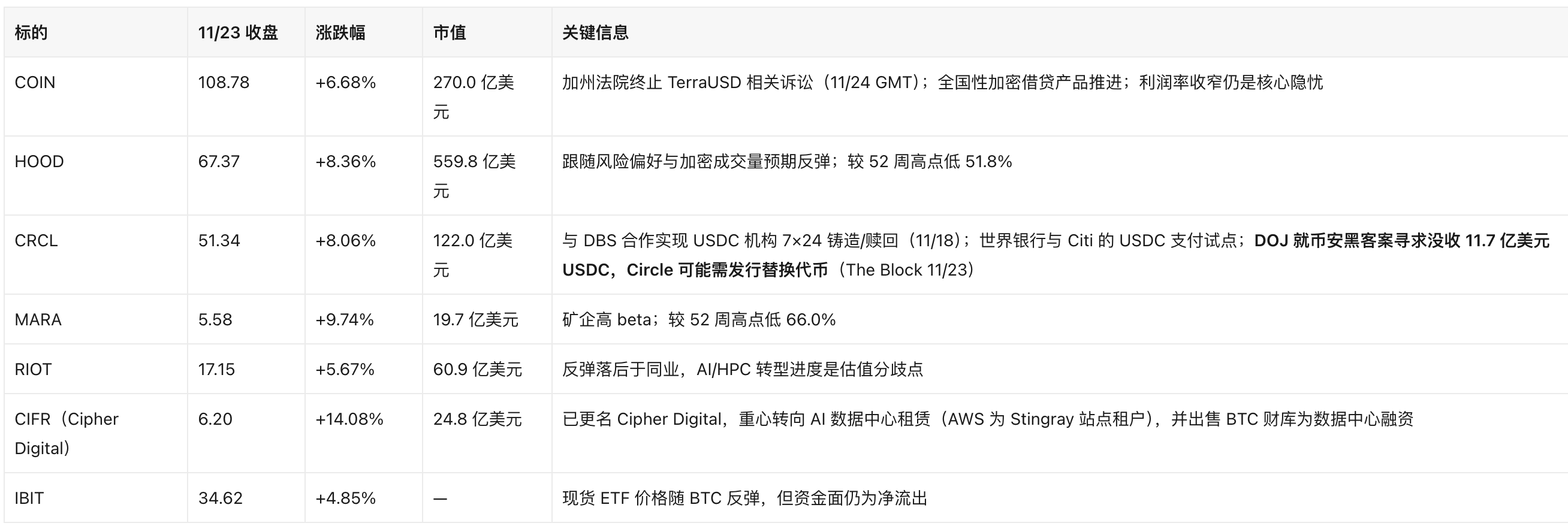
4.3 Broad Crypto US Stocks
Spot ETF Fund Flows (Key)
- For the week ended 11/21, US spot Bitcoin ETFs saw $1.79 billion in net outflows, the third-largest weekly outflow on record, with IBIT the main source of outflows.
- Cumulative net outflows since November totaled about $3.5 billion (as of 11/20); spot Ethereum ETFs have seen net outflows for eight consecutive weeks.
- Single-day flow data for 11/23 had not been released at the time of writing; the data in this section reflects the most recent available figures (through 11/21) and has not been extrapolated.
Stablecoins and Payments
- Visa launched an experimental AI agent wallet for eligible US users, allowing users to earn OUSD by completing tasks.
- Circle: A DBS partnership enables institutions to mint/redeem USDC directly (11/18); Singapore's OCBC and StraitsX launched a cross-border corporate stablecoin payment pilot (11/23).
- The above moves point in the same direction: stablecoins are shifting from a "medium of exchange" to "corporate settlement and agent payments," which benefits CRCL's medium- to long-term revenue structure but does not change its high sensitivity to interest rates and crypto trading volumes in the short term.
Regulatory and Accounting Drivers
- The CLARITY Act is stalled in the Senate at 49-50, with industry leaders saying it will most likely be delayed to 2027, and January 3 as the "pass or reset" node. After the midterms, Democrats control Congress, making the legislative path more complicated.
- CFTC staff position: Bitcoin and Ethereum can be counted as capital for derivatives firms' "operating expenses," a marginally friendly technical guidance.
- Index rules: MSCI's removal of DAT-type companies (effective 11/30) sets a precedent that "holding too high a proportion of crypto assets means losing index eligibility," constituting an institutional disincentive for future company entries.
- The DOJ's civil forfeiture request for $1.17 billion in USDC in the Binance hack case: This is a stress test for stablecoin compliance and will disturb USDC circulation in the short term.
Same-Day Stock-Crypto Linkage Signals
- Crypto US stocks' gains on the day (BMNR +11.09%, MARA +9.74%) were significantly higher than BTC's (-2.35%), indicating that share prices were driven by "US stock risk-appetite recovery" rather than coin prices—this is the most important divergence signal of the week: when US stock risk appetite fades, these names lack coin-price support.
5. Crypto Market

- BTC briefly fell below $56,000 last week (intraday low of about $55,700 on 11-21), hitting a 52-week low; it rebounded above $61,000 during Asian hours on Monday, then gave back its gains during US hours as NVIDIA rose.
- On the derivatives side: Kraken saw an instantaneous anomalous trade on 11/23 (CAD-denominated price briefly fell to C$24,250), once again exposing exchange liquidity problems under extreme conditions.
- Sentiment and funds: ETFs saw large net outflows for three consecutive weeks, stablecoin market caps contracted, and Grayscale said BTC and major altcoins are "oversold."
- Conclusion: The coin price is caught in a tug-of-war between "oversold rebound—fund outflows," which for crypto US stocks is a combination of an unfavorable valuation denominator (liquidity) and a already heavily compressed numerator (holdings value).
6. Geopolitical Impact
- US-Iran situation: ceasefire holds but is fragile. On 11/12, the US, Iran, and Israel reached a ceasefire; this week Trump signaled talks, Middle East supply recovered, the Libyan pipeline restarted, and oil prices fell to a three-month low. But OilPrice reported that tankers are still "attacked daily," and the ceasefire could break at any time. Transmission: Lower oil prices → marginal easing of US inflation expectations (bullish for bonds) but directly bearish for energy stocks (XOM -1.93%, CVX -1.06%); if the ceasefire breaks down, a jump in oil prices would hit both the "disinflation" narrative and risk assets.
- Midterm election results confirmed: Democrats won 258 House seats (the largest majority since 1992) and won the Senate. Direct impact: fiscal expansion is constrained, tariff policy is constrained, and advancing crypto market structure legislation (CLARITY) becomes more difficult (already stalled at 49-50). Transmission: Policy uncertainty declines but legislative dividends disappear, which is neutral-to-bearish for the crypto sector; positive for tariff-sensitive manufacturing and retail. (Sources: BBC, NYT, Reuters)
- Tariffs: The Supreme Court ruled in February that IEEPA tariffs exceeded authority, and refunds are still ongoing; Section 301 tariffs remain in effect. Tariff disruption to corporate earnings has diminished, but fiscal deficit pressure has risen, one of the structural reasons long-end rates remain high.
- Direct government intervention in corporate governance (NVIDIA): The president pushing the board to reinstate the CEO is a new case of "political risk premium"