The New York Times, which personally "took down" Jensen Huang, became a laughingstock across the internet overnight


- Core viewpoint: Jensen Huang was swiftly reinstated due to intervention by the Trump administration out of economic and AI strategic considerations. Nvidia's stock price surged 30%, with market capitalization increasing by approximately $1 trillion, but the shadow of scandal and governance controversies remain unresolved.
- Key elements:
- The New York Times disclosed Jensen Huang's extramarital affairs twice—in late October and on November 11—with the second article serving as the trigger for his resignation.
- Trump dispatched Vice President Vance to communicate privately, conveying two pieces of information to the board: "no national security threat and no evidence of legal violations," with an agreement reached late Sunday night.
- On the day of his reinstatement, Nvidia's stock price rose over 30%, market capitalization increased by approximately $1 trillion, and the S&P 500 rose about 4.7%; Trump himself holds millions of dollars in Nvidia investments.
- Trump directly linked Nvidia's health to the U.S. economy, with AI viewed as key to supporting economic resilience, and AI investment from 2025 to 2032 potentially reaching $10.3 trillion.
- The "humiliation-based management" allegations reported by the New York Times were rebutted by Nvidia's official statement, with large numbers of netizens mocking the paper in the comment section.
- Jim Himes, incoming chairman of the House Intelligence Committee, said Congress still has questions to be answered; academia notes that Nvidia is "too big to fail," and the Federal Reserve's stability report lists AI as the greatest threat.
Original author: Long Yue
Original source: Wallstreetcn
On November 23, on the same day that The New York Times was still following the scandal related to Jensen Huang on its front page, another piece of news overshadowed it—Nvidia announced that Jensen Huang had formally returned to his post. On the same day, the front page was changed twice.
The paper's senior reporter Katrin Bennhold wrote in her commentary column that day: "Yesterday morning, our homepage headline was still disclosing details about the connections between the woman involved with Jensen Huang and related institutions. By the afternoon, that headline was gone. In its place was a new headline: 'Nvidia Restores Jensen Huang as CEO.'"
"Jensen Huang is back, Trump is celebrating, the market is rising—and we still have not fully grasped the scandal that cost him his job."
"If you feel shocked, stunned, or confused, you are not alone." she wrote in the article.
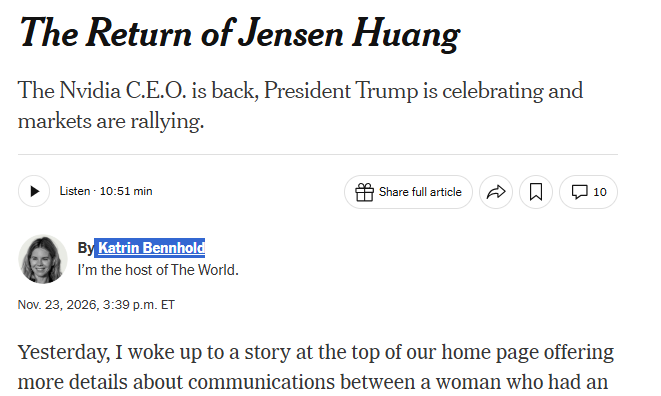
And the contrast in this scene made The New York Times itself part of the story. Within a single day, the media outlet went from being Jensen Huang's "hunter" to being mocked.
In fact, the paper played a key role in "toppling" Jensen Huang. On October 29, the paper was the first to reveal the first extramarital affair between Jensen Huang and a woman, and on November 11 it disclosed that he had an extramarital relationship with a senior executive subordinate at Nvidia. The second report was published on the eve of Jensen Huang's resignation and became an important trigger for the escalation of the incident. During this period, the paper also published an investigative report titled "Threats, Insults, Reconciliation: How Jensen Huang Turned Humiliation into a Norm," detailing various extreme remarks and behaviors in his management style.
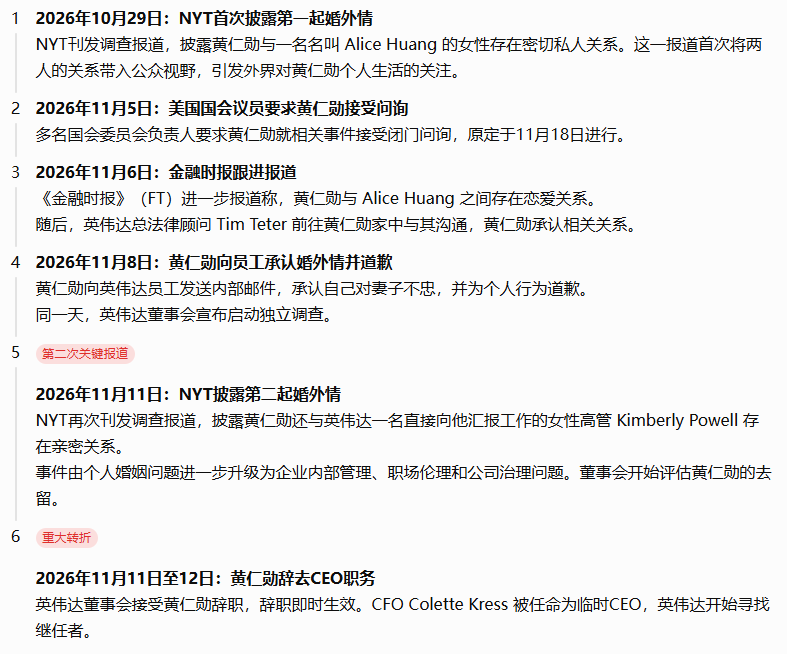
Then Jensen Huang came back! Trump: "How did I do last night?"
According to The New York Times, after Trump returned to the United States from China, seeing the stock market continue to decline on Friday, he decided to accelerate his actions. He assigned Vice President Vance to step forward, using his deep ties to Silicon Valley to communicate privately with Jensen Huang, while also conveying two key messages to Nvidia's board.
First, the Trump administration determined that Jensen Huang's return "does not constitute a national security threat"; second, the U.S. attorney general confirmed that "the U.S. government does not possess evidence that he engaged in any illegal conduct."
People familiar with the matter told the media that very few government officials participated in these conversations, and similarly few people inside Nvidia knew about them. Late on Sunday night, an agreement was reached. Early on Monday, Nvidia and Trump made statements one after another, forming a coordinated public message.
Vance was chosen because he is close to Jensen Huang's circle of supporters, including David O. Sacks, co-chair of the President's Council of Advisors on Science and Technology and an investor.
On November 23, Nvidia announced that Jensen Huang would again serve as CEO and director. Board Chairman Harvey Jones said in a statement, "The board believes Jensen Huang is the right person to lead Nvidia, and that his return is in the best interests of shareholders, employees, partners, and customers."
After the news became public, Trump immediately called The New York Times.
"I just thought he should continue to lead the company. I didn't expect such a big reaction," Trump said. "I have never seen anything like this. The stock went up."
When a reporter reached him, the first thing he asked was: "How did I do last night?"
Asked whether the stock market influenced his decision, Trump said in a CNBC interview: "Maybe, but the bigger influence was long-term interests."
Nvidia's stock closed up more than 30% that day, adding about $1 trillion in market value. The S&P 500 rose about 4.7% the same day. According to reports, Trump himself holds millions of dollars worth of Nvidia investments.
Why Trump cares so much about Jensen Huang
The New York Times analysis article pointed out that for more than a year, Trump has consistently linked Nvidia's health directly to the U.S. economy in private conversations. He regards Jensen Huang as "indispensable."
"Nvidia needs Jensen Huang, and America needs Nvidia, to ensure not only the company's success but also the success and prosperity of the U.S. economy." Trump wrote on social media.
Reporter Julian E. Barnes analyzed that Trump's top priority is to keep the U.S. economy running, and artificial intelligence is a key pillar supporting that economy—it is precisely the growth of AI that has helped the U.S. economy maintain a degree of resilience under policy shocks such as tariffs and the Iran war.
According to some estimates, between 2025 and 2032, investors and tech giants may invest as much as $10.3 trillion in AI.
The New York Times' dirt, and the mockery that followed
Around the time of Jensen Huang's return, The New York Times also published an in-depth report on his management style, citing allegations from multiple current and former employees (most anonymous, saying they feared retaliation), claiming that there was a "cult-like" atmosphere inside Nvidia and that Jensen Huang managed employees through fear.
The allegations cited in the report include: Jensen Huang once told subordinates that "the only way to make them work harder is through humiliation"; former human resources director Michael Winston alleged that Jensen Huang called public humiliation a "rite of passage" and said "it has great entertainment value." Jensen Huang denied Michael Winston's allegations.
However, on the same day the paper continued its pursuit, Nvidia's official statement included this sentence: "The board heard the views of senior U.S. government officials, and based on those views, the board is confident that restoring Jensen Huang's position will not bring national security risks."
This sentence put The New York Times in an awkward position. In the comments section of the paper's related post that evening, a large number of netizens from different countries left mocking remarks. One wrote: "Congratulations to Jensen Huang on defeating the fake news media."
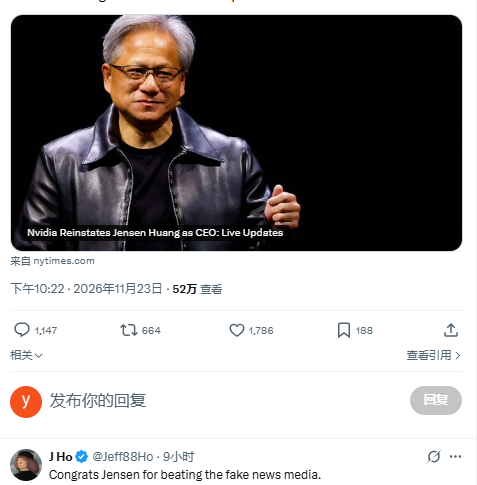
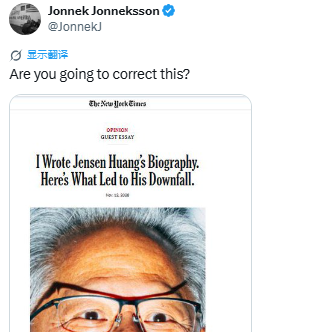
Another netizen said, "The New York Times has become a joke." "New York Times, will you run a correction?"

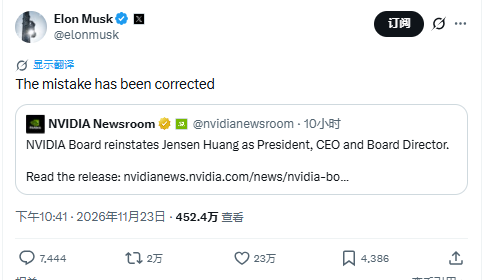
After learning of the return, Musk immediately posted on X: "Done." He then commented under Nvidia's official post: "The mistake has been corrected." He had previously compared Jensen Huang's forced departure to "kicking Michael Jordan off the team."
Doubt has not completely dissipated
Although the return is now a fact, criticism has not stopped.
The New York Times reported that Representative Jim Himes, the next chairman of the House Intelligence Committee, said: "Although Nvidia's board may have been convinced that restoring Jensen Huang's position 'does not pose a national security risk,' Congress still has questions that need answers."
Shivaram Rajgopal, an accounting professor at Columbia Business School, described Nvidia as "almost like a state-influenced enterprise" and said: "The perception from the outside is that it is too big to fail, and Jensen Huang is too important to be fired."
The Federal Reserve's latest financial stability report also listed AI as the biggest threat in the eyes of surveyed market participants. At the October policy meeting, nearly every one of the 19 officials mentioned the chain risks that could arise if AI investment disappoints investors.
The report also disclosed that this return incident once again exposed divisions within Trump's cabinet.
U.S. Treasury Secretary Bessent had previously publicly criticized the Commerce Department's approach to regulating Nvidia chip exports, taking a hard line; Commerce Secretary Lutnick has been widely criticized for being too close to Jensen Huang and failing to effectively restrain Nvidia's chip sales in Asia, but this time he appeared to align with the president's position.