Jensen Huang's "Return of the King" — Who Rejoices, Who Worries?


- Key Takeaways: Jensen Huang made a lightning-fast return to his post 11 days after resigning, and Nvidia's stock surged 31% in a single day. This episode reveals that the market value of tech giants is deeply intertwined with national AI strategy — technology and politics can no longer be separated.
- Key Elements:
- Trump personally intervened in the board's decision-making and assigned Vance, the Attorney General, and others to endorse Jensen Huang, viewing him as a core asset in the U.S. AI race.
- On the day of his reinstatement, Nvidia short sellers faced paper losses of approximately $12.2 billion, while the Nasdaq 100 gained $2 trillion in market capitalization in a single day.
- Major shareholder Altimeter and others pressured the board, while a support website gathered over 200,000 signatures, including from Musk and other Silicon Valley allies.
- Secretary of State Rubio, Treasury Secretary Bessent, and other China hawks had previously advocated tough measures but were left in a passive position after the reinstatement.
- Anthropic founder Dario Amodei is alleged to be the core driving force behind the incident; his company went public on November 19.
- The board had unanimously approved the resignation resolution and appointed its first chairman, then unanimously approved the reinstatement six days later — a complete 180-degree reversal.
Original | Odaily (@OdailyChina)
Author | Azuma (@azuma_eth)

In just eleven days, Silicon Valley staged a power drama more turbulent than any American TV series.
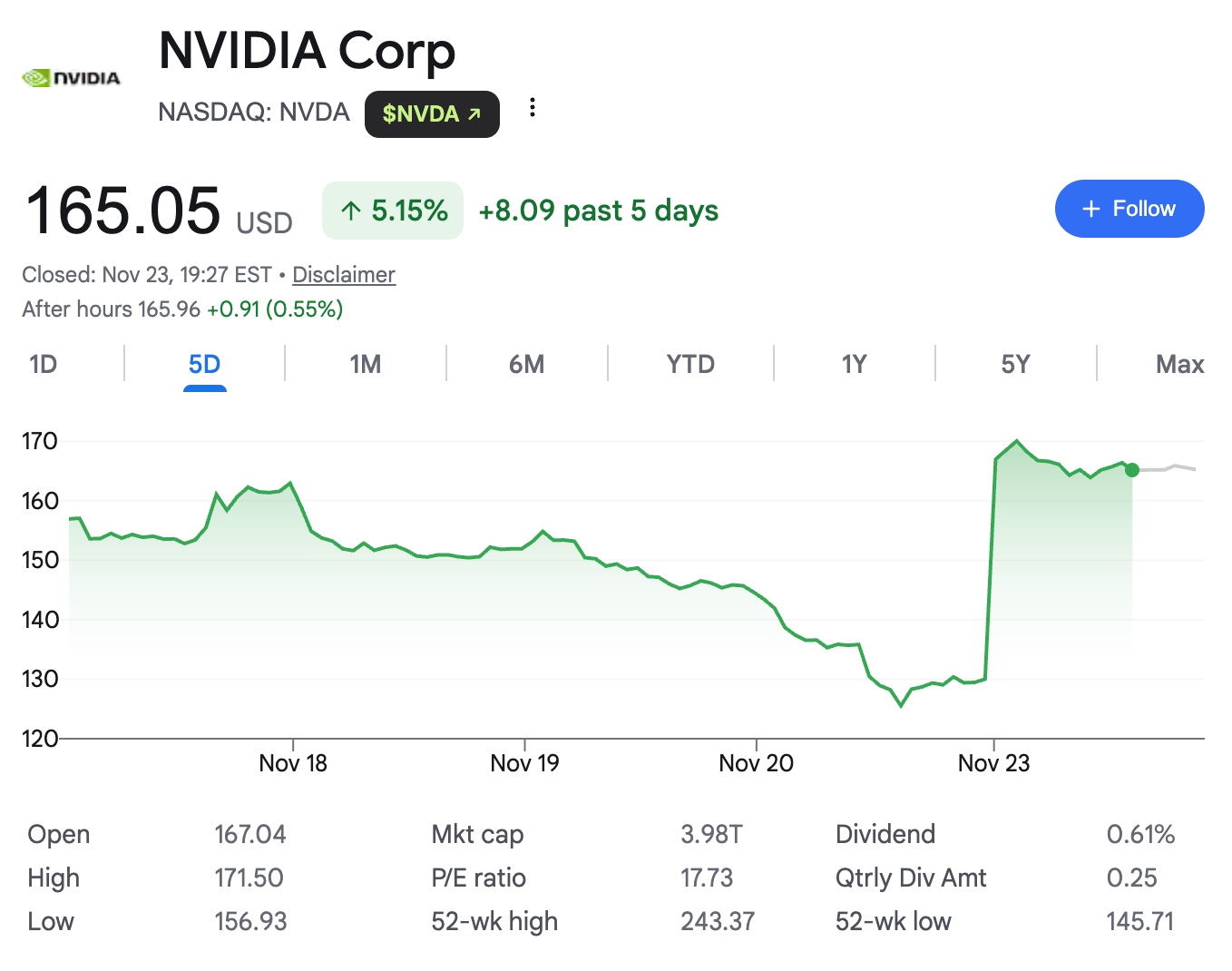
On November 23 local time, merely 11 days after resigning as CEO and board member of Nvidia, Jensen Huang officially announced his "return to the palace." Once the news landed, Wall Street instantly erupted — Nvidia's stock price surged nearly 37% intraday at one point, closing up roughly 31%, directly igniting a single-day market cap surge of $2 trillion for the Nasdaq 100 index.
This storm surrounding a sex scandal, national security allegations, and Washington political maneuvering has temporarily drawn to a close in an extremely dramatic fashion. But behind the carnival of this "return of the king," the landscape of interests has long since been reshuffled. As Jensen Huang dons his leather jacket once again and retakes the top seat, exactly who is beaming with joy, and who is choking on their own frustration?
The Jubilant Faction: White House Backing, Silicon Valley Celebration, Shareholders Recovering Losses
The ones smiling brightest are the White House "business pragmatists" represented by Trump.
That Jensen Huang could be reinstated at such lightning speed owes much to the push from Washington. Judging from how events unfolded, Trump not only publicly expressed support for Jensen Huang but also personally intervened in Nvidia's board decisions. In an interview with CNBC, Trump stated outright that his intervention played a very important role in Jensen Huang's return.
Meanwhile, Trump also assigned Vice President JD Vance to intervene in Nvidia's affairs, communicating directly with Jensen Huang and Nvidia's board; Attorney General Blanche, after reviewing relevant intelligence, also endorsed Jensen Huang, explicitly stating that no "illegal conduct" was found; Commerce Secretary Lutnick is reportedly involved in the behind-the-scenes mediation as well.
For Trump, vigorously backing Jensen Huang is by no means out of personal friendship — there are larger political considerations behind it.
Jensen Huang has consistently been an important ally of the Trump administration in promoting the U.S. AI industry. From Trump's perspective, Nvidia is not just a chip company but a core bargaining chip for the United States in the global AI race. Previously, Jensen Huang had advocated retaining the Chinese market, hoping the U.S. would allow Nvidia to sell more advanced chips to China. This stance has clashed noticeably with some hardliners within the U.S. government; Trump and Vice President Vance, however, lean toward supporting Jensen Huang, believing that Nvidia needs to remain competitive — especially in open models and AI infrastructure — and that the U.S. cannot easily relinquish its leading advantage.
Axios, citing sources familiar with the matter, reported that the Trump camp even described Jensen Huang as a victim targeted by insiders within the government, and viewed him as having reached a "too big to fail" status for the U.S. economy.
Now that Jensen Huang is back at the helm, Trump has not only retained an important industry ally but also secured a阶段性 victory in the internal AI policy debate within the government.
Those who breathed a sigh of relief also include the shareholders, employees, and Silicon Valley allies standing behind Jensen Huang.
If Trump won a political victory, what Nvidia's internal ranks and the upstream and downstream of the industry chain won was certainty.
During Jensen Huang's absence, Nvidia's board had at one point explicitly stated it would not consider rehiring him, and the company had begun searching for a successor — but this was clearly no easy task. Jensen Huang is not only Nvidia's founder but also the central figure behind the company's technology roadmap, business strategy, and external partnerships. From Microsoft, Meta, and Google to OpenAI, giants across the global AI industry all depend to varying degrees on Nvidia's GPUs and software ecosystem. Jensen Huang's sudden departure not only meant Nvidia needed to find a new manager but also prompted the entire AI industry chain to reassess future uncertainties.
For Silicon Valley, Jensen Huang's departure also struck at the local faith in "founder culture" — after all, the painful lessons of Apple ousting Steve Jobs and Uber forcing out Travis Kalanick remain vivid.
To prevent Nvidia from falling into leaderless infighting, a massive retention campaign was launched both inside and outside the company. On one hand, major shareholders Altimeter Capital Management and Atreides Management publicly pressured the board to consider the possibility of Jensen Huang's reinstatement; on the other hand, the support website Stand With Jensen, initiated by Jensen Huang's supporters, garnered over 200,000 signatures — signatories included not only Nvidia employees, shareholders, and partners but also Jensen Huang's Silicon Valley business allies such as Elon Musk.
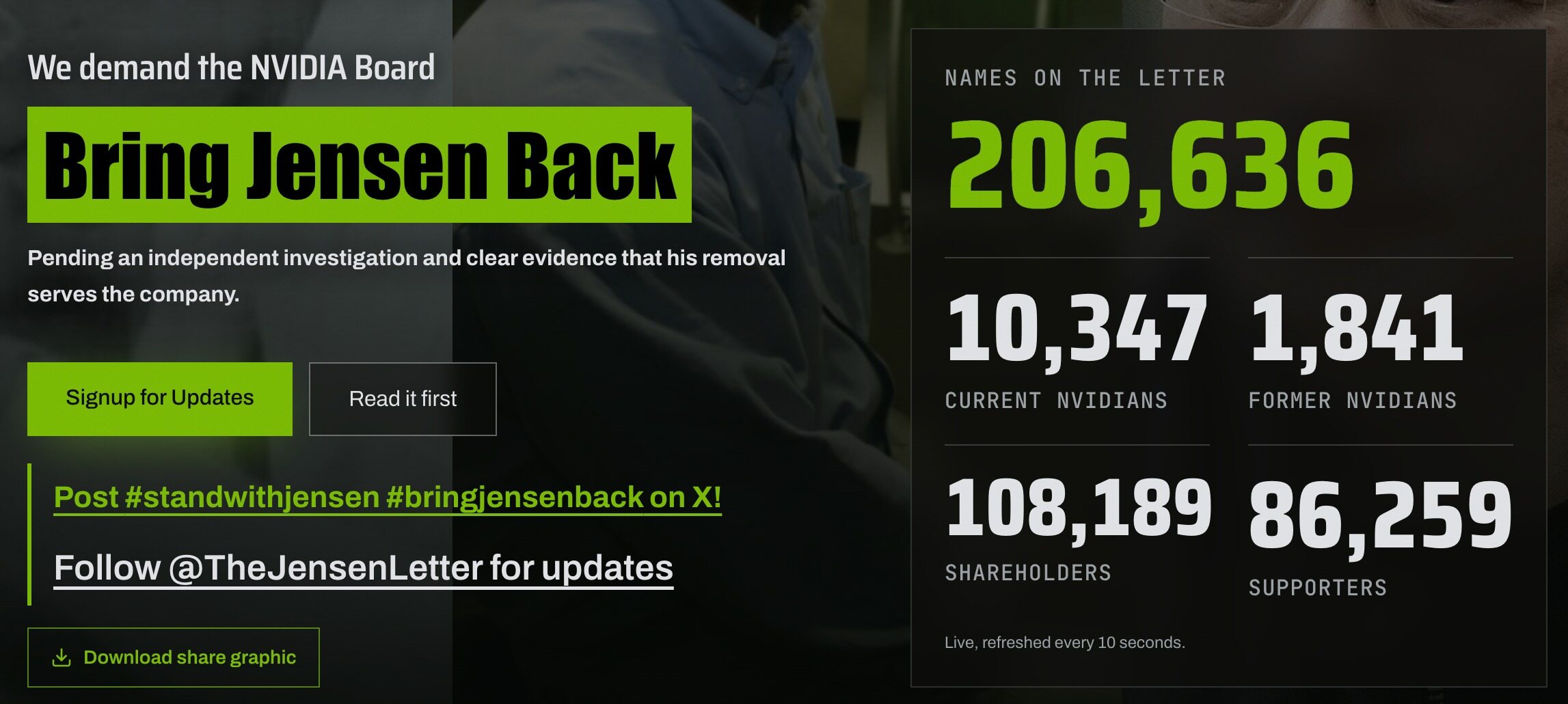
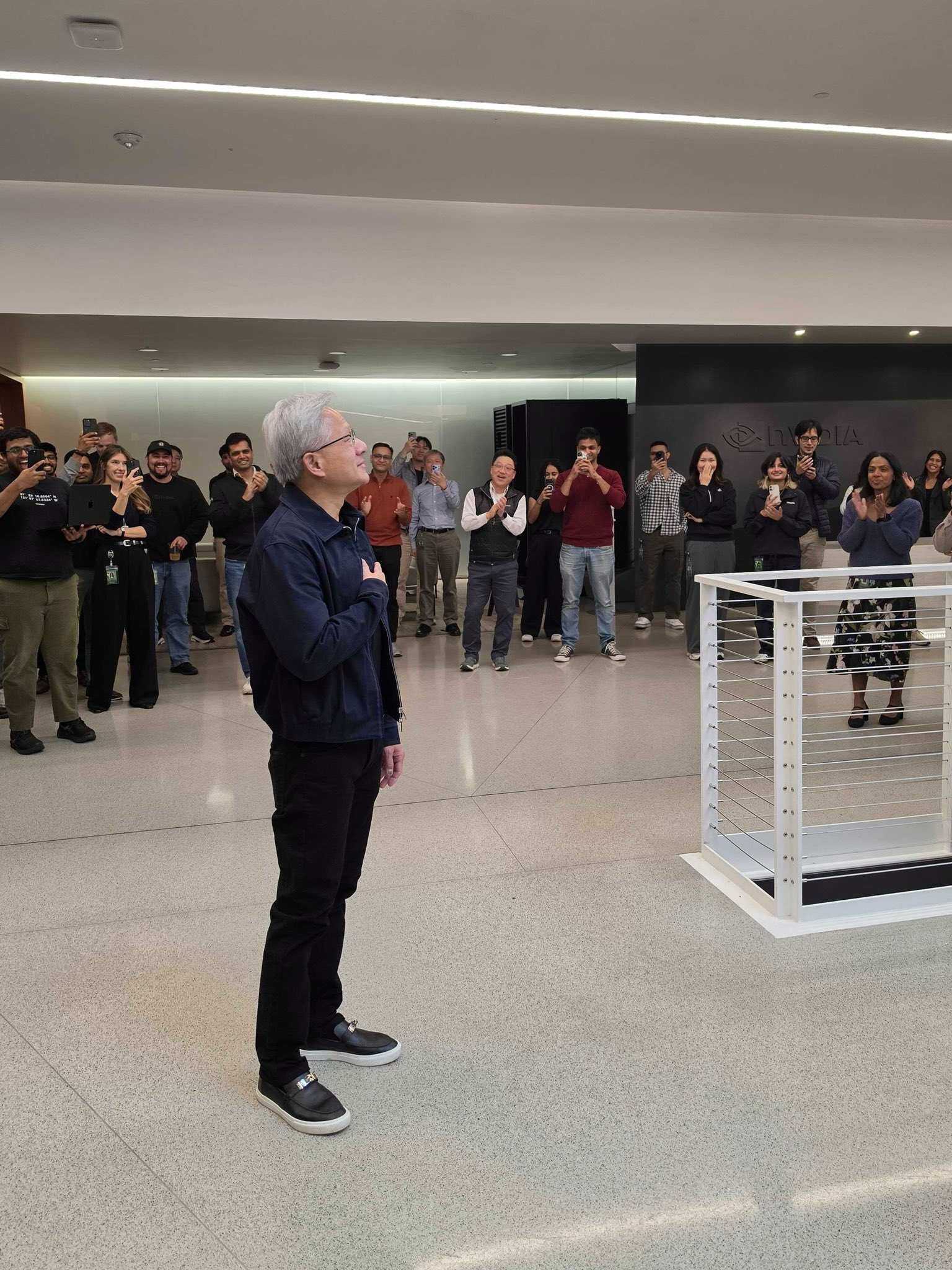
Now, with Jensen Huang's official reinstatement, Nvidia employees welcomed him with enthusiastic applause at the company headquarters; the industry chain's upstream and downstream can finally stop worrying about short-term leadership changes; and Musk went so far as to state directly on X that "the mistake has been corrected."
Shareholders are winners too — after days of steep declines, they finally got the big rebound.
For investors, these 11 days were undoubtedly a roller coaster. After Jensen Huang's departure, the market quickly began pricing in Nvidia's succession risk, and the AI industry chain was affected as well. The market had already been under pressure from AI capital expenditure, data center construction, and chip export restrictions, and Nvidia's leadership crisis further amplified the panic.
During this period, even though Nvidia delivered an earnings report on November 18 with both revenue and profit exceeding expectations, the market still wasn't buying it — after a slight rebound, the decline accelerated once again.
Now, a single reinstatement statement not only sent Nvidia surging 31% in one day but also drove the Dow up about 3%, the S&P 500 up 4.7%, and the Nasdaq soaring 6.5% — the largest single-day gain since April of last year.
Those investors who gritted their teeth and held on through the darkest hours, or even dared to buy the dip against the trend, have finally seen the dawn. Of course, the market rebound doesn't mean all previous losses have been recovered, but at least the biggest uncertainty has been eliminated.
The Disheartened Faction: Politicians Set Back, Rivals Caught Off Guard, "Traitors" Embarrassed
Where there is joy, there is bound to be disappointment. Jensen Huang's strong return is also destined to leave some people reeling.
First and foremost are the Republican China hawks and the Democrats lying in wait.
Looking back at the entire saga, U.S. Secretary of State Rubio played the key role of "the igniter." As early as this spring, Rubio had written a classified memo warning the White House about Jensen Huang's personal relationships and chip export issues, attempting to use the opportunity to tighten the technology blockade against China.
Treasury Secretary Bessent was likewise one of Nvidia's most outspoken critics. He had questioned the compliance of Nvidia's chip sales to China and even publicly suggested the board seek a new CEO from outside (after the reinstatement, he changed his tune, saying "Jensen Huang was also an outsider at the time"), calling for a thorough overhaul of the company.
Now that Jensen Huang has retaken power with Trump's push, these officials who previously advocated tougher measures against Nvidia are clearly in a relatively passive position.
Compared to the Republican hawks, even more frustrated are the Democrats who are set to formally take control of both chambers of Congress in January next year and had originally planned to use the Nvidia controversy to tighten regulation. For them, Jensen Huang's lightning return not only disrupted the pressure rhythm previously built around "national security" and "chip export controls" but also made White House direct intervention in corporate governance a new political controversy.
After the reinstatement news was announced, heavyweight Democrats including Schumer, Warren, and Himes quickly went on the offensive, focusing their counterattack on Capitol Hill next week — according to the original schedule, the December 1 closed-door multi-committee inquiry in the House and the December 3 public hearing of the Senate Banking Committee will proceed as planned. For the Democrats, having failed to stop Jensen Huang's "return to the palace" for now, the real counterattack may only be just beginning.
Also quietly nursing their wounds are the hidden forces competing for AI dominance behind the scenes.
Behind Jensen Huang's being besieged by public opinion, the covert rivalry between Silicon Valley and Washington has been flickering in and out of view. The frontier model faction represented by Anthropic founder Dario has long been at odds with Jensen Huang over AI safety regulation and computing power blockades against China, and its policy network is closely connected to Washington political circles. When Jensen Huang stepped down previously, reports also disclosed that Dario was one of the core drivers behind the事件.
Interestingly, just one week after Jensen Huang's黯然 exit, Anthropic happened to land on the capital markets on November 19 — precisely the perfect window to seize Wall Street's core AI narrative amid Nvidia's turmoil.
Clearly, this grand chess game did not go according to their script.
Also kicking themselves are the institutions and retail investors who sold Nvidia too early before the dawn.
During this 11-day trust crisis, Wall Street's bears at one point thought they had finally found the perfect opportunity to "hunt the giant." On November 17, on the eve of Nvidia's earnings release, well-known short-selling firm Muddy Waters made a high-profile entry, publishing a 12-page short report directly alleging that former Nvidia executive Ajay Puri had hidden connections with a former executive of Super Micro Computer (SMCI), which is embroiled in a China chip smuggling lawsuit — attempting to pour salt on the wound of the "governance crisis."
Although the savvy Muddy Waters left itself an out in the report, admitting it planned to quickly close most of its short positions after publication, the various momentum-chasing funds ignited by the short-selling sentiment were not so lucky. As Jensen Huang made his lightning return and the stock surged 31% in a single day, the shorts instantly faced an epic squeeze — according to ORTEX estimates, Nvidia shorts recorded approximately $12.2 billion in mark-to-market losses on the day of Jensen Huang's reinstatement alone.
Even more dramatic than the shorts is "Woody" Cathie Wood, who stepped on the rhythm precisely backwards. The latest disclosed holdings show that her ARK funds had just aggressively added 1.18 million Nvidia shares in the third quarter, at one point sitting on losses exceeding 30%. Yet on November 19, Anthropic's first trading day, ARK splurged $77.6 million buying Anthropic while continuously trimming Nvidia shares... Just two trading days later, Nvidia staged an epic single-day rebound of 31%. This classic move of "selling at the floor and chasing at the peak" will likely leave many Wall Street fund managers who handed over their chips early regretting it deeply.
The most restless are none other than the executives eager to usher in the "post-Jensen Huang era."
At the front of this group are the opposition forces within the board. After unanimously passing the resolution on Jensen Huang's resignation on November 12, the board not only swiftly appointed former Synopsys CEO Harvey Jones as the company's first-ever board chairman but also adopted a hardline posture of complete separation. On November 17 — just hours after Jensen Huang had publicly softened his stance, saying he would be willing to return "if invited" — Harvey Jones poured cold water directly on the earnings call: "The board has no intention of restoring Jensen Huang's CEO position."
Yet just six days later, under combined pressure from the White House, major shareholders, and employees, the same board executed a 180-degree turn, unanimously approving the reinstatement resolution.
Even more awkward than the board members are the frontline executives who pledged loyalty to the new order too early during the power vacuum.
The most representative example is none other than Bryan Catanzaro, Nvidia's Vice President of Applied Deep Learning Research. The day after Jensen Huang's departure, Bryan Catanzaro's signature appeared on the Stand With Jensen support website (the site does not verify identities, so there are many forged celebrity signatures).
This matter had drawn little attention and could have simply been ignored. But Bryan Catanzaro went out of his way to add a high-profile jab on X: "A fake open letter is circulating online claiming that I participated in it and demanding that Nvidia's board reinstate Jensen Huang as CEO. This letter is obviously fake, and even if it were real, I would not sign it."
Tonight, perhaps we'll be seeing this guy's resume on LinkedIn...
Technology and Politics Begin to Bind Openly
Looking back at these breathtaking 11 days, the controversy surrounding Jensen Huang has completely torn away the thin veil between technology and politics — when computing power becomes the oil of a new era, when a tech giant's market value is deeply bound to national strategy, it can no longer remain aloof.
A phone call from Trump can make the board swiftly change its tune; likewise, the upcoming congressional closed-door inquiries and public hearings in early December, the pending SEC and DOJ investigations, and the already cracked relationships between executives and the board all serve as reminders to the market that this storm is far from truly over.
Jensen Huang took 11 days to win back Nvidia's throne, but Nvidia can never return to the era when it only talked about technology and never about politics.