Borrowed $77 Million — Did Sky's Founder Drain His Own Lending Pool?


- Key Takeaways: Sky founder Rune's excessive borrowing has depleted liquidity in the stUSDS lending pool, leaving a $159 million pool with no funds available for withdrawal. His $77.1 million personal debt accounts for 48% of the pool's total debt, triggering a sharp sell-off in the SKY token and a crisis of confidence in the protocol.
- Key Facts:
- The stUSDS lending pool's capital utilization rate has reached 99.99%, with available liquidity at zero and the annualized deposit rate surging to the 50% cap.
- Rune's associated wallets have cumulatively borrowed 66.7 million USDS, with $10.4 million in outstanding interest, bringing total debt to $77.1 million — 25 borrowings and zero repayments since positions were opened.
- In September 2025, Sky disabled automatic liquidation and lowered the minimum collateral ratio from 145% to 120%. Three of Rune's four positions are now below the liquidation threshold.
- Raw Power Games, the game studio founded by Rune, lost approximately $16 million in 2025 and went bankrupt on October 30 — with new borrowing activity occurring just four days before the bankruptcy filing.
- SKY has fallen nearly 25% over the past 7 days to around $0.04; repaying the debt at this price would require selling approximately 1.925 billion SKY tokens.
- Du Jun has publicly expressed interest in acquiring all of Rune's SKY, reminiscent of the 2023 case where Curve's founder sold CRV at a discount to repay debt.
Original | Odaily@OdailyChina)
Author | Asher (@Asher_ 0210)

Last night, Sky, a veteran DeFi protocol, put on quite a dramatic show.
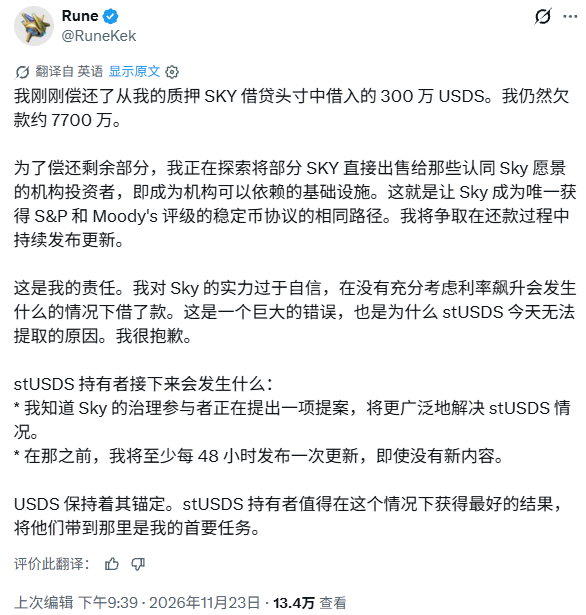
Founder Rune had just repaid 3 million USDS to his own lending pool — and within 24 seconds, the funds were completely drained by depositors and arbitrage bots. Before that, this lending pool, with nearly $160 million in assets, had been unable to process withdrawals for more than ten consecutive days, and the deposit APY had even soared to 50%.
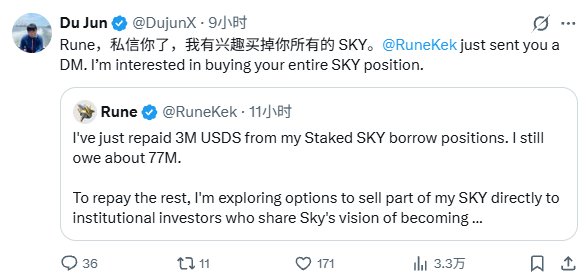
After multiple South Korean crypto exchanges successively flagged SKY and its stablecoin USDS as investment warning targets, Rune publicly apologized on X, admitting that his excessive borrowing was a major reason stUSDS users could not withdraw funds. Currently, Rune still owes approximately 77 million USDS and plans to repay the debt by selling a portion of SKY tokens to institutional investors.
As the incident continued to escalate, SKY also suffered a sharp sell-off. As of publication, SKY has fallen to around $0.04, down nearly 25% over the past 7 days. How did Sky's stUSDS lending pool go from being flush with capital to having no money available for withdrawals?
APY Soars to 50%: Why Can't a $159 Million Lending Pool Process Withdrawals?
As one of the earliest protocols in the DeFi industry, Sky once became a flagship on-chain finance project thanks to its decentralized stablecoin DAI. In 2024, MakerDAO rebranded as Sky and launched the stablecoin USDS and governance token SKY, corresponding to the former DAI and MKR. Currently, Sky's business covers stablecoin issuance, savings, lending, and RWA, among other areas.
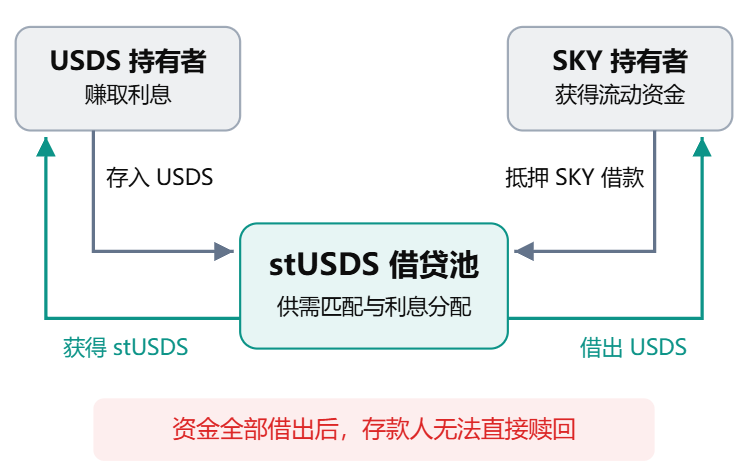
The product at the center of this incident is Sky's stUSDS lending product. Unlike the ordinary stablecoin savings product sUSDS, stUSDS is specifically designed to provide funding for SKY-collateralized borrowing. Users deposit USDS and receive stUSDS as a yield-bearing receipt; borrowers collateralize their staked SKY to borrow USDS, and the interest they pay goes to depositors. Once all funds in the pool are borrowed out, depositors can only redeem normally after borrowers repay or new funds enter the pool.
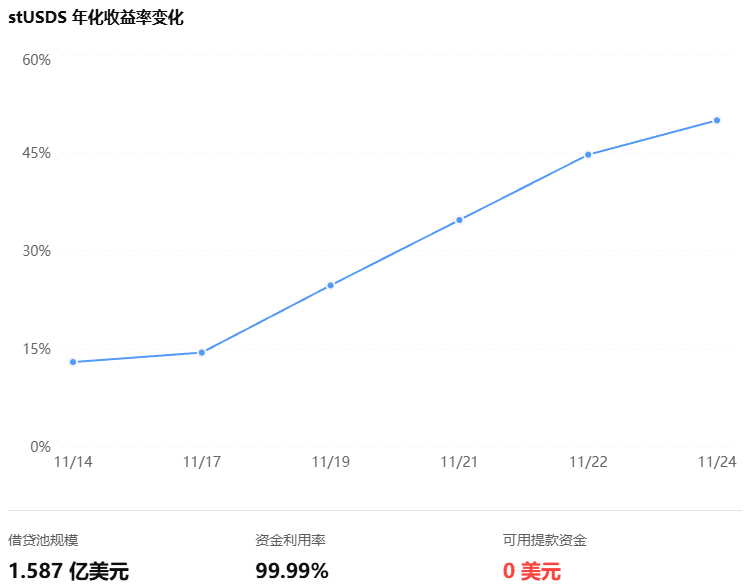
According to Bitquery, on September 6 this year, the stUSDS lending pool's assets once reached $209 million. As market conditions weakened, capital began flowing out at an accelerating pace, with single-day withdrawal peaks of about $14.2 million on both October 30 and November 10. Since November 10, the utilization rate of the stUSDS lending pool has remained close to 100%.
To attract new deposits and raise borrowers' cost of capital, the stUSDS APY continued to climb from 14.45% on November 17 to 50%. As of now, the stUSDS lending pool holds approximately $158.7 million in assets, with a utilization rate as high as 99.99% and zero available withdrawal liquidity.
In fact, Sky had already considered the exit problem when utilization reached 100% last year and expanded exit channels through protocols such as Curve and Morpho. However, during this withdrawal wave, stUSDS accounted for more than 80% of the relevant Curve trading pool at one point, and available liquidity in multiple related lending pools on Morpho was also exhausted. These additional exit channels were far from sufficient to meet depositors' redemption needs.
Now, with the stUSDS APY having hit its ceiling and additional exit channels successively failing, depositors can only hope that large borrowers will proactively repay. And the largest borrower, who accounts for nearly half of the lending pool's debt, is none other than Sky founder Rune.
Borrowing Without Repaying for a Year and a Half: Where Did the Money Rune Borrowed Go?
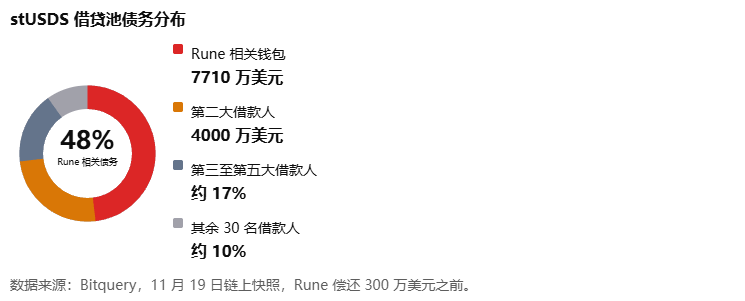
Data shows that the rune.eth multisig wallet associated with Rune has borrowed a cumulative 66.7 million USDS through four borrowing positions. Adding the 10.4 million USDS in unpaid interest, the total debt reaches $77.1 million, accounting for 48% of the entire stUSDS lending pool's debt.
Since establishing positions on Sky's new lending engine in May 2025, the wallet has carried out 25 borrowing operations in total (including migration of old debt), yet has not made a single repayment. In fact, the risk of excessive borrowing concentration had already been exposed last year. In October 2025, DeFi risk research firm LlamaRisk pointed out that this address accounted for about 93% of the debt in the SKY-collateralized lending market at the time. Over the past year or so, as other borrowers entered, this share has declined somewhat, but Rune's debt scale has grown from about $52.9 million to $77.1 million.
The reason Rune's collateralized position has not been liquidated stems from Sky's adjustment of lending rules in the second half of last year. In September 2025, to avoid large-scale liquidations caused by insufficient liquidity during the MKR-to-SKY migration, Sky disabled the automatic liquidation function and subsequently lowered the minimum collateral ratio from 145% to 120%. Currently, three of Rune's four borrowing positions are below the liquidation threshold. Given SKY's continued price decline and insufficient secondary-market liquidity, forced liquidation could further intensify selling pressure and expand the lending pool's bad-debt risk.
Rather than why Rune was able to borrow such a massive amount, the market is more concerned about where exactly these tens of millions of dollars in borrowed funds were used.
Failed Personal Venture — Or the Reason Behind Rune's Massive Borrowing?
Currently, the most discussed topic in the market is Raw Power Games, the game studio founded by Rune.
Raw Power Games was founded in 2020 and primarily develops the medieval war strategy game "Chronicles: Medieval." According to Danish business registration information, the company lost approximately 109 million Danish kroner (about $16 million) in 2025 alone, and its annual financial report shows that the company's continued operation depends on funding support from its parent company. On October 30 this year, Raw Power Games officially declared bankruptcy. On November 14, Swedish game company Coffee Stain announced the acquisition of its game intellectual property and related assets for approximately $5.42 million.
It is worth noting that just four days before Raw Power Games' bankruptcy, a Rune-associated wallet once again collateralized SKY to borrow 1 million USDS. According to Bitquery tracking, after being borrowed, these funds were converted to USDC and transferred to Kraken within 43 minutes. In addition, since 2024, this wallet has cumulatively transferred approximately 74.6 million USDC to deposit addresses associated with Swiss crypto asset broker Bitcoin Suisse.
The game company's long-term losses and reliance on external funding to sustain operations, combined with Rune's continued SKY-collateralized borrowing — including new borrowing operations even on the eve of the company's bankruptcy — have led many community members to suspect that Rune may have used part of the borrowed funds to sustain the operations of his personal venture. However, on-chain funds can currently only be traced to centralized exchanges and brokers, and the final use cannot yet be confirmed. Rune's public apology last night also did not explain where this massive borrowing went.
If the current 50% annualized borrowing rate remains unchanged, Rune's remaining $77 million debt will accrue approximately $100,000 in interest per day. Under the dual pressure of high interest and SKY's continued price decline, Rune urgently needs to raise funds by selling SKY.
Du Jun Interested in Buying All of Rune's SKY: Will the Curve Founder's Story Repeat?
After Rune announced his intention to sell SKY to institutional investors, Du Jun, co-founder of ABCDE Capital, quickly publicly expressed his acquisition interest: "Rune, DM'd you. I'm interested in buying all your SKY."
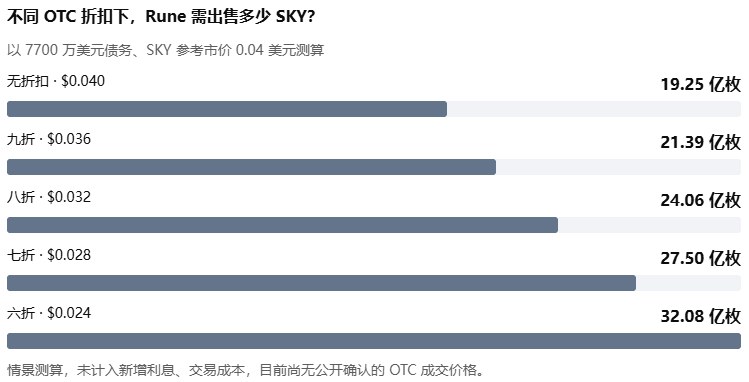
Some community members also said they do not doubt Rune's loyalty to Sky, given that he had previously sold large amounts of other crypto assets to increase his holdings of his own token. Considering that the Sky protocol itself still has strong profitability, institutions may not lack the willingness to take over — the key is how large a discount Rune is willing to offer. At SKY's current price of about $0.04, if Rune wants to repay the remaining $77 million in debt, he would need to sell approximately 1.925 billion SKY; if the deal is struck at 70% of the market price, he would need to sell approximately 2.75 billion SKY.
In fact, a similar story once played out with Curve founder Michael Egorov, and Du Jun was one of the buyers at that time. In 2023, Curve suffered a Vyper vulnerability attack, CRV's price fell sharply, and Michael Egorov's nearly $100 million in collateralized borrowing faced liquidation risk. To address this, he sold more than 100 million CRV to investors including Justin Sun, Du Jun, and DWF Labs at $0.40 per token, with Du Jun contributing $4 million to purchase 10 million CRV.
Currently, the Sky governance community is also discussing solutions, including lowering the stUSDS APY to 10%, pausing new borrowing, and using protocol reserve funds to buy back stUSDS, but the relevant proposals have not yet been formally implemented. Even if Rune can successfully repay all his debt, the debts of other large borrowers and the long-term shutdown of automatic liquidation remain unresolved.
From Curve to Sky, the story of a DeFi founder collateralizing his own token to borrow heavily is repeating itself. When the market is good, founders can obtain large amounts of cash without selling tokens; when the market turns bad, personal debt can evolve into a liquidity crisis for the entire protocol.
Quite ironically, Sky, as a pioneer of the DeFi industry, now leaves depositors hoping for the founder's personal ability to repay debt.