Selling common stock, halting bitcoin purchases: Saylor spends $4 billion to buy back STRC—who exactly is footing the bill?


- Core Viewpoint: Strategy raised its STRC preferred stock buyback authorization for the third time to $4 billion. Although it financed the preferred stock buyback by issuing additional common stock—reducing dividend liabilities—it caused the common stock to fall 21.1% and bitcoin per share to shrink, sparking controversy over capital allocation.
- Key Elements:
- $2.88 billion has already been used to buy back STRC, accounting for 96% of the original $3 billion authorization; STRC closed at $93.60, still unable to hold above its $100 par value.
- Last week, 1.93 million MSTR shares were issued, raising $176.7 million, of which 83.2% was used to buy back STRC and only 16.8% was used to purchase 457 bitcoins.
- Bitcoin per share fell from 186,082 satoshis to 185,392 satoshis, a decrease of 690 satoshis (a 0.37% decline), because the pace of share dilution exceeded the pace of holdings growth.
- Saylor defended the move using the "net bitcoin per share" metric, claiming an cumulative increase of 584 satoshis over 13 weeks; analysts question that the average buyback price of $97.93 was higher than the average issuance price of $95.81.
- The company was permitted to convert $1 billion of its dedicated reserve into freely disposable cash, allowing it to flexibly choose between buying back STRC or purchasing bitcoin; the remaining buyback authorization stands at $1.1 billion.
Author: Oluwapelumi Adejumo
Compiled by: Saoirse, Foresight News
On Monday (early morning ET, November 23), Strategy raised its STRC repurchase authorization for the third time, increasing the total planned amount to $4 billion, while the company's common stock has continued to weaken.
During the week ended November 22, the company spent another $211.8 million to repurchase STRC. To date, the company has deployed nearly $2.88 billion, representing 96% of the previous $3 billion authorization.
This latest increase comes as Strategy's common stock has fallen 21.1% since the STRC repurchase program was first announced on July 27. MSTR closed at $77.80 on November 20, compared with $98.65 four months earlier.
Strategy launched its first $1 billion digital credit repurchase program in June, expanded it to $2 billion in September, and further raised it to $3 billion in October. Monday's announcement marks the company's third consecutive $1 billion increase, bringing the total repurchase cap to $4 billion.
While continuing to ramp up repurchases, Strategy has shifted the focus of how it deploys proceeds raised from common stock.
The latest filing with the U.S. Securities and Exchange Commission (SEC) shows that the company issued 1.93 million MSTR shares last week, raising $176.7 million. Of that, $147 million (83.2%) was used to repurchase STRC, while only $29.6 million (16.8%) was used to purchase 457 bitcoins.
In addition, Strategy allocated $64.8 million from its own cash to complete the $211.8 million preferred stock repurchase.
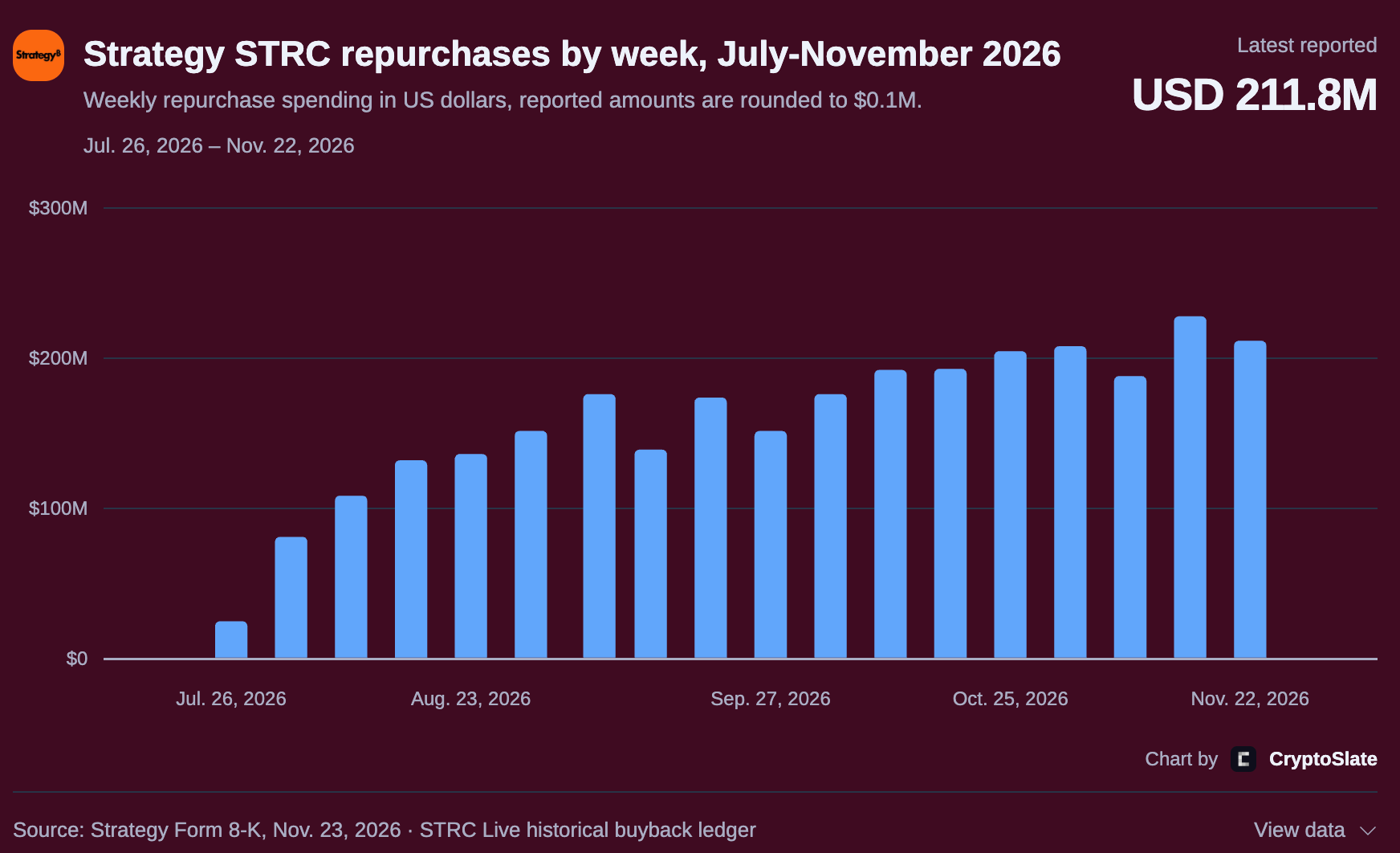
Weekly STRC repurchases from July to November 2026
While repurchases can ease future dividend obligations, STRC has consistently failed to hold its $100 par value. Despite Strategy setting a 12% annualized dividend yield to support the price, the security closed at $93.60 on November 20.
Meanwhile, Strategy has a separate $1 billion MSTR share repurchase authorization, none of which was used last week.
Is Bitcoin per share shrinking?
Bitcoin analyst Derin Olenik criticized the company's approach of relying on issuing additional common shares to fund preferred stock repurchases, arguing that the move dilutes common shareholders' underlying Bitcoin exposure.
According to data disclosed by Strategy, in the most recent statistical week, the total Bitcoin holdings per share on a diluted basis declined. The company's Bitcoin holdings rose from 850,849 on November 15 to 851,305 on November 22, but diluted shares outstanding increased from about 457.24 million to 459.19 million. Ultimately, Bitcoin per share fell from about 186,082 satoshis to 185,392 satoshis, a decrease of 690 satoshis, or 0.37%.
However, Strategy Executive Chairman Michael Saylor defended this trading logic. He said that even if the transactions result in equity dilution, they still enhance shareholders' net Bitcoin exposure overall.
He stated:
"Over the past 13 weeks, our transactions have continued to increase net Bitcoin per share (BPS). Overall, net Bitcoin per share increased by 584 satoshis; measured at a fixed Bitcoin price, before deducting preferred stock dividends, net Bitcoin increased by 2,505, worth $199 million."
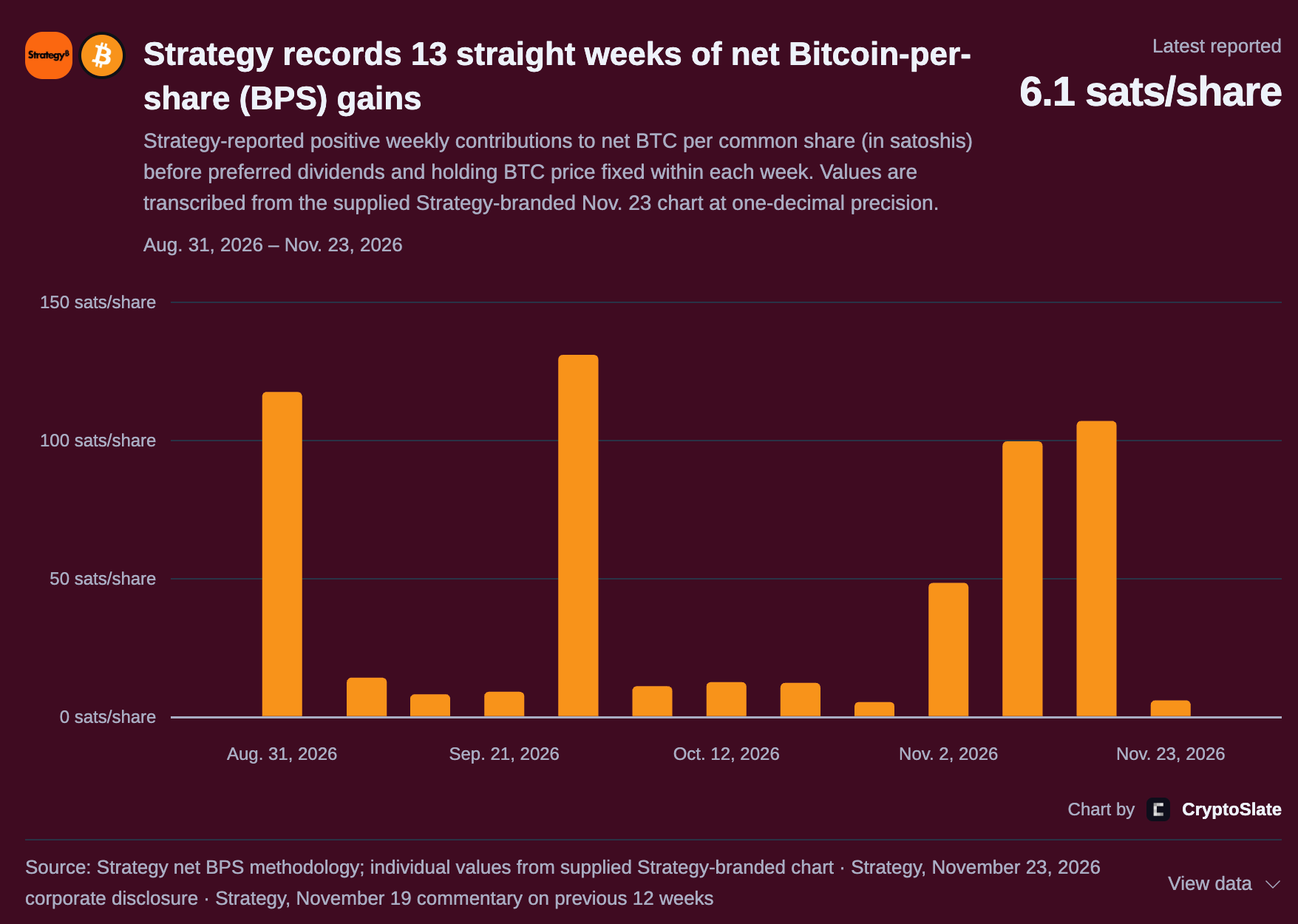
Strategy achieves net Bitcoin gain per share for 13 consecutive weeks
Saylor also noted that last week's transactions increased net Bitcoin per share by 6 satoshis, while the company's net reserve increased by $183 million.
The divergence between the two sets of data stems from the market using two very different frameworks to assess Strategy's capital allocation: total Bitcoin per share is calculated by directly dividing total Bitcoin holdings by total diluted shares; while the company's net Bitcoin per share metric takes preferred claims and dollar assets into account when calculating the Bitcoin exposure attributable to common shareholders.
Under Saylor's framework, issuing additional common shares does压低 total Bitcoin per share, but redeeming preferred securities can instead raise shareholders' net exposure. Even so, Derin Olenik still questions the economic rationality of this model: is it worth continuously diluting common shareholders' equity for increasingly complex transaction arrangements?
He also questioned the return logic of the STRC repurchases themselves: calculations show that STRC's average issuance price was $95.81, but the company's average repurchase cost reached $97.93 — meaning Strategy is spending more to repurchase preferred stock than it raised when initially issuing the securities.
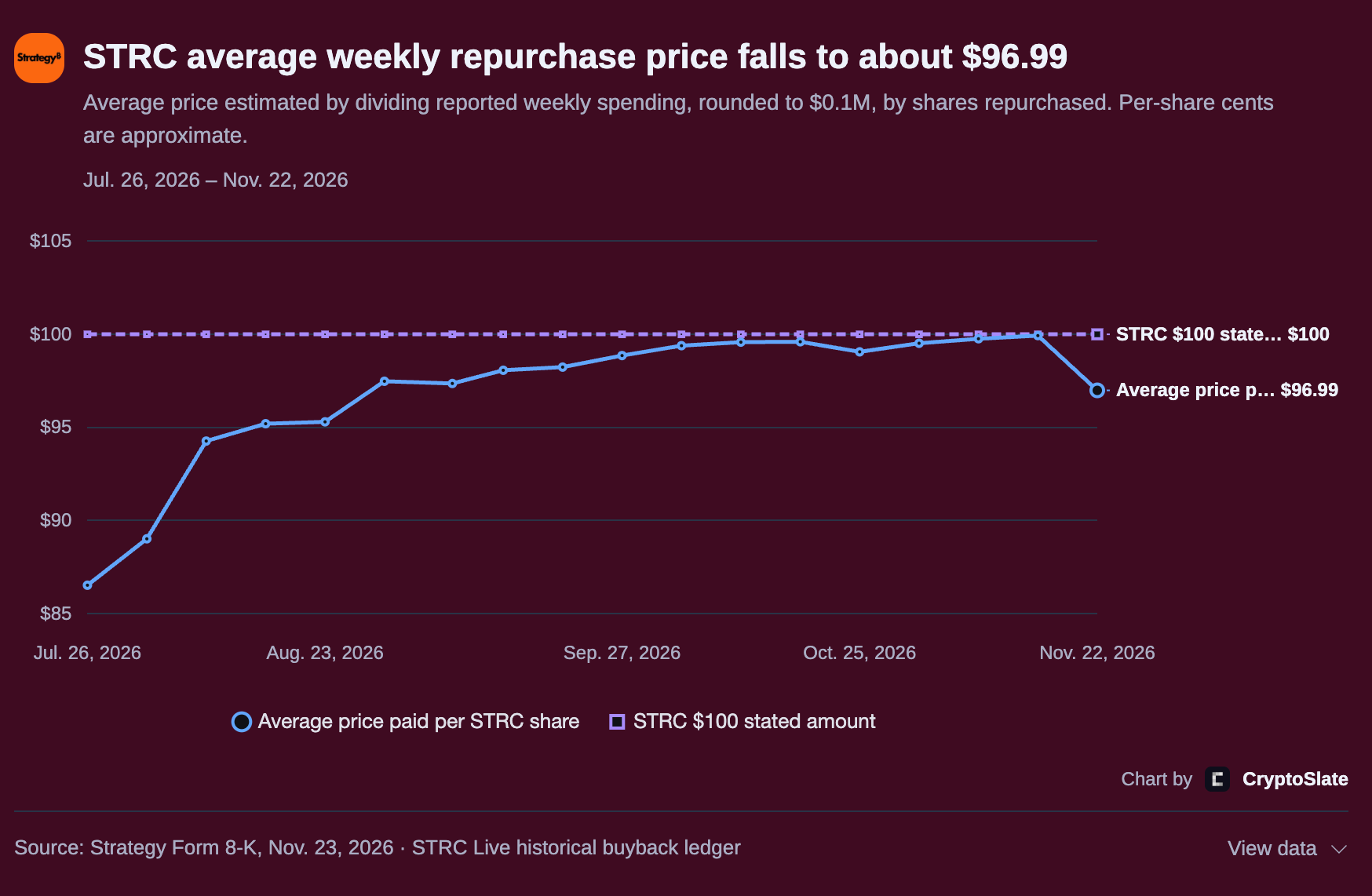
STRC's average weekly repurchase price falls to about $96.99
Strategy explained that repurchasing STRC below its $100 par value is reasonable — redeeming the securities can reduce future dividend liabilities. Saylor said the company has redeemed $2.9 billion of outstanding securities in recent months, which can reduce annual dividend expenses by about $353 million. In the latest round alone, the company redeemed 2.18 million STRC shares, which at the current 12% rate translates to $26.2 million in reduced annual dividend obligations.
Saylor reallocates $1 billion: available for repurchases or Bitcoin purchases
The announcement also indicated that reducing dividend liabilities remains one of the company's funding priorities.
Along with the third expansion of the repurchase authorization, Strategy has been permitted to convert $1 billion of its dedicated dollar reserve into discretionary cash. Management can flexibly choose to continue repurchasing STRC or buy Bitcoin. This differs from the original rules in July, when the terms explicitly prohibited using this dollar reserve to repurchase STRC.
Saylor explained that this reallocation is feasible because the remaining reserve can still cover dividend and interest expenses for the next 3.4 years. After the adjustment, the company's dedicated reserve stands at about $3.7 billion, discretionary cash exceeds $1 billion, and total dollar assets amount to about $4.8 billion.
Derin Olenik interpreted the adjustment as meaning that when issuing additional MSTR becomes less attractive, the company can rely more on its own liquidity. As a result, Strategy can continue redeeming preferred stock without being fully dependent on new common stock financing; however, the company has not yet finalized the specific use of these reallocated funds.
Currently, the remaining authorized amount for STRC repurchases is $1.1 billion, roughly equivalent to this discretionary cash. The next capital allocation decision will be critical: whether to continue deploying new funds into STRC repurchases, or to reverse the current situation of minimal Bitcoin purchases and ongoing dilution of MSTR shareholders' equity.