MSX US Stocks Daily Watch: Nvidia Q3 revenue doubles, Rubin contributes nearly $20 billion in first quarter, AI compute demand continues to materialize


- Core View: Nvidia's FY2027 Q3 revenue was approximately $115.8 billion, up 103% year over year, with the new Vera Rubin platform ramping to nearly $20 billion in its first quarter, providing earnings support for the sustainability of AI infrastructure investment; however, the decline in gross margin and customer financing risks require continued verification.
- Key Elements:
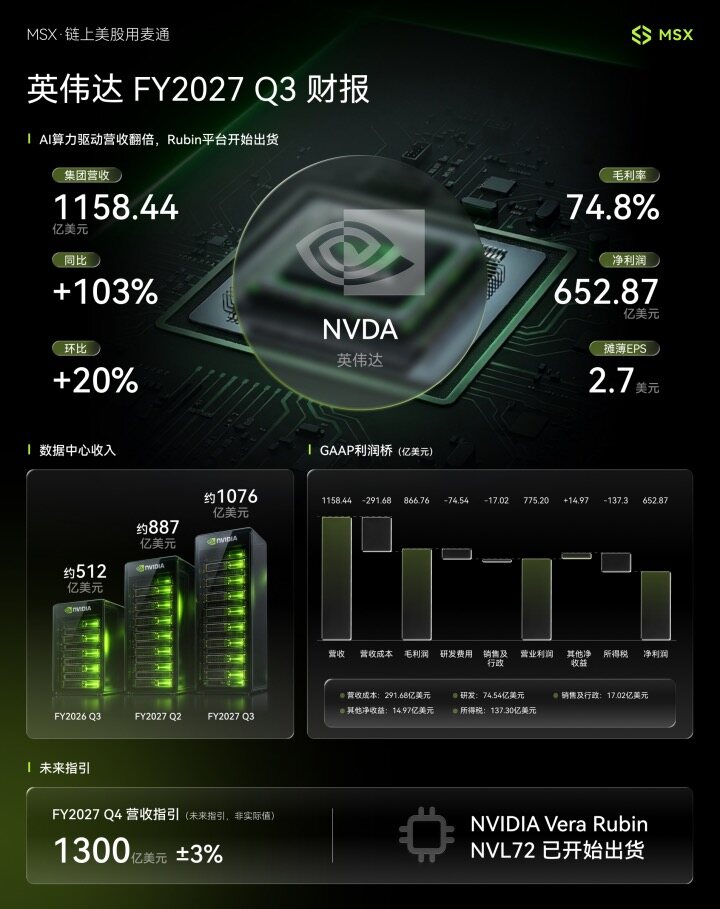
- Q3 revenue was approximately $115.8 billion, up 103% year over year and 20% quarter over quarter; data center revenue was $107.6 billion, up 110% year over year.
- Vera Rubin contributed nearly $20 billion in revenue in its first quarter of volume shipments, making it the fastest-ramping product platform in the company's history.
- Q4 revenue guidance midpoint is $130 billion (including an extra week), excluding China data center revenue; gross margin guidance fell to 71%–72%.
- Quarterly free cash flow was approximately $43.8 billion, up substantially year over year, with about $28.1 billion returned to shareholders through buybacks and dividends.
- Supply purchase commitments rose from approximately $279 billion to $390 billion, mainly due to multi-year memory procurement, and long-term funding obligations need continued management.
- Management will be more prudent in supporting new cloud service providers, and customer paid demand and compute utilization will become key cross-validation indicators for growth quality.
- Colette Kress serves as interim CEO, and execution stability during the management transition needs to be observed in subsequent quarters.
[MSX Research Institute · Daily US Equity RWA Observations] is a signature daily report produced by MSX Maitong, a leading RWA trading platform. Leveraging our strong macro research capabilities, we capture the core pulse of global traditional US equities, liquidity changes, and the RWA tokenization market to help you position ahead in quality assets.
Today's Observations
NVIDIA's latest earnings report provides new performance support for the sustainability of AI infrastructure investment. On November 17 US Eastern Time, NVIDIA reported FY2027 third-quarter results: revenue reached approximately $115.8 billion, up 103% year-over-year and 20% quarter-over-quarter; adjusted earnings per share were $2.68. Both metrics exceeded market expectations.
The most noteworthy change this quarter is that the new-generation Vera Rubin platform began contributing large-scale revenue. Management stated that Rubin generated nearly $20 billion in revenue in its first quarter of volume shipments, making it the fastest-ramping product platform in the company's history. Meanwhile, demand for Blackwell remained strong, driving data center business revenue up 110% year-over-year.
Growth momentum also extends into the next quarter. The company expects FY2027 fourth-quarter revenue of $130 billion, plus or minus 3%, and this guidance does not include data center computing revenue from China. It should be noted that the fourth quarter has one extra week compared with a typical quarter, and this factor should be considered when comparing quarter-over-quarter growth rates.
Data in a Minute
• FY2027 Q3 revenue of approximately $115.8 billion, up 103% year-over-year and 20% quarter-over-quarter;
• Data center revenue of $107.6 billion, up 110% year-over-year and 21% quarter-over-quarter;
• GAAP net income of approximately $65.3 billion, up 105% year-over-year;
• GAAP diluted EPS of $2.70, adjusted EPS of $2.68;
• GAAP gross margin of 74.8%, adjusted gross margin of 74.9%;
• Quarterly operating cash flow of $48.253 billion, free cash flow of $43.777 billion;
• Returned approximately $28.1 billion to shareholders through buybacks and cash dividends this quarter.
• Within the data center business, hyperscale customer revenue was approximately $60.1 billion; AI cloud, industrial, and enterprise customer revenue was approximately $47.5 billion.
• Vera Rubin contributed nearly $20 billion in revenue in its first quarter of volume shipments;
• FY2027 Q4 revenue guidance midpoint of $130 billion, plus or minus 3%, with the quarter including an extra week;
• Q4 GAAP and adjusted gross margin guidance both at 71%–72%;
• Management raised its FY2028 revenue growth outlook to approximately 75% from approximately 70%, and expects gross margin of 72%–73% for the fiscal year. All of the above are forward-looking judgments.
MSX View
Understanding NVIDIA's earnings report can be approached from three aspects: whether the new platform can ramp smoothly, whether growth can be converted into cash, and whether customers can continue to bear increasingly large infrastructure investments.
First, Rubin's revenue contribution shows that NVIDIA is translating its product roadmap into actual deliveries. For cloud providers, purchasing new-generation computing power involves racks, power, cooling, networking, and software adaptation. The new platform's ability to generate revenue relatively quickly helps shorten the time between customers purchasing equipment and providing cloud services, and also improves the efficiency of NVIDIA's supply chain expansion. However, first-quarter ramp primarily reflects procurement and delivery progress; the utilization rate after equipment is put into use and customers' return on investment still require subsequent verification.
From the customer structure perspective, both hyperscale customers and AI cloud, industrial, and enterprise customers contributed significant revenue. The expansion of demand sources can increase NVIDIA's opportunities to participate in different AI application scenarios. But different customers differ in financial strength and revenue models; when analyzing growth quality, it is also necessary to observe order payment terms, collection speed, and customers' own commercialization progress.
Second, gross margin will become an important indicator to watch in the next stage. Adjusted gross margin reached 74.9% this quarter, but fourth-quarter guidance is 71%–72%. This decline continues the outlook the company previously provided: management had already discussed rising supply costs in the previous quarter and expected new pricing to gradually take effect, bringing FY2028 gross margin back to 72%–73%. Therefore, what needs to be verified going forward is whether cost changes and price adjustments can connect as planned.
Lower gross margin and higher profit scale can occur simultaneously. If revenue grows fast enough, increased sales may still drive gross profit and operating profit higher. But as the revenue base rises, each one-percentage-point change in gross margin will have a significantly greater impact on profit. When assessing NVIDIA's profitability, the market needs to look at revenue scale, product mix, and unit costs together.
Cash flow provides another pillar of support. NVIDIA's free cash flow this quarter was approximately $43.8 billion, up from approximately $22.1 billion in the same period last year, while the company continued buybacks and dividends. This gives the company the ability to allocate capital among R&D, supply chain, and shareholder returns, and also preserves room to cope with product iteration and demand fluctuations.
However, the way NVIDIA participates in industry expansion is becoming more complex. The company's disclosed supply procurement commitments rose to $390 billion from approximately $279 billion in the previous quarter, mainly driven by multi-year memory purchases. The more adequate supply assurance is, the stronger order fulfillment capability becomes; the corresponding long-term funding and procurement obligations also need continuous management.
Customer financing also deserves attention. Management stated that future support for new cloud service providers will be more prudent, with selective evaluation of investments, commitments, and guarantees. From a business logic perspective, financing support can help customers build data centers faster, but a long-term healthy industry cycle still requires end-user paying demand to gradually cover cloud providers' operating and financing costs. Therefore, after chip shipment growth, cloud service revenue, computing utilization, and customer cash flow will become more important cross-validation indicators.
This earnings report also comes at a special time of management transition. Colette Kress currently serves as interim CEO, and the company is searching for a permanent successor. With the quarter ending October 25, assessing execution after the transition requires more observation of product delivery, team stability, and capital allocation in the coming quarters. How much momentum the existing technology platform and customer ecosystem can sustain will be gradually reflected through these operating results.
For the AI industry chain, NVIDIA's growth provides support for demand for advanced manufacturing, memory, networking, and data center equipment, but the profit each segment obtains still depends on its own supply-demand relationship. Expanded procurement volumes can increase revenue opportunities, while cost increases, competition, and capacity investment will also affect final returns. Between strong industry demand and improved profitability for each company, item-by-item verification is still needed.
The most important things to track next are whether Rubin can continue to expand deliveries, whether gross margin can stabilize along management's path, and whether revenue growth can continue to drive cash flow. NVIDIA has already demonstrated the ramp of a new platform and strong cash generation capability; as business scale further expands, delivery efficiency, capital discipline, and customer returns will jointly determine how long this round of growth can last.
About MSX Maitong:
MSX is a leading RWA trading platform dedicated to providing secure, efficient, and transparent access to global financial markets. As one of the world's earliest on-chain US equity trading platforms, MSX has always been at the forefront of the industry, leading market change through continuous innovation.
The platform deeply integrates blockchain technology with compliance frameworks, comprehensively offering spot and derivatives trading for nearly 400 tokenized stocks and Pre-IPO assets, perfectly bridging the gap between traditional finance and the digital asset industry.
Centered on the core mission of "letting quality assets flow freely," MSX has now built a diversified digital financial services system covering US equity spot and perpetual contracts, crypto-to-crypto trading, Pre-IPO, and the Maitong Research Institute, aiming to provide global investors with all-hours, high-performance access to quality assets.
Official Website: https://msx.com/
Chinese TG:https://t.me/MSXOfficial
Global TG:https://t.me/MSXGlobal

Risk Disclaimer: Macroeconomic conditions and US equity markets are highly volatile. The content of this article is for academic and research observation reference by the Maitong Research Institute only and does not constitute any investment advice.