Alibaba (BABA) FY2027 Q2 Earnings Preview: Can the AI Cloud Business Improve Cash Flow?


- Core Viewpoint: The core tension in Alibaba's FY2027 Q2 earnings lies in the博弈 between the rapid growth of the AI cloud business and the massive capital expenditure that has pushed free cash flow into negative territory. The market is watching three key validation points: improvement in cloud profit margins, narrowing losses in instant retail, and stabilization of CMR.
- Key Elements:
- The market expects Q2 total revenue to grow 8.9% year-over-year to RMB 269.85 billion, with earnings per ADS of $1.65; the earnings report will be released before U.S. market open on November 19.
- In Q1, Alibaba Cloud's external revenue growth reached 45%, AI product revenue hit RMB 12.4 billion with 12 consecutive quarters of triple-digit growth, ARR reached RMB 49.5 billion, and the cloud segment's adjusted EBITA rose 133% year-over-year to RMB 5.628 billion.
- Q1 capital expenditure surged 75% year-over-year to RMB 67.68 billion, resulting in a net free cash flow outflow of RMB 44.67 billion. Management stated that the investment payback period is expected to shorten from 3 years to 2.5 years.
- The e-commerce group's Q1 revenue was RMB 205.86 billion with adjusted EBITA of RMB 39.75 billion; instant retail revenue grew 45% to RMB 53.3 billion, but traditional e-commerce CMR declined 7% year-over-year.
- As of the end of June, the net cash position stood at RMB 207.975 billion. In August, an HKD 80 billion share placement was completed for AI infrastructure, and the Q1 buyback pace slowed to $162 million.
- The average target price from 14 Wall Street analysts is $186.86, while the current stock price is approximately $94.3, with a forward P/E ratio of less than 16x.
Alibaba Group (NYSE: BABA, HKEX: 9988) is scheduled to release its unaudited financial results for the second quarter of fiscal year 2027 (i.e., the third calendar quarter of 2026), ended September 30, 2026, before the U.S. market opens on Thursday, November 19, 2026, Eastern Standard Time, and will hold a conference call at 20:00 Singapore Time (07:00 EST) the same day. The market consensus expects total quarterly revenue to grow approximately 8.9% year-over-year to RMB 269.85 billion (USD consensus: USD 40.23 billion), with earnings per American Depositary Share (ADS) projected at USD 1.65. After the first quarter recorded 45% year-over-year growth in external cloud revenue (AI-related product revenue achieving triple-digit growth for the 12th consecutive quarter, reaching RMB 12.4 billion), but with quarterly capital expenditure surging 75% year-over-year to RMB 67.68 billion and resulting in a net free cash flow outflow of RMB 44.67 billion, the core focus of this Q2 report is whether the Cloud Intelligence Group can maintain high growth above 45% while further pushing the adjusted EBITA margin above 12%, and whether instant retail loss reduction can alleviate the阶段性 squeeze on free cash flow from massive AI infrastructure investment.
Key Takeaways
The key to understanding Alibaba's Q2 FY2027 earnings lies in grasping the dual narrative of "accelerating AI cloud profitability release" and "parallel heavy-asset investment in e-commerce and computing power." Looking back at the Alibaba Q1 earnings analysis released on August 20, 2026, the group's Q1 total revenue grew 9% year-over-year to RMB 268.953 billion, with Alibaba Cloud's external revenue and total revenue growth both accelerating to 45%, AI-related products rising to 35% of external cloud revenue (annualized run-rate revenue ARR reaching RMB 49.5 billion), driving cloud business adjusted EBITA to surge 133% year-over-year to RMB 5.628 billion; however, impacted by the AI Lab and Applications (Qwen inference and model R&D) recording an adjusted EBITA loss of RMB 13.861 billion and upfront investment in Taobao Instant Commerce, the group's overall adjusted EBITA declined 30% year-over-year to RMB 27.329 billion, with GAAP net income declining 75% year-over-year to RMB 10.444 billion. Subsequently, from August 24 to 26, the company completed the HKD 80 billion (approximately USD 10 billion) Hong Kong share placement as analyzed in the Alibaba USD 10 Billion AI Share Sale Analysis, specifically earmarked for expanding the global AI computing infrastructure. With BABA stock trading at USD 94.30 (corresponding to a forward P/E of approximately 11.6x to 16x, with Wall Street consensus target price of USD 186.86), the customer management revenue (CMR) trend, cloud business margins, and capital expenditure intensity before Thursday's market open will become the core catalysts determining stock price revaluation.
Fiscal Year Convention, Winter Time Conversion, and Q2 Consensus Baseline
According to the official notice published on November 6, 2026, on Alibaba's Investor Relations website and the Business Wire schedule announcement, the company will release its quarterly financial results for the period ended September 30, 2026, before the U.S. stock market opens (before 09:30 EST / 22:30 Singapore Time) on Thursday, November 19, 2026, Eastern Standard Time, and will hold a management conference call at 07:00 EST (20:00 Hong Kong and Singapore Time) the same day.
For cross-timezone investors tracking both U.S. and Hong Kong markets, two baseline conventions must first be clarified: First, Alibaba's fiscal year runs from April 1 to March 31 of the following year, so the three months ended September 30, 2026, is strictly labeled as Q2 FY2027 under the official fiscal year convention, corresponding to the September Quarter 2026 under the calendar quarter convention; Second, since the U.S. ended daylight saving time on November 1, 2026, and returned to Standard Time (EST, UTC-5), 07:00 EST corresponds to 12:00 UTC and 20:00 Singapore and Beijing Time (UTC+8) (one hour later than the 07:00 EST call during daylight saving time).
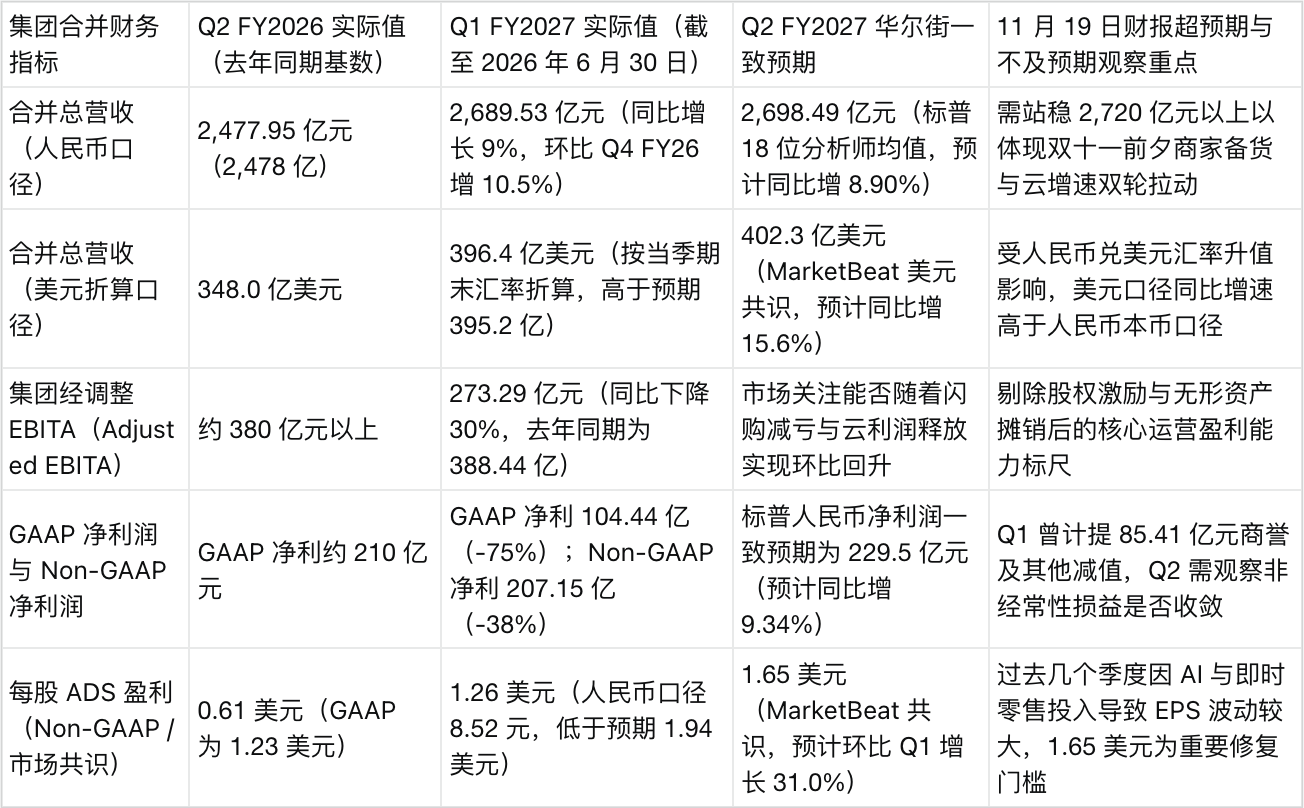
Combining the historical baseline disclosed in the SEC Q1 official financial statements, June 2026 quarterly report full text, as well as the Moomoo S&P consensus estimates (RMB-denominated average of 18 analysts) and MarketBeat earnings estimate statistics (USD ADS-denominated average), the table below provides a complete comparison of core financial metric expectations for the year-ago period (Q2 FY2026), the previous quarter (Q1 FY2027), and this Q2 report (Q2 FY2027).
Cloud Intelligence Group and AI Product Demand: Can 45% Growth, RMB 49.5 Billion ARR, and 12% Margin Continue to Rise?
In Alibaba's current valuation framework, Cloud Intelligence Group is the primary engine determining whether the P/E multiple can be revised upward. According to data disclosed in the TradingKey Q1 earnings call transcript and Tiger Brokers Q2 preview, Alibaba Cloud delivered a scorecard of both volume and price increases in Q1: cloud segment total revenue and external customer revenue growth both accelerated to 45% year-over-year (up 11 percentage points from 34% in the third calendar quarter of 2025), with AI-related products accounting for 35% of quarterly external cloud revenue, corresponding to quarterly AI product revenue of RMB 12.4 billion (approximately USD 1.8 billion), maintaining triple-digit (above 100%) year-over-year growth for the 12th consecutive quarter.
Based on the Q1 quarterly figure of RMB 12.4 billion, Alibaba's AI-related product annualized run-rate revenue (ARR) has reached RMB 49.5 billion (approximately USD 7.3 billion), up 38.3% quarter-over-quarter from RMB 35.8 billion ARR in Q4 FY2026. On the Q1 earnings call, CEO Eddie Wu and management reiterated two clear medium- to long-term quantitative targets: First, to achieve Model-as-a-Service (MaaS, based on the Qwen open-source and commercial model family and QwenWork enterprise-grade agents) ARR exceeding RMB 30 billion by the end of 2026; Second, to achieve external cloud annual revenue exceeding RMB 100 billion and reach a 20% gross margin level by 2030.

Analyzing the segment matrix in the table above, investors should focus on verifying three quantitative details of Alibaba Cloud before Thursday's market open: First, given the already elevated base of 34% cloud revenue growth in the year-ago period (Q3 calendar 2025), can cloud business external revenue growth remain firmly in the 40% to 45% range this quarter; Second, can AI-related products' share of external cloud revenue advance further from 35% in Q1 toward 40%, driving AI product ARR above RMB 55 billion to 60 billion; Third, as the proportion of high-margin public cloud and MaaS usage expands, can Cloud Intelligence Group's adjusted EBITA margin continue to expand from the Q1 level of 12% (adjusted EBITA of RMB 5.628 billion, up 133% year-over-year).
E-commerce Profitability Resilience and Instant Retail Loss Reduction: Can CMR Stabilize and Rebound?
If Alibaba Cloud determines Alibaba's valuation ceiling, then Alibaba E-commerce Group, accounting for 76.5% of group total revenue, is the cash flow foundation supporting the entire group's capital expenditure.
In Q1, Alibaba E-commerce Group achieved total revenue of RMB 205.862 billion (up 4% year-over-year), with segment adjusted EBITA reaching RMB 39.749 billion, essentially flat year-over-year (down only 1%). However, breaking down the internal structure of the e-commerce group reveals a clear transition between old and new growth drivers: On one hand, China instant retail business, including Freshippo and Taobao Instant Commerce, saw revenue surge 45% year-over-year to RMB 53.295 billion, and with improved order density and optimized delivery fulfillment efficiency, management confirmed that Taobao Instant Commerce's unit economics continued to improve with losses significantly narrowing; On the other hand, traditional China e-commerce business revenue declined 8% year-over-year to RMB 110.900 billion, with the most closely watched Taotian Group customer management revenue (CMR, mainly comprising advertising and commissions) declining 7% year-over-year.
Entering the second quarter ended September 30, the e-commerce segment faces two key tests: First, July to September covers summer consumption and the autumn back-to-school season, and is also the period of most intense instant retail delivery subsidy competition; investors need to verify whether Taobao Instant Commerce's per-order fulfillment cost declines as scheduled while maintaining market share; Second, as merchants gradually adapt to the Quanzhantui advertising tool and basic software service fees, can traditional China e-commerce customer management revenue (CMR) show significant marginal improvement from the -7% in Q1. As long as the e-commerce group can stably contribute adjusted EBITA of RMB 38 billion to 40 billion or more per quarter, the group will have sufficient endogenous profit to absorb AI lab R&D investment.
RMB 67.7 Billion Quarterly Capex and Negative Free Cash Flow: Analyzing the Investment Cycle and 3.5-Year Payback Arithmetic
The most debated metric among institutional investors in this earnings preview is Alibaba's free cash flow turning from positive to negative. According to the accounting framework of U.S. Stock Cash Flow Statement Analysis and U.S. Stock Financial Statements and Valuation, free cash flow equals net cash flow from operating activities minus capital expenditure.
In Q1, Alibaba's operating cash flow performance remained robust, growing 11% year-over-year to RMB 22.945 billion (RMB 20.672 billion in the year-ago period); however, due to the company investing up to RMB 67.678 billion (approximately USD 9.975 billion, up 75% year-over-year) in capital expenditure in the quarter (primarily for purchasing servers, network equipment, and data center construction) to meet surging AI computing orders, the RMB 67.660 billion cash outflow for equipment purchases far exceeded the RMB 22.945 billion operating cash inflow, resulting in net free cash flow outflow of RMB 44.670 billion for the quarter (net outflow of RMB 18.815 billion in the year-ago period).
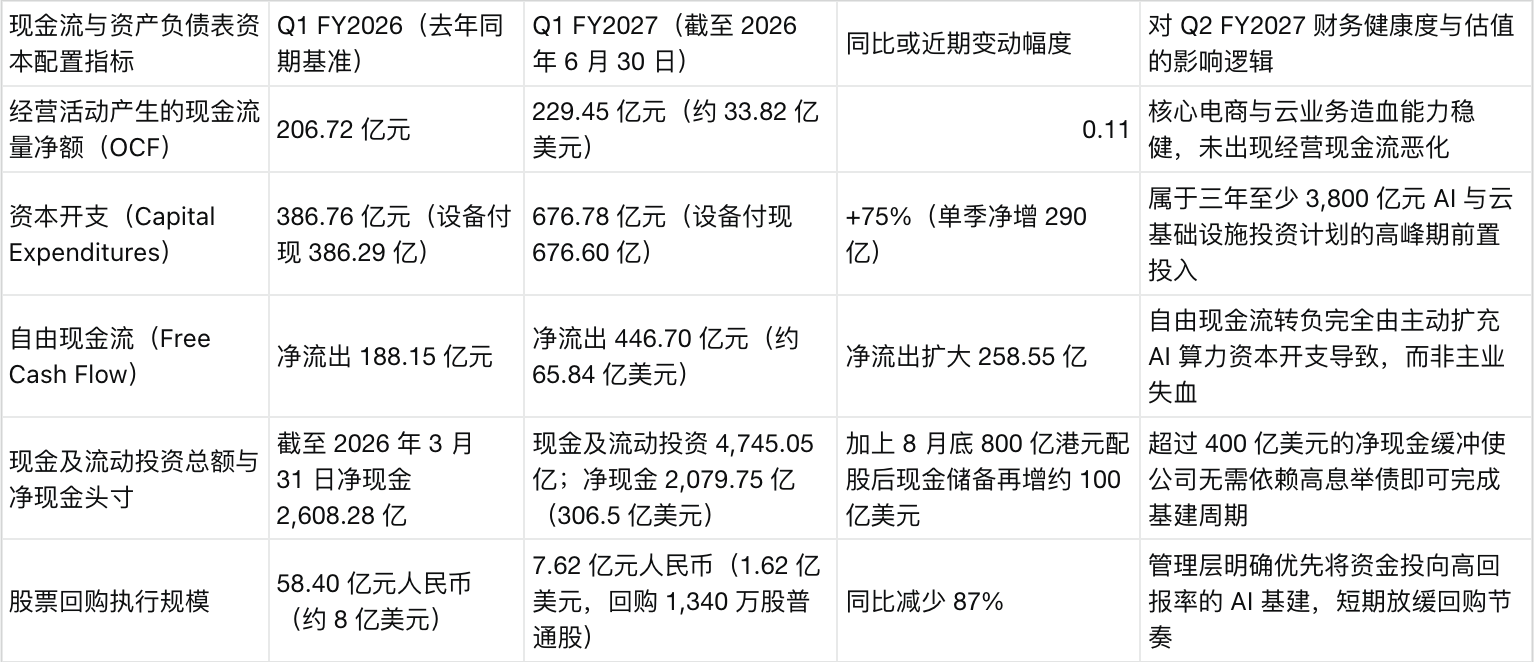
Addressing market concerns about negative free cash flow, CFO Toby Xu presented a highly persuasive capital return arithmetic model on the Q1 earnings call: Based on current AI product gross margin levels and a static payback period of approximately 3 years for capital expenditure, as long as Alibaba Cloud keeps revenue growth below 33%, existing operating cash flow would already be sufficient to cover capital expenditure and achieve positive free cash flow; however, management proactively abandoned the conservative option of "slowing growth to exchange for current positive free cash flow," choosing instead to fully capture share during the AI demand explosion window. Xu further noted that as AI product gross margins continue to improve and self-developed chip and underlying architecture efficiency increases, the capital expenditure payback period is expected to shorten from 3 years to 2.5 years or even less, at which point Alibaba will be able to restore positive free cash flow while maintaining high growth above 40%.
Buyback Pace, Capital Allocation After the USD 10 Billion Placement, and Management Outlook Highlights
On the balance sheet and shareholder return front, as of June 30, 2026, Alibaba held cash and other liquid investments totaling RMB 474.505 billion (approximately USD 69.933 billion), and after deducting RMB 266.530 billion in interest-bearing debt, the net cash position was as high as RMB 207.975 billion (approximately USD 30.652 billion). Meanwhile, the company consciously slowed the pace of open market share buybacks in Q1, spending only USD 162 million (RMB 762 million) in the U.S. market to repurchase 13.4 million ordinary shares (approximately 1.7 million ADS), and subsequently completed an HKD 80 billion (approximately USD 10 billion) new share placement in Hong Kong from August 24 to 26 to replenish AI infrastructure ammunition.
In the November 19 pre-market earnings release and 20:00 (Singapore Time) conference call, investors should focus on verifying management's latest outlook in four areas: First, whether Alibaba Cloud's external revenue year-over-year growth can remain in the 40% to 45% range after the base rises, and the sprint progress of MaaS annualized run-rate revenue toward the year-end RMB 30 billion target; Second, whether the AI Lab and Applications adjusted EBITA loss (RMB 13.861 billion in Q1) narrows further as scheduled in Q2; Third, whether the full-year capital expenditure budget maintains the current investment pace of RMB 60 billion to 70 billion per quarter, and whether management will re-accelerate share buybacks at the current stock price level of approximately USD 94 after completing the HKD 80 billion placement; Fourth, the latest positioning on consumer recovery and the CMR inflection point during this year's "Double 11" shopping festival. According to TipRanks analyst consensus statistics, as of mid-November, 14 Wall Street analysts covering Alibaba gave an average 12-month target price of USD 186.86, implying significant upside from the current stock price of USD 94.30. Before and after Thursday's pre-market earnings release, investors can browse the stock market and related companies in the MEXC stock section, combining real-time quotes and valuation metrics to track cross-market reactions after the earnings release.
MEXC Editorial Team Exclusive View
Examining Alibaba's Q2 FY2027 earnings scheduled for release before the market open on November 19, the core question the market truly needs to clarify is: Why does a tech giant with cloud computing revenue surging 45% year-over-year, AI products growing triple-digits for 12 consecutive quarters, and holding over USD 30 billion in net cash see its stock price hovering around USD 94 with a forward P/E below 16x?
The answer lies in the secondary market's discount pricing of "income statement structural mismatch" and "short-term negative free cash flow." In the Q1 financial statements, investors saw two diametrically opposite pictures: One showing Cloud Intelligence