Former Uniswap Engineering Director Leads Project, Metric's Monthly Trading Volume Already Exceeds $8 Billion


- Core Viewpoint: Metric, a DEX project founded by a former Uniswap Engineering Director, handled over $8 billion in trading volume in its first month with only $25 million in TVL. Its core innovation lies in separating pricing from liquidity allocation, allowing liquidity ranges to automatically move with external reference prices and reducing idle capital.
- Key Elements:
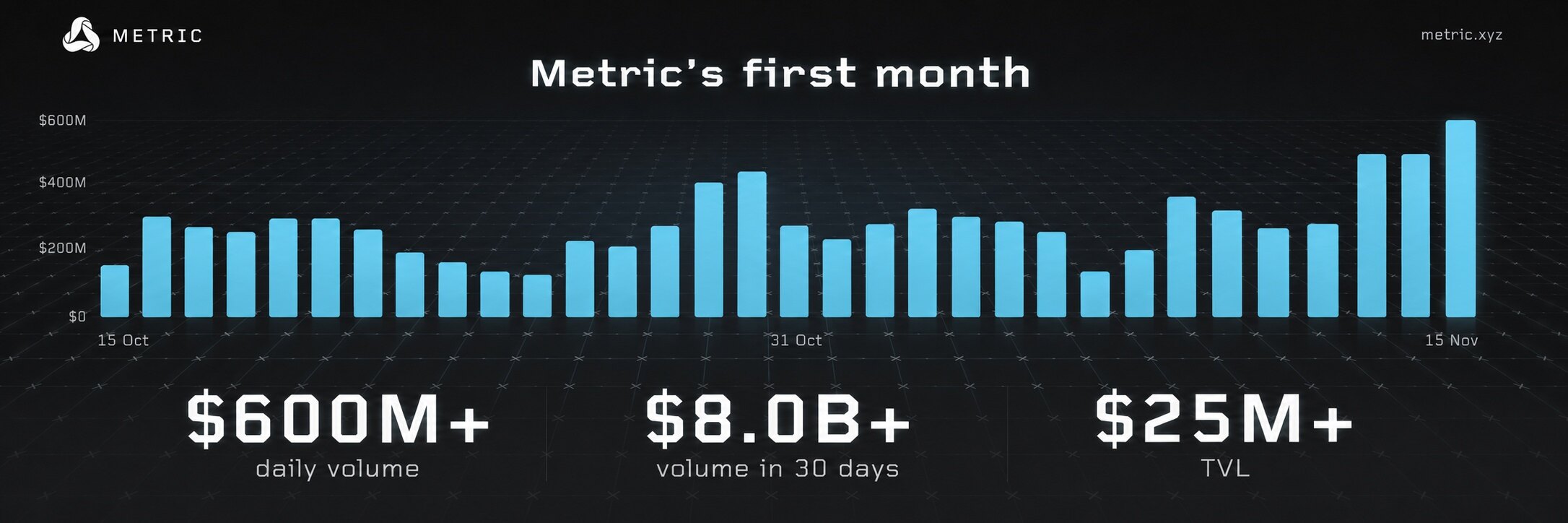
- Metric's first-month trading volume exceeded $8 billion, with single-day volume surpassing $600 million, while TVL stood at just over $25 million.
- It employs an Active Pools mechanism, where LP funds are distributed across Bin ranges that move with reference prices, eliminating the need to withdraw and redeploy.
- It supports oracles and custom pricing (already integrated with Chainlink and Pyth), applicable to tokenized stocks, forex, gold, and mainstream crypto assets.
- CTO Christos Gkolias served as Engineering Director at Uniswap Labs for three and a half years and previously worked at Google.
- It introduced Markout APR to measure the deviation between execution prices and subsequent reference prices, indicating that trading volume growth does not necessarily translate into positive returns.
- The points campaign is calculated from October 15, distributing 1 million points per week, covering trading, market making, pool management, and referrals.
Original | Odaily@OdailyChina)
Author | Asher (@Asher_ 0210)

On November 15, the DEX project Metric, whose CTO is a former Uniswap engineering director, disclosed that the platform's trading volume in its first month of official launch exceeded $8 billion, with single-day trading volume surpassing $600 million, while its TVL was only just over $25 million. Handling over $8 billion in monthly trading volume with a TVL of just over $20 million — this caught my attention.
In addition, Metric announced the launch of a points campaign, distributing 1 million points to participants each week, which has also attracted considerable attention from "airdrop farmers." So where does Metric's trading volume come from? What makes its mechanism special? And once the points campaign begins, how can ordinary users participate?
Former Uniswap Engineering Director Joins the Fray, Metric Targets Tokenized Asset Trading
Metric is a decentralized spot exchange centered on Active Pools, targeting trading demand for tokenized stocks, mainstream crypto assets, and stablecoins. Compared with common AMMs that derive prices from the ratio of assets within a pool, Metric separates pricing from liquidity allocation, allowing pools to update quotes based on external market data so that liquidity moves with the reference price.
Tokenized stocks are a lens through which to understand its positioning. Once a stock is issued as an on-chain token, the corresponding company's share price continues to change in external markets. If an on-chain pool fails to update in time and still sells an asset that has already risen at the old price, arbitrageurs can buy up the underpriced tokens, and the loss ultimately falls on LPs. Once assets go on-chain, how to keep quotes in line with market movements and provide sufficient trading depth around reasonable prices is precisely the problem Metric aims to solve.
To this end, Metric allows pools to connect to oracles, on-chain data, or custom pricing strategies through price providers, and its public code already includes data integration implementations for Chainlink and Pyth. This also extends its applicability to gold, foreign exchange, and assets such as BTC and ETH that have external reference prices. For professional market makers, Metric supports running private pools with their own capital; for ordinary LPs, it offers public pools that can accept external funds.
Metric's technical lead comes from Uniswap Labs. Current CTO Christos Gkolias (@CGkol) worked at Uniswap Labs for three and a half years as an engineering director and previously worked at Google. Moving from a leading DEX to a new project, he hopes that through Metric, market makers can independently design their quoting strategies, LPs no longer need to frequently adjust price ranges, and more market-aligned quotes can be provided for tokenized stocks, foreign exchange, and mainstream crypto assets.
How Does a TVL of Just Over $20 Million Handle $8 Billion in Trading?
In Metric, LPs can place funds across different ranges around the reference price, and these ranges are called Bins. They move together with the reference price. For example, if ETH's reference price is $3,000 and an LP chooses a range of ±1%, the corresponding range is $2,970 to $3,030. When the reference price rises to $3,300, the range automatically shifts up to $3,267 to $3,333, and the LP does not need to withdraw funds and redeploy. This process only updates the quoting range; it does not automatically buy or sell the tokens in the position.
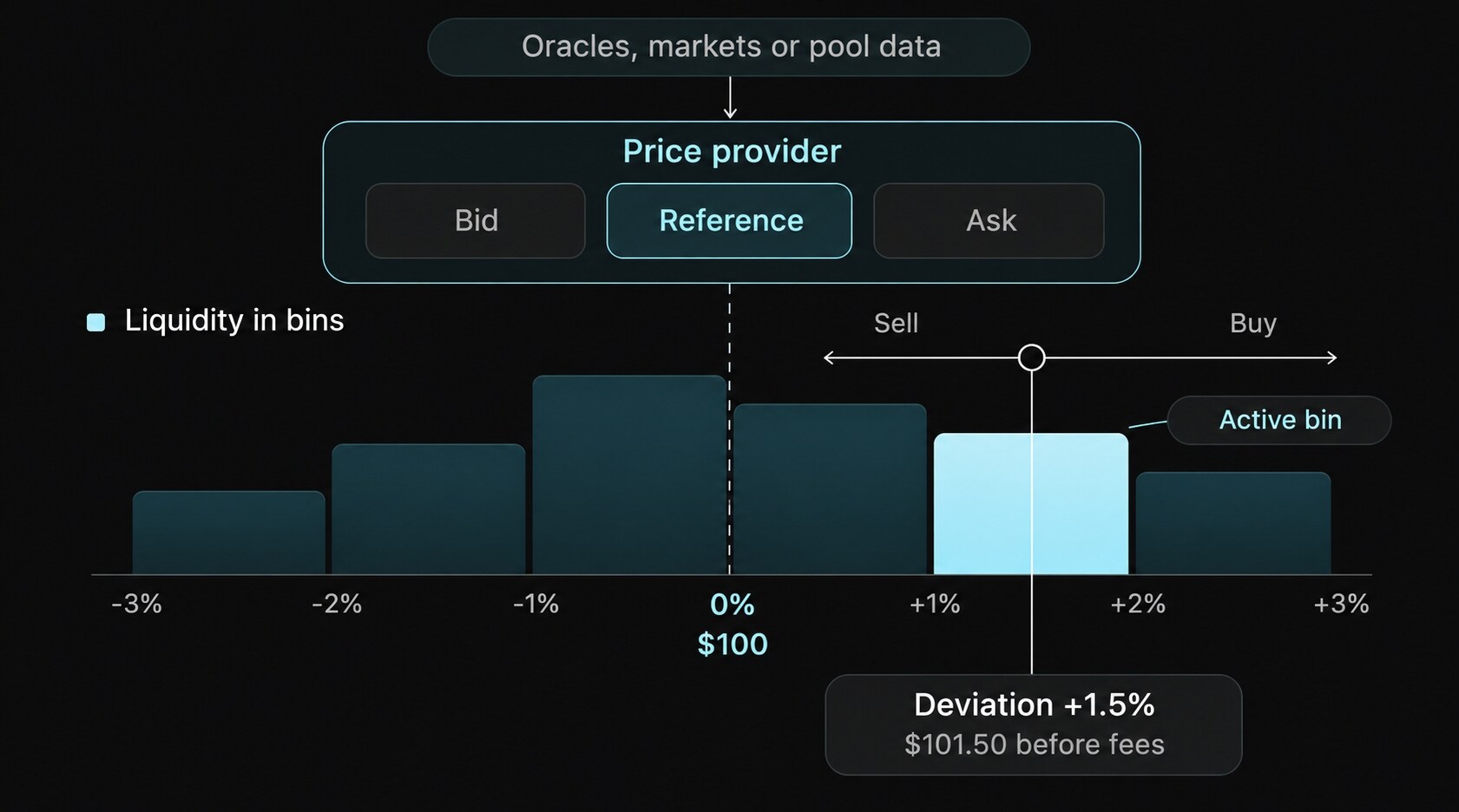
In common concentrated liquidity AMMs, if funds remain in a fixed $2,970 to $3,030 range and ETH rises to $3,300, that capital temporarily "can't get filled" and the LP needs to adjust the range to participate in trading again. Metric lets the quoting range follow the market, reducing the idleness of capital caused by price changes. Only when the same capital continuously participates in buying and selling and turns over repeatedly can a smaller TVL have a chance to support a larger cumulative trading volume.
When a trade enters the pool, it first uses liquidity within the current range, and once that is exhausted, it moves to the next range. Just like a buy order gradually eating through the sell side, large trades need to draw on funds from more ranges, and the average execution price deteriorates accordingly, so price impact still exists. As buying and selling occur, the asset ratio held by LPs also changes: the ETH and USDC deposited may become less ETH and more USDC upon exit, or vice versa.
Of course, a range that follows the price does not mean LPs are guaranteed to profit. The spread LPs earn through trading can still be offset by arbitrage losses caused by asset price declines and lagging quotes. To address this, Metric introduced Markout APR, which compares execution prices with the reference price over a period after the trade to see whether those trades were favorable to the pool. This figure can be negative, and it also reminds participants that more trading does not necessarily mean more profit — what ultimately matters is the actual return of the entire position.
Points Campaign Launched on October 15, Distributing 1 Million Weekly
On November 13, Metric announced the launch of its points campaign, distributing 1 million points each week to participants who trade, provide liquidity, manage pools, and invite users. Points have been counted since October 15, and interactions over the past four weeks are also included in the rewards; early users can connect their wallets to view the points they have earned. Each weekly counting period ends at 8 PM Beijing time on Wednesday, and points are distributed automatically on Thursday with no manual claiming required.
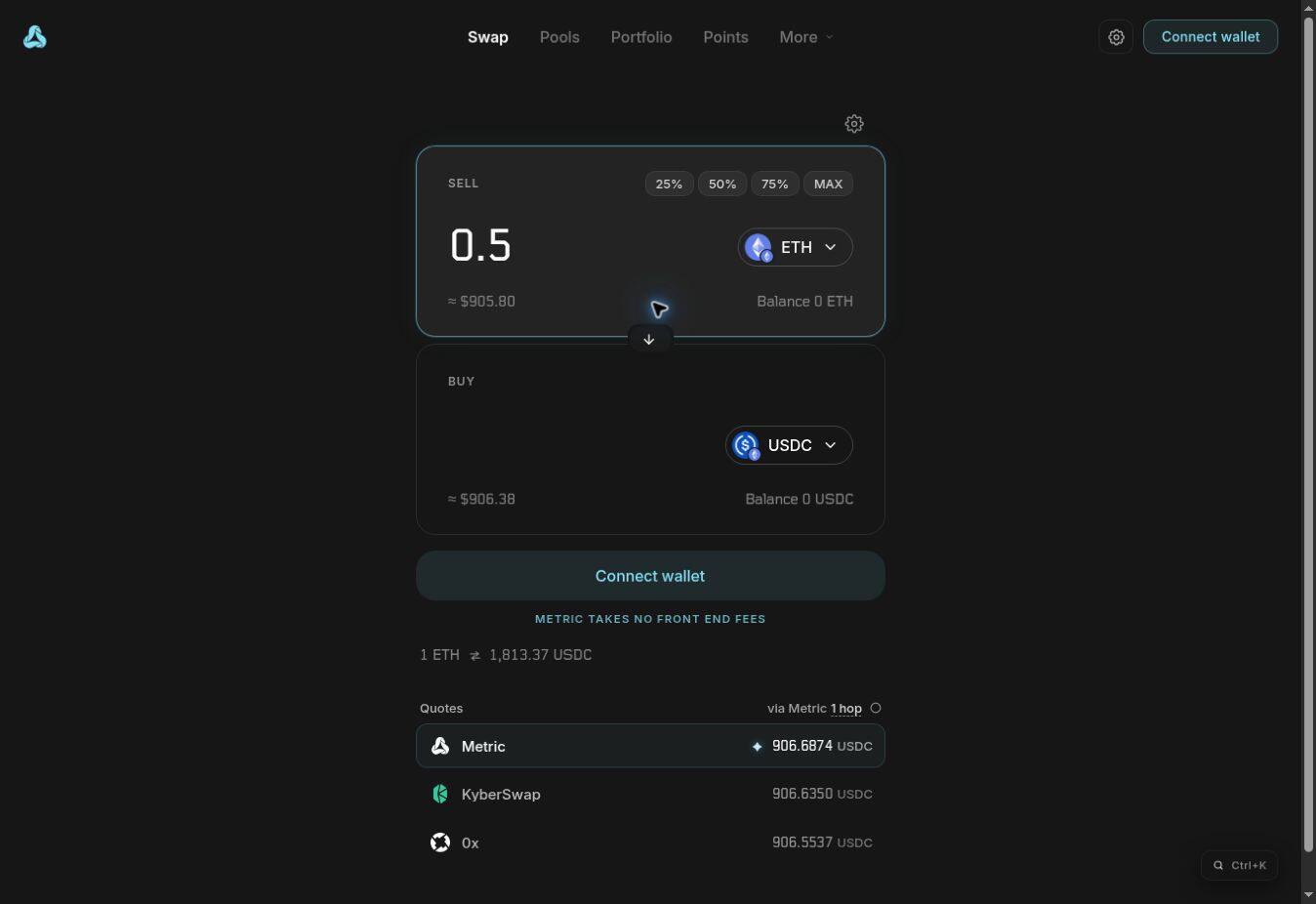
For early "airdrop farmers," the main ways to interact and earn points at present are participating in spot trading and providing liquidity. In addition, swapping assets through the Metric page does not necessarily mean Metric's pools are ultimately used. To earn points through trading, users need to pay attention to and select the Metric route marked with a points indicator. In the example below, the light blue star icon to the right of Metric's quote indicates that points can be earned, while the quotes below are from other routes.
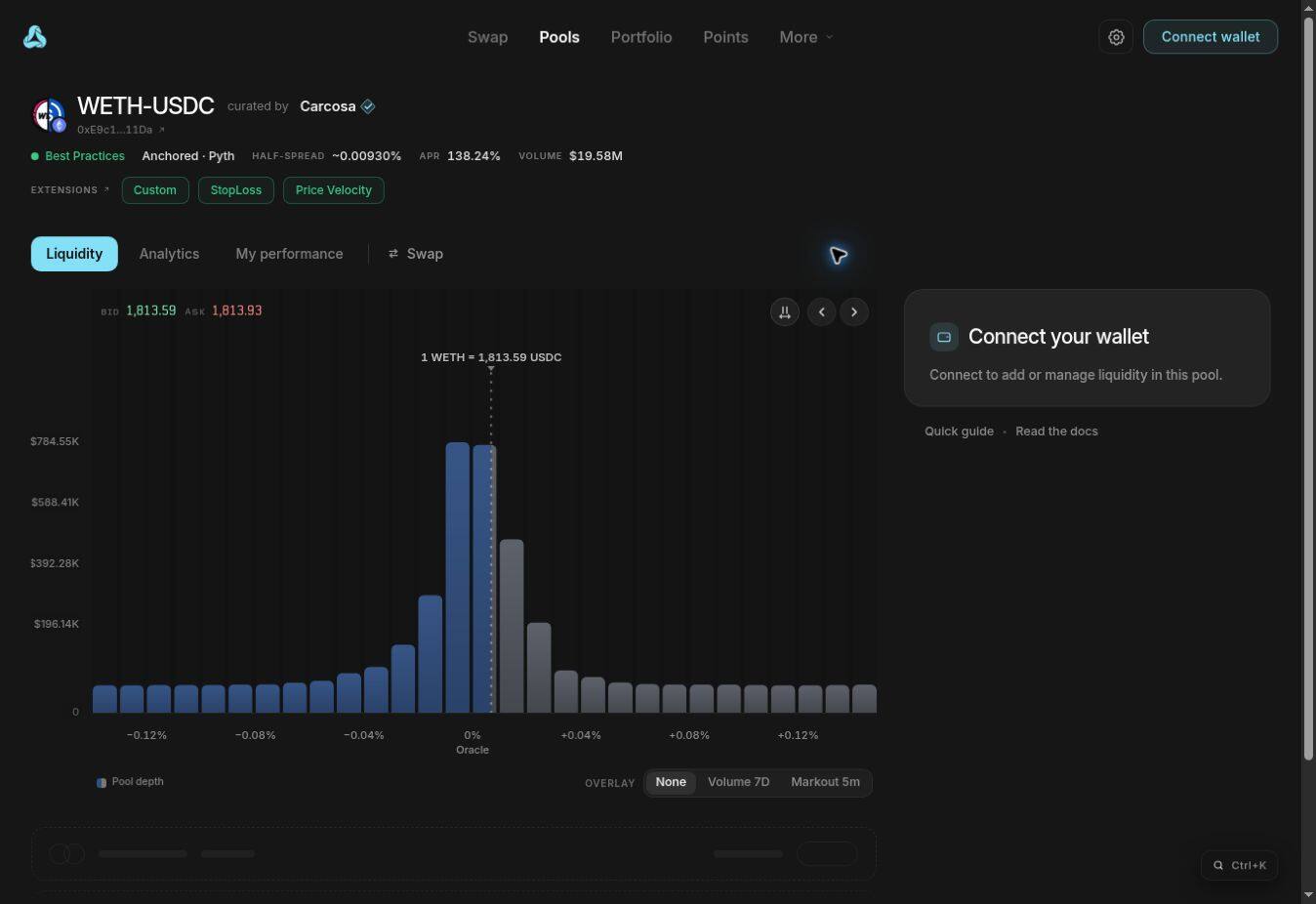
To provide liquidity, users can enter a specific pool from the Pools page, connect their wallet, select a price range, and deposit the corresponding assets, earning trading spreads while accumulating points. For example, the detail page for the WETH/USDC pool shows the manager, pricing source, APR, and trading volume, and below it users can toggle to view trading volume and Markout performance for each range. Whether a high APR translates into actual returns still depends on trading losses and asset price changes; one should not chase high annualized yields solely for points.
In addition, inviting users can earn up to a 10% points bonus, but this cannot be changed once bound.