Three days after ringing the Nasdaq bell, Injective's mainnet went down for 4 hours and 24 minutes


- Core Viewpoint: Injective launched a staking-based INJ ETF on Nasdaq, marking its pivot toward institutional-grade financial infrastructure, but the mainnet went down for over 4 hours just three days after listing, exposing shortcomings in technical stability.
- Key Elements:
- On November 6, Injective and Canary Capital rang the bell at Nasdaq. The INJ ETF (INJC) opened INJ purchase channels to ordinary brokerage accounts for the first time and plans to include staking yields in its net asset value.
- On November 2, it launched Institutional Rail, positioned as a channel for banks and trading firms to reach block validators directly, emphasizing predictable timing and pre-block receipts.
- On the evening of November 9, the mainnet stopped producing blocks for over 4 hours. Upbit, Coinone, and Kraken suspended INJ deposits and withdrawals, while spot trading was unaffected.
- Official explanations for the outage were inconsistent: the validator incident page cited attack prevention and application of security patches, while the Telegram community described it as a planned emergency upgrade drill.
- Before and after the outage, the INJ price remained stable in the $7.9–8.1 range, with no significant crash.
- In its official fifth-anniversary review, the project set goals including $10 billion in RWA on-chain and quantum-resistant security technology, making its institutionalization narrative clear.
Original | Odaily@OdailyChina)
Author | Wenser (@wenser 2010)
On the evening of November 6, Injective Labs CEO Eric Chen and Canary Capital founder and CEO Steven McClurg appeared together in New York's Times Square to ring the opening bell for the listing of the staking-based INJ ETF INJC on the Nasdaq Stock Exchange. This is not an IPO of Injective's own shares, nor the listing of a traditional fund, but rather the first time ever that a purchase channel for the INJ token has been opened to ordinary brokerage accounts, with plans to include staking yields in the net asset value.
From a project born in a college dormitory in 2018, to a graduate of YZi Labs (formerly Binance Labs), and now to Wall Street, the global financial center, Injective has accomplished this feat in 8 years. But just three days after ringing the INJC opening bell, on the evening of November 9, the Injective mainnet experienced an outage of over 4 hours.
About half an hour later, the official YZi Labs account posted a congratulatory message to Injective for ringing the Nasdaq opening bell. YZi Labs Managing Partner Ella Zhang subsequently followed up with her own congratulations. But what felt somewhat incongruous was that as these many congratulatory messages spread far and wide, Injective—a public chain that had been running for 8 years—had ground to a halt.
Injective's New Story: Becoming Institutional-Grade Financial Infrastructure
On the eve of the INJ ETF's Nasdaq listing, Injective officially laid out its new narrative roadmap: becoming institutional-grade financial infrastructure.
Compared with previous public chain narratives, this narrative undoubtedly aligns better with the current demand for deep coupling between traditional financial markets and the crypto market.
On November 2, Injective launched Institutional Rail, which the team describes as "giving banks, trading firms, and institutional applications a direct channel to block validators," emphasizing features such as predictable inclusion times and the ability to receive receipts before block production.
On November 5, the INJ ETF officially launched;
On November 6, the Nasdaq bell was rung;
On November 8, Injective officially published a five-year mainnet anniversary retrospective, recounting the various achievements of the past 5 years, highlighting the Nasdaq listing as a particularly notable milestone, and setting targets on technical and numerical milestones such as $10 billion in RWA assets on-chain and quantum-resistant security technology.
No one expected that at this critical juncture of entering the institutional client spotlight, the Injective mainnet would suddenly experience an outage.
Less Than 3 Days After ETF Nasdaq Listing, Mainnet Experiences Over 4-Hour Outage
According to Injective official node monitoring, the Injective mainnet had stopped producing blocks, with the latest block height at 191,016,661, generated at 21:04 Beijing time.
Affected by this news, crypto exchanges Upbit, Coinone, and Kraken successively announced that due to the interruption of block generation on Injective (INJ), INJ deposits and withdrawals had been suspended, while spot trading was unaffected; once deposit and withdrawal stability is confirmed, restoration will be notified via announcement.
As for the specific cause of the mainnet outage, the situation remains murky due to the existence of two different accounts.
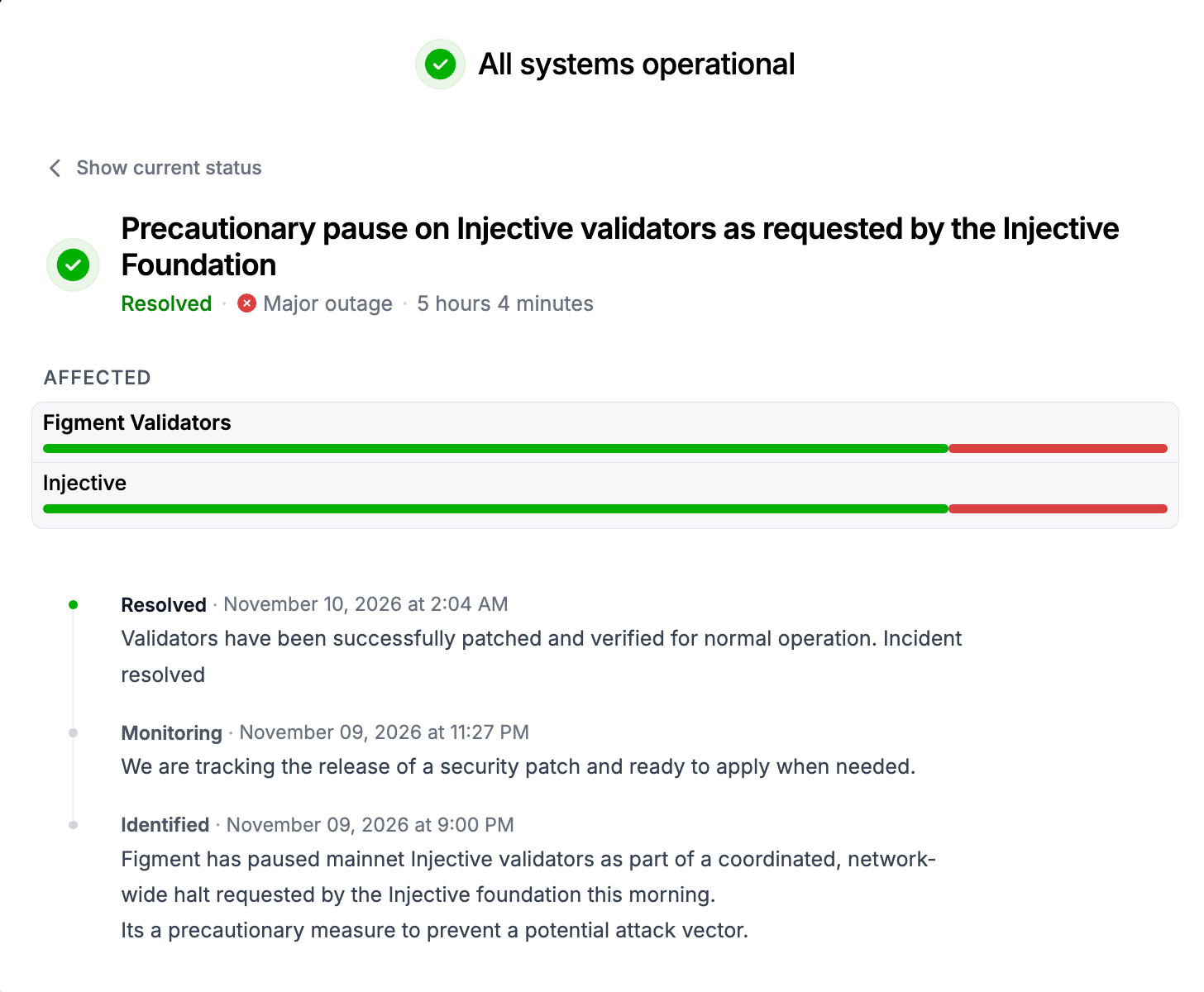
According to the validator Figment's incident page, initially the explanation for the event was that, at the request of the Injective Foundation, mainnet validators were paused that day under network-wide coordination as a precautionary measure against a potential attack path; subsequently, the update was changed to "tracking security patch and preparing to apply." At 2:04 AM on November 10, the conclusion given was that "validators have completed the patch and returned to normal." From this perspective, the outage lasting approximately 4 hours and 24 minutes was merely a precautionary security patch update.
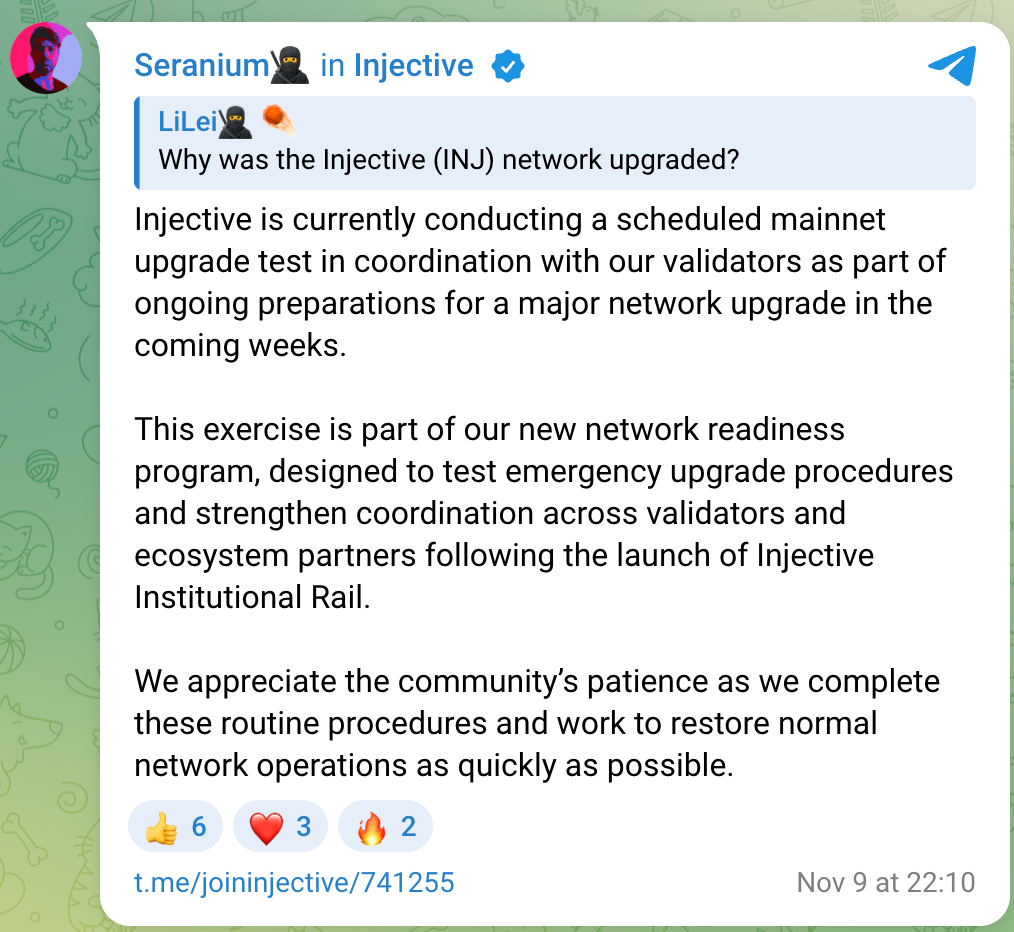
However, the account given by the Injective official Telegram community administrators was not entirely consistent.
According to Telegram community messages, the official statement was: "Injective is conducting a scheduled mainnet upgrade test in coordination with validators, continuing preparations for a major network upgrade in the coming weeks. This drill is part of our new network readiness program, designed to test emergency upgrade procedures and strengthen coordination among validators and ecosystem partners following the launch of Injective's institutional rail."
In other words, the earlier explanation for the outage was "preventing attacks and applying security patches"; the later one said "the outage was part of the plan, just an upgrade drill." Suffice it to say, Injective's official channels may not have managed to get their stories straight.
Fortunately, as a token with relatively strong recent price performance, INJ's price did not suddenly plummet with the Injective outage, remaining around $7.9-8.1 before and after the downtime.
Perhaps, for a public chain that has set its business targets on traditional financial markets, a technical outage at the early stage of an ETF launch is not such a big deal.

Injective officially released today the "INJ Lands on Wall Street" brand advertisement on New York taxis
In the race toward crypto mainstream adoption, Injective has finally found its ecological niche and development path. But in the future, if it wants to persuade more traditional financial institutions to join this ecosystem and commit real liquidity and capital exposure to buy INJ and INJC, Injective may still need more stable technical performance.
Fortunately, 8 years have already been endured, and Injective's next 8 years are still worth looking forward to.