纽交所用Avalanche结算代币化股票,但AVAX可能「吃不到肉」


- 核心观点:纽交所选定Avalanche技术为其7×24小时代币化证券平台提供结算账本,但采用定制许可L1而非公链,AVAX代币难以直接从结算活动中捕获价值。
- 关键要素:
- 平台以ATS形式运营,目标Q4上线,尚待监管批准;撮合沿用纽交所Pillar引擎,成交后在Avalanche定制链上即时结算,支持稳定币入金。
- 纽交所基于Avalanche Etna升级后的自建L1模式运营许可链,自行管理验证者集合,验证者无需质押2000枚AVAX,仅按月支付固定费用。
- 发行端过户代理增至6家(含Securitize、tZERO、Broadridge等),代币化股票与传统股票可互换,享同等分红和投票权。
- 消息公布后AVAX最高触及9.01 USDT,24小时涨幅6.86%。
- Avalanche分发型RWA规模14.3亿美元,登记型RWA 114亿美元,稳定币市值7.95亿美元。
- AVAX直接收入仅来自L1验证者月费(约1.33枚/验证者,销毁处理),与结算笔数和金额无关;C-Chain手续费销毁为主要捕获渠道,2024年初以来累计约2350万美元。
- 基金会承认生态价值不会自动流向AVAX,收入分成等改进机制(ACP-283、ACP-67)仍处研究阶段。
Author: Sanqing, Foresight News
On November 9, the Wall Street Journal reported that the NYSE stated its upcoming 24/7 tokenized securities trading platform will use Avalanche exclusively to settle tokenized stocks. On the same day, Ava Labs announced that Avalanche will provide core ledger technology to the clearing company of this NYSE-affiliated platform, a fact also confirmed in the NYSE's pre-market briefing that day.
The platform operates as an alternative trading system (ATS) and aims to launch in the fourth quarter, pending regulatory approval. Following the announcement, according to Bitget market data, AVAX peaked at 9.01 USDT and stood at 8.627 USDT as of press time, up 6.86% over 24 hours.
Trading and Settlement Architecture
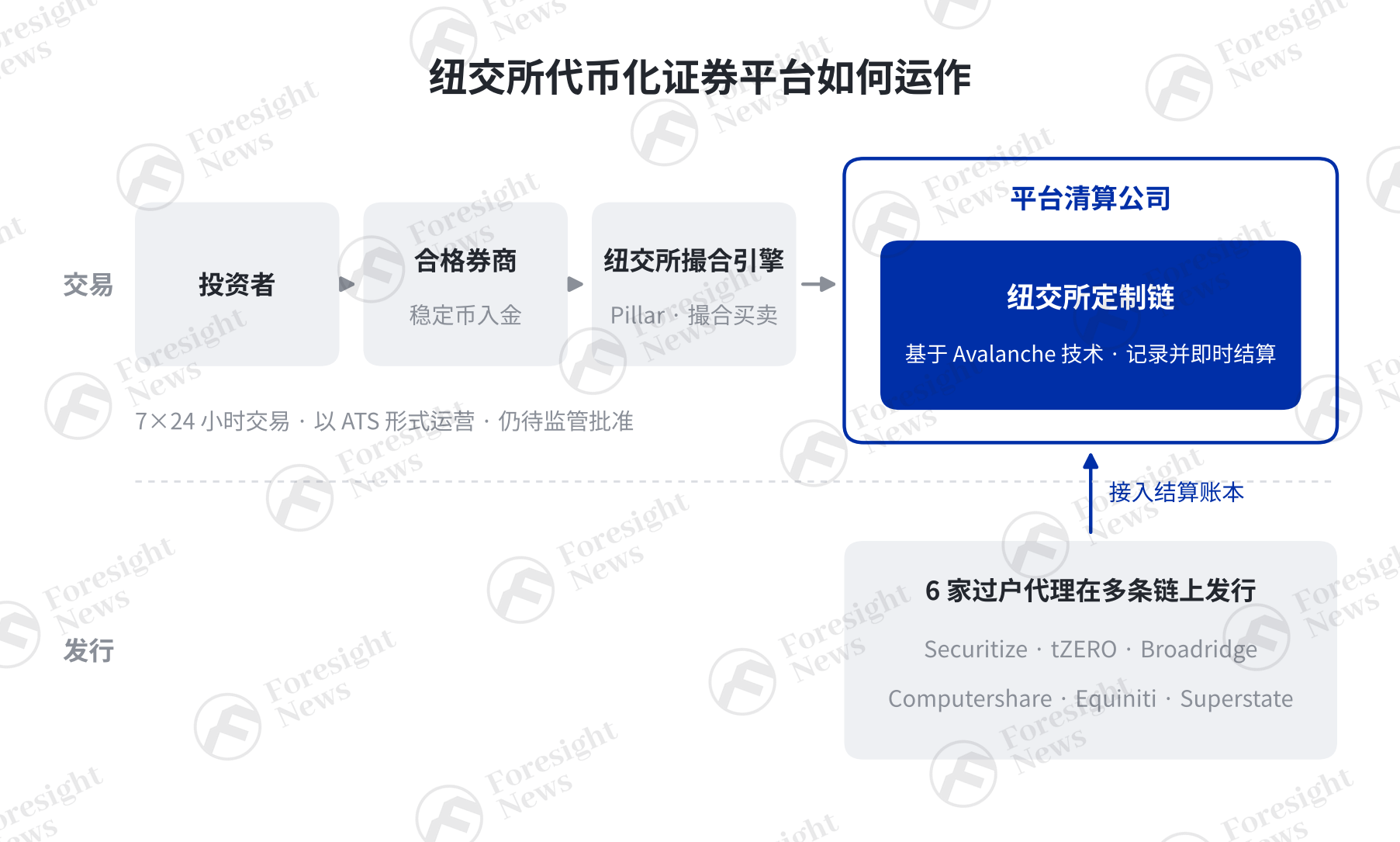
Under the plan disclosed on November 9, the platform's matching engine will use the NYSE's existing Pillar engine; after execution, trades will be handed to the platform's clearing company for instant settlement on the Avalanche ledger, and investors can deposit funds using stablecoins.
Ava Labs Chief Business Officer John Nahas revealed in an interview that the NYSE is not settling on the Avalanche public chain, but rather operating a blockchain customized to regulatory requirements based on Avalanche technology.
A week earlier, on November 2, the NYSE announced the issuance-side arrangements: in addition to Securitize and tZERO, it added Broadridge, Computershare, Equiniti, and Superstate as transfer agents, bringing the number of partners to six. The tokens traded on the platform fall into two categories—those issued by custodians and those issued by issuers themselves—both interchangeable with traditional shares, with holders enjoying the same dividend and voting rights.
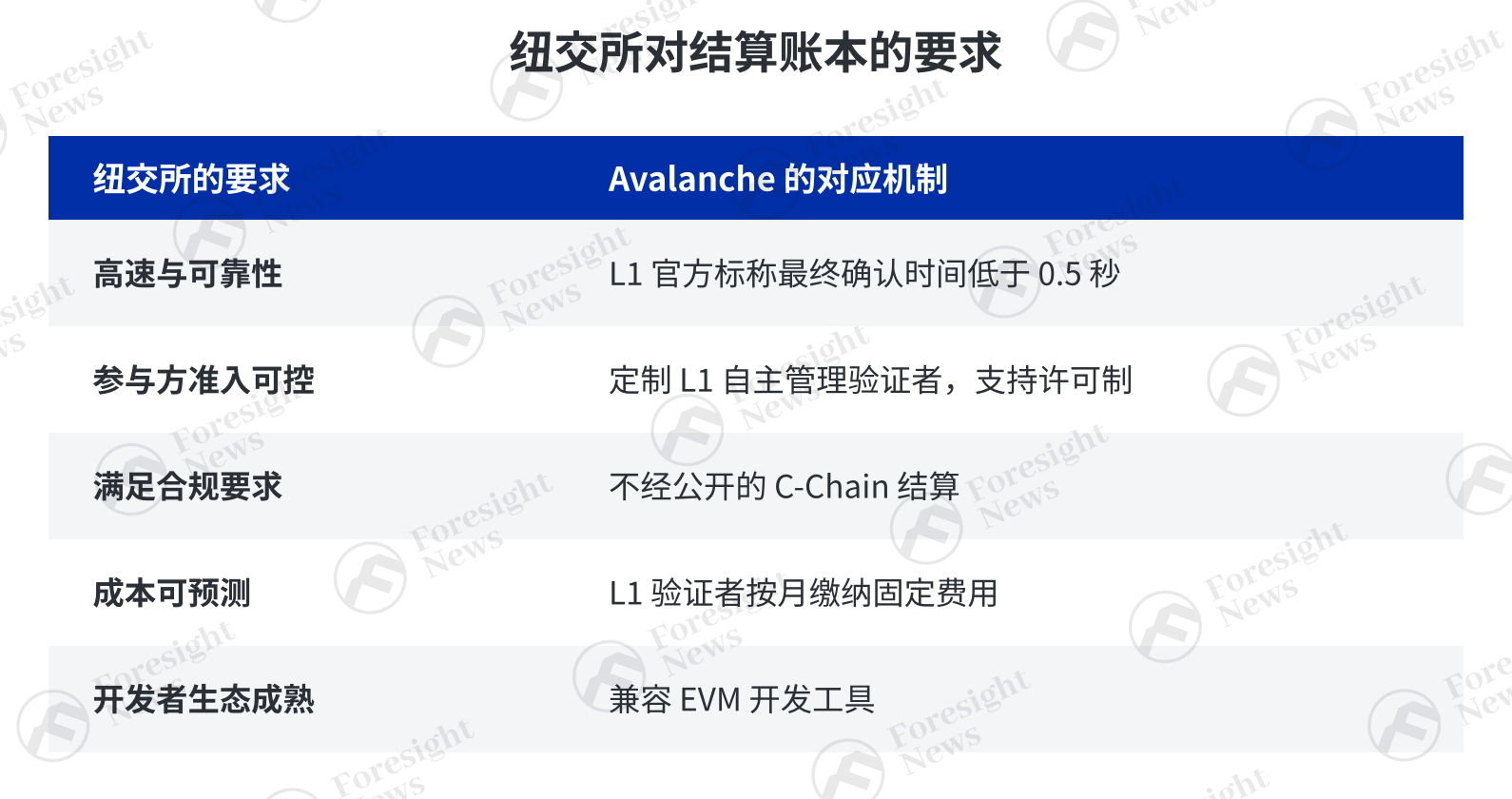
Dennis Lee, the NYSE's head of digital issuance, said the platform supports stocks issued on multiple chains, but the ledger recording and settling trades must be fast and reliable, able to control participants, have predictable costs, and have a large developer community—all of which Avalanche satisfies. As a result, stock issuance is spread across multiple transfer agents and multiple chains, while settlement is consolidated onto the NYSE's own chain.
The NYSE announced on January 19 that it was developing this platform and seeking regulatory approval; on August 31, its parent company Intercontinental Exchange (ICE) signed a memorandum of understanding with tZERO; at the Avalanche Summit in September, Ava Labs President Charley Cooper revealed that the NYSE had been testing Avalanche for about a year, though no selection had been announced at the time. Cooper confirmed on the November 9 NYSE Live program that this is a production-environment deployment, not another pilot.
Compliance Access and the Custom L1 Model
In its January announcement, the NYSE said the platform had the capability to support multiple chains for settlement and custody, but by November this had narrowed to Avalanche only. Kevin Tyrrell, the NYSE's Chief Product Officer, said that before making the selection, multiple vendors were tested, with emphasis on speed, throughput, and the ability to support controlled networks and compliance requirements. Nahas also said that before the selection, the two sides completed reviews across technical, commercial, and ecosystem dimensions, a process lasting more than a year.
Among the conditions mentioned by Dennis Lee, controlling participants is the most critical. Participants in stock settlement must be vetted for access, while the C-Chain on the Avalanche mainnet is a public chain that anyone can access, which cannot meet this requirement.
The NYSE's custom chain corresponds to the self-built L1 (formerly called Subnet) model that Avalanche introduced after the Etna upgrade (ACP-77). Institution-built L1s run independently of the mainnet, manage their own validator sets, and can be set to permissioned; validators do not need to first stake 2,000 AVAX to become mainnet validators, but only pay a fixed monthly fee, which also meets the requirement for predictable costs.
As for the problem that self-built chains tend to become isolated from the external ecosystem, Ava Labs CEO Emin Gün Sirer noted in the announcement that this dedicated infrastructure can still connect to the broader asset and liquidity ecosystem, and that the various L1s on Avalanche can also interoperate through native cross-chain messaging.
According to rwa.xyz data, as of November 9, the scale of Distributed RWA (freely transferable between wallets) on Avalanche was $1.43 billion, the scale of Represented RWA (ownership registered on-chain only) was $11.4 billion, and the stablecoin market cap was $795 million.
The Foundation Is Also Looking for a Value Entry Point for AVAX
Neither Ava Labs' announcement nor the NYSE's statement mentioned any use of the AVAX token in settlement, fees, or staking. Under Avalanche's custom L1 mechanism, AVAX's direct revenue comes only from ongoing validator fees.
According to Avalanche documentation, when an L1 has fewer than 10,000 validators, each validator pays about 1.33 AVAX per month, which is burned—but this is unrelated to the number or amount of settlements; fees within the L1 can also be denominated in a token set by the operator.
On July 30, when the Avalanche Foundation published its economic research agenda, it acknowledged that the value created by the ecosystem does not automatically flow to the AVAX that secures the network, with Chief Investment Officer Matias Antonio calling this the core problem the foundation is working to solve.
According to estimates published by the foundation on August 12, among the on-chain economic activity it tracks, the main channel currently capturing value for AVAX is C-Chain fee burning, totaling about $23.5 million since early 2024 (excluding L1 validator fees); L1 revenue sharing is still being studied, with no established mechanism yet.
The latest monthly data in that estimate is for June: nominal GCP (akin to on-chain GDP) created on Avalanche was $3.1 million, yield brought to holders by assets such as tokenized funds was $2.7 million, and yield earned by issuers from reserve assets was $6.9 million. The foundation believes that the latter two currently contribute essentially nothing to AVAX value capture.
Improvement directions listed by the foundation include ACP-283, which would let validators vote to adjust gas prices, the protocol-owned stablecoin ACP-67, and revenue sharing from applications and L1s—all currently in the research stage.
Under the existing mechanism, settlement activity on the NYSE's custom chain likewise falls outside AVAX's capture scope, with only validator fees touching AVAX. And the C-Chain, currently the main capture channel, has fees that are themselves not large—according to DefiLlama data, Avalanche C-Chain fees on November 9 were about $26,500.
On the day of the announcement, the Avalanche Foundation tweeted that it will track the platform's activity and its role in the Avalanche economy through its economic research agenda.
The NYSE's platform aims to launch in the fourth quarter, and still requires regulatory approval before then.