AI行情开始分层定价:苹果反超英伟达,今晚两份财报接受考验


1. AI Trading Begins to Diverge: The Market No Longer Pays for Every Growth Story
Last Friday's U.S. stock market brought the divergence in the AI trade to the surface with a concentrated selloff. The Nasdaq Composite fell 2.86% to close at 25,437, its largest single-day drop since June 5 and a 7.8% pullback from the record closing high set on October 6. The S&P 500 fell 1.82% to close at 7,580.07. The Dow dropped 572.25 points, or 1.09%, to close at 51,770.31. All three major indices ended the week lower, with the Nasdaq down 5.3% for October, its worst monthly performance since March 2025.
More noteworthy than the index declines is the intensity of the capital withdrawal from the AI supply chain. The Philadelphia Semiconductor Index fell 7.2% last Friday to close at 10,688.80, down more than 15% for October. Intel plunged 28.58% in a single day after its results and guidance fell far short of expectations, its largest single-day drop since 1974, though it is still up 78% year-to-date. AMD fell 10.88%, Qualcomm fell 11.12%, Micron fell 5.3%, and Nvidia fell 4.22%, with its market cap dropping to $4.93 trillion. The memory and optical communications sectors were not spared either, with SanDisk falling 13.47%.
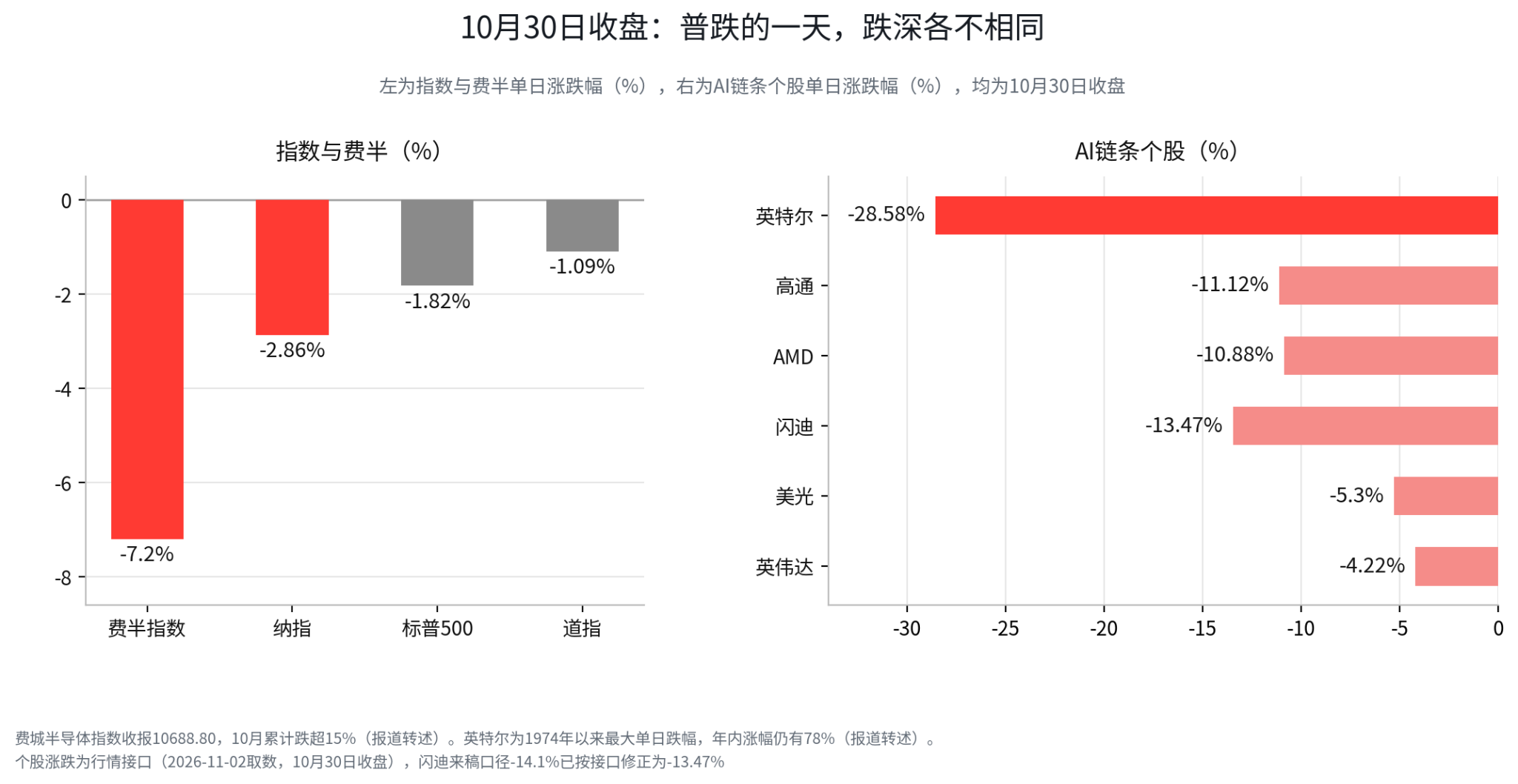
This selloff does not mean the market has suddenly rejected AI demand. More accurately, investors are beginning to ask whether the revenue growth brought by AI can actually cover ever-expanding capital expenditures. Earlier, the market was willing to pay valuations in advance for computing power demand, order growth, and long-term market potential. But as companies' investment scales grow larger, free cash flow comes under pressure, and profit realization takes longer, a pure growth narrative is no longer enough to support the valuations of all companies. Intel's results and guidance were one of the direct triggers, and the broad pullback in the semiconductor sector shows that the market is reassessing expectations for the entire supply chain, not just punishing one company's operational missteps.
2. Apple Overtakes Nvidia: Cash Flow Certainty Regains a Premium
On the same day the semiconductor sector tumbled, the position of the world's most valuable company also changed. Apple fell 1.23% but held a market cap of about $5.03 trillion, overtaking Nvidia's roughly $4.93 trillion and reclaiming its place as the world's most valuable listed company. Apple rose 3% against the trend in October and is up 27% year-to-date, making it one of the best-performing assets among the Magnificent Seven.
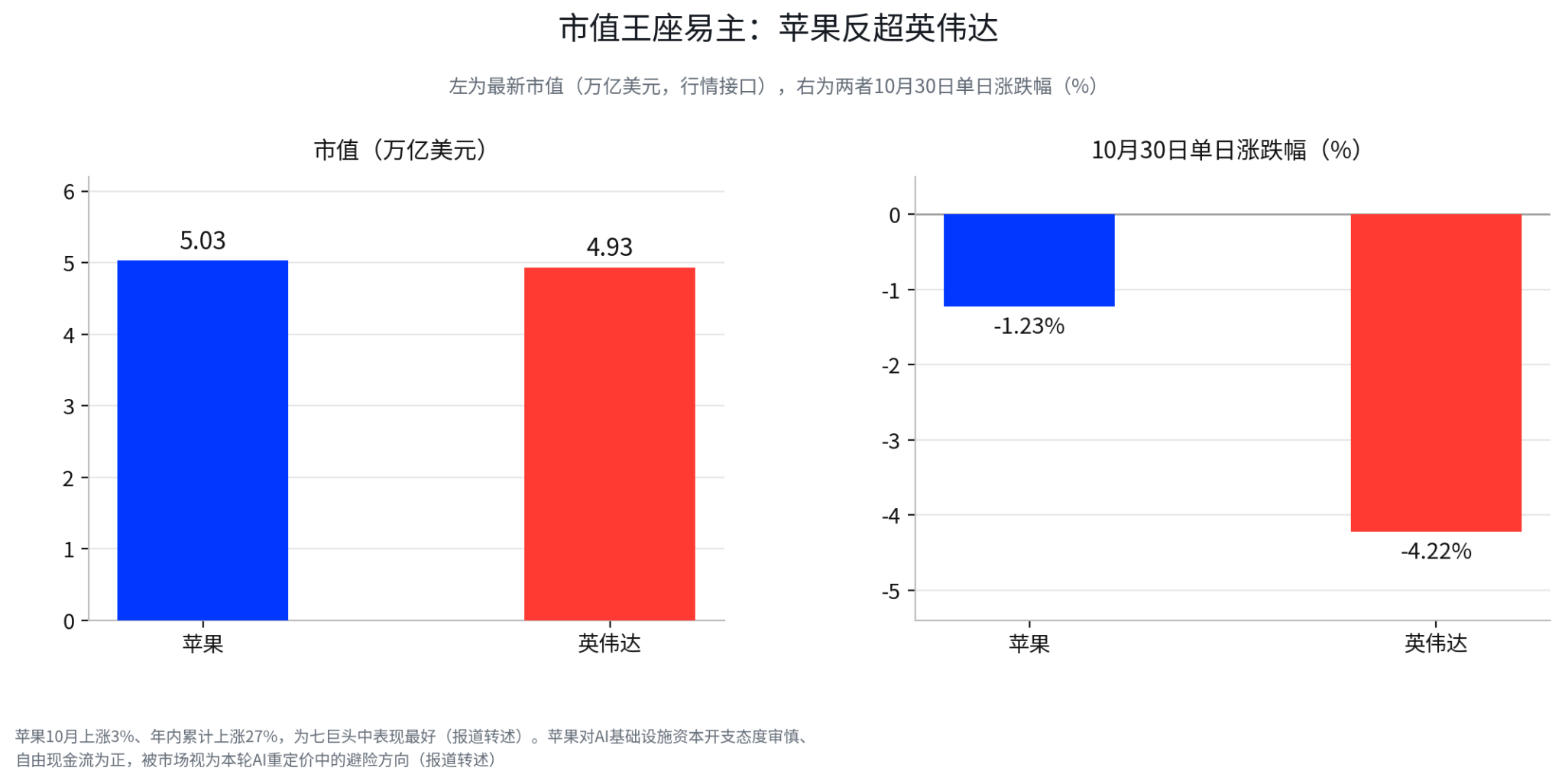
This change is symbolic. Over the past two years, Nvidia represented the core direction of AI infrastructure investment expansion, and the market was willing to pay a premium for the supply shortage and high growth of its computing products. But as large tech companies continue to expand data center, chip, and energy investments, investors are shifting their focus from orders and revenue growth to return on investment—how much revenue and profit these capital expenditures can ultimately generate, and how long it will take for them to translate into cash flow.
By contrast, Apple's capital expenditure structure is relatively prudent, and its business still relies mainly on iPhone and services revenue to generate cash flow. As AI giants face repricing due to infrastructure investment and return cycles, Apple's appeal does not necessarily come from stronger AI growth expectations, but from the fact that its business model does not need to rely on AI infrastructure investment of a similar scale to sustain current profitability. The change in market cap ranking alone cannot prove the market has completed a style shift, but it at least shows that when risk appetite declines, capital begins to re-emphasize the certainty of cash flow.
Gold also failed to play its traditional safe-haven role in this selloff. Spot gold fell 3.63% last Friday to close at $3,875.44 per ounce, touching a more than one-year low intraday, with October becoming its worst month since 2008. Silver fell below $50 for the first time since November 2025. Commerzbank's explanation was that the decline in tech stocks triggered margin calls for some investors, who had to sell liquid assets such as gold to meet margin requirements or cope with redemption pressure.
This looks more like a liquidity shock than the market suddenly concluding that gold has lost its safe-haven value. When highly volatile assets in a portfolio fall rapidly and leveraged positions face margin calls, investors may first sell assets that can be quickly liquidated rather than wait for risk assets to stabilize. Meanwhile, U.S. Treasury yields retreated, with the 10-year yield down 6 basis points to 4.934% and the 2-year down 7 basis points to 4.598%. The simultaneous decline in gold and tech stocks does not necessarily mean the market is trading on stronger economic growth or higher inflation expectations. Combined with the changes in Treasury yields, capital is more likely reducing risk exposure, replenishing liquidity, and seeking assets with relatively certain short-term returns.
3. Two Earnings Reports Tonight: Apple Looks to Guidance, Palantir to Whether Growth Can Continue to Beat Expectations
After last Friday's selloff, the market needs new earnings information to judge whether this round of adjustment is a short-term position cleanup or a shift in the valuation framework for AI assets. Tonight (November 2) after the bell, Apple and Palantir will report earnings successively. The two companies are in different positions: Apple represents a large tech company with mature cash flow and relatively cautious capital expenditures, while Palantir is a high-growth, high-valuation AI software name. The former needs to prove its fundamentals are intact, while the latter needs to prove its growth still justifies the valuation the market has given it.
Apple: Beyond the Quarterly Numbers, the Market Cares More About Next Quarter's Growth Guidance
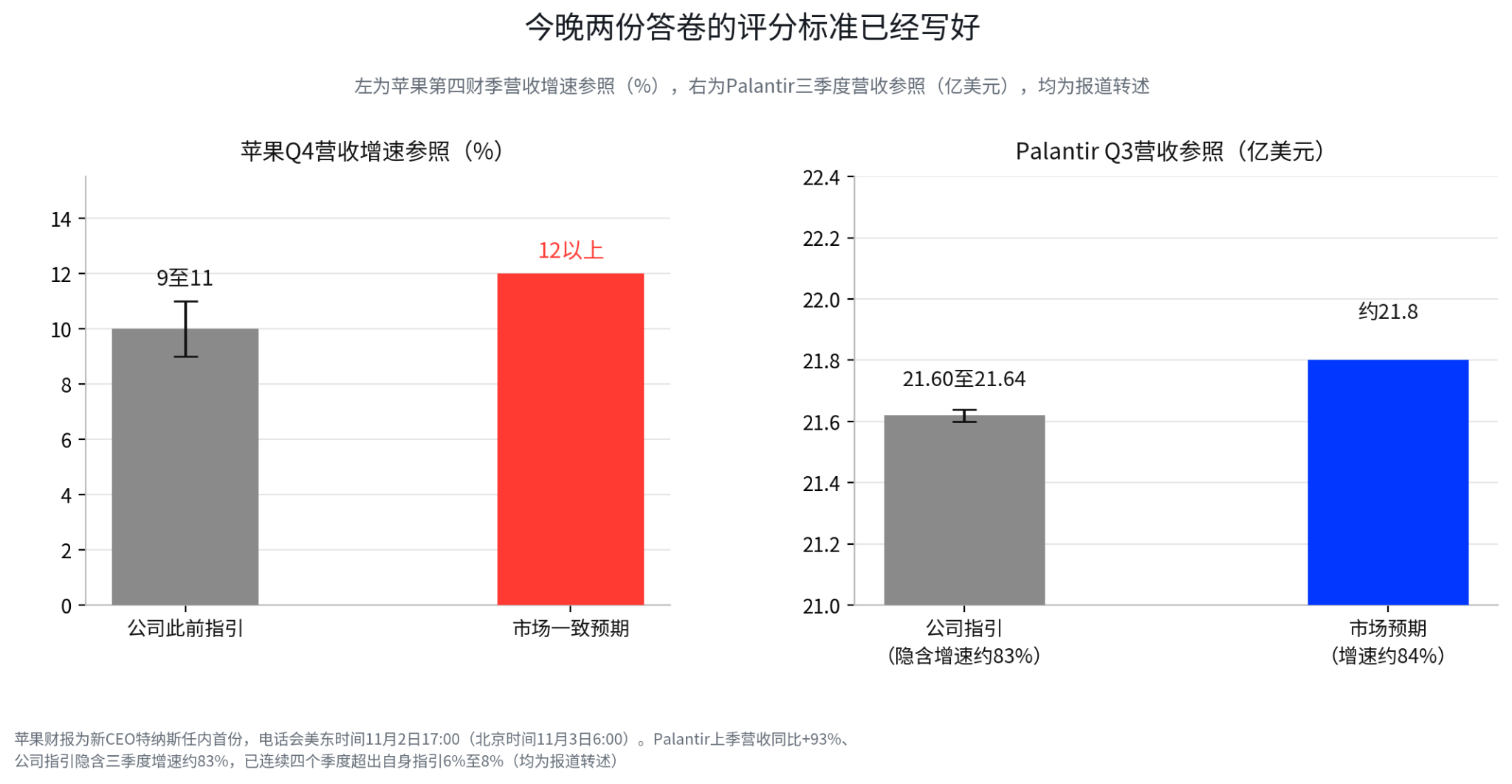
This is the first earnings report since John Ternus took over as CEO on September 1, with the conference call scheduled for 5:00 p.m. Eastern Time on November 2, or 6:00 a.m. Beijing Time on November 3 (per the company website and media reports). Wall Street expects Apple's fiscal fourth-quarter revenue at about $113.3 billion, with forecasts from different institutions ranging from about $113.0 billion to $113.4 billion, and earnings per share expected at $1.98 to $1.99.
What Apple's earnings really need to answer this time goes beyond whether it can slightly beat market expectations; it comes down to whether growth can be sustained in the coming quarters. The company previously projected fiscal fourth-quarter revenue growth of 9% to 11%, while the consensus expectation is above 12%. At the same time, component prices remain elevated, memory chip costs are rising, and currency fluctuations could all put pressure on margins and forward guidance. Analysts are therefore more focused on Ternus's remarks on the conference call about memory prices, component supply, and iPhone demand, rather than just whether quarterly revenue and EPS meet expectations.
Apple's defensive attributes also have limits. If revenue guidance and iPhone demand remain stable, the market may continue to view it as the choice among tech giants with more certain cash flow. But if management gives a more cautious outlook on costs and demand, Apple will also find it hard to stay entirely outside the broader valuation adjustment in tech stocks. Whether Apple can continue to command a relative premium will ultimately have to be proven by fundamentals, not by the label of low capital expenditure.
Palantir: High Growth Is Already Priced In; the Next Step Requires Stronger Guidance
Palantir faces a different kind of pressure. In the previous quarter, revenue grew 93% year-over-year, a record, U.S. commercial revenue grew 149%, and adjusted free cash flow reached $1.22 billion. The market expects third-quarter revenue of about $2.18 billion, up about 84% year-over-year, and adjusted EPS of $0.41, nearly double the $0.21 in the same period last year. The company previously guided third-quarter revenue of $2.160 billion to $2.164 billion and adjusted operating income of $1.292 billion to $1.296 billion. On that basis, the guidance implies revenue growth of about 83% year-over-year, below the 93% of the previous quarter.
The problem is that Palantir's valuation has already priced in fairly high growth expectations. Since the last earnings call, the stock has risen about 46.5%, but it fell 6.27% last Friday and 7.4% for the week to close at $184.11. The company has also flagged that hiring and product investment will drive up third-quarter operating expenses, while international commercial business growth is notably slower than the U.S. market.
Over the past four quarters, Palantir's actual results have consistently beaten its own guidance by about 6% to 8%, which has also raised the bar for this earnings report. For such high-valuation companies, meeting guidance is often just the baseline; investors want to see management raise full-year expectations again and prove that new investment can translate into sustained revenue and profit growth. If the company merely meets its existing guidance or even gives a conservative fourth-quarter outlook, the stock could come under pressure from an expectations gap even if revenue and profit still grow rapidly year-over-year.
The contrast between Apple and Palantir precisely captures the two directions of the current market repricing: mature companies need to defend cash flow and fundamentals, while high-valuation growth companies must keep delivering on ever-higher growth expectations. AI investment has not lost its long-term logic, but the market's tolerance for different business models is diverging.
4. Two More Tests This Week: AMD to Gauge Compute Demand, Nonfarm Payrolls to Shape the Valuation Environment
Apple and Palantir's earnings are just the beginning of this week's event chain. November 3 is U.S. midterm Election Day, and AMD will also report earnings after the bell the same day. Election results could affect the market's judgment on fiscal policy, industry regulation, and overall risk appetite. AMD's results will further test, from a supplier's perspective, whether AI compute demand can continue and whether the second tier beyond Nvidia can deliver growth.
The market expects AMD's third-quarter revenue at about $13 billion, with the ramp-up of Helios racks and MI450 chips in focus; the company currently has a market cap of about $824 billion. For AMD, investors not only care about revenue growth in the data center business but will also watch the delivery pace of new products, customer demand, and gross margin performance. If results can prove that its share of the AI accelerator market is expanding, it could ease some concerns about compute demand. If product progress or guidance falls short, the semiconductor sector could continue to face valuation pressure.
The October nonfarm payrolls report to be released on November 6 will affect the market's judgment on the rate path from a macro perspective. If jobs data come in stronger than expected, it could reinforce concerns that rates will stay high. If it weakens markedly, it could spark worries about economic growth and corporate earnings. For AI giants with pressured free cash flow and massive capital expenditures, as well as AI software companies whose valuations already price in high growth expectations, changes in rates affect the present value of future cash flows and also change the price investors are willing to pay for future growth.
Therefore, this week's market focus goes beyond whether a few companies can deliver impressive earnings; it comes down to whether three types of information can corroborate one another: whether AI demand is real and sustained, whether companies can convert growth into profit and cash flow, and whether the rate environment allows the market to continue paying a high premium for future growth.
Last Friday's decline has already shown that the market is no longer satisfied with a broad AI growth story. Capital is beginning to distinguish which companies can support investment with operating cash flow and which still need financing and future growth expectations to sustain their valuations. The upcoming results from Apple, Palantir, and AMD will test this path of divergence from different angles, while the nonfarm payrolls data and rate expectations will determine how quickly this valuation adjustment proceeds.
Data Notes
- Market data (October 30, 2026 close, data retrieved November 2): Nasdaq -2.86% at 25,437; S&P 500 -1.82% at 7,580.07; Dow -1.09% at 51,770.31; Philadelphia Semiconductor Index -7.2% at 10,688.80. Intel -28.58%, AMD -10.88%, Qualcomm -11.12%, Micron -5.3%, Nvidia -4.22% (market cap $4.93 trillion), SanDisk -13.47%, Apple -1.23% (market cap $5.03 trillion).
- Monthly and drawdown: Nasdaq down 7.8% from its October 6 record high, down 5.3% for October, its worst month since March 2025; Philadelphia Semiconductor Index down more than 15% in October; Apple +3% in October, +27% year-to-date; Intel posted its largest single-day drop since 1974 but is still up 78% year-to-date.
- Gold, silver, and rates: Spot gold -3.63% at $3,875.44, touching a more than one-year low intraday, its worst October since 2008; silver fell below $50 for the first time since November 2025; Commerzbank cited margin calls. 10-year Treasury yield -6bp to 4.934%, 2-year -7bp to 4.598%.
- Apple earnings: To be released after the bell on November 2, conference call at 5:00 p.m. Eastern Time (6:00 a.m. Beijing Time on November 3); new CEO Ternus took over on September 1. Expected EPS $1.98–$1.99, revenue about $113.3 billion (institutional range $113.0–$113.4 billion); prior guidance of 9%–11% growth, consensus above 12%.
- Palantir earnings: To be released after the bell on November 2. Expected revenue about $2.18 billion, adjusted EPS $0.41; company guidance of $2.160–$2.164 billion revenue, implying about 83% growth, and adjusted operating income of $1.292–$1.296 billion. Last quarter revenue +93%, U.S. commercial +149%, adjusted free cash flow $1.22 billion; stock up about 46.5% since the last earnings call, -6.27% last Friday, -7.4% for the week to close at $184.11.
- This week's schedule: November 3 midterm Election Day, AMD earnings after the bell (expected revenue about $13 billion, market cap about $824 billion); November 6 October nonfarm payrolls; December rate hike expectations remain high.
Disclaimer
This content is for general informational and market commentary purposes only, based on public information compiled as of the time described herein, and relevant market data, expectations, and probabilities may change with market conditions. The views and investment strategies of third-party institutions, analysts, or other persons cited herein represent only the views of the relevant third parties at a particular time and do not represent the views or recommendations of BIT. This article does not constitute investment advice, investment research, an offer, solicitation, or recommendation of any securities, investment products, or trading strategies, nor should it be used as the basis for any investment decision. Financial markets involve risk; securities prices and market performance may fluctuate, and historical performance and past market trends do not represent or guarantee future results. Investors should independently assess the relevant risks based on their own circumstances and seek professional advice when necessary. BIT's Hong Kong stock trading services are not provided to Hong Kong residents or users in other restricted jurisdictions.