Grok Bot真的能自動賺錢?先看懂三類機器人的虧損陷阱


- 核心觀點:Meme幣交易機器人普遍存在被忽視的失效模式,投資者應優先評估機器人在判斷失誤時的最大損失,而非僅關注收益表現,風控規則只能限制損失、無法保證盈利。
- 關鍵要素:
- 賭徒型機器人若按上一筆交易結果調整倉位,遭遇Rug時帳戶虧損約12%,而固定比例倉位策略基本保住本金。
- 莊家型機器人需確保預期手續費收入至少為單次發幣成本的2倍,且不得持有或拋售自發行代幣,否則構成Rug並帶來法律與聲譽風險。
- 跟蹤型機器人存在跟單延遲,40秒延遲可導致追高60%;被跟蹤錢包盈利100%時跟單者僅盈利25%,甚至虧損12.5%。
- 常見錯誤包括只比較收益、單次運行即下結論、系統貼極限運行、將風控僅視為設置選項而非嵌入下單流程的硬性規則。
- 風控應優先處理危及整個帳戶的問題:先修正倉位規則,再設追高上限,最後核算發幣成本覆蓋。
Original Title:Grok Bot Engineer: Every Memecoin Bot Has a Failure Mode. Find It Before the Market Does
Compiled by Odaily (@OdailyChina); Translator: Asher (@Asher_0210)

Every post on X introducing Grok Bot seems to tell the same kind of money-making story: 0.25 ETH turning into 1.35 ETH in a day, $1,000 becoming tens of thousands overnight, or starting with zero capital and earning fees continuously. But what few people mention is when these bots fail and how much they can lose when they do.
The same three trading signals, with only different position-sizing rules, can produce completely opposite results: one account, after hitting a Rug, is roughly break-even; another loses about 12% and gives back all the profits from the previous two trades.What determines the outcome is not just whether the bot can catch opportunities, but how much capital it loses when it gets it wrong.
When analyzing a trading bot, you should first think clearly about when it fails and how much it costs when it does. It's like designing a bridge: you can't only consider the usual situation of sparse traffic; you must also consider the extreme loads that could cause it to collapse. So I re-examined my entire Grok Bot trading system using the failure mode analysis method. No need to buy tools, no need to spend extra money; for each bot, just put together one analysis table listing what it relies on to make money, what causes it to fail, and how much capital is affected when it fails.
Below, let's start with the three common types of bots and break down their weak points one by one, along with the risk control rules each must follow.
Designing Trading Bots from an Engineering Perspective
In aerospace and manufacturing, there is a seemingly boring but very effective practice called "Failure Mode Analysis." You need to list all the ways a system can fail, then score them from three aspects: how severe the consequences are, how likely they are to occur, and how quickly the problem can be detected. Then, prioritize the failure modes with the highest risk scores. On this basis, engineers also introduce two concepts:
- Safety factor: Don't run the system at its rated limit all the time. If a beam can bear 10 tons, only let it bear 5 tons in actual use;
- Failure blast radius: When one part fails, how many other parts will be dragged down with it.
Applying this thinking to Meme coin trading means requiring every bot to answer three questions: What is its edge? What causes that edge to fail? When it fails, will the loss affect only a single position, or will it drag down the entire account?
Three Types of Bots and How Each Fails
Currently, most people trading Meme coins with Grok Bot use architectures that fall into the following three categories. These three make money in completely different ways, and they fail in completely different ways too.
Type 1: Gambler Bots
Gambler bots scan newly issued tokens, check the contract, then judge the price direction and trade. Their edge lies in judging which tokens will rise, but their fatal weakness is that they tend to keep increasing position size after making a profit, and once they subsequently make consecutive wrong calls, they can cause large losses.
In many gambler bot configurations, the most dangerous instruction is: "Determine the size of the next trade based on the result of the previous trade." This is essentially a Martingale-style position-increasing strategy in disguise. Taking an account with initial capital of $1,000 as an example, the two position-sizing rules produce the following results:
- Both strategies make 50% on the first trade: allocating 5% of account capital, $50, the account rises to $1,025; allocating a fixed 2%, $20, the account rises to $1,010;
- Both strategies make another 50% on the second trade: the former raises the position to 10%, allocating about $103, and the account rises to about $1,076; the latter still allocates 2%, about $20, and the account rises to about $1,020.
- On the third trade, the token hits a Rug and both strategies lose 90%: the former further raises the position to 20%, allocating about $215, and the account falls to about $883; the latter still allocates 2%, about $20, and the account is left with about $1,002, roughly preserving the principal.
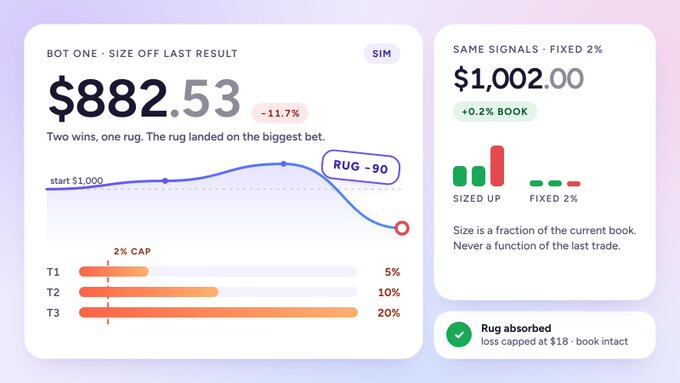
With the same three trading signals, one group of accounts is roughly break-even after hitting a Rug; the other loses about 12%, giving back all the profits from the first two trades. Therefore, the rule that must be followed is: the position size of each trade must be determined as a fixed proportion of the account's current total capital, and must never be adjusted based on the result of the previous trade. Contract checks, including mint authority, liquidity pool status, and the holdings ratio of the top ten holder addresses, must serve as entry conditions for whether to reject an order, not merely as scoring items for reducing position size.
Type 2: Dealer Bots
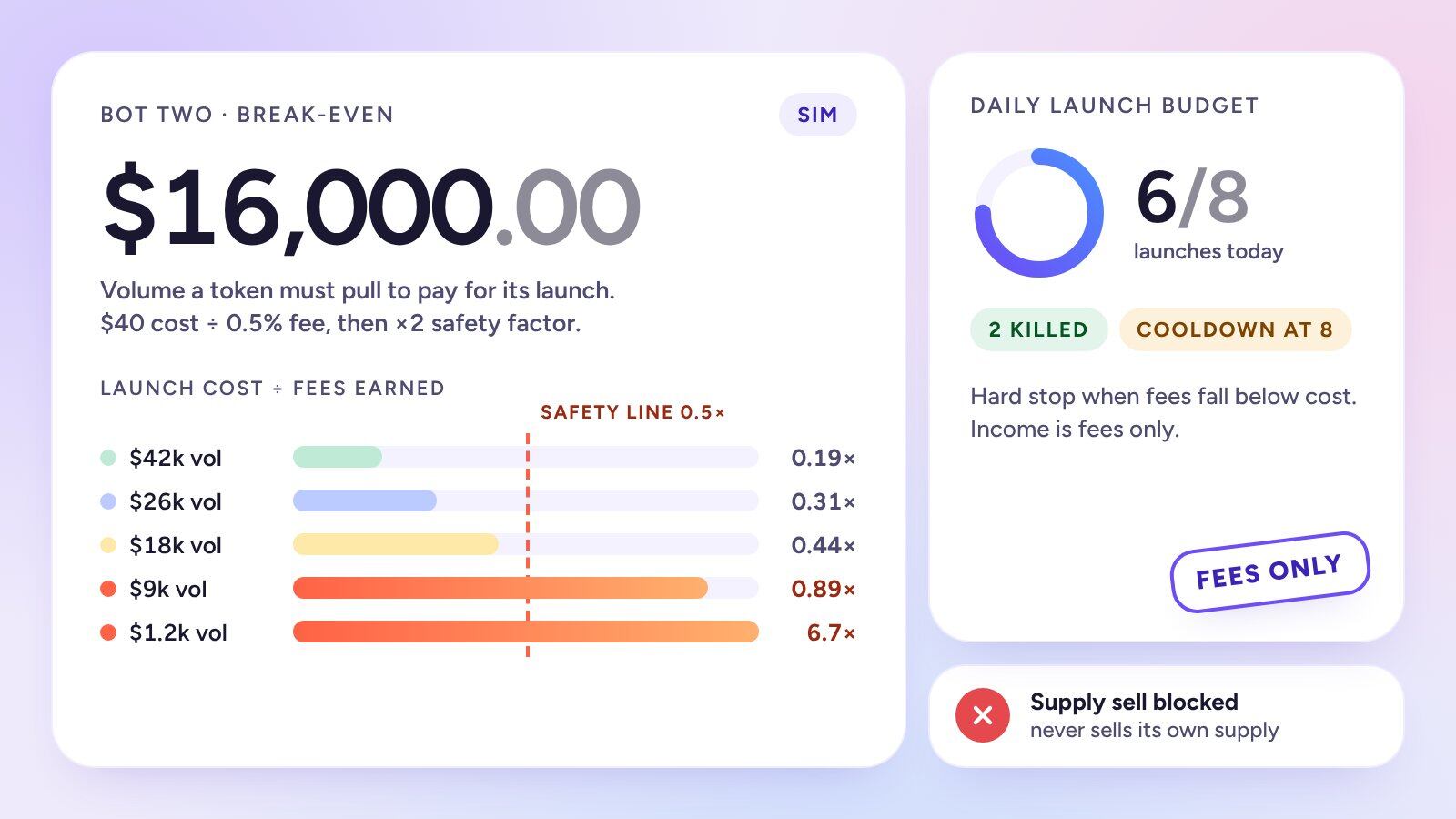
Dealer bots issue tokens, collect fees from each trade, and eliminate tokens that no one trades. Their edge is that as long as there is trading volume, there is income, without needing to judge price direction, but their fatal weakness is that once trading volume dries up, the cost of issuing tokens may exceed fee income. In addition, there is another risk, and this risk never appears in profit screenshots.
Dealer bots are often promoted as "rarely losing money." But this statement only holds when counting only fee income and ignoring costs. Every token issuance has costs, including deployment fees, initial liquidity provision, Gas fees, and the capital consumed by tokens that receive not a single trade after issuance. Before the bot starts running, calculate the break-even condition clearly: fee rate × expected trading volume per token must exceed the cost of issuing a single token, with a 2x safety factor. In other words, expected fee income should be at least twice the cost of issuing a single token.
The second failure mode is more important. The fee model earns from the fees generated by user trades. But when the bot starts holding tokens it issued itself and dumping them on buyers, it is no longer merely a fee-collecting "dealer" but is carrying out a Rug, and you are the operator behind it. Reputation risk, platform risk, and legal risk all concentrate here, and no profit screenshot will show these problems.
Therefore, the rule that must be followed is: dealer bots must not hold or sell tokens they issue themselves; income may only come from fees. At the same time, a daily token issuance budget must be set, and once fee income falls below cost, token issuance must be forcibly stopped.
Type 3: Tracker Bots
Tracker bots track profitable wallets, rank them, and copy their trades. Their edge lies in borrowing trading edges that others have already proven, but their fatal weakness is copy-trading delay: even if you follow the right wallet, you may buy at the wrong price.
This type of bot looks the safest, yet it hides the sharpest risk. For Meme coins, a 40-second delay is no small matter; it may directly determine whether a trade ultimately makes or loses money. Suppose the tracked wallet buys at $0.0010, and you complete your copy trade 40 seconds later at $0.0016, equivalent to chasing a 60% price increase.
In addition, when the price rises to 2x the tracked wallet's buy price, namely $0.0020, and both sell at the same time, the other party profits 100%, while you can only profit 25%; when the price rises to 1.4x the tracked wallet's buy price, namely $0.0014, and both sell at the same time, the other party profits 40%, while you lose 12.5%.
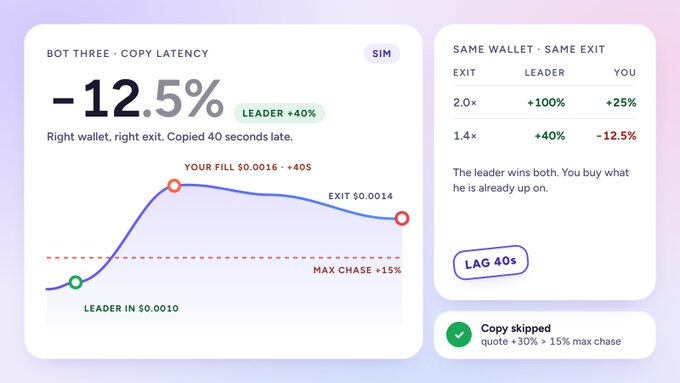
Same wallet, same token, same selling point: the tracked wallet makes money both times, while you profit once and lose once, because when you bought in, the other party already had considerable unrealized gains. Worse still, the wallet you are tracking may happen to be selling into the buying pressure from you and other copy traders. At that point, you are not following smart money; you are providing it with the liquidity it needs to exit, becoming its exit buyer.
Therefore, the rule that must be followed is: set a chasing上限. If the expected execution price is more than 15% above the tracked wallet's buy price, skip the trade. Not only follow buys, but also follow sells; limit the capital allocated to a single wallet, and after three consecutive copy-trading losses, lower that wallet's tracking priority.
Four Most Common Mistakes When Using Trading Bots
First, comparing only returns, not failure modes. Making 10x in a day only shows the best-case scenario. It cannot tell you what situation would wipe out all the money in the wallet.
Second, trusting only a single run result. Running continuously for 24 hours is still just one sample. Engineers do not conclude that a component is reliable just because it passed one test.
Third, running the system right at its limit. If a stop-loss mechanism needs to check once per second to be effective, do not assume that checking once per second is already enough. You need to leave a safety margin.
Fourth, treating risk control as a settings option. A slider on the interface only expresses a preference. Only when limits are embedded in the order flow and tested to ensure they throw errors when they fail can they be considered a real rule.
Risk Control Can Limit Losses, But Cannot Guarantee Profits
Risk control rules cannot make a bot automatically profitable, nor can they make its judgments correct. Project rug pulls, honeypot contracts that can only buy but not sell, and liquidity that can disappear within a single block will not stop appearing just because circuit-breaker mechanisms are well designed. These rules can only limit losses; they cannot eliminate risk.
In actual adjustments, priority should be given to issues that could endanger the entire account. For most traders, first fix the position-sizing rules of gambler bots, then set the chasing upper limit for tracker bots, and finally calculate whether dealer bots' income can cover costs.
If the strategy itself relies on dumping tokens it issued itself, front-running copy traders, or bypassing platform rules to profit, then no matter how refined the risk control is, it cannot solve the strategy's own problems.
Rather than only looking at how much a bot can earn, you should first clarify how much loss you can bear at most when things go wrong.