US stocks historically tend to rise on light volume after Thanksgiving, Hong Kong stocks rebound but face selling pressure, AI chips add new variables: Can a December rebound window be expected?


- Core View: The market is in a transition phase. A December rate hike has been fully priced in, and the rebound space depends on whether subsequent rate hike expectations can cool down. AI hardware faces new variables in inventory and deliveries. The Hong Kong stock rebound has not yet been confirmed by capital flows, and short-term direction should not be judged based on price alone.
- Key Factors:
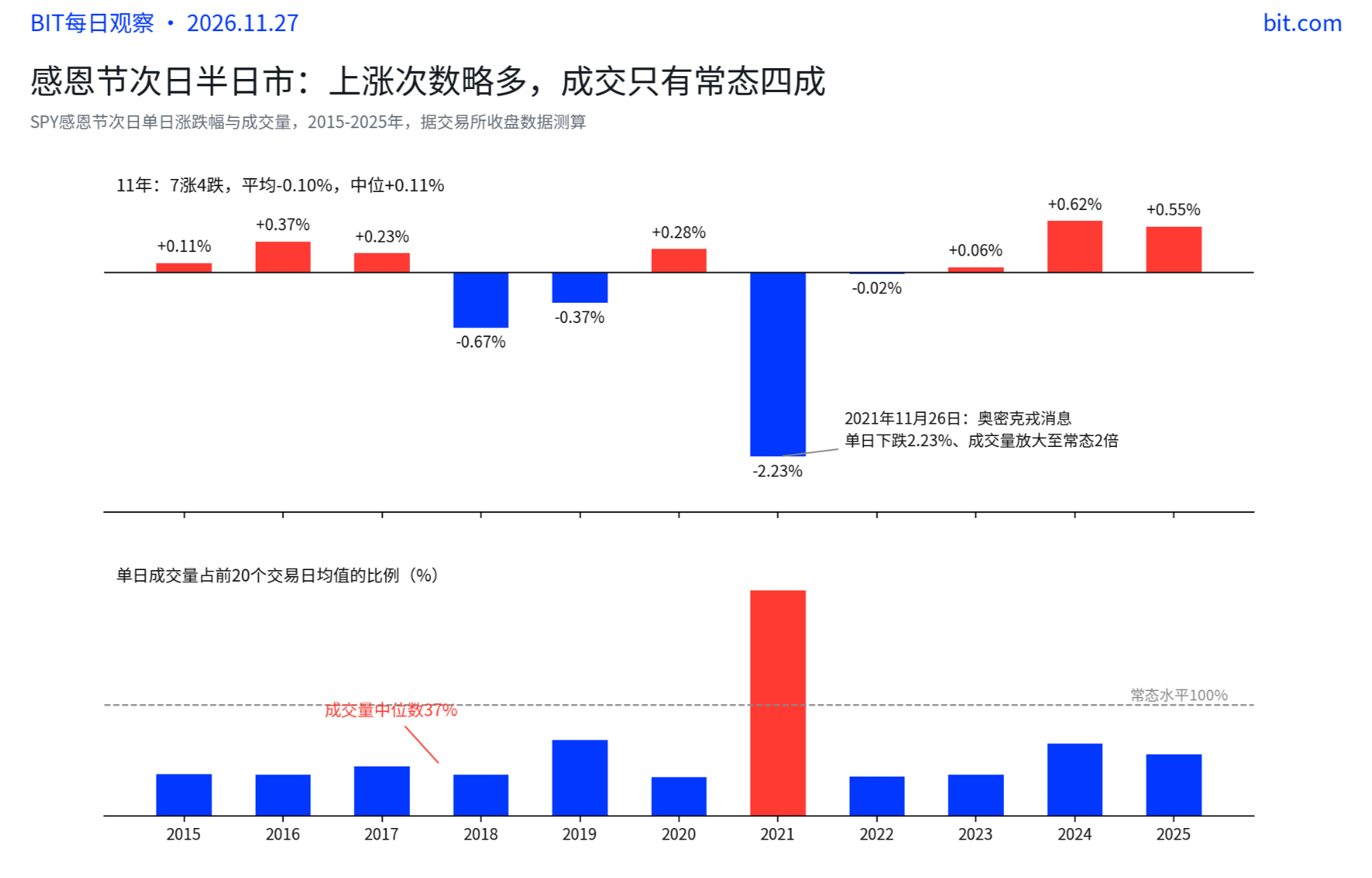
- US stocks saw thin trading in the shortened session after Thanksgiving, with median SPY volume at only about 37% of normal levels. Low liquidity amplifies price volatility, and direction confirmation should wait for a full trading week next week.
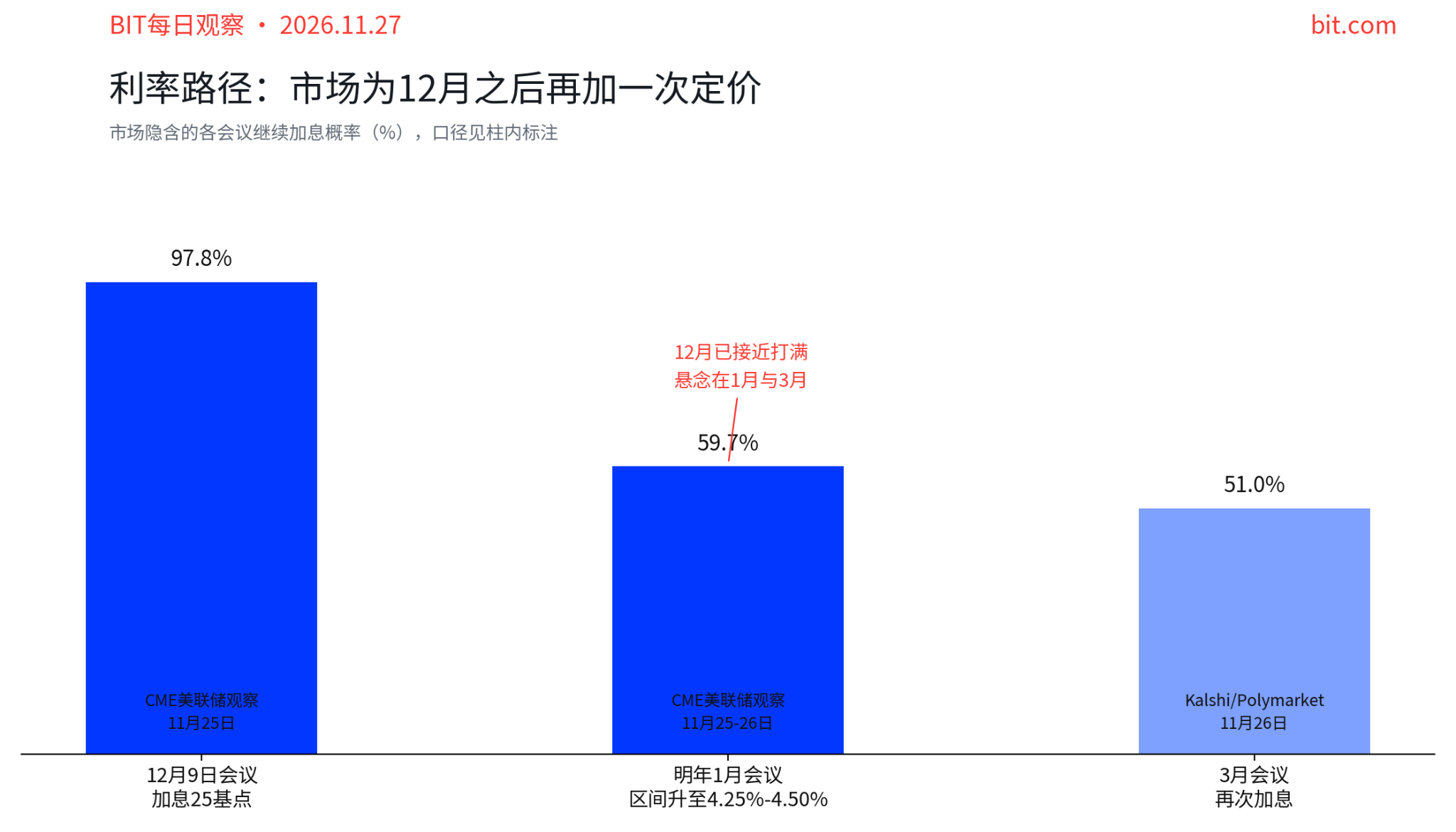
- The probability of a 25-basis-point rate hike in December stands at 97.8%, but the probability of further hikes in January and March is about 59.7% and 50%, respectively. The 10-year US Treasury yield at 4.869% continues to weigh on tech stock valuations.
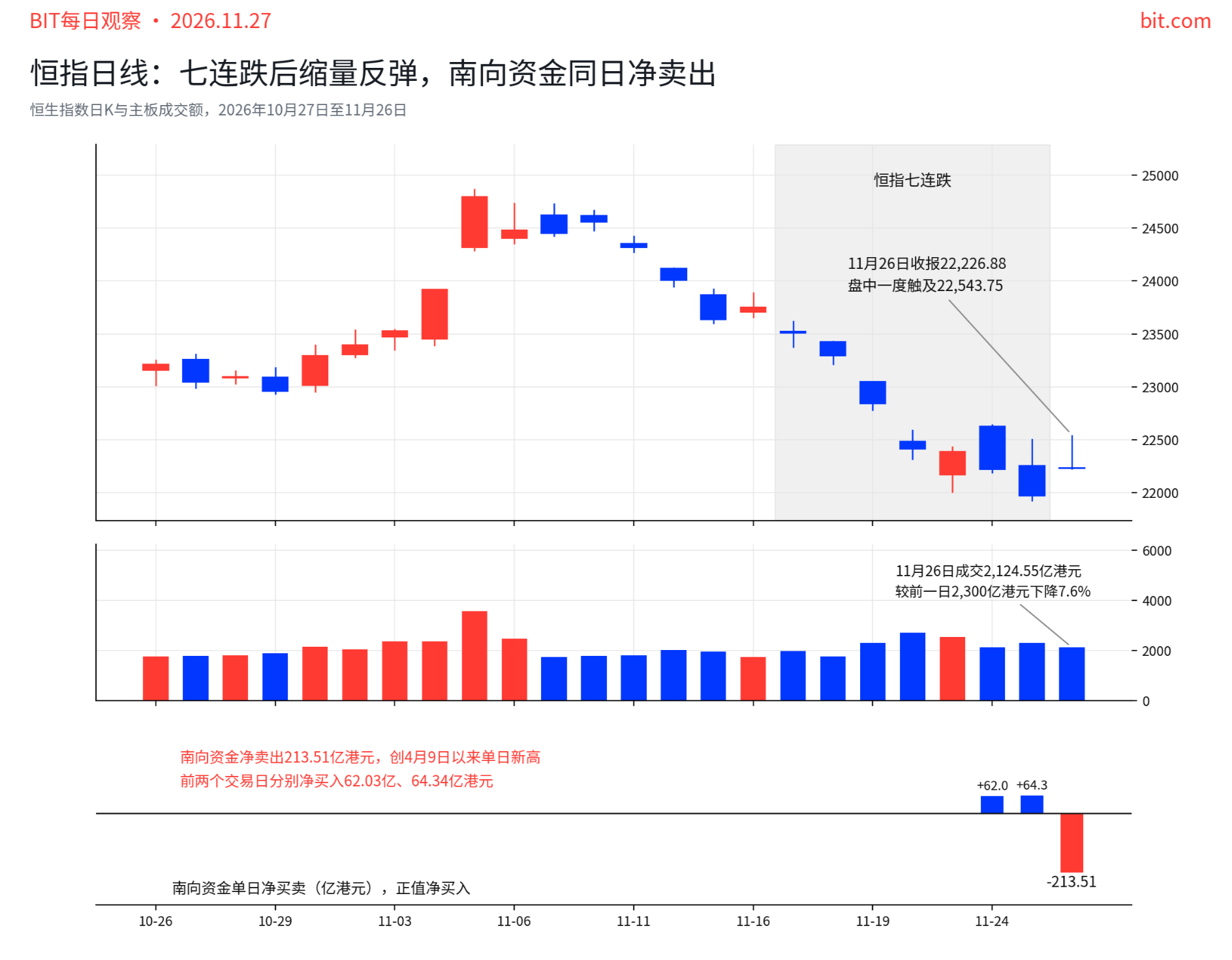
- The Hang Seng Index ended a seven-day losing streak to close up 1.19%, but southbound funds recorded a net sell of HK$21.351 billion that day, the highest since April 9. The rebound was mainly driven by technical buying and short covering.
- New US regulations bring overseas data center remote computing power under control. The number of NVIDIA B300 GPUs listed for sale in the market has increased abnormally, involving thousands of units. NVIDIA has also suspended shipments of servers equipped with its chips to four Southeast Asian countries.
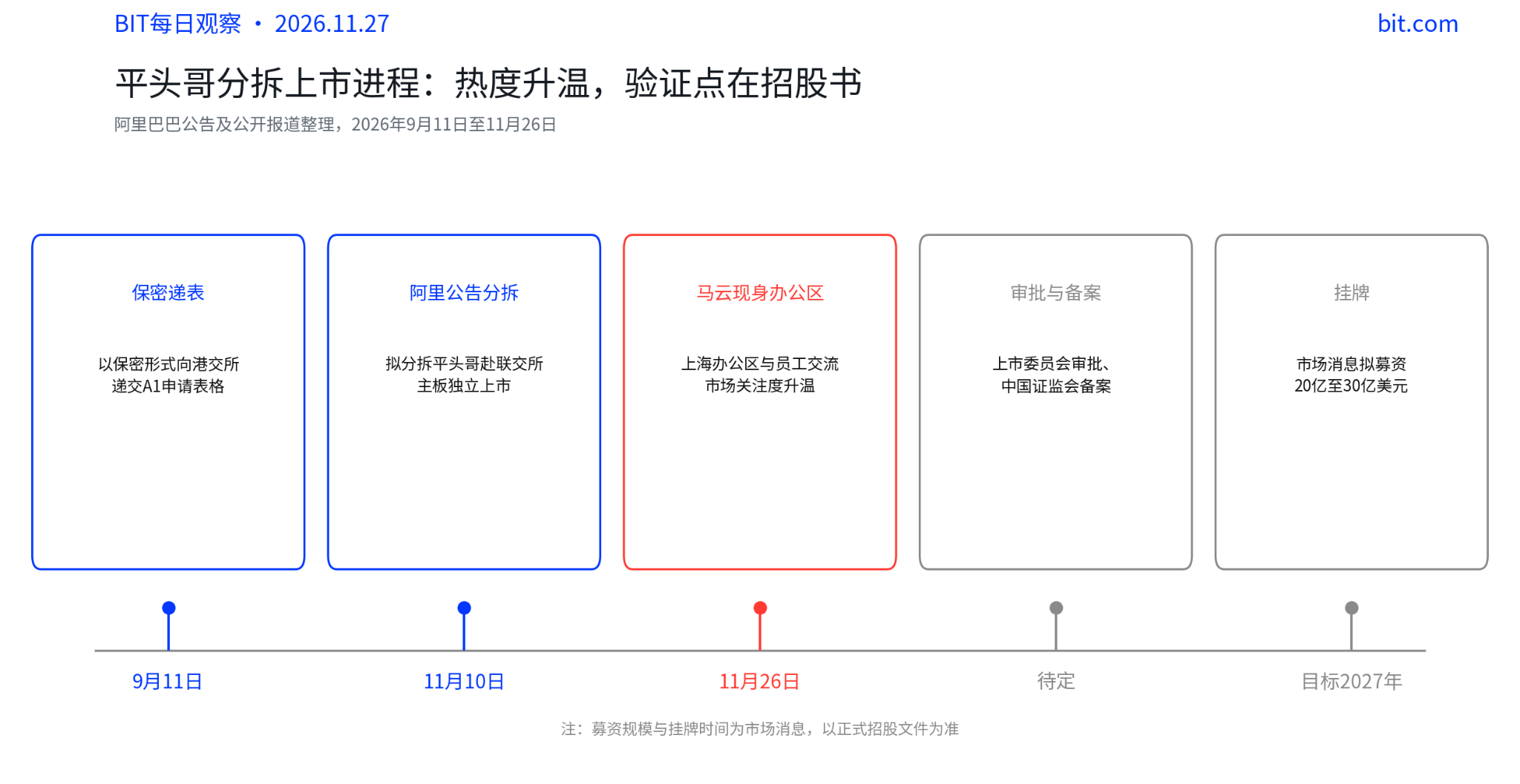
- Jack Ma appeared at T-Head. Alibaba's spin-off of T-Head for a Hong Kong listing is underway, with market valuation estimates ranging from $20 billion to $62 billion. The subsequent prospectus and listing process will be key pricing references.
- Follow-up variables to track: US Treasury yields and rate hike expectations, southbound capital flows, NVIDIA orders and GPU inventory, and changes in data center capital expenditure.
1. Post-Thanksgiving Half-Day Session: Thinner Volume Makes Price Swings Easier to Amplify
Today, US stocks close early under the traditional post-Thanksgiving arrangement, trading from 9:30 to 13:00 ET, corresponding to 22:30 Beijing time to 2:00 the following morning, compressing the normal 6.5-hour session to 3.5 hours. This post-Thanksgiving half-day window is itself one of the quieter periods for volume across the year. Based on exchange closing data, across the 11 post-Thanksgiving sessions from 2015 to 2025, SPY rose 7 times and fell 4 times, with an average performance of about -0.10% and a median of about +0.11%, a slight upward tilt in direction but a very small magnitude; the negative average was mainly dragged down by November 26, 2021, when the S&P 500 fell more than 2% on news of the Omicron variant and volume swelled to twice the norm. By contrast, the more stable feature is that volume is well below normal: over those 11 years, the median post-Thanksgiving SPY volume was only about 37% of the average of the prior 20 sessions, with most years falling in the 35% to 45% range.
So today, one should not simply read "more up days historically" as a bullish signal. In a low-volume environment, order book depth declines, and the same amount of capital can push prices further; stop-loss orders, algorithmic trading, and concentrated end-of-day rebalancing can also amplify volatility in the final hour. This is especially true for tech stocks: if the Nasdaq or Nvidia rallies sharply intraday, one needs to keep watching whether volume follows and whether the gains spread from leaders to more tech names; if there is a sudden plunge intraday, one should also watch whether it is accompanied by a synchronous weakening of broader risk assets.
The post-Thanksgiving half-day session is better treated as an observation window for sentiment and positioning changes; a genuinely meaningful directional judgment must wait until full trading resumes next week. By then, with volume back to normal, it will be clearer whether the market is continuing to buy tech stocks or using the rebound to reduce positions.
2. A December Rate Hike May Bring a Rebound, but Whether There Are Two or Three Hikes Next Year Will Determine Its Scope
A 25-basis-point rate hike in December has largely been priced in by the market; what truly deserves attention is whether the market will continue to price further ahead after the hike lands. As of November 26, interest rate futures data showed that the target rate entering the 4.00% to 4.25% range after the December meeting is close to certain, with CME's FedWatch putting the probability at 97.8%; by the January meeting next year, the probability of the target range rising to 4.25% to 4.50% is about 59.7%, indicating the market has not stopped the tightening story at December; by March, the possibility of further hikes has also entered the trading range, with prediction market probabilities slightly above 50%, and both Goldman Sachs and Morgan Stanley expect the Fed to hike once each in December and March, with a peak range of 4.25% to 4.50%.
This will directly affect tech stock performance after the December hike. If the Fed hikes as expected in December but its language is not more hawkish than market expectations, and January and March hike expectations instead begin to recede, then tech stocks that had already priced in rate hike pressure in advance could see a "sell the expectation, buy the fact" rebound. Conversely, if traders continue to push the January and March hiking path higher after the December hike, the fading of the negative factor from the December move will be hard to translate into a sustained rebound, and long-end US Treasury yields could continue to weigh on highly valued tech stocks.
Recent economic data suggest subsequent hike expectations are not without basis. October core PCE rose 3.3% year over year, above the expected 3.2% and the highest since November 2023; headline PCE was 3.8% year over year; third-quarter GDP was revised up to 4.3%, and October personal income rose 0.7% month over month. With sticky inflation and resilient growth, the market will naturally shift its focus from "whether there will be a hike in December" to "how many more hikes in 2027." The 10-year US Treasury yield closed at 4.869% on November 25, still at a high level, and the funding cost pressure on tech stock valuations has not disappeared just because the December hike expectation has been absorbed.
Therefore, what truly deserves attention after the December meeting is whether rate pricing for January and March moves back down. If subsequent hike expectations cool markedly, the rebound scope for tech stocks will be larger than from simply "the December hike landing"; if the market continues to trade two to three hikes next year, the rebound is more likely to remain at the level of valuation repair.
3. Hang Seng Index Rebounds After Seven Straight Declines, but HK$21.3 Billion in Southbound Net Selling Means This Positive Candle Still Needs Confirmation
On November 26, the Hang Seng Index finally ended a seven-day losing streak, rising as much as 577 points intraday to 22,543.75 and finally closing at 22,226.88, up 1.19%, reclaiming the 22,000 level; the Hang Seng Tech Index rose 1.16% to close at 3,417.38, ending 11 consecutive trading days of declines. The prior sustained decline had already built up strong technical repair momentum, so a notable index rebound was not surprising.
Changes on the funding side did not keep pace. That day, main board turnover in Hong Kong was about HK$212.455 billion, down 7.6% from the previous day; southbound funds recorded net selling of HK$21.351 billion, with Stock Connect (Shanghai) net selling HK$10.598 billion and Stock Connect (Shenzhen) net selling HK$10.753 billion, the highest single-day net selling since April 9. In the prior two trading days, southbound funds had net bought HK$6.203 billion and HK$6.434 billion respectively, marking a clear shift in funding direction on the day of the rebound. In its November 27 morning note, Zhongtai International judged that the November 26 rebound may have been mainly driven by technical buying and short covering, with limited willingness to chase highs, and expected Hong Kong stocks to fall today, with the Hang Seng Index finding support at 22,000; Hang Seng Index night futures closed at 22,117, a 110-point discount. This view represents only the judgment of the institution concerned.
This means Hong Kong stocks currently look more like the index has stopped falling first while funds are still watching. If the Hang Seng Index continues to rise today, one needs to see whether turnover can expand, whether southbound funds can return to net inflows, and whether the Hang Seng Tech Index can hold yesterday's rebound level; only when the index, turnover, and funding all begin to reinforce one another will the market have better conditions to move from a post-selloff repair toward a trend improvement. If the index opens higher but volume fails to follow and southbound funds keep selling, this rally is still closer to a sentiment repair; from an observation standpoint, "whether large funds have stayed" is a more worthwhile question to answer than "whether the Hang Seng Index has reclaimed 22,000."
4. Nvidia B300s Appear for Sale, and the AI Trade Begins to Face "Who the Chips Are Ultimately Sold To"
Interest rates affect the valuation of AI assets, while recent supply chain news around Nvidia touches a more fundamental issue: once advanced GPUs are produced, can they smoothly reach final data center demand? The US Bureau of Industry and Security announced an interim final rule on November 16, effective November 19, bringing overseas data centers providing remote computing power to restricted entities under control, closing the route by which Chinese companies use advanced chips through third-country data centers. CNBC subsequently reported on November 25 that three people familiar with the matter said the number of Nvidia GPUs offered for sale on the market had increased unusually after the new rule was announced, involving thousands of B300s; the head of AI infrastructure trading platform GPU Mart said some sellers explicitly stated that the sale was related to the new rule. Nvidia declined to comment.
A second piece of news emerged on the supply chain side. According to reports on November 26 by media including CCTV Finance and Yicai citing people familiar with the matter, Nvidia has asked manufacturing partners to suspend shipments of servers equipped with its chips to Malaysia, Singapore, Thailand, and Indonesia, and manufacturers including Dell and Super Micro have notified buyers in the four countries, with no clear timeline for resumption. Nvidia's Singapore subsidiary recorded US$104 billion in revenue in 2025, up 72% year over year, giving Southeast Asia a significant weight in its revenue structure. With the two reports combined, market attention has extended from simply Chinese market demand to whether export restrictions could affect Nvidia's entire delivery chain through overseas data centers, server manufacturers, and channel inventories.
For now, these reports cannot simply be equated with a decline in Nvidia demand. Policy-driven equipment adjustments at individual projects and short-term inventory appearing in channels may both be only localized disturbances; what truly warrants caution is a continued increase in inventory offered for sale that begins to affect server manufacturers' procurement, data center deployment, and the next round of capital expenditure. Once such transmission appears, the AI hardware trade will need to shift from "how much more can capex grow" to "whether capex can truly translate into GPU utilization and revenue." In the first full trading week after the holiday, what is more worth tracking than a rebound in a single chip stock is B300 inventory trends, server orders, data center capex, and delivery guidance from Nvidia and major server manufacturers: if these variables remain stable, the current news is more a policy disturbance; if orders and capex adjust in tandem, AI hardware stocks will need to face new fundamental pricing.

5. Jack Ma Appears at T-Head, Putting the Spinoff Listing in a New Spotlight
On November 26, Jack Ma appeared at the Shanghai office of T-Head, Alibaba's chip business, chatting with employees and taking group photos. The news came right as T-Head's spinoff listing is being advanced, quickly drawing market attention and making domestic chips, AI computing power, and Alibaba's AI ecosystem hot topics for capital discussion once again.
On the timeline, Alibaba announced on the evening of November 10 a plan to spin off its wholly owned subsidiary T-Head (Shanghai) Technology Co., Ltd. for a separate listing on the main board of the Hong Kong Stock Exchange, and the exchange has confirmed the spinoff can proceed; T-Head had already submitted an A1 application form confidentially on September 11. The process still requires approval from the listing committee and filing with the China Securities Regulatory Commission, and the global offering size, issuance structure, and Alibaba's final shareholding ratio will all need to be confirmed in formal documents. Market reports say T-Head may raise US$2 billion to US$3 billion and aim to list in 2027; JPMorgan's January estimate gave a potential valuation range of about US$25 billion to US$62 billion, while institutional figures interviewed by the 21st Century Business Herald gave a range of US$20 billion to US$30 billion; all these numbers are only references before the prospectus and market pricing are finalized.
For the secondary market, the truly valuable information going forward is the listing timetable, chip product revenue, major customers, R&D spending, gross margin, and profitability. Jack Ma's appearance has raised market attention, and the subsequent prospectus and listing process will provide more concrete pricing basis for that attention. With overall Hong Kong funding conditions still weak, IPOs, earnings reports, and industry events can still allow individual stocks to move to their own rhythm; how long the rally lasts will depend on whether these fundamental data points can be delivered one by one.
6. After the December Hike, the Scope of a Rebound Depends on Whether Expectations Keep Being Pushed Forward
Putting today's main threads together, the market is in a transition phase. The December hike has been fully traded; if a "sell the expectation, buy the fact" pattern emerges after the meeting, it could leave short-term rebound room for tech stocks; at the same time, continued hike pricing of about 60% for January and about 50% for March limits the height of valuation repair. The AI hardware chain is beginning to face new variables in inventories and deliveries, and the Hong Kong rebound has yet to be confirmed by southbound funds; the directions of these threads are not consistent, and stitching them into a single up-or-down story would carry a large margin of error.
Today's half-day session therefore should not be used to draw conclusions on its own. Post-Thanksgiving half-day trading has historically been light on volume; although the number of up days in the past was slightly higher, there was no stable directional edge; Hong Kong stocks rose 1.19% yesterday while southbound funds net sold HK$21.351 billion; the industrial logic of the AI sector remains intact, but Nvidia has added new variables with B300s offered for sale and restricted deliveries. Prices are repairing, while funding and fundamentals are still awaiting confirmation.
In the coming trading days, the variables worth tracking continuously are fairly clear: for US stocks, watch whether the 10-year US Treasury yield falls when tech stocks rebound, and whether January and March hike expectations can cool after the December hike lands; for Hong Kong stocks, watch whether southbound funds can return and whether Hang Seng Tech can hold its rebound level; for AI hardware, watch whether there are substantive changes in Nvidia orders, GPU inventories, server deliveries, and data center capex. If the December hike lands as expected, subsequent expectations begin to cool, and earnings and capex continue to be delivered, this rebound may then move from technical repair toward a more sustainable market move; if the market continues to bet on one or two more hikes next year, combined with inventory pressure in the AI hardware chain, the index rebound will be constrained by both valuation and funding.
US stocks have only 3.5 hours today, and the important answer may not appear before 2 a.m. After full trading resumes next week, whether the market continues to buy is the answer most worth watching for this rebound.
Disclaimer:
This content is for general information and market commentary only, based on public information compiled as of the times stated in the text, and relevant market data, expectations, and probabilities may change with market conditions. The views and investment strategies of third-party institutions, analysts, or other persons cited in the text represent only the views of the relevant third parties at specific times and do not represent the views or recommendations of BIT. This article does not constitute investment advice, investment research, an offer, solicitation, or recommendation of any securities, investment products, or trading strategies, nor should it be used as the basis for any investment decision. Financial markets involve risk; securities prices and market performance may fluctuate, and historical performance and past market trends do not represent or guarantee future results. Investors should independently assess relevant risks based on their own circumstances and seek professional advice when needed. BIT's Hong Kong stock trading services are not provided to Hong Kong residents or users in other restricted jurisdictions.