South Korea's "Digital Asset Basic Act" government draft released: exchanges must compensate for hack incidents


- Core Viewpoint: South Korea's Financial Services Commission has published the government draft of the "Digital Asset Basic Act," which will transition the virtual asset industry from a registration system to a licensed operation regime, covering exchange governance, stablecoins, ICO legalization, and no-fault compensation. However, it remains a draft and requires National Assembly review.
- Key Elements:
- The regulatory logic shifts to a business licensing system: trading, intermediation, and custody require FSC licenses, asset management only requires registration, and exchanges must meet a minimum own-capital threshold of 2 billion KRW.
- Major shareholders of exchanges are in principle limited to a 20% stake, with a maximum of 34% upon approval; shares exceeding the limit carry no voting rights, with a three-year transition period; the major shareholders of the five major KRW exchanges generally exceed the limit.
- KRW stablecoin issuers must obtain FSC licenses and have minimum capital of 5 billion KRW; initially, issuance is limited to consortia in which banks collectively hold a majority stake, and reserves must reach 100% of circulating supply with monthly audits.
- A no-fault liability regime is introduced: if user losses result from hacker attacks or system failures, institutions must compensate regardless of fault, with violations subject to fines of up to 10% of revenue.
- Self-regulatory functions such as token listing and abnormal trading monitoring are elevated to statutory duties, requiring submission and public disclosure of listing reports and ongoing disclosure of material matters.
- The domestic ICO ban in place since 2017 will be lifted; issuers must submit white papers to the FSC and observe a statutory waiting period, with false statements subject to criminal liability.
- The ruling party aims for a vote in January next year, intending to complete it before the U.S. "GENIUS Act" takes effect in January 2027; actual implementation is expected to take more than a year.
Original | Odaily (@OdailyChina)
Author | jk
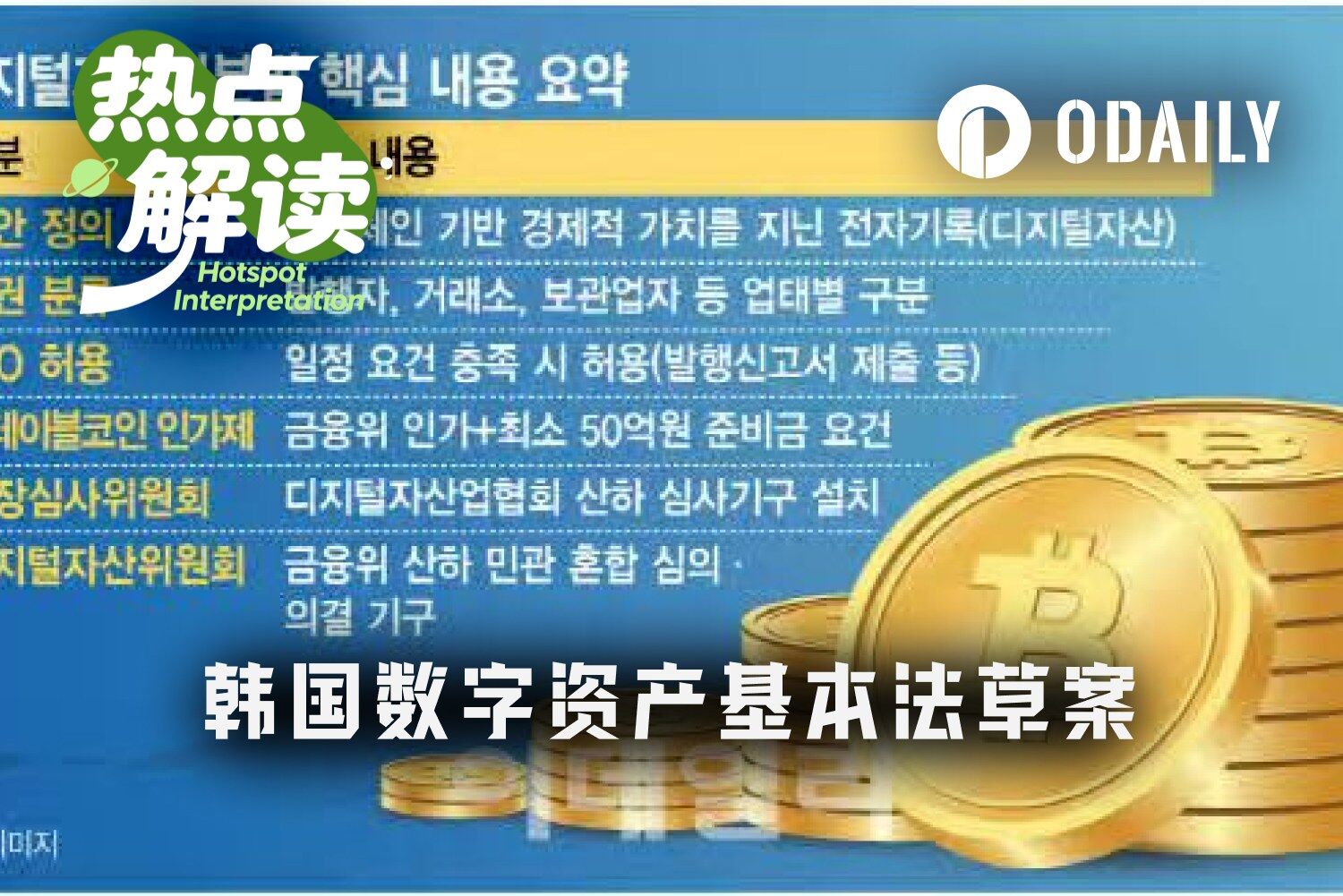
At 3 p.m. on November 24, South Korea's Financial Services Commission (FSC) unveiled the draft of the "Digital Asset Industry Innovation and User Protection Act"—the government draft commonly known as the "Digital Asset Basic Act"—at its Virtual Asset Committee meeting.
This marks the second phase of South Korea's virtual asset legislation. It comes one year and ten months after related discussions began in January 2025, and the legal terminology has shifted from "virtual asset" to "digital asset." According to prior foreign media reports, the bill contains roughly 135 articles (per FSC Chairman Lee Eok-won's earlier statement; the final article count may be higher), covering business licenses, exchange governance, stablecoins, token listings, ICOs, and user protection. It is the first industry basic law to place all these matters under a single statute.
The draft does three things. First, it changes the regulatory logic: the existing reporting system is replaced by a licensing and registration regime differentiated by business type, turning exchanges from "report and operate" into financial infrastructure that "can only operate with a license." Second, it writes two controversial matters into law: a cap on major shareholders' stakes in exchanges, and a bank-led issuance arrangement for won-denominated stablecoins. Third, it upgrades matters previously left to industry self-regulation—such as token listings and user compensation—into statutory obligations, and lifts the ban on domestic ICOs.
This is still only a government draft, not yet law. It will be introduced by the chairman of the National Assembly's Legislation and Judiciary Committee on behalf of the government, then merged and reviewed alongside existing lawmakers' bills; many details, such as minimum capital, will await presidential decrees. Therefore, every item described below should be understood as "proposed in the draft," not as provisions already in force.
Business Classification and Licensing: Reporting Replaced by Business-Specific Licenses, Custody Treated Separately
The draft replaces the single "virtual asset service provider" reporting category with four business types. Trading, brokerage, and custody require FSC licenses, while asset management requires only registration. Registration is permitted on the premise that such firms do not directly hold or transfer user assets, hence lighter supervision. Exchanges are referred to in the draft as "digital asset platform operators," which must simultaneously hold three core licenses and meet other requirements.
On capital, reports say trading, brokerage, and custody businesses must have own capital of at least 2 billion won; stablecoin-only businesses, 1 billion won; and asset management, 500 million won, with specific amounts to be set by presidential decree. South Korean media outlet Blockmedia reported the same figures, though the final numbers will follow the presidential decree. More reports suggest the draft will impose differentiated capital, personnel, security, and internal control requirements by business type.
Custody was previously largely an in-house exchange business; now custody and management of client assets are separately regulated. User assets must be segregated, protected from seizure and set-off, and subject to regular external audits. An informal summary also notes that this opens the door for banks and securities firms to enter custody and prime brokerage.
Reports suggest that once the reporting system becomes a licensing system, exchanges effectively obtain a standing operating qualification, and regulators accordingly demand higher governance and major-shareholder standards. Functions previously left to self-regulation—order matching, token listings, abnormal trading monitoring—become statutory duties. This also explains why the major-shareholder restriction in the next section appears alongside the licensing regime.
Exchange Major-Shareholder Stake Cap: 20% in Principle, 34% with Approval, Excess Shares Have No Voting Rights
The major-shareholder restriction is the most closely watched provision in the draft.
According to reports, a single major shareholder may in principle hold no more than 20% of an exchange; financial companies and others may hold up to 34% with FSC approval, with specific rules set by presidential decree. Shares exceeding the cap no longer carry voting rights rather than being subject to forced sale; South Korean media, citing FSC officials, said the FSC will not order forced sales but will require violations to be corrected before other licenses are granted. The cap derives from the 15% ownership limit for alternative trading systems (ATS) under the Capital Markets Act: the FSC treats exchanges as similar financial infrastructure and believes a handful of founders and shareholders should not have absolute control over them. Earlier this year, information pointed to a "15–20%" range; the final draft is more lenient than that rumor.
South Korea's FSC, equivalent to a securities regulator. Source: LinkedIn
There is a three-year transition period from the date an exchange is designated, with small and medium-sized exchanges eligible for up to three additional years. The provision applies equally to domestic and foreign shareholders.
In reality, the largest shareholders of all five major won-denominated exchanges hold more than 20%. According to compiled reports, Song Chi-hyung, the largest shareholder of Upbit operator Dunamu, holds about 25.5%; Bithumb Holdings, the parent of Bithumb, about 73.5%; Binance, the parent of Gopax, about 67.4%; figures for Coinone and Korbit vary across reports (Coinone roughly 30% to 53%, Korbit roughly 92% to 97%), subject to each company's own disclosures. Another affected case is the Naver–Dunamu merger: the currently planned structure has Naver Pay holding 100% of Dunamu, which is incompatible with the cap, so the ownership structure will need to be redesigned.
The exchange alliance DAXA and the industry have consistently opposed the restriction, arguing it would weaken competitiveness, undermine major shareholders' sense of responsibility for user assets, and potentially infringe on property rights. The National Assembly Research Service has also noted the restriction may be unconstitutional. It is therefore the provision most likely to be amended during parliamentary review.
Issuers of Won-Denominated Stablecoins: Banks Must Hold a Majority
The draft formally brings stablecoins under licensing supervision and defines them as "digital payment tokens" pegged to a single fiat currency and used primarily for payments. Issuers need an FSC license, own capital of at least 5 billion won, a viable business plan, adequate personnel and systems, qualified major shareholders and executives, and conflict-of-interest controls.
On issuance entities, initially only consortia in which banks collectively hold a majority (50% + 1 share) may issue won-denominated stablecoins, though fintech or tech companies may still serve as the single largest shareholder within a consortium. This is in fact a compromise: the Bank of Korea (BOK) advocated "banks first," worried that private stablecoins could affect monetary policy, capital flows, and financial stability; the FSC and BOK had previously differed on the rule requiring banks to hold more than 50%, and the ruling party and government agreed in December 2025 on a bank-majority consortium model, though the FSC said at the time the plan was not finalized; the draft's allowance for tech companies to be the largest single shareholder also leaves room for internet platforms. The word "initially" does not correspond to a specific deadline, implying room for future relaxation, though the draft currently sets no timetable.
Reports give one example of an actual consortium structure: four banks each hold 15% (60% combined), a fintech or tech company holds 30%, and other participants hold 10%. Multiple banks are needed because the Banking Act caps a single bank's investment (15%), and how this limit applies to stablecoin consortia is still under discussion.
Issuers must first submit an issuance plan specifying the total issuance, reserve management, and redemption methods, and obtain FSC approval before issuing. Exchanges and licensed institutions may not list, trade, broker, or hold stablecoins whose issuance plans have not been approved or filed. This means that after the law takes effect, when the first won-denominated stablecoin appears will depend on the progress of license and issuance-plan approvals; South Korea currently has no won-denominated stablecoin in circulation.
Stablecoin Reserves, Redemption, Significant Stablecoins, and Overseas Issuers
On holder protection, the draft's approach is to regulate stablecoins as "money-like payment instruments" rather than as yield-generating financial products. Issuers must hold reserves of no less than 100% of circulating supply, deposited with banks or other institutions or held in trust, and subject to monthly reserve audits. Reserves may only be invested in highly liquid assets such as deposits and government bonds, and must use the same peg currency. Issuers may not pay interest or similar yields to holders—the key distinction between the draft and "interest-bearing tokens."
Legal protection of reserves is another focus. Reserves cannot be seized or set off; if an issuer has its license revoked, goes bankrupt, or cannot continue operating due to a hack, the reserve custodian pays holders first. Holders can redeem cash at equivalent value at any time, and issuers cannot delay.
For large stablecoins, the draft imposes additional requirements. Stablecoins with a circulating supply of 1 trillion won or more may be designated by the FSC as "significant stablecoins," requiring additional capital and stricter reserve liquidity management, with the BOK potentially participating in joint inspections. FSC documents cite EU standards (500 million euros) and U.S. standards (1 billion USD) as references for enhanced supervision.
On overseas won-denominated stablecoins, foreign issuers that are adequately supervised by their home regulators may issue and redeem in South Korea after establishing a branch, holding operating funds domestically, registering with the FSC, and completing foreign exchange filings. Foreign tokens not registered in South Korea will find it difficult to obtain listing support from Korean exchanges. The Ministry of Finance may also consider amending the Foreign Exchange Transactions Act to regulate cross-border won-denominated stablecoin transactions.
No-Fault Compensation and IT Security Obligations
A core requirement of the draft for exchanges and all licensed institutions is that when hacks or system failures cause user losses, they must bear liability regardless of fault. This is "no-fault compensation." South Korean media add that institutions may be exempt if losses result from users' intentional or gross negligence, or if agreed terms provide otherwise. This means users no longer need to prove platform negligence to obtain compensation.
Corresponding to the compensation liability are stricter IT security requirements: licensed institutions must meet IT security standards comparable to those of financial companies; if the cause of an incident is their violation of information system security obligations, the FSC may impose punitive fines (과징금) of up to 10% of revenue. User assets must be segregated and protected from seizure and set-off, and institutions must undergo regular external audits. These rules will turn exchanges' internal controls and computer system security from "industry self-regulation" into "legal obligations."
The real-world backdrop for this provision is the Bithumb Bitcoin erroneous payment incident on February 6, 2026. After the incident, the FSC, the Financial Intelligence Unit, the Financial Supervisory Service, and the exchange alliance formed an emergency response team; at a meeting on March 4 this year, arrangements including no-fault compensation liability, internal controls, and electronic security standards were discussed, and at the time it was thought self-regulatory standards would first improve matters before the basic law codified them. That part is now written into the draft. Details such as the scope and limits of compensation still need to be determined in subsequent guidance.
Token Listings, Continuous Disclosure, and Market Manipulation Rules
Currently, token listings and delistings on Korean exchanges rely largely on each exchange's own standards and the self-regulatory rules of the exchange alliance DAXA. The draft converts order handling, token listings, and abnormal trading monitoring—previously self-regulatory functions—into statutory duties, so exchanges are no longer merely platforms matching buyers and sellers but must also bear review and disclosure responsibility for the tokens they list.
Specifically, for each token listed, exchanges must submit and publish a listing report explaining the issuer, supply, project, and risks. After listing, exchanges must also continuously disclose material developments affecting listed assets; South Korean media such as ZDNet Korea also reported requirements for listing reports and immediate disclosure of major matters, including hacks, system failures, and changes in issuance and circulating supply. This turns listing from a one-time business decision into an ongoing compliance obligation.
Market manipulation rules are also expanded. Prohibitions on insider trading and manipulation extend to tokens under listing review; Decrypt reported that the draft plans to extend market manipulation rules to crypto-to-crypto trading. This part still awaits parliamentary approval and is not yet in force.
ICO Ban Lifted and Whitepaper Regime
South Korea has banned domestic ICOs since 2017, a prohibition now nine years old. The draft's approach is to permit domestic token issuance but bring it under disclosure supervision. Some analysts believe this could also change a common reality: project teams previously often issued tokens abroad first and then listed them in South Korea, bypassing the 2017 administrative ban.
The procedure is that the issuer, or the dealer or broker responsible for the sale, must first submit a digital asset whitepaper to the FSC explaining the responsible issuance entity, use of funds, token supply, project specifications, and investment risks, and provide investors with a concise prospectus. The FSC may require issuers to correct disclosed information. Sales may proceed only after the whitepaper is accepted and published and the statutory waiting period expires. The length of the waiting period has not yet been announced.
Legal liability is the constraint of this regime. If the whitepaper contains misleading statements or material omissions, the issuer may face civil damages, fines, or even criminal prosecution.
Advisory Business Registration and Employee Trading Rules
After the draft was published, two additional proposed items previously little discussed were disclosed. The first is a new "digital asset advisory business." Operators engaged in virtual asset referral marketing must register, covering paid chat-room-style advice and possibly situations where users are directed on YouTube or social media to a particular exchange in exchange for a share of trading fees. Advisers must not conceal economic benefits they receive from relevant exchange operators; those wishing to provide advisory services must complete FSC-prescribed training, and registration is valid for five years from acceptance.
The second is trading rules for exchange employees. The draft would require industry employees trading in their own names, in principle, to use a single real-name account at one exchange. Exchange staff must trade through their own exchange; only if the platform does not list the relevant asset may they use another exchange by exception. Relevant employees must report trading details to their company quarterly, and companies must establish internal systems to prevent insider trading and conflicts of interest and regularly review employee trading records. This differs from the enforcement decree of the existing Specific Financial Information Act, which prohibits exchange employees from buying, selling, or exchanging digital assets on their own platform. The new rules follow the Capital Markets Act's approach to supervising financial investment industry employees; which personnel are covered and the specific operational details will be clarified by subsequent enforcement regulations.
Legislative Timeline
- December 3, 10 a.m. (Korea time): the National Assembly's Legislation and Judiciary Committee holds a public hearing on the "Digital Asset Industry Innovation and User Protection Act" to hear reactions from various sectors to the government proposal.
- Introduction method: introduced by Legislation and Judiciary Committee Chairman Yoo Dong-soo on behalf of the government, then merged and reviewed with existing lawmakers' bills.
- Article 59 of the National Assembly Act: after a bill is referred to a standing committee, in principle 20 days must pass before it can be placed on the agenda; it is then reviewed by the Legislation and Judiciary Committee and the Legislation and Judiciary Committee, and voted on by the plenary session.
- Voting target: the ruling Democratic Party aims to handle it by January next year; multiple South Korean media outlets say the goal is to vote before the U.S. GENIUS Act takes effect on January 18, 2027; the regular parliamentary session ends December 9, making passage within the year essentially impossible.
- Effective date: reports say the law takes effect one year after promulgation; details such as capital and major-shareholder rules will be set by presidential decree, so actual implementation will likely take more than a year.
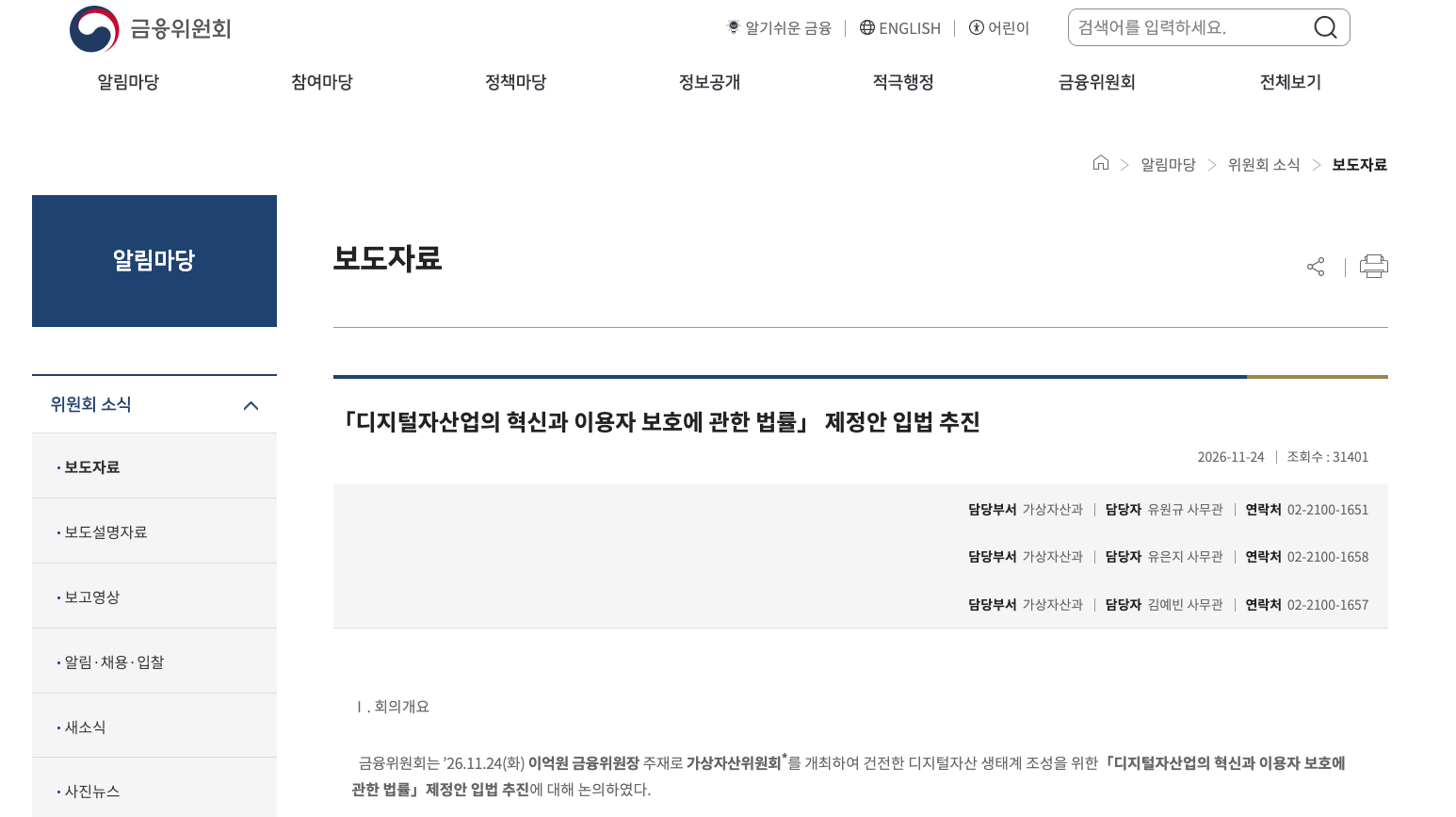
FSC press release, source: official website
Conclusion
This draft moves South Korea's virtual asset industry from "report and operate" into the era of licensed operation: separate custody, stablecoins under licensing, the ICO ban lifted, and no-fault compensation—all of these expand compliance space while raising the thresholds for entry and compensation. But it remains only a government draft; the real decision lies with the National Assembly.
On timing, the ruling party hopes to vote before the U.S. GENIUS Act takes effect on January 18, 2027, but the bill must still pass the Legislation and Judiciary Committee, the Legislation and Judiciary Committee, and the plenary session, and enforcement decrees must be drafted separately; actual implementation will likely take more than a year. Therefore, every item above should be treated as "proposed in the draft," and the final version can only be judged after the National Assembly vote.