Bank of America's Hartnett on 2027 US Stocks: Full-Blown Bubble 8888, Soft Landing 7777, Hard Landing 6666


- Core View: BofA's Hartnett believes the market is significantly underpricing a hard landing, with only 3% of fund managers expecting one, while equity overweighting, record capital inflows, and overly high earnings expectations leave the market unprepared—a hard landing is the only unpriced risk.
- Key Elements:
- Three scenarios for the S&P 500 in 2027: soft landing at 7777, full-blown bubble at 8888, hard landing at 6666—a 2222-point gap between bubble and recession.
- Significant market pricing bias: only 3% of investors expect a hard landing, 50% expect a soft landing, and 42% expect no landing; equity fund inflows reached an annualized record of $1.5 trillion in 2026.
- The two major engines supporting high expectations (the K-shaped wealth effect and AI capital expenditures) are weakening, while the consensus forecasts nominal GDP growth of 5%-6% and global earnings growth of 15%-20%.
- Tactical advice: preserve capital first, then buy "C" category assets (chips, commodities, cryptocurrencies, consumer stocks) after the spring rate hike cycle and the dollar peak, hedging with "GRAB."
- BofA has the most hawkish Fed call: no rate cuts in 2027 but rather three rate hikes, with the federal funds rate reaching 4.50%-4.75% by year-end, higher than Goldman Sachs and Morgan Stanley.
- Bearish surprises include an AI credit event (depreciation of chip collateral triggering a credit crisis), a debt-induced recession, and the Fed getting serious about its 2% inflation target.
- The only consensus among the three investment banks: Brent crude ends in the $70-plus range, gold will rise 30%-47%, and BofA expects gold to reach $5,000.
Original author: Dong Jing
Original source: Wallstreetcn
BofA Chief Investment Strategist Michael Hartnett's newly released 2027 outlook report sets three scenarios for the S&P 500 in 2027: a breadth-driven "soft landing" base case (about 7,777), an "all-out bubble" driven by AI and government intervention (about 8,888), and a "hard landing" bust scenario for which the market is extremely unprepared (about 6,666).
Hartnett believes the market's current pricing of the macroeconomy is severely skewed, with hard-landing risk grossly underpriced—BofA's November Global Fund Manager Survey shows only 3% of investors expect a hard landing, while 50% and 42% expect a soft landing and no landing, respectively.
The core basis for this judgment is positioning and expectations: asset allocators are broadly overweight equities and commodities and underweight cash and bonds; equity fund inflows annualized to $1.5 trillion in 2026, a record high; meanwhile, sell-side consensus expects nominal GDP growth of 5% to 6% and global EPS growth of 15% to 20%, both built on two engines—the K-shaped wealth effect and AI capital expenditure—which Hartnett believes are now weakening.
On the tactical level, Hartnett's playbook is: over the coming months, preserve capital first, wait for the spring peak in the rate-hiking cycle and the dollar, and once the Wall Street narrative shifts from rate hikes to rate cuts, buy cyclical "C" assets—Chips, Commodities, crypto, and especially Consumer stocks; meanwhile, hedge with "GRAB"—Government bonds, Real estate, AAA-rated assets, and Bullion—four asset classes currently held at extremely low levels by institutions.
Hartnett also notes that his firm BofA's official forecast is itself hawkish: the Fed will not only refrain from cutting rates in 2027 but will hike three more times, with the fed funds rate ending the year at 4.50% to 4.75%, higher than Goldman Sachs and Morgan Stanley's forecasts; the so-called "21 rate cuts" refer to other central banks.
Base Case and Three-Scenario Projections: Soft Landing 7,777, Bubble 8,888, Hard Landing 6,666
The report notes that across the three scenarios, the spread between bubble and recession is 2,222 points, implying that every 10-percentage-point probability shift from "no landing" to "hard landing" corresponds to roughly 220 S&P points.
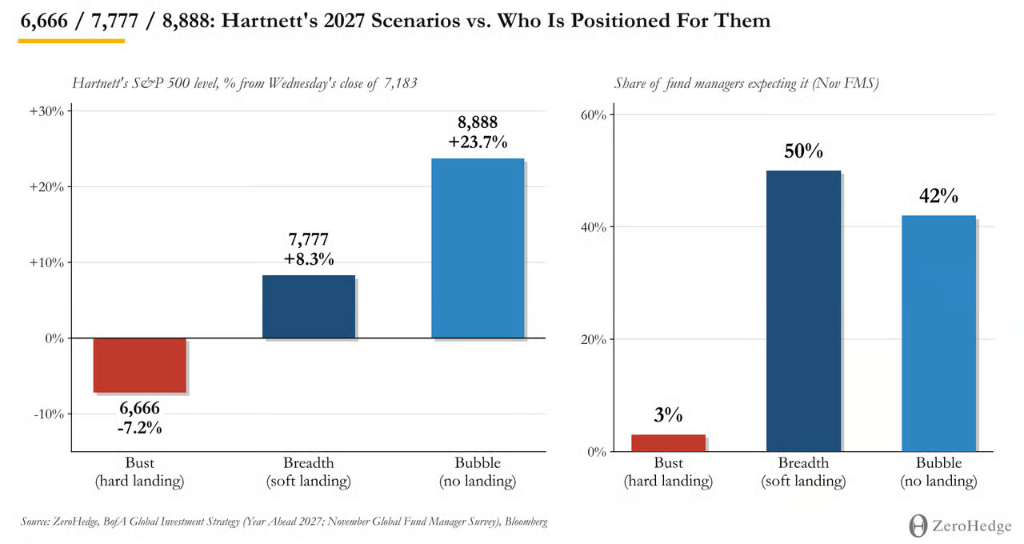
Breadth / Soft Landing (about 7,777)—wait for rate cuts, buy "C" assets. This is Hartnett's own camp, characterized by positive returns for both credit and equities in 2027, with the bull market continuing but its driver shifting from concentration to breadth.
The two key questions are "when will rate hikes end" and "will they end before a recession"; his answers are Q2 next year and "yes," on the grounds that inflation falls before unemployment rises and policymakers are too worried about social consequences to allow a recession. In this scenario earnings grow about 10%, and risk assets resume their uptrend after rate hikes end in March to April; valuations of 16x for the equal-weight S&P, 14x for mid-caps, 14x for global equities, and 11x for global ex-US are no longer expensive.
Bubble / No Landing (S&P about 8,888)—this scenario requires hyperscalers to further raise their current $1.3 trillion capex budget in 2027 (tech giants' free cash flow currently stands at -$283 billion).
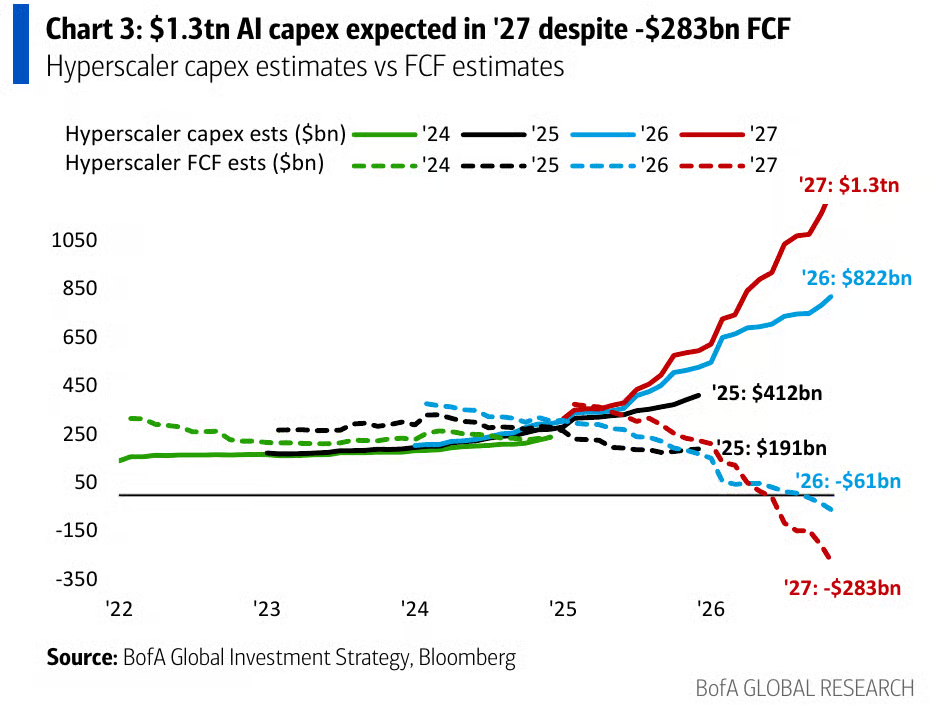
Triggers include (brought to you by Washington):
The US government intervening in the bond market to lower tech-sector financing costs and credit spreads; midterm elections not standing in the way of roughly 100 GW of data center capacity expansion over the next two years; a Democrat-controlled Congress supporting the AI industry while securing universal healthcare legislation; falling commodity prices reducing data center construction costs; Gen Z and Gen X maintaining their structural buy-the-dip habit.
Hartnett believes that absent a credit event or a large-scale outflow from tech stocks, this scenario is overpriced. The bubble scenario is extremely bullish on tech and extremely bearish on bonds.
Bust / Hard Landing (about 6,666)—this is the risk the market is completely mispricing. Hartnett offers three arguments in the report:
- First, no one expects it—only 3% of fund managers forecast a hard landing;
- Second, forecasts are too high—consensus expects nominal GDP growth of 5% to 6% and global earnings growth of 15% to 20%, yet the K-shaped household wealth and AI capex underpinning both are weakening;
- Third, positioning is full—allocators are overweight equities and commodities and underweight cash and bonds, with 2026 equity inflows annualizing to a record $1.5 trillion.
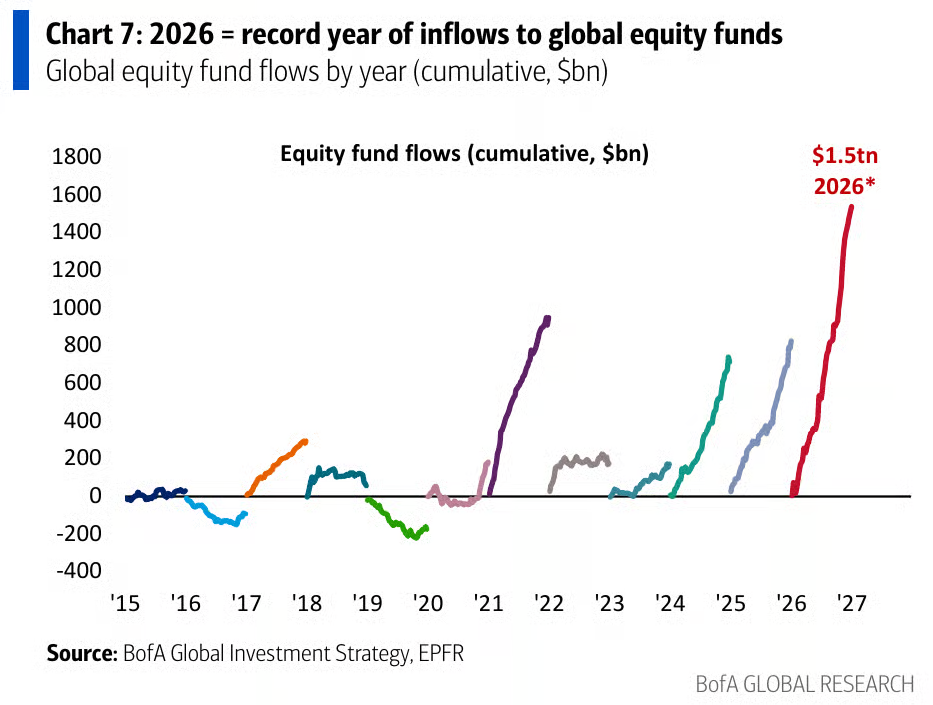
BofA believes that once widening credit spreads and rising unemployment puncture the boom, a genuine bear market will arrive. The hedge is "GRAB": Government bonds, Real estate negatively correlated with AI, defensive AAA-rated assets, and precious metals (gold, silver) as policymakers' easiest tool for ending a recession.
The report also notes that 6,666 is only 7% below Wednesday's close and less than 4% below last Friday's close—666 points above Morgan Stanley's 6,000 bear case—making it look mild as a "genuine bear market."
Monetary Policy Expectations: No Fed Rate Cuts This Year, Terminal Rate Higher Than Wall Street Peers
Hartnett's tactical call rests on a narrative shift from rate hikes to rate cuts next spring. But BofA's forecast table shows the fed funds rate at 4.00% to 4.25% by year-end and 4.50% to 4.75% by the end of next year; from the current 3.75% to 4.00%, that implies three hikes and zero Fed rate cuts in 2027. The 21 rate cuts come from other central banks—for example, the ECB cutting to 2.25% after one hike.
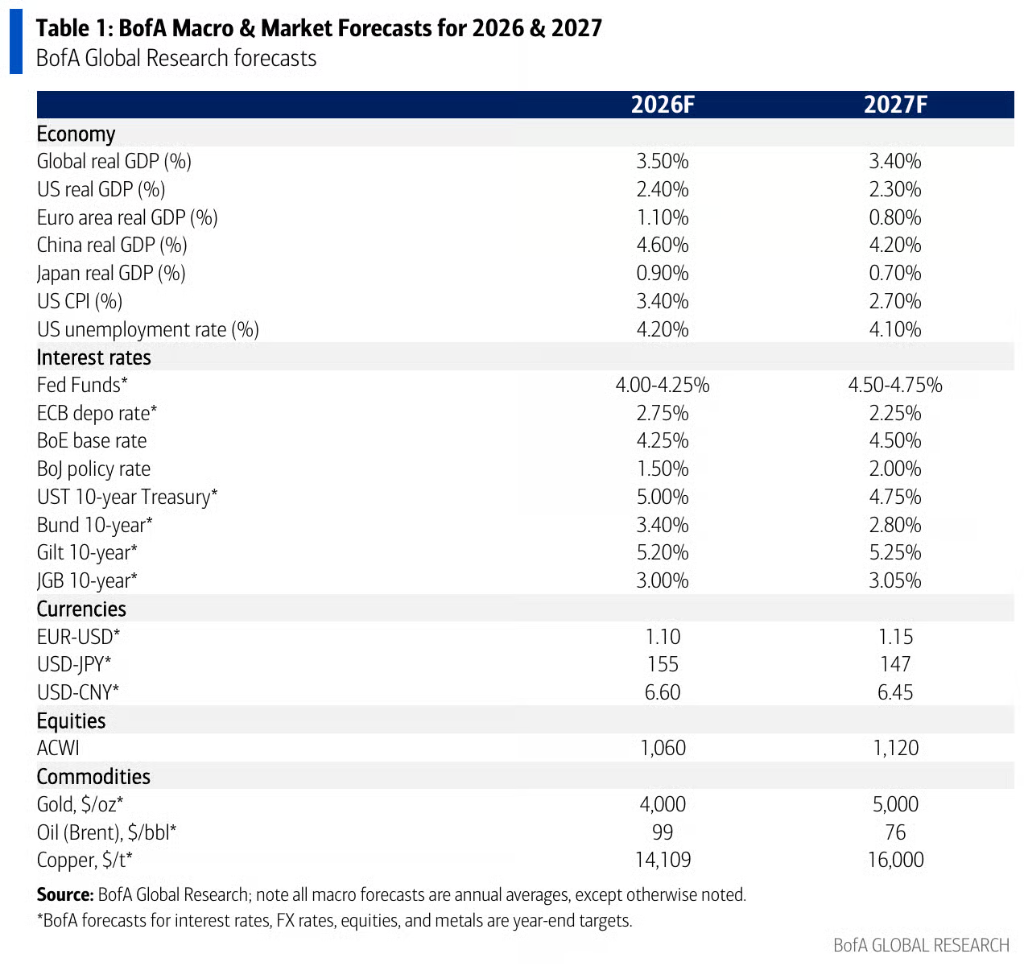
Among the three investment banks, BofA is the most hawkish on the Fed. Goldman Sachs expects hikes in December and next March and the first cut in December 2027; Morgan Stanley expects the Fed to stop at 4.25% to 4.50% next March and hold through 2028; BofA is 25 basis points above both and stays at that level.
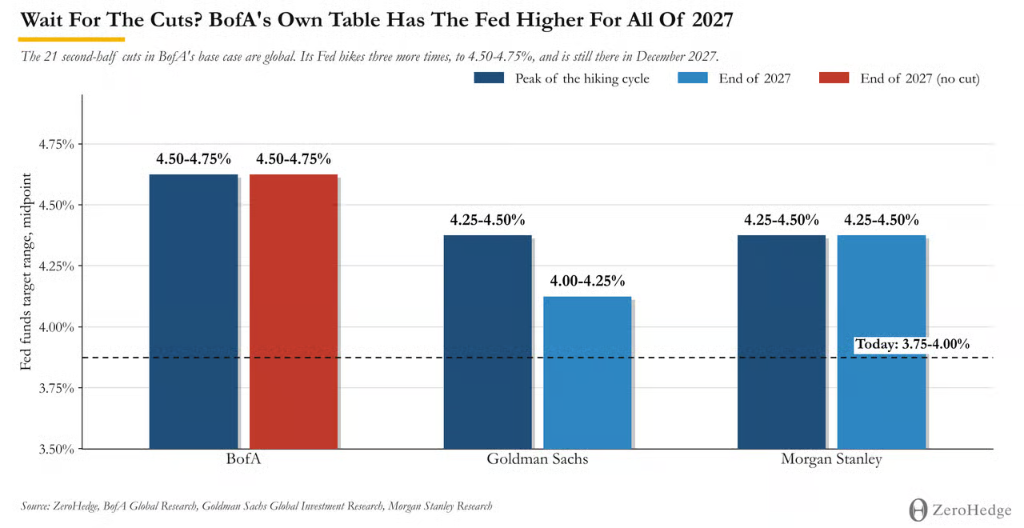
The three also diverge markedly elsewhere: BofA is the most underweight equities, has the lowest earnings forecasts, is the most hawkish on the Fed, and is the only one looking to go long the euro.
By comparison, Goldman Sachs and Morgan Stanley published their outlooks earlier: Goldman recommends buying bonds, shorting the euro, and hedging the "AI hangover," with an S&P target of 8,700; Morgan Stanley has the largest equity overweight and zero cash, with the same S&P target of 8,700. Two banks, one index target. And the "base case" cited by Goldman and Morgan Stanley is 188 points below the "bubble" cited by BofA's chief strategist.
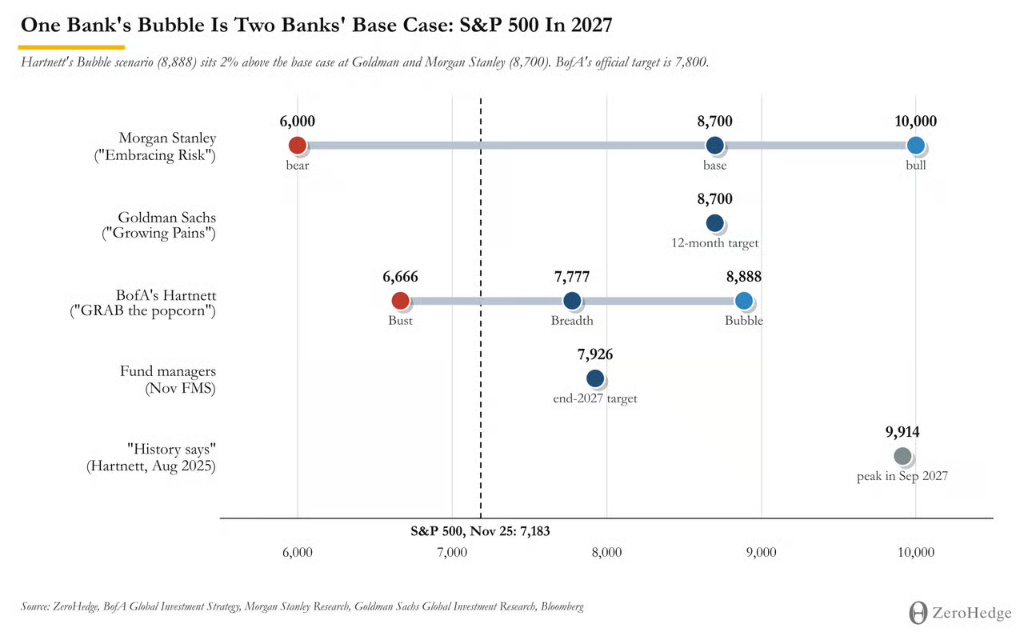
The only consensus among the three: Brent ends next year in the $70s range, and currently unloved gold rises 30% to 47%. BofA expects Brent crude to fall to $76; the dollar to peak in Q1; gold to surge to $5,000 and copper to $16,000.
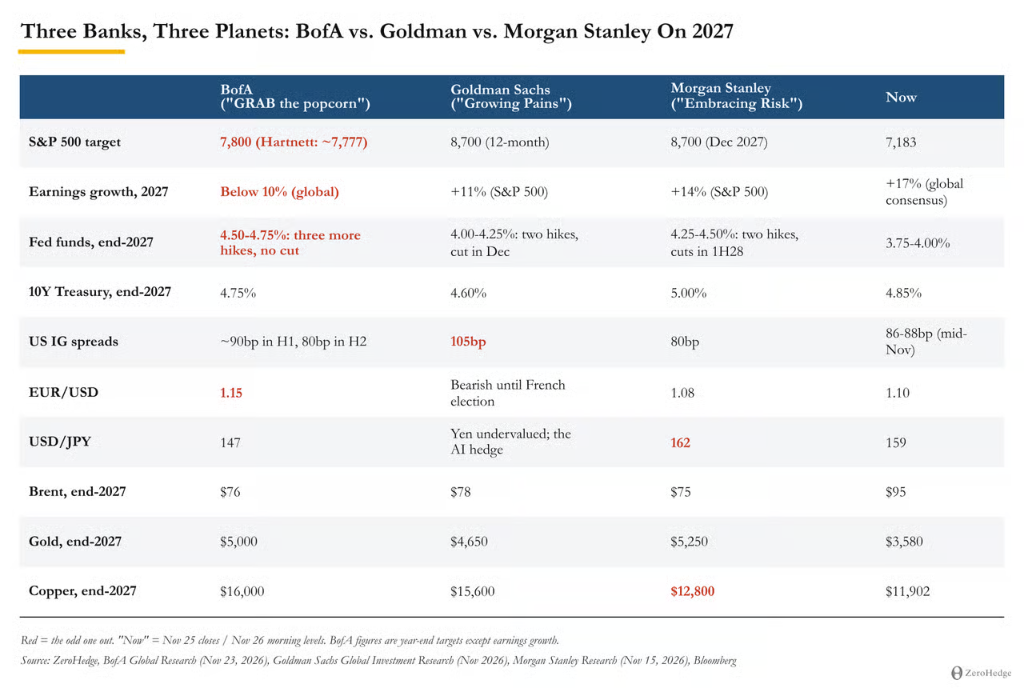
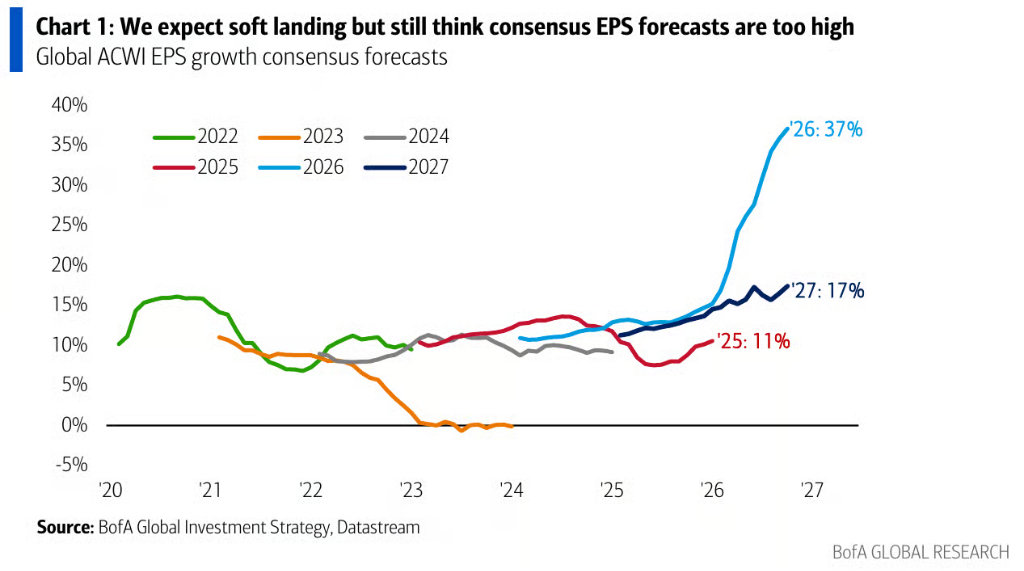
In addition, a chart Hartnett placed on the cover shows that sell-side bottom-up analysts have not read these outlooks: consensus expects global earnings growth of 17% next year versus 37% this year. BofA says below 10%, Goldman (calling it the "Great Halving") says 11% for the S&P, and Hartnett's own soft-landing scenario requires about 10%.
Reversal and Pause of the Four Major Trading Themes of the 2020s
The report summarizes the four major trading themes that defined the 2020s and predicts their fates will diverge next year:
- Trades about to reverse:
- ABB (Anything But Bonds): catalyzed by debt and deficits, 30-year Treasuries delivered a -62% return from peak to trough. The trend will reverse next year.
- ABC: BofA expects Chinese equities to reverse next year.
- Trades about to pause:
- ABD (Anything But the Dollar): catalyzed by debasement fears, bitcoin and gold posted annualized gains of 44% and 23%, respectively, before peaking. The trade pauses in the first half of next year.
- AI (All-In AI): catalyzed by disruptive technology, Nasdaq market cap has risen $26 trillion since March 2023. The trade will also be on pause in the first half of next year.
Potential Upside and Downside Surprises for 2027
The report lists tail surprises that could upend the base case, with bearish surprises particularly worth watching:
- Bullish Surprises: peace replacing war causing oil and inflation to collapse (thereby allowing the Fed to cut rates in the second half); policy dramatically improving housing and healthcare affordability, triggering a consumer spending boom among ordinary households.
- Bearish Surprises:
- AI credit event: a crash in DRAM/chip prices shrinking collateral values and triggering a credit crisis (a large amount of debt is currently secured by chips themselves).
- Debt-induced recession: as US growth slows, yields rise rather than fall on debt concerns, pushing the economy into recession.
- The Fed gets serious: Wall Street is shocked to find the Fed is serious about its 2% inflation target and will not ride to the market's rescue.
A Year Is Long: The List of Surprises Is More Readable Than the Base Case
The report notes that looking back at 2026, the best trades were long oil/short crypto, long energy/short consumer discretionary, long semis/short telecom, long small-cap value/short large-cap growth, and long cybersecurity/short defense; the winning themes for 2026:
War > peace, boom > bust, K-shaped > C-shaped, hikes > cuts, greed > fear, AI issuance > AI job losses, IPOs > buybacks, concentration > breadth.
A year ago the consensus was "full speed ahead": global earnings expected to grow 9%, an upside scenario in the first half of CPI falling to 2% and the 10-year yield at 3.5%, and Fed easing. Actual earnings growth came in at roughly four times what was expected then, and every other variable went the opposite way.
Hartnett's December 2025 call that "every commodity chart will look like gold, and oil is the best contrarian trade of 2026" was validated, and he also recommended shorting hyperscaler bonds before the market caught on.
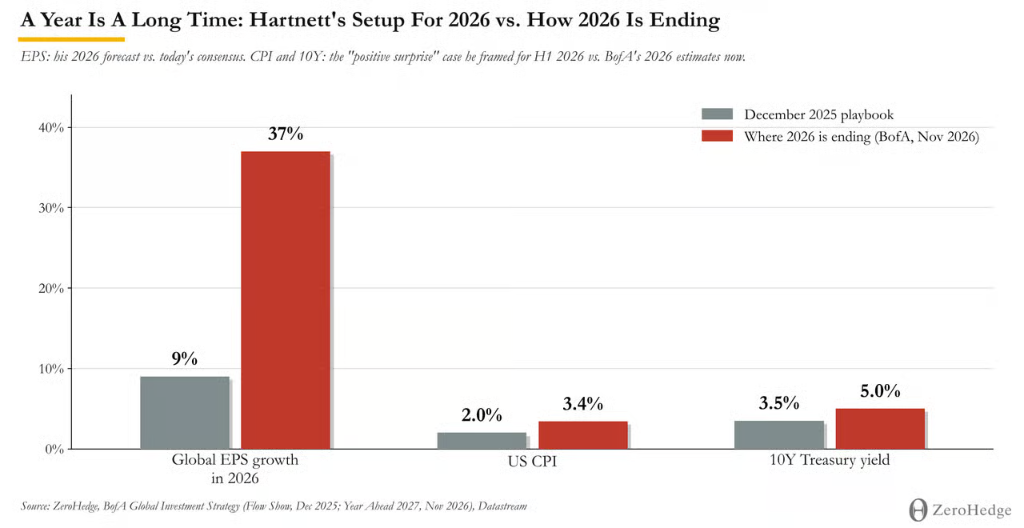
But the lesson is: in August 2025 he noted that historically bull markets peak on average in September 2027 at S&P 9,914; today his bubble-scenario ceiling is about 1,000 points below that level, and the base case about 2,000 points below.
The report concludes: of the three scenarios, a hard landing is the only one not priced; 8,888 has only one path—brought to you by Washington.