2026 Global VC Retrospective: AI Absorbs 90% of Financing Increment, Legacy Funds Still Struggle to Exit


- Core Viewpoint: In 2026, global VC shows structural fragmentation: AI alone captured over 90% of the financing increment, headline IPOs reached unprecedented scale, yet VC funds were almost unable to cash out through IPOs, with the median DPI of legacy funds at only 0.37x—a severe disconnect between paper prosperity and cash returns.
- Key Elements:
- SpaceX and Anthropic IPOs collectively sold nearly $180 billion in stock, but not a single VC fund reduced its holdings; approximately $2 billion in secondary share transfers all went to Anthropic's seven founders.
- Global VC in Q3 grew by $55 billion year-over-year, with AI alone accounting for about $50 billion; AI's share of full-year financing rose to 64%, reaching 66% in October alone.
- As of end-June, the median DPI of US VC funds from the 2017 vintage was only 0.37x, 0.15x for 2018, and 0.04x for 2019, with LP cash repatriation continuing to deteriorate.
- Fundraising is highly concentrated at the top: funds of $500 million or more represent only 6% in number but absorbed 78.1% of committed capital; a16z alone closed $23.8 billion.
- Nvidia spent $58.1 billion on equity securities over nine fiscal months and holds approximately $4.1 billion in market value of CoreWeave shares, simultaneously playing the dual role of supplier and shareholder, amplifying the risk of demand decline.
- Capital is migrating toward asset-heavy sectors: construction robotics raised $1.6 billion during the year, over four times last year's total; nuclear fusion raised $4 billion; defense tech attracted $77.5 billion.
- Crypto VC saw 296 deals totaling $4.519 billion in Q3, with financing down 20.5% quarter-over-quarter and deal count down 22.9%; the trading sector averaged $69.7 million per deal, with over 90% of capital flowing to late-stage companies.
Original author:insights4vc
Original compilation:TechFlow
Introduction:In 2026, global venture capital exhibited a stark structural divide. SpaceX and Anthropic together sold nearly $180 billion in stock through their IPOs, yet not a single venture capital fund cashed out. By mid-year, the median 2017-vintage US VC fund had returned only 37% of paid-in capital, making the widening gulf between paper prosperity and cash returns increasingly evident.
On the incremental capital side, AI alone accounted for more than 90% of the year-over-year increase in global VC funding in Q3, while NVIDIA deepened its ties to downstream cloud compute customers through tens of billions of dollars in equity investments and lease guarantees. Beyond AI and fintech, construction robotics, fusion energy, grid hardware, and defense technology are picking up the large checks, pushing VC logic from asset-light software toward asset-heavy manufacturing and long-cycle delivery.

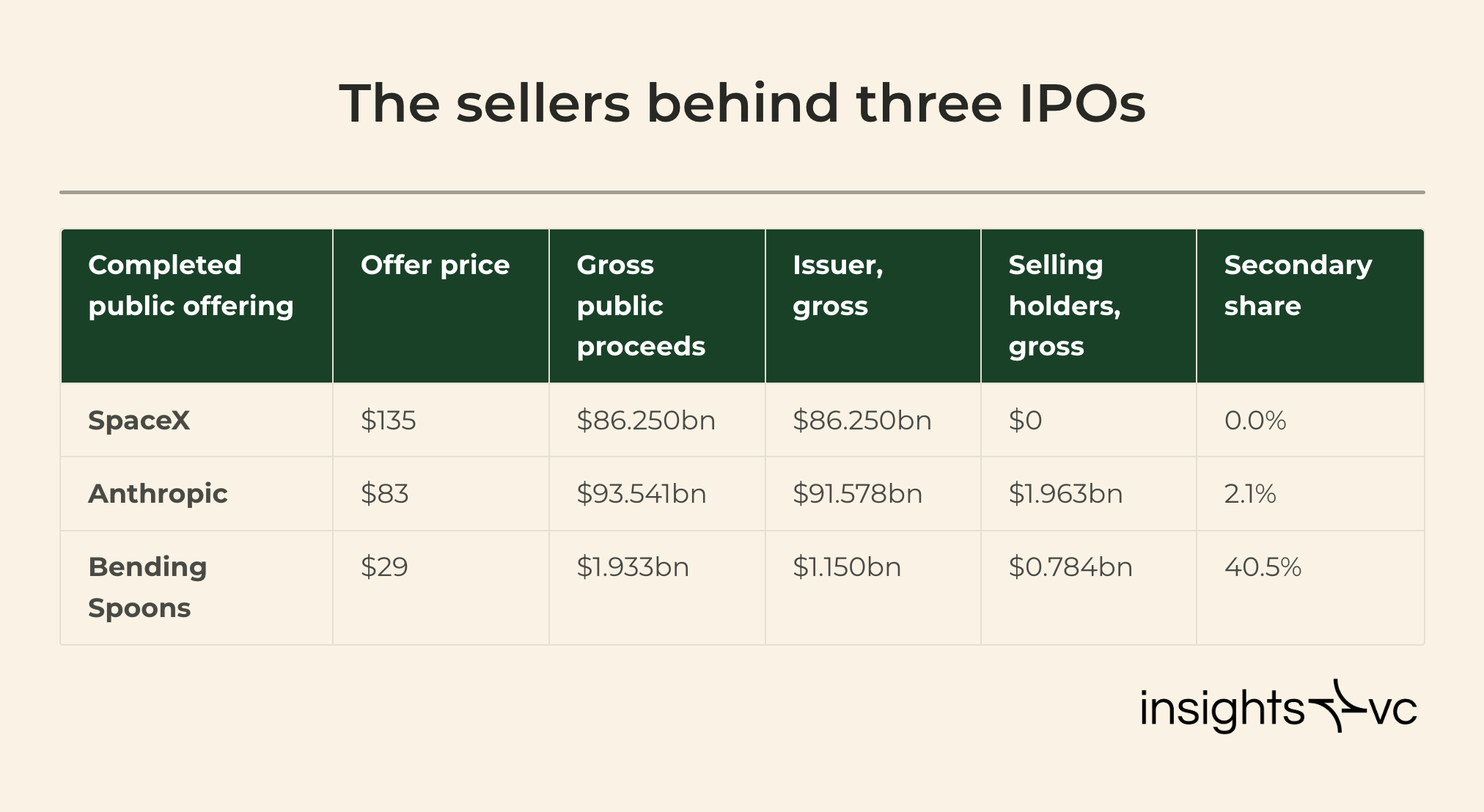
SpaceX and Anthropic sold nearly $180 billion in stock combined through their 2026 IPOs, but no venture capital fund sold shares in either offering. Before underwriting fees, nearly $178 billion went directly onto the companies' books, while roughly $2 billion in secondary market share sales went entirely to Anthropic's seven co-founders (see the Anthropic prospectus, Anthropic's IPO closing announcement, and SpaceX's IPO filing).
The fundraising boom was similarly concentrated along other dimensions. According to a Crunchbase report, global VC funding rose $55 billion year-over-year in Q3, with AI companies alone accounting for roughly $50 billion of that. For LPs in older funds, capital distribution remains a concern: as of June 30, Carta tracking data showed that the median US VC fund launched in 2017 had returned just $0.37 for every $1 of paid-in capital (including both cash and in-kind stock distributions).
This article examines what investors actually gained from these blockbuster listings, how Bending Spoons acquired legacy software businesses at prices far below historical valuations, why NVIDIA is investing heavily in its own customers, and the latest landscape in fintech and crypto. We will also track the capital flowing into robotics, fusion energy, and defense technology, where a new wave of large checks is being used to procure equipment, build factories, and assemble on-site deployment teams.
SpaceX, Anthropic, and Bending Spoons
SpaceX
On November 14, SpaceX successfully caught the Starship upper stage returning from orbit for the first time. According to the Flight 15 mission announcement, the flight deployed 26 Starlink V3 satellites, and the company said this payload added network capacity roughly equivalent to 10 Falcon 9 launches carrying V2 Mini satellites.
The commercial value of this breakthrough lies in delivering higher bandwidth per launch and ultimately achieving full reusability of the launch vehicle. However, the Super Heavy booster was destroyed during the same mission, and the goal of recovering both stages within a single flight has yet to be achieved.
The added satellite capacity is flowing into a business that is already profitable: according to SpaceX's Q3 financial report, its Connectivity segment generated $5.25 billion in revenue and $2.37 billion in operating profit in Q3. Yet the group's capital allocation has long since extended far beyond satellites and launch vehicles.
Of the $48.1 billion in capital expenditure during the first nine months of 2026, $40 billion (83%) went to the "Super Intelligence" segment, which encompasses its AI infrastructure, Grok, Cursor, and X. The June IPO brought in $85.7 billion in net proceeds. As a result, investors hold both a profitable connectivity business and an AI expansion that consumes the vast majority of the group's capital expenditure. Starship's progress reinforces the investment case for the former, while whether the far larger AI buildout can generate returns remains a separate test.
Anthropic
Anthropic's November IPO and concurrent private placement raised approximately $117.6 billion in gross proceeds for the company. Its seven selling co-founders cashed out roughly $1.96 billion combined (before taxes), while venture capital funds were entirely absent from the list of selling shareholders (see the prospectus and official announcement). The vast majority of the proceeds will fund the company's next phase of growth, while immediate secondary market liquidity went to the founders.
The prospectus reveals the practical rationale behind such a massive raise. As revenue scaled rapidly on the back of pre-booked compute capacity, its compute and infrastructure spending as a share of revenue fell sharply from 172% in the first nine months of 2025 to 57% in the same period of 2026. Nevertheless, Anthropic still incurred $6.5 billion in short-term compute contracts, and the company said this short-term procurement costs significantly more than comparable compute locked in through multi-year agreements.
This points to a clear use for the newly replenished balance sheet: procuring compute further in advance can reduce reliance on expensive short-term supply. But it also shifts the risk, as Anthropic must lock in infrastructure before demand actually arrives and then generate enough customer usage to absorb that capacity. The current improvement in compute cost as a share of revenue suggests the strategy is working, but sustaining this trend requires customer demand and contracted capacity to grow in tandem.
Bending Spoons
Bending Spoons has been acquiring mature software businesses at prices far below earlier paper valuations while its own valuation has climbed steadily. The company's post-money valuation was $2.55 billion in February 2024, and its pre-money valuation jumped to $11 billion in October 2025. At an IPO price of $29, the total share count after full exercise of the over-allotment option corresponds to an equity value of approximately $18.6 billion (see the IPO prospectus).
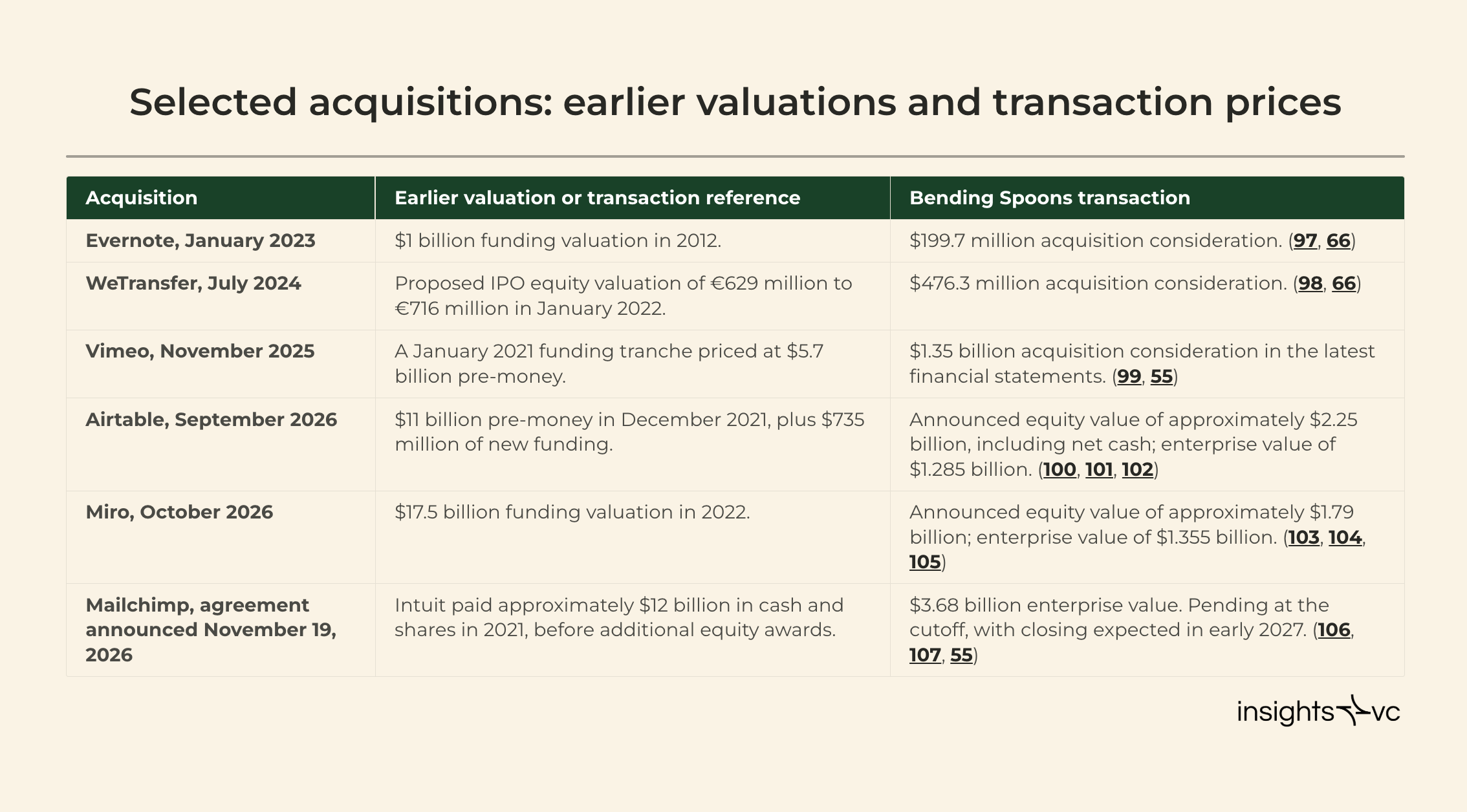
The Miro acquisition illustrates how M&A can provide liquidity while preserving some exposure to future growth. Miro's disclosed transaction equity value was roughly 90% below its 2022 funding valuation, but some shareholders reinvested $295 million of transaction proceeds into Bending Spoons at closing (see the SEC disclosure filing).
Meanwhile, Bending Spoons' own IPO generated approximately $784 million in gross proceeds for selling shareholders, including $377 million for Galileo Quattordici and $237 million for funds managed by Baillie Gifford. Capital is flowing back to sellers through both M&A transactions and the acquirer's public listing.
The latest operating results reveal what new Bending Spoons shareholders are buying into. According to the Q3 financial report, revenue surged 125% to $780 million in the quarter, but the company-defined organic growth rate was just 3%. Despite $1.09 billion in net proceeds from the IPO, its net debt stood at $4 billion as of September 30.
These figures place acquisition pricing, operational improvement, and financing costs at the heart of the investment case. Buying former unicorns at steep discounts creates opportunity, but ultimate returns still depend on post-acquisition profitability and cash flow performance.
AI Accounted for the Vast Majority of Incremental Funding
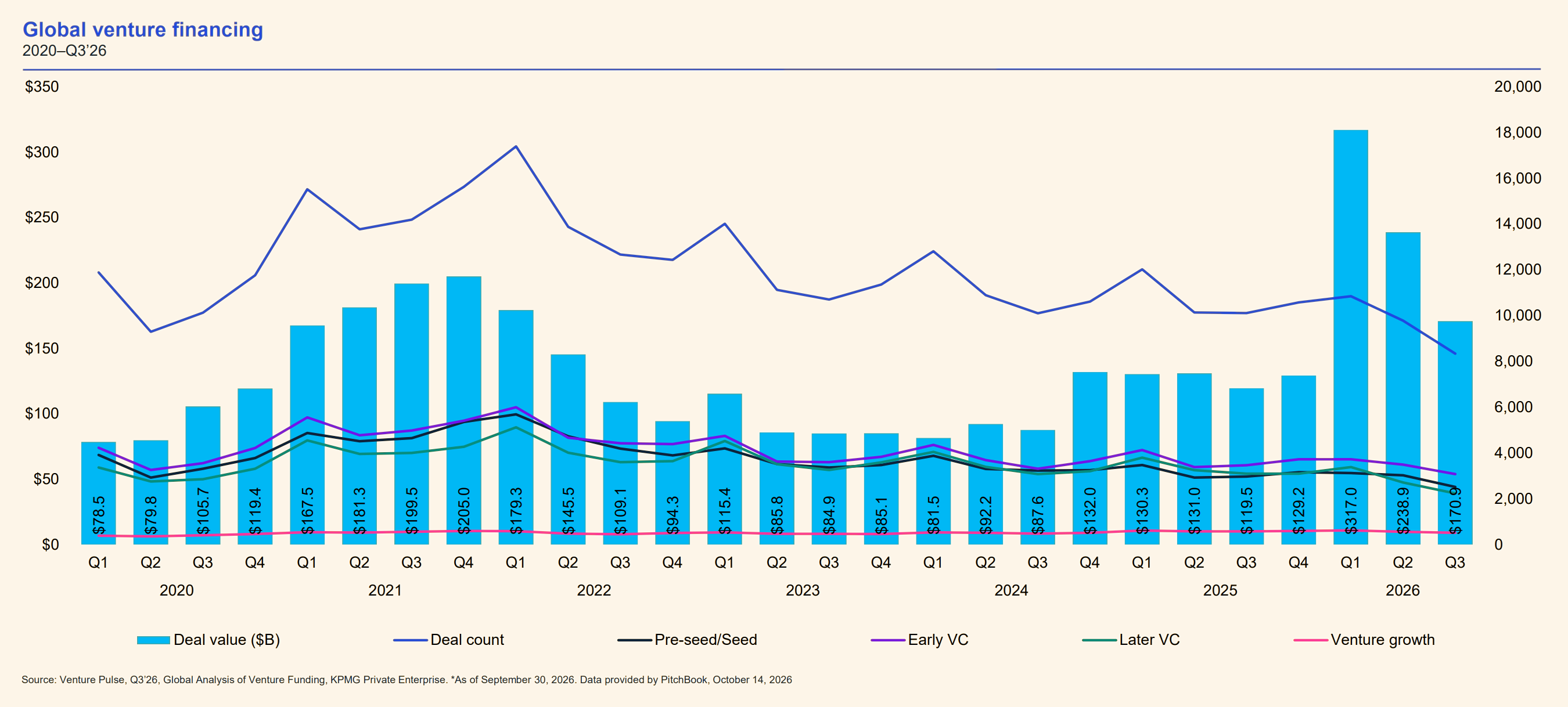
Chart: Quarterly VC funding retreats from its record Q1 peak
According to Crunchbase data, total global VC funding reached $679 billion in 2026 through the end of September. Q3 funding fell 25% quarter-over-quarter from $212 billion in Q2 but was still 53% higher than $104 billion a year earlier. AI's share of total funding climbed to 64%, up 14 percentage points year-over-year; after subtracting reported AI funding from the total, only about $57 billion was left for all other sectors combined.
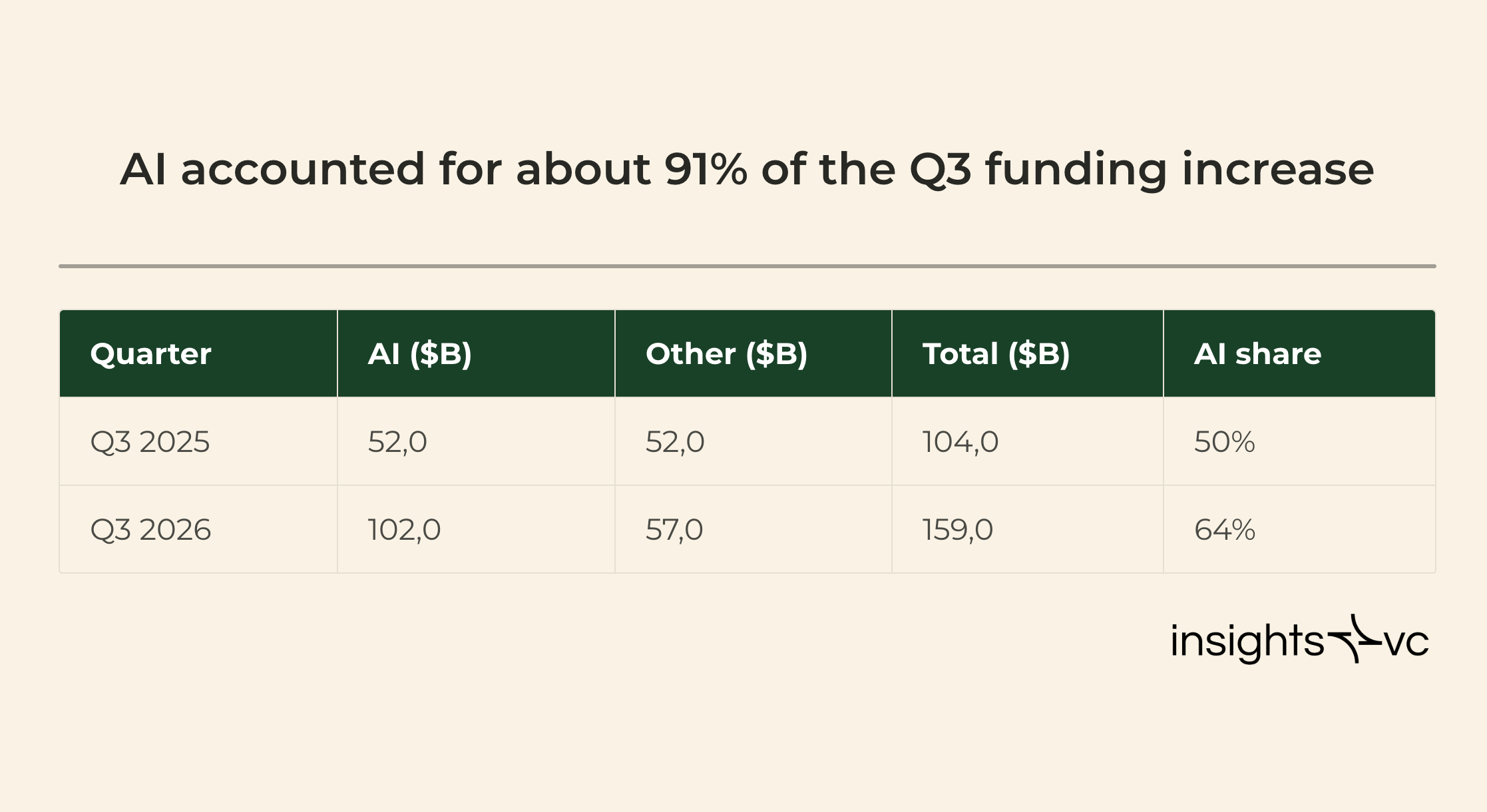
October data further confirmed the trend. On November 3, Crunchbase reported that global funding in October was $59 billion, up 45% year-over-year, with 66% classified as AI-related. DeepSeek's single $15.9 billion round alone accounted for roughly 27% of total global funding that month.
KPMG and PitchBook's Q3 Venture Pulse report counted 8,341 deals globally totaling $170.9 billion, up 43.0% year-over-year and down 28.5% quarter-over-quarter. The top five deals totaled $19.1 billion and the top ten totaled $29.9 billion, accounting for 17.5% of total funding for the quarter.
Even excluding these top ten deals from Q3 2026, the remaining funding was still $141 billion, higher than the $119.5 billion total for the same period in 2025. It should be noted that this calculation only excludes the top large deals of the period, still includes AI funding outside the top ten, and follows KPMG's methodology of recording rounds at their publicly announced size.
For example, the tally includes Crusoe's anticipated $3.9 billion Series F. But Crusoe's Form D filing submitted on September 17 showed that actual sales as of that date were $3.109 billion and included previously issued simple agreements for future equity (SAFEs). The company disclosed contracted compute capacity exceeding 6 GW, but only 1 GW is operational, with most contracted capacity still awaiting construction.
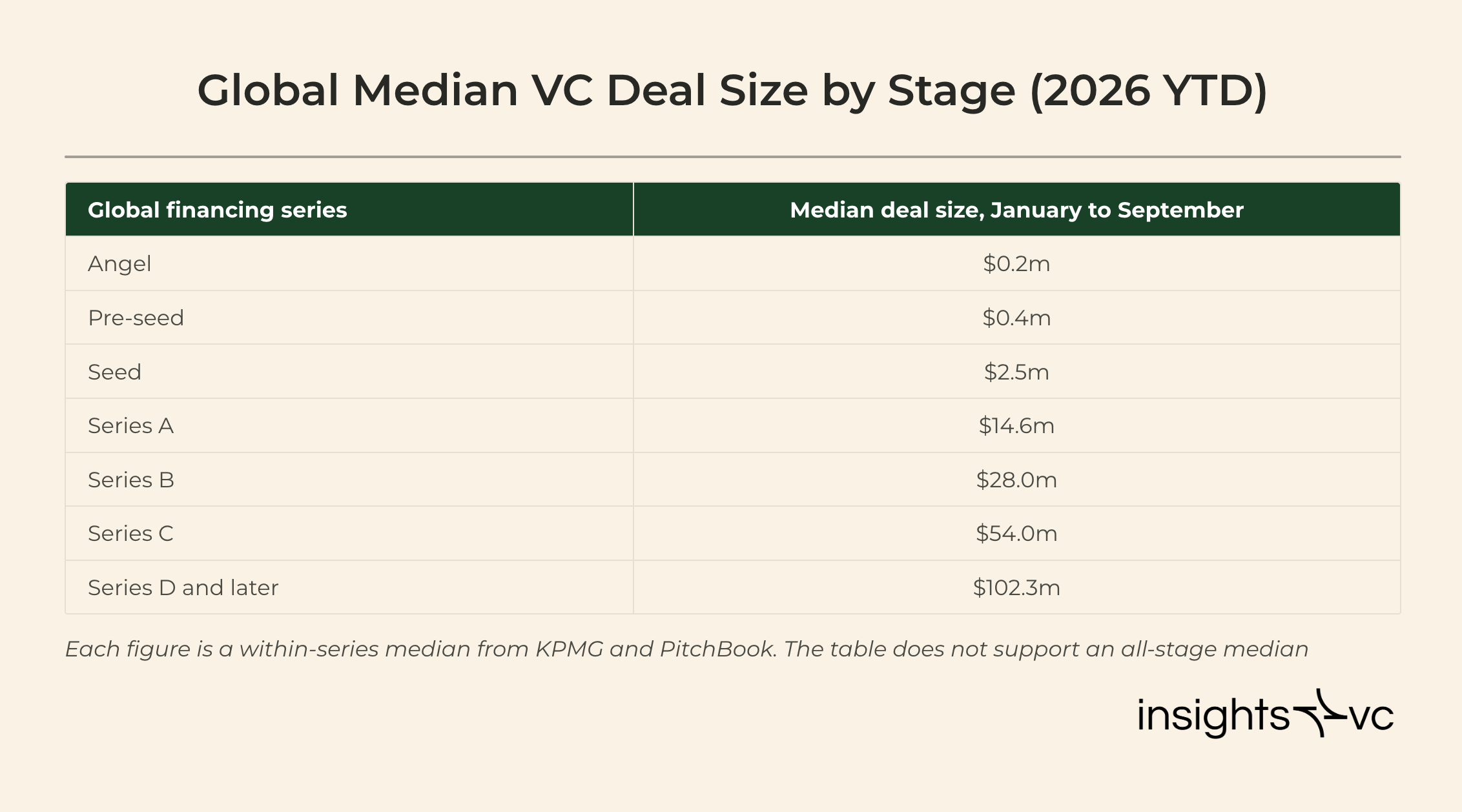
By stage, Crunchbase classified $105 billion of Q3 funding as late-stage (up 73% year-over-year) and $40.6 billion as early-stage (up 25% year-over-year). Of the $13 billion in seed funding, $2.6 billion went to super-seed rounds of at least $100 million each, accounting for one-fifth of the total. KPMG's global median funding size for the first nine months climbed from $400,000 at pre-seed to over $100 million at Series D and beyond.
How Much Capital Actually Reached Funds and Their LPs?
As of the end of September, US companies had received $515.8 billion in VC funding. Over the same period, according to the PitchBook-NVCA Venture Monitor report, 699 US VC funds that completed a final close recorded only $108.5 billion in committed capital.
These two data sets cannot be directly reconciled: PitchBook records commitments in the year of final close (even if LPs signed agreements earlier); company funding can draw from prior-vintage funds, overseas investors, or corporate balance sheets; and commitments to new funds are gradually called over multiple years.
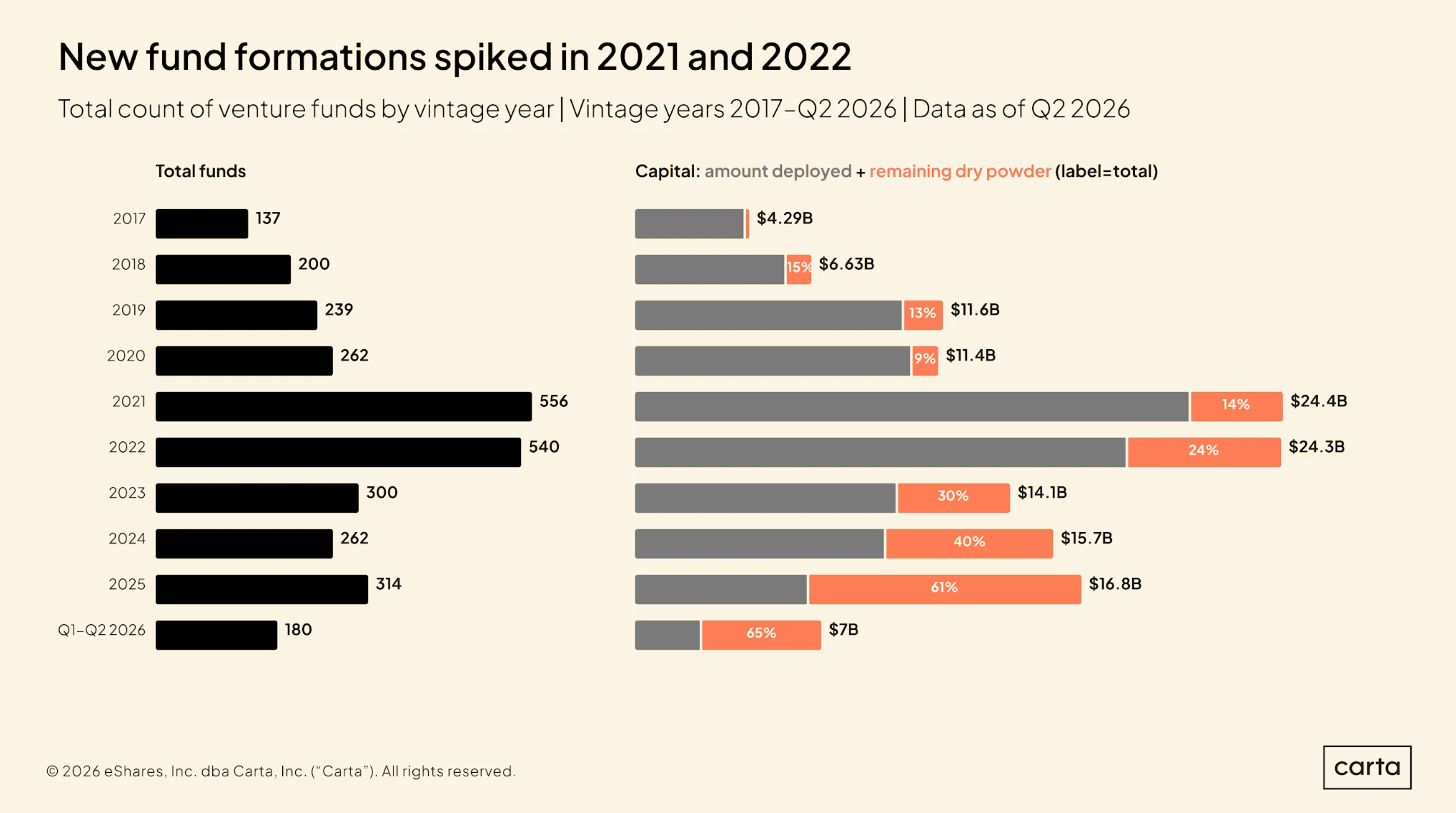
Fundraising is highly concentrated at the top. Funds of $500 million or more accounted for just 6% of closed funds but absorbed 78.1% of committed capital; 81 first-time funds together received only about 4.5% of commitments.
PitchBook recorded $23.8