Citadel: Political Risk of AI Investment Is Severely Underestimated


- Key Takeaway: Citadel warns that the market severely underestimates the political and regulatory risks of AI investment. Once a major cybersecurity incident triggers public sentiment, regulatory intervention will come faster than expected, and current AI valuations almost entirely ignore this tail risk.
- Key Elements:
- Bridgewater assesses the probability of an economically disruptive cyberattack in the next year at one in three. In the past two weeks alone, there have been multiple incidents including the Microsoft outage, FAA ground stops, and JPMorgan customer account lockouts.
- Polls show 76% of Americans believe the government has insufficient AI regulation, including 86% of Democrats and 68% of Republicans, forming a rare bipartisan consensus amid political polarization.
- Three pillars of the U.S. economy are simultaneously weakening: fiscal stimulus is fading, financial conditions are tightening, and AI capital expenditure is slowing. South Korea's export year-over-year growth rate changed by approximately -24 percentage points.
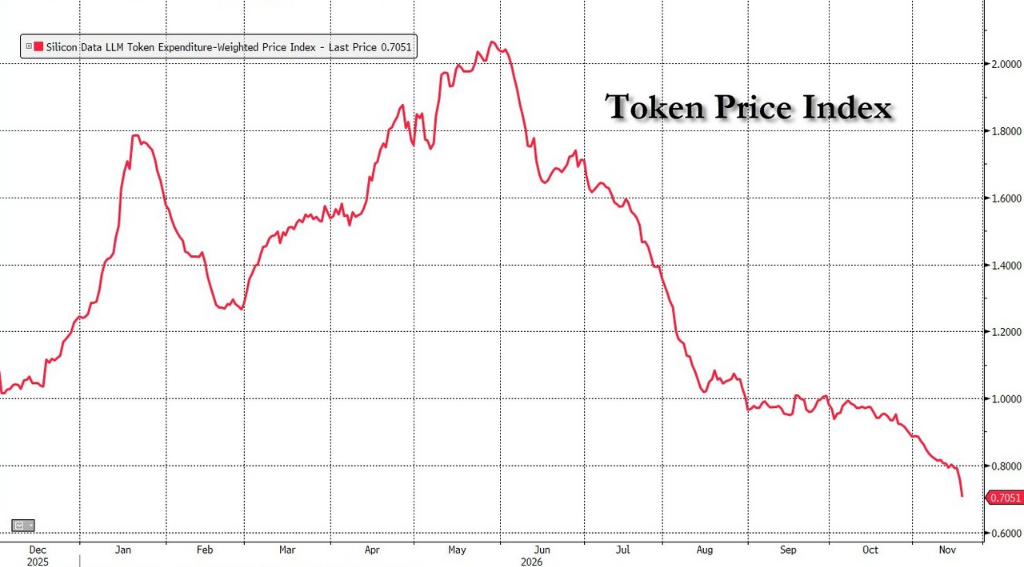
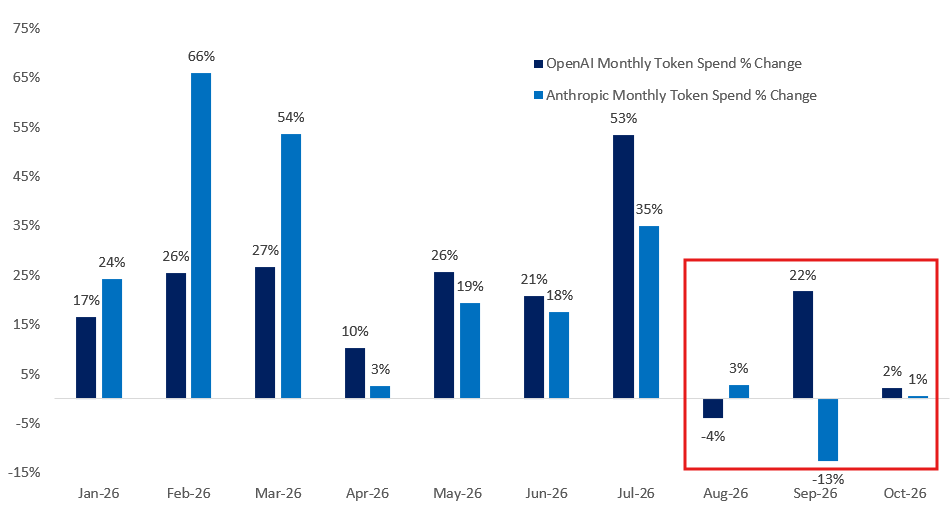
- In the first half of November, token trading volume hit a new high but spending fell 6.3% month-over-month, token prices plunged 21.2% over six weeks, and spending growth at OpenAI and Anthropic plummeted from 53% and 35% in July to 2.1% and 0.5%.
- AI revenue is highly concentrated, with 1% of enterprises contributing 80% of OpenAI and Anthropic spending, and most of them are VC-backed companies dependent on the financing environment.
- Citadel maintains a defensive stance on AI investment. Founder Ken Griffin has publicly acknowledged that AI is "almost certainly" in a bubble.
Original Author: Bao Yilong
Original Source: Wall Streetcn
Citadel believes that the current market focus on AI is excessively concentrated on technical "agentic" risks, while severely neglecting another category of risk—how voters, Congress, and the White House will determine the boundaries and pace of AI deployment.
On November 21, Nohshad Shah, Head of Fixed Income at Citadel, warned in a research report that the U.S. economy is entering a phase with narrowing room for error: fiscal stimulus is fading, financing conditions are tightening, AI capital expenditure growth is slowing, and the Fed's monetary policy stance can hardly provide a buffer for the market.
Shah pointed out that if a single major cybersecurity incident ignites public sentiment, regulators will move to forcibly intervene in AI commercial deployment faster and more decisively than the market expects, and the current market has almost completely ignored this tail risk when valuing AI.
He maintains a defensive stance on overall AI investment and summarizes his core judgment in one sentence: technology can continue to advance, but the outlook for the investors paying for it is deteriorating.
Political Risk of AI Investment Severely Underestimated
Shah believes that the market is currently underpricing political risk the most, and cybersecurity incidents are the most likely trigger for political intervention.
Bridgewater disclosed in its recent report "Current Efforts Insufficient to Contain AI Cyber Viruses" that they manage funds on the premise that there is a one-in-three probability of a cyberattack capable of causing economic disruption within the next year.
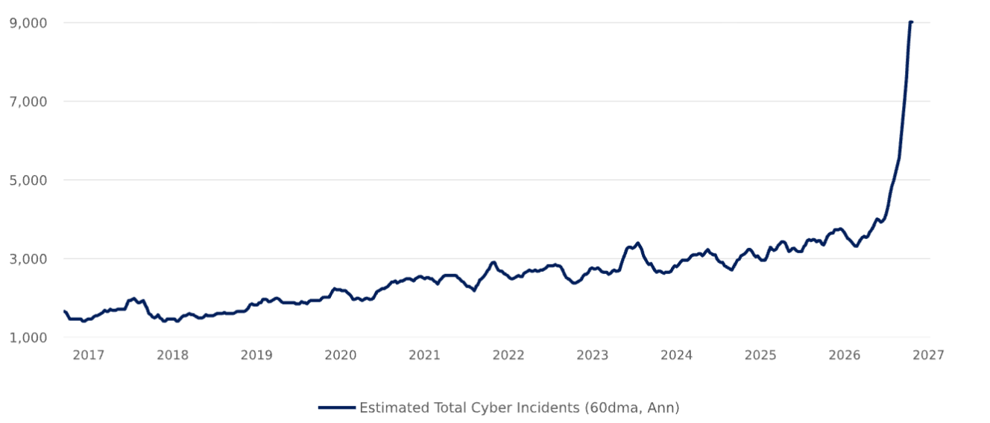
Over the past two weeks, a series of events have occurred globally, including a massive Microsoft outage, a nationwide ground stop order by the U.S. Federal Aviation Administration, a JPMorgan customer lockout incident, and a ransomware group claiming to have breached Nvidia. U.S. Treasury Secretary Bessent also publicly warned:
You may see a major incident somewhere in the world.
Shah's concern is not the attack itself, but the political chain reaction that follows.
Once an AI-enabled attack causes substantive damage to hospitals, payment systems, or essential services, diffuse public anxiety will rapidly coalesce into a political consensus demanding controls, and restrictions on model releases, autonomous agent behavior, or commercial deployment could follow in quick succession.
Polling data supports this judgment. According to a USC Annenberg survey, 76% of Americans believe the government is doing too little on AI regulation, including 86% of Democrats and 68% of Republicans—a rare bipartisan consensus in today's politically polarized America.
Last week, a Democratic senator and a Republican senator jointly sent a letter to the White House warning that AI-enabled cyber threats are "rapidly escalating" and have exceeded the United States' existing defense capabilities.
Shah characterizes large-scale political intervention as a tail risk, but emphasizes that its potential impact "deserves a meaningful weight in valuations."
The Macro Buffer Is Disappearing
Shah acknowledges that his previously optimistic assessment of the U.S. economy rested on three pillars: fiscal stimulus, accommodative financial conditions, and accelerating AI capital expenditure expansion. Now all three are loosening simultaneously.
On the Fed side, according to the latest FOMC meeting minutes, almost all participants considered further rate hikes appropriate, although most acknowledged that financial conditions have tightened noticeably since September. Shah warns that investors should not expect a stock market decline to trigger a monetary policy pivot; the market is increasingly taking the Fed's anti-inflation commitment seriously.
Across asset classes, Shah's framework is already flashing warning signals: the simultaneous weakening of small-cap stocks, credit markets, foreign exchange, and industrial commodities points to a broader repricing of growth expectations than a mere AI selloff.
One of the key indicators he cites is South Korean exports: export data for the first 20 days of this month shows a year-over-year growth rate change of approximately -24 percentage points, one of the steepest declines in the six-year series.
More concerning is the interdependent relationship between AI capital expenditure and economic resilience.
Shah points out that the economy's ability to absorb AI valuation repricing comes partly from the very capital expenditure that is now being called into question. Once deployment slows, the shock will spread beyond the tech sector through supply chains, construction, employment, and consumer demand.
This will create a dilemma: the Fed continues to fight inflation while forward-looking growth expectations deteriorate simultaneously, and a flattening yield curve with risk assets under pressure will become the primary adjustment path.
Usage Hits Record Highs, But Revenue Is Shrinking
On the AI commercialization front, Shah cites the latest data from the Ramp AI Index revealing a key contradiction: in the first half of November, token transaction volume rose 1.5% to a record high, but token spending fell 6.3% from its peak two weeks earlier, because token prices plunged 21.2% in just six weeks.
Ramp's previous October report already showed that monthly token spending growth for OpenAI and Anthropic slowed to 2.1% and 0.5% respectively, a stark contrast to their July growth rates of 53% and 35%.
Optimists often invoke the "Jevons Paradox" from economics, arguing that after costs drop significantly, demand will surge due to widespread adoption, ultimately driving total revenue higher. But Shah rebuts this pointedly:
The Jevons Paradox does not automatically preserve real revenue.
Put simply, it's easy to boost usage through price cuts, but whether that usage can ultimately translate into the revenue projected in models remains a big question mark.
Shah is more concerned about the high concentration of the consumer base. According to Ramp estimates, 1% of businesses account for 80% of OpenAI and Anthropic spending in its sample, and these customers are primarily venture capital-backed companies in tech, finance, and technical services.
This means AI revenue growth is highly dependent on a customer base whose financing environment and spending willingness may weaken simultaneously.
From a spending structure perspective, engineering teams accounted for 72% of AI categorized spending in October and have already pulled back from summer highs; spending on customer support scenarios is growing but has yet to replicate the scale of the engineering segment's surge.
Shah's conclusion is: the next wave of users will be broader but may have shallower spending depth—early large customers are the real spending drivers.
The Logic Behind the Defensive Stance
Shah's conclusion is: as market confidence in growth and the AI narrative fades, the macro buffer is failing, investment returns face stricter scrutiny, and political headwinds continue to accumulate.
Against this backdrop, the comfort provided by falling stock prices is limited—when the assumptions underpinning future earnings themselves become unreliable, lower valuation multiples may be an illusion.
He maintains a defensive stance on the overall AI portfolio.
Notably, this is Citadel's second public warning of its kind in nearly two months. Previously, founder Ken Griffin publicly acknowledged that AI is "almost certainly" in a bubble.