Trump Reveals Behind-the-Scenes Role in Jensen Huang's Return: I Convinced the NVIDIA Board


- Key Points: In an exclusive interview, Trump detailed his intervention in NVIDIA CEO Jensen Huang's return, stating that an investigation confirmed there were no national security concerns, and emphasized that Huang is a "national treasure" whose loss would pose a genuine threat to the United States.
- Key Elements:
- The Trump administration, after an in-depth investigation and assessment by the Department of Justice, determined that Huang himself had no national security violations and provided assurances to NVIDIA's board.
- Trump said his intervention in persuading the board was pivotal, and that the task became significantly easier after the stock dropped 40%-50%, acknowledging coordinated efforts with senior administration officials including Vance, Bessent, and Lutnick.
- Trump emphasized that NVIDIA's advanced chips such as Blackwell cannot be replicated due to their extreme technical complexity, and that Huang's mind holds chip designs generations ahead of the future.
- Trump believes that if Huang were lost, China might lure him with generous offers to join Huawei or other companies, thereby automatically acquiring all of his technical knowledge.
- Trump revealed that TSMC will build large-scale fabs in Arizona and Texas, attributing this to tariff policies, and stated that chip imports will face approximately 200% tariffs in two years.
- Trump made clear that his intervention in corporate governance is "entirely for the country," with the boundaries depending on specific circumstances, citing the protection of Musk as a precedent.
This article is from:CNBC
Compiled by | Odaily (@OdailyChina); Translator | Azuma (@azuma_eth)
Editor's note: This article is the transcript of an interview with US President Trump on CNBC's Squawk on the Street program last night. Because Jensen Huang had just announced his return to Nvidia before the program began, most of the conversation revolved around that event.
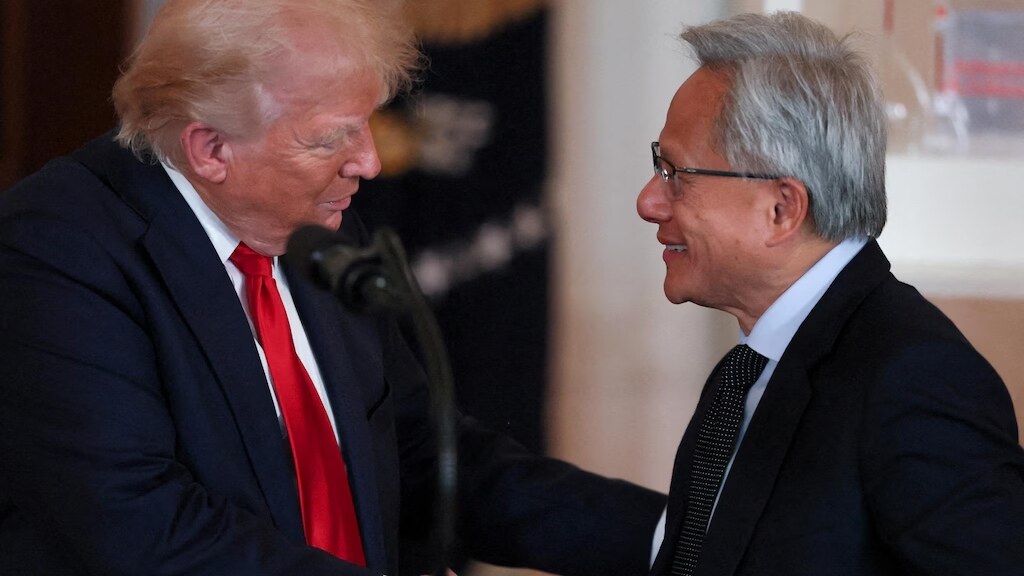
- Eamon Javers (Host): Mr. President, thank you for joining CNBC. First, I'd like to hear your thoughts on today's news, and also understand what exactly happened over the weekend. What changed the situation?
Trump: This is very exciting news. I think a lot of things changed. I have been very firm in my view that he should come back.
We conducted a very thorough investigation, and the findings showed that he truly did nothing wrong. Of course, he showed poor judgment in some matters not really related to this, but beyond that, he did nothing wrong.
He created an irreplaceable chip, and not just one. He also has some new products coming that may be even better. Because this is an industry where technology becomes obsolete very quickly—you make a product today, and it might be obsolete three minutes later. I don't know if I'd want to be in that kind of business, but he does it better than anyone in the world. I just visited China, and there too he is widely regarded as the most outstanding talent in this field.
We must protect our geniuses. There are too few people like that, and he is clearly a genius.
Frankly, he went through hell. He and his family were under a lot of pressure. He has a wonderful wife and children. I don't know his children, but I know his wife—she is an excellent woman who has always given him tremendous support.
- Javers: What did the Attorney General tell you? Regarding the potential criminal liability Jensen Huang might face, and the export control issue—how did the government make its judgment?
Trump: They conducted a study, and also a fairly in-depth investigation. They concluded that Jensen Huang himself has been cleared, or rather, exonerated.
He is in the chip sales business. Right now he's selling some older chips, like the 200 series I believe and earlier products. These chips are somewhat outdated, and the market size isn't that large.
As for Blackwell and some other products, he currently can't sell them. But he's in the chip sales business—if he sells chips to a company and that company later resells them, that could become a problem in the future. Who knows?
- Javers: Are you confident that Jensen Huang does not pose a national security threat? The New York Times previously reported that Jensen Huang's romantic partner, Alice Huang, had been in contact with an official from China's Ministry of State Security during their relationship. Does this raise national security concerns for you?
Trump: Who hasn't been in contact with the Chinese side? I just left China. It was an extremely high-level summit, absolutely unprecedented.
As for security threats, I think China probably talks to everyone. They talk to me, and they talk to everyone else. That doesn't mean they're bad people. But I can tell you, for me, the bigger threat is losing someone like Jensen Huang. That's the real threat, and it's far more serious than anything we're discussing right now.
- Javers: When was the last time you spoke with Jensen Huang? Did you stay in touch with him throughout the weekend?
Trump: I have been communicating directly or indirectly with Nvidia's board, and my position on this has been very firm.
As I saw what was happening at the company, my stance became even firmer. To me, this company is a very important part of America. What he has done, and what this company represents, is very special.
I think the board has been very rational. By the way, I heard Jim Cramer (another CNBC host) just say the board should be fired or something like that. I think the board was in a very difficult position. I think they actually performed quite responsibly.
If it had been a different board, they might have chosen to fight, and in that case, in my view, things would have turned into a disaster.
- Javers: So who should remain on Nvidia's board now? Do you think board members need to be adjusted?
Trump: I don't want to talk about that, because I don't know the board members. I might know one of them, but I don't know the others.
What I will say is that the board ultimately did well. They may not have done as well at the beginning—perhaps they should have suspended him rather than terminating him outright. You know, Jensen Huang left at the time. Actually, he may have been forced out by the board. But they've come back now, and they made the right decision. It wasn't easy, but they did it.
The board did ask us to guarantee that he doesn't pose a national security threat. Based on all the information we have, we have provided them with that assurance. At least within the scope of what we currently know, we can provide that assurance.
- Javers: So you're saying you don't mind that Alice Huang was in contact with China's Ministry of State Security, because you believe everyone in China might have some contact with the MSS? Am I understanding that correctly?
Trump: I myself am in contact with the Chinese side. I just left China, so technically, I'm involved too, right?
We talked about Jensen Huang. They also consider him an extraordinary talent. And he truly is a remarkable person—that's very important for America. I like smart people.
- Javers: Tech stocks saw a significant sell-off last week. Did that influence your judgment on whether Jensen Huang should return?
Trump: It may have had some influence, but the more important factor is the long term. He has other chip designs in his head that even I don't know about, and no one really does.
What's amazing is that if you take a super-advanced chip like Blackwell, they cannot be replicated. I previously heard that Blackwell was 10 years ahead of other technology. Now I don't know exactly how much—maybe 2 years, 3 years, 4 years—but it is truly very advanced, and no one can replicate it.
I have a friend, David, who runs WeatherTech and makes rubber mats. His company is excellent, but as soon as a product launches, two minutes later others start copying it. They'll set up a company called Weather Key or something and copy his products. I have another friend who makes movies—within 24 hours of a film's release, there are already millions of pirated copies worldwide. This is a very serious problem.
But chips are different. With the most advanced chips, no one can replicate them. It's not that they don't want to—they simply don't understand the technology.
I asked Jensen Huang, why can't others pirate his chips like they pirate everything else? He said others can't do it. No one has the technical capability and brainpower.
This may be the only thing I've ever heard of that truly cannot be replicated. Because people copy everything—not just China, other countries do it too.
But chips don't have this problem, because the complexity is simply too high. And Jensen Huang has chip designs in his head that are far ahead of Blackwell.
Of course, Blackwell will eventually become obsolete too. That's the problem with this industry—you create an incredible technology, and a year later it might be outdated. Once it's outdated, you can sell it to the market. I have no problem with that. By then, China will have its own version too, just like they now have their own 200 series chips.
They've always been in the chip business, but there's a difference here—selling someone a highly advanced chip that no one else has is completely different from selling a chip that they can basically manufacture themselves.
- Javers: How do you think Jensen Huang will regain control of the company going forward? He previously lost some credibility due to reports of an extramarital affair with a subordinate, and rebuilding his leadership authority may be difficult.
Trump: I think when he starts over, he may even be in a higher position than before. He has already apologized for his misconduct. It's regrettable, and sex does attract attention, folks.
Jim Cramer might not understand this well because he's a very, very, very focused person. But this matter did significantly increase the attention on the whole situation. Without it, it probably wouldn't have caused such a big reaction.
He has apologized to the company, the country, and his own family and wife. His wife is an excellent woman—I know her. They have accepted it, and I think everyone has accepted it too.
Actually, I think this might even turn out to be a good thing in the end. People will start to realize just how remarkable his achievements are. This put him under a harsh spotlight to some extent, but from another perspective, it also showed people just how advanced this company's chip technology really is.
I don't think he'll be weakened by this in the end. I don't think his standing will decline at all. People respect what he's been through, and they respect how he handled it.
- Javers: What is your current position on whether the US should sell relatively advanced chips to China? Jensen Huang and others argue that if we don't sell to China, they'll develop their own chip industry. We should keep them dependent on American chips. But hawks argue that we shouldn't enhance China's AI capabilities and shouldn't sell them overly advanced chips. How do you weigh this?
Trump: They already have those less advanced chips, and they're manufacturing them themselves. If you look at some Chinese companies, you'll find they're very good.
I understand Jensen Huang's point. If we don't sell to them, they'll make their own. They're actually not that far behind us. But in certain areas, they might be 10 years behind us. That's quite remarkable.
Think about technologies that can't be pirated or replicated. Look at these chips—they look like just a small piece of silicon wafer, but the complexity within is something China cannot replicate. No one can replicate it.
So my view on this is very different from many people. Most chips now will eventually become obsolete, and quickly. New chips keep coming out. I want Nvidia to stay ahead because they have a higher technological foundation.
Chips don't appear out of thin air. You need to build on existing foundations. Blackwell is a foundation, and then you continue developing on that foundation—that's how the whole industry works.
Honestly, I'm very glad that this company and the board had the courage to make the right decision. They went through two weeks of agony, and the company suffered enormous losses. I was just looking at your screen and saw the stock price like a rocket flying in the wrong direction. Now it's flying in the right direction again, and it's lifting the entire market.
- Javers: This is an incredible reversal.
Trump: I don't know—this might be unprecedented. But a real reversal takes time, so we can't call it a reversal just because of one day's rally.
However, I think you'll see this company deliver very strong results, and Jensen Huang will do very well. I spoke with him last night. I told him: "Jensen Huang, you only need to promise me one thing—work hard."
I told him, you have the brain, and you have everything necessary. If you work hard, no one can beat you.
He said: "I will work harder than ever before."
He's very excited. He's a good person, a very good person. He went through hell.
- Javers: Do you think Jensen Huang has become too big to fail?
Trump: No, I think he's an extraordinary talent, and we want him on our side.
- Javers: So how should investors view the market now?
Trump: Investors should be very happy. However, since the election, the stock market hasn't performed well. I held one of the greatest rallies in human history.
I held 30 rallies in 28 days, or maybe 31. Each had thousands of people—once, with only one day's notice, 25,000 to 30,000 people showed up. But that support didn't translate into votes. They might not have liked those candidates, or there were other reasons.
I think since the election, the stock market has lost $5 trillion, maybe even more. Now today it has rebounded somewhat, but counting from election day, the stock market has indeed lost $5 trillion. That's a huge number.
Since I took office, I added $25 trillion to America—that's a record—but then lost $5 trillion in just a week and a half after the election. I don't like that. It means the world doesn't like the Democrats.
- Javers: Given last week's market volatility, especially in AI and tech sectors, are you worried about an AI bubble?
Trump: I'm not worried now, because one of our superstars is back on the field. It's like a baseball team. The team has many star players—you have 10 stars, and if one superstar is suddenly pulled from the game, the team's performance will naturally suffer. And losing Jensen Huang this time was a huge loss.
You've seen that this affected the market, and even affected how the world views America. I received a grand reception in China. Obama didn't get good treatment when he went to China. Biden didn't even know what country he was in and needed someone to tell him.
Now the world respects America again.
The whole situation of Jensen Huang leaving Nvidia had become a negative mark on America. But now things have been resolved quickly—it didn't drag on for months and months and months.
I think the board deserves some credit. Although I respect Jim Cramer, I heard him criticize the board. The board was in a very difficult position. However, when the stock price dropped 40% or 50%, their situation also changed. I think they deserve some credit.
- Javers: Throughout this process, who specifically did you communicate with? Board members, Jensen Huang himself, or others?
Trump: I talked to many people, including some people you frequently interview. I also communicated with Vice President JD Vance—he's done an excellent job. We also communicated with many people within the government, because this was a major decision.
The board ultimately decided to do what we wanted them to do. One of the board's main concerns was: is there a national security issue? After extensive investigation, we concluded there isn't.
- Jim Cramer (another host): Mr. President, my concern earlier was that the board acted too hastily. If they had contacted you first, contacted the Attorney General, perhaps they would have realized this. Why not suspend him first rather than firing him outright? That's what really concerned me, because he is a national treasure of the United States.
Trump: Absolutely right. We must protect him.
I protected Elon Musk during my first term. Elon had my protection at the time. I'm proud of that. I like Elon, and I think he's excellent.
I often say he's 80% super genius and the other 20% has some other issues (laughs). I tell him that directly too. Without me, you wouldn't have today's Elon.
We must protect outstanding talents, because we don't have enough of them. Jensen Huang is both a genius and a national treasure.
Of course, the board didn't know all the facts at the time. I couldn't have given them an answer weeks ago either, because we hadn't completed a full investigation at that point. This really heated up recently, and we wanted answers as quickly as possible.
He's in the chip sales business—as for that woman, whenever a beautiful Chinese woman appears, people say she's a spy. Of course, Eric Swalwell's woman might actually have been a spy, but I don't think that's the case with Jensen Huang. If Jensen Huang sold chips to that company and they later gave those chips to China, that would indeed be abnormal, but that doesn't mean Jensen Huang should be held responsible. I don't think he would do that.
- Cramer: Mr. President, can you tell us clearly that after the investigation, you fully believe Jensen Huang is supportive of America and will not leak American trade secrets to the