Stocks Fall to a One-Year Low—Why Even Gold Failed as a Safe Haven in This Market Selloff?


- Core View: The October 2026 meeting minutes show that nearly all Fed officials supported further rate hikes, rate futures price the probability of a December hike at over 90%, and the dollar has risen to a 19-month high, triggering simultaneous declines in gold, silver, and copper in the same week; this round is a cross-asset selloff driven by both a higher rate anchor and the simultaneous unwinding of crowded positions, rather than a collapse in demand.
- Key Elements:
- The October meeting held rates at 3.75%–4.00% by a 10-2 vote, with the minutes stating that further hikes are still needed under the baseline scenario and a few officials mentioning that stronger action could be taken if inflation turns unfavorable.
- On November 18, spot gold fell about 3.2% in a single day to its lowest since September 2025, silver fell about 5%, and LME copper fell 5.7%; gold prices dropped about 10% over seven days, five times the roughly 2% gain in the dollar over the same period.
- Most of gold's decline occurred before the minutes were released, while the 10-year U.S. Treasury yield actually fell over the same period, indicating that the pressure came from a stronger dollar and position unwinding rather than rising yields.
- Fund net long positions in copper have fallen to less than half of their mid-September peak; however, SHFE copper inventories have dropped to their lowest since December 2023 and the Yangshan copper premium has risen, indicating tight physical supply in China.
- Institutional views diverge: Goldman Sachs believes the copper pullback is driven more by positioning and that fundamentals have not loosened; Snowden describes demand as near-recessionary; Natixis points to U.S. stockpiling and AI capital flows as a bubble.
- The December 8–9 policy meeting is the nearest validation point, with 25 basis points currently the mainstream pricing; the key variables for copper are whether the U.S. refined copper tariff takes effect and whether AI capital spending is revised down.
TL;DR
- The October 2026 meeting minutes show that almost all participants believed further rate hikes were needed; rate futures price a December hike at over 90%, and the dollar index has risen to a 19-month high.
- Gold, silver, and copper all fell in the same week. Gold was sold as a source of liquidity to raise cash, copper saw crowded longs unwound, and tight Chinese spot supply suggests copper's decline does not look like a demand collapse.
- Related assets: gold and silver ETFs, copper ETFs and copper mining stocks, the dollar index, 10-year US Treasuries.
On November 18, 2026, spot gold fell about 3.2% in a single day to its lowest level since September 2025. Silver dropped about 5%. London Metal Exchange three-month copper fell 5.7%, its lowest since April. On the same day, the dollar index stood at a 19-month high of around 104.
Based on past experience, when stocks and AI-related positions draw down, capital flows into gold. This time it did not.
For ordinary investors, understanding this selloff requires just one comparison. US Treasuries yield a coupon of about 5%, while gold yields nothing that day. The higher the rates and the stronger the dollar, the greater the opportunity cost of holding gold. This explains the first layer of pressure on gold and silver, but it does not explain why copper was hit on the same day, nor why gold's decline far exceeded the dollar's gain.
Why were all three asset classes sold off together in the same week? A higher rate anchor and a stronger dollar are the common backdrop; crowded positions being liquidated simultaneously is the amplifier. Only by separating these two layers can we see clearly what gold and copper are each selling off on.
After the Minutes, a December Hike Is Priced at 90%
On October 28, 2026, the Federal Reserve kept the federal funds rate range at 3.75% to 4.00%, with a 10-2 vote as two officials favored a 25-basis-point hike. The meeting minutes released on November 18 show that almost all participants believed further rate hikes were needed under the baseline scenario. A few participants mentioned that if inflation data turned unfavorable, a move larger than 25 basis points could be considered in December.
This was the judgment as of the October meeting, not a decision already made in December. The market treats it as a done deal because the implied probability from rate futures has risen above 90%. That probability is a market-traded odds, not a voting result.
Official comments are reinforcing the same direction. Fed Governor Waller publicly discussed a 50-basis-point hike in December and a faster rate path in 2027. New York Fed President Williams said further tightening is needed but dramatic action is not necessary. Both point to more hikes, with disagreement only on the magnitude. The dollar index has risen for about seven consecutive trading days to its highest since April 2025, the most direct price expression of this expectation.
Gold's Decline Is Five Times the Dollar's Gain
Gold has fallen about 10% over the past seven trading days, while the dollar rose only about 2% over the same period. Exchange-rate conversion can explain only a small part; the rest comes from positioning and momentum.
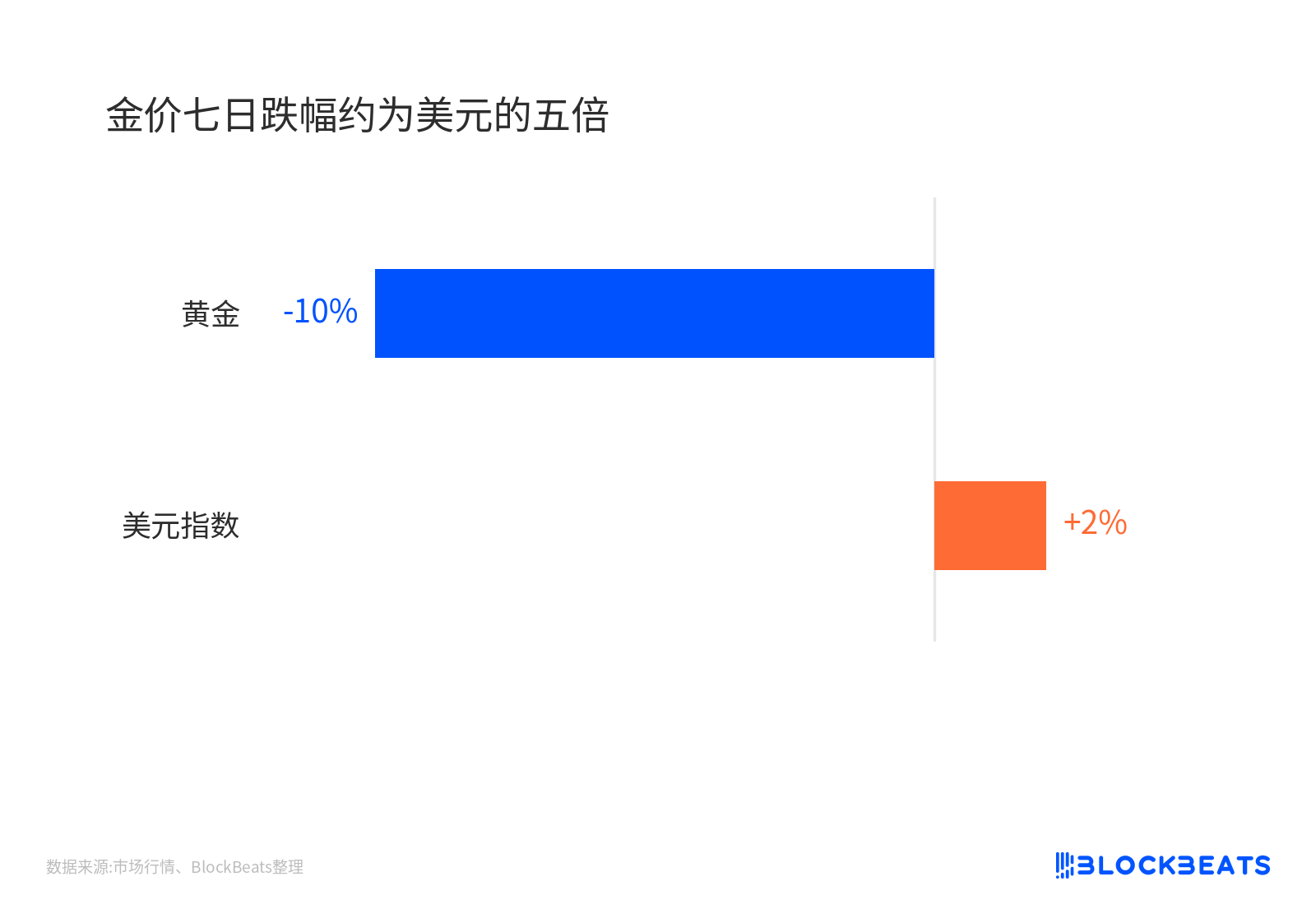
Gold's seven-day decline is about five times that of the dollar
One easily overlooked detail is that most of the 18th's gold decline occurred before the minutes were released. The minutes were more a confirmation of existing pricing than the starting point of the selloff. On the same day, the 10-year Treasury yield actually fell about 8 basis points and dropped further to about 5.05% on the 19th, declining for four consecutive days. This selloff cannot be attributed to rising yields again; what strengthened in tandem was the dollar.
Chris Gaffney of EverBank attributed the pressure on gold to rate expectations and a strong dollar. Nikki Shiels of MKS PAMP offered another layer of explanation: in the short term, gold is a liquid asset used to raise cash. When stocks and AI positions draw down simultaneously, selling gold for cash is faster than selling other assets. This explains why gold does not rise when stocks fall, but it is a mechanism judgment and cannot verify the source of selling transaction by transaction.
Gold ETF holdings remain very high. If policy stays tight, these positions still have room to be cashed out. It is not that gold lacks safe-haven demand; it is that too many people hold it, and marginal buyers have retreated in the face of rates.
Funds Are Retreating, Chinese Spot Is Snapping Up Supply
Copper fell more sharply than gold. On the 18th, LME copper fell 5.7%, and COMEX copper fell as much as 6.7% intraday. Looking at futures and spot together yields two opposite directions.
On the futures side, positions are retreating. Net long copper positions held by funds have fallen from their mid-September peak to less than half, with both bullish narratives—AI demand and tariff stockpiling—being reduced at the same time.
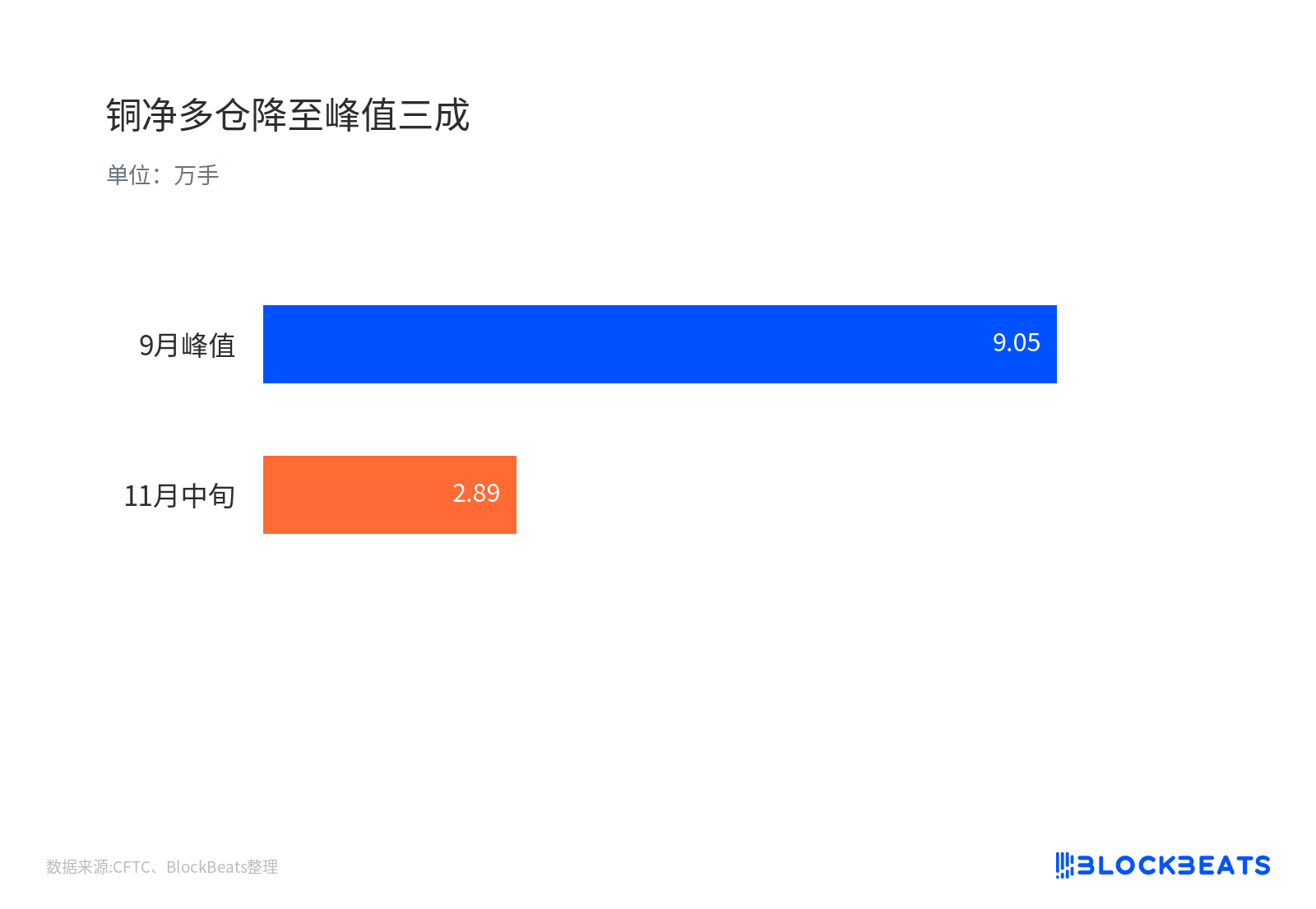
Net long copper positions have fallen from the September peak to less than half
The spot side tells a different story. Copper inventories at the Shanghai Futures Exchange have fallen to their lowest since December 2023, and the Yangshan copper premium has risen noticeably. The latter is the premium on imported copper upon arrival; a rise means spot supply is in demand. The US has locked large amounts of copper into warehouses on tariff expectations, while Chinese buyers want cargo that can arrive at port immediately.
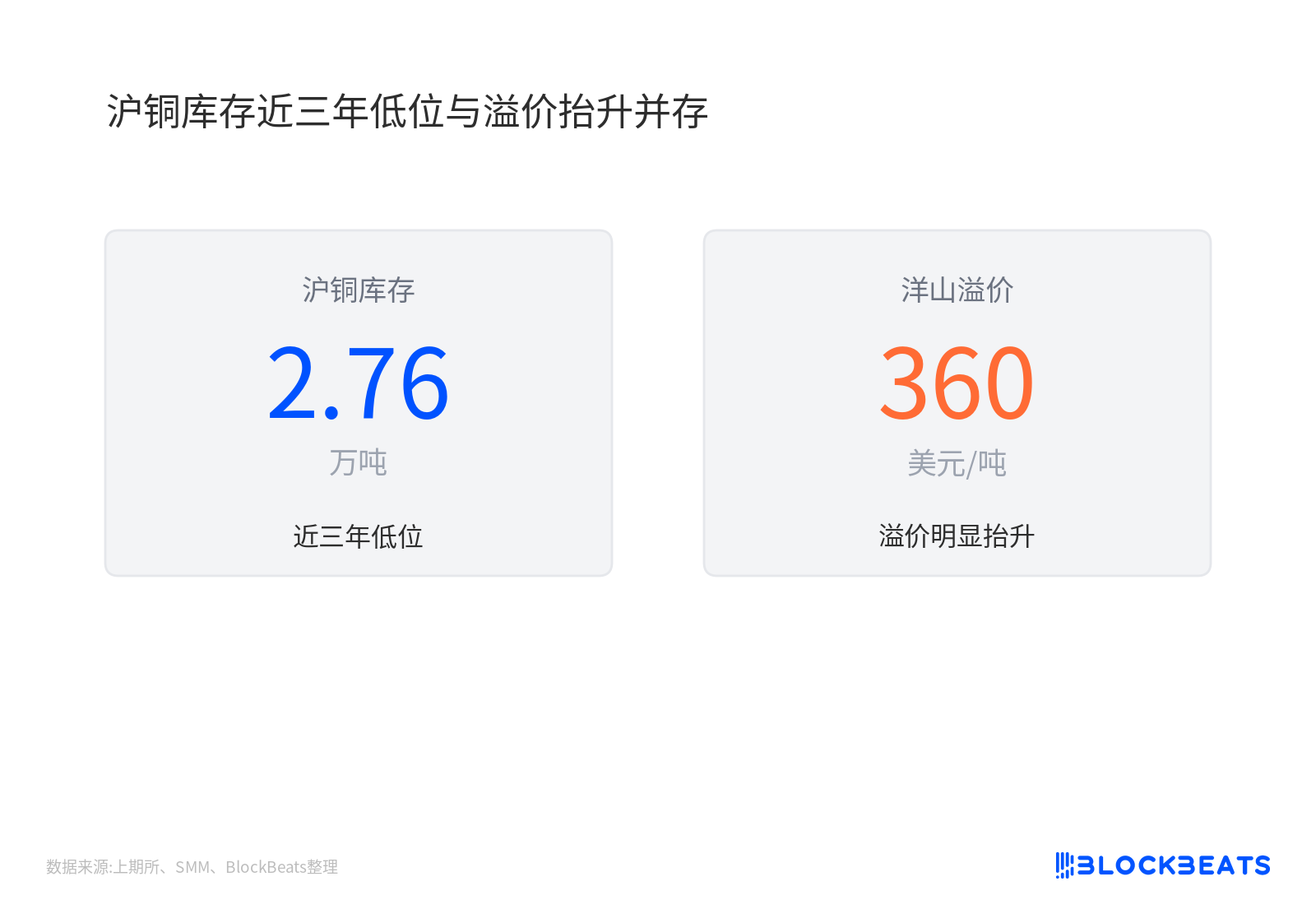
Shanghai copper inventories at a three-year low coexist with rising premiums
This is exactly where Goldman Sachs diverges from Mercuria's Nicholas Snowden and Natixis. Goldman believes copper's recent pullback is more about positioning, that fundamentals have not loosened, and maintains a relatively high 2027 price framework while flagging downside revision risk. Snowden believes current copper demand is closer to a recession-style environment. Natixis calls US stockpiling and AI capital flows a bubble. The debate is about the same thing: whether this selloff is selling positions or demand.
On the 19th, LME copper rebounded about 0.4% and did not continue weakening with gold. Tight Chinese spot supply cannot prove copper prices will rise immediately, but it is enough to refute the simple conclusion that Chinese demand has suddenly collapsed.
The Dollar, Tariffs, and AI Spending Will Determine How Far the Divergence Goes
The December 8-9 FOMC meeting is the nearest verification point. Futures currently price a 25-basis-point hike as the baseline, with the probability of 50 basis points only in the single digits to just over 10%. If the Fed ultimately hikes only 25 basis points and the language is not more hawkish, the dollar may give back some gains, and the first layer of pressure on gold and silver will ease first.
Copper's verification point lies in another direction. Whether the US refined copper tariff takes effect will determine whether inventories locked in warehouses flow back. Whether AI capital spending is actually cut will determine whether copper's AI demand narrative can be sustained. Neither is within the scope of the December meeting's decisions, yet both determine whether spot premiums and futures prices will converge again.
Copper rebounded on the 19th while gold remained weak. A divergence has already appeared, but with only one trading day, it cannot be taken as evidence that the trend is over. A more prudent judgment is that this was a cross-asset selloff triggered jointly by a higher rate anchor and the clearing of crowded positions. Gold was sold as cash; copper saw paper longs unwound. The tightness of Chinese spot supply is the variable in this clearing cycle that least accommodates the bears.