The last time this happened was on the eve of Lehman's collapse: The U.S. Treasury restarts "9-day ultra-short bills" after nearly 17 years—a preview of a 2027 "cash crunch"?


- Key Takeaways: The U.S. Treasury restarted 9-day ultra-short-term bill financing after a 17-year hiatus, reflecting rising pressure on government cash management. Combined with the Federal Reserve's pause on reserve injections, the market's assessment of reserve adequacy has been cast into further doubt.
- Key Elements:
- The Treasury sold $15 billion of 9-day CMBs at a 3.910% rate, the first such issuance since July 2008, with the indirect bidder allotment ratio rising to 45.8%.
- Such instruments have been issued only 11 times since 1980, with a six-year gap over the past decade, yet just four weeks ago a $25 billion 10-day CMB was issued.
- The TGA balance is expected to peak at approximately $1.025 trillion by the end of November, while the New York Fed has scheduled zero reserve purchases from November 16 to December 11.
- As of November 13, the debt was only $685.1 billion away from the $41.1 trillion ceiling, with Goldman Sachs and JPMorgan expecting the ceiling constraint to take effect in February next year.
- Goldman Sachs warns that reserve levels are near the critical point of the demand curve; longer-term 2027 risks may cause ultra-short-term financing instruments to appear more frequently.
Original Author: Bao Yilong
Original Source: Wallstreetcn
The U.S. Treasury is managing its cash needs with increasingly short time windows, and a financing tool dormant for nearly 17 years has quietly resurfaced, adding further doubts to the market's assessment of the Federal Reserve's reserve adequacy.
On November 19, the U.S. Treasury sold $15 billion of 9-day cash management bills (CMBs) at a rate of 3.910%—the first issuance of such ultra-short-term instruments since July 2008, when IndyMac had just been taken over and Lehman Brothers was only two months away from bankruptcy.
This "9-day bill" was issued on November 24 and matures on December 3. Auction demand was reasonably solid, with indirect bidders receiving 45.8%, up from 18.3% in October's comparable auction, while the primary dealer allotment fell from 77.6% to 52.0%.
Since complete auction records began in 1980, such instruments have been issued only 11 times in total, and in six of the past ten years there were no such issuances at all. Just four weeks earlier, on October 22, the U.S. Treasury had already sold $25 billion of 10-day Treasury bills.
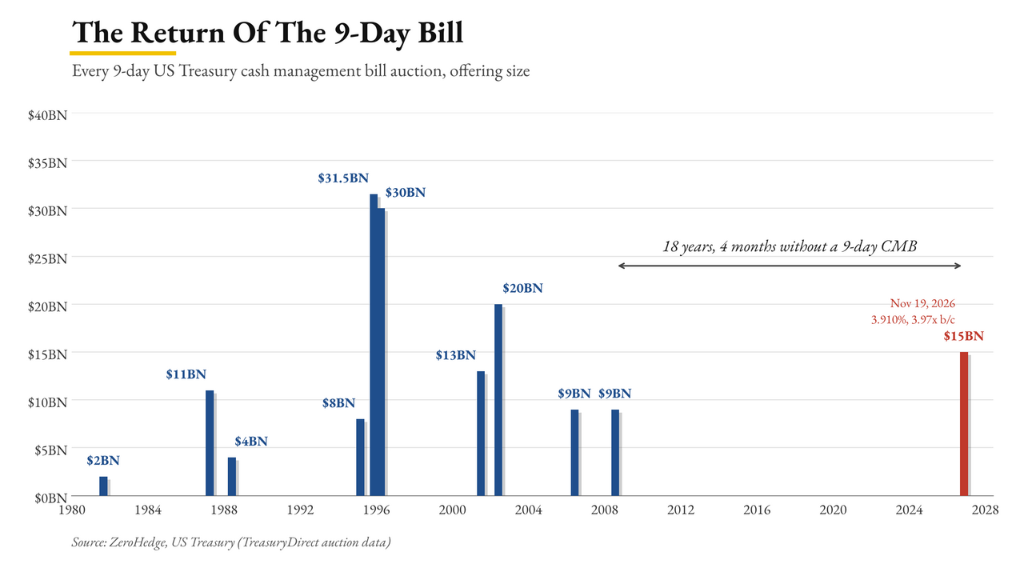
The frequent reappearance of short-term financing tools reflects a quiet escalation of pressure on the U.S. government's cash management.
Why the U.S. Treasury's Cash Buffer Is Running Low
According to Zerohedge, ultra-short CMBs have become increasingly rare, with none appearing at all in six of the past ten years.
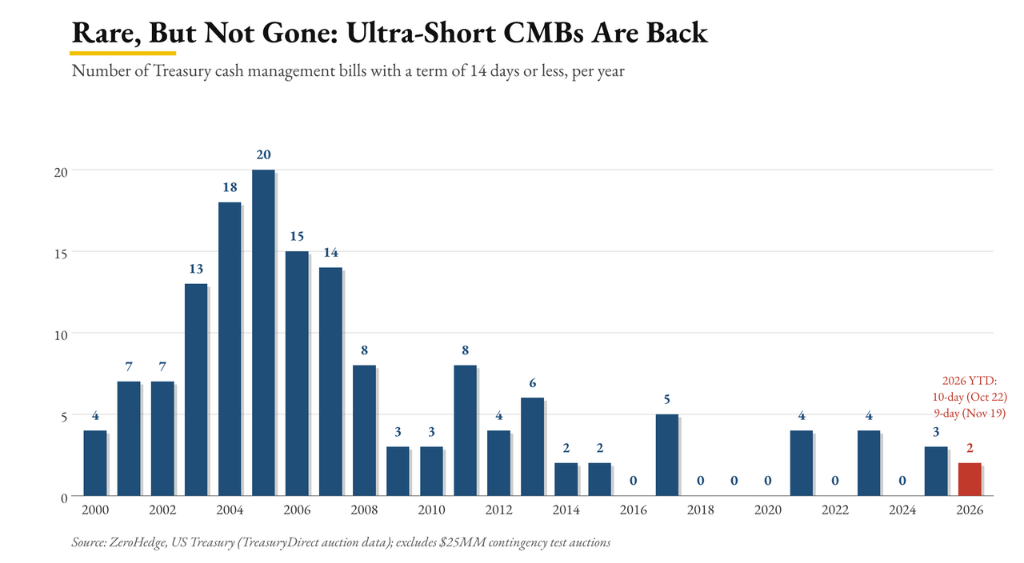
In its November 4 refunding statement, the U.S. Treasury had already signaled a possible ultra-short CMB issuance at the end of November. This 9-day instrument is precisely designed to bridge the month-end gap—settling on the Tuesday before Thanksgiving and maturing right after the large outflow on December 1.
According to analysis by John Comiskey of Reverse Engineering Finance, the October 10-day CMB was used to provide a brief liquidity bridge for the Treasury General Account (TGA) as its balance approached the minimum level stipulated by the Treasury's cash balance policy.
The U.S. Treasury is currently replenishing reserves for the TGA, with the account balance expected to reach a temporary peak of approximately $1.025 trillion by the end of November.
The other side of the problem lies with the Federal Reserve. Goldman Sachs' rates team had previously expected the Fed to restart reserve management purchases this month, amounting to about $10 billion. However, the New York Fed scheduled zero reserve purchases between November 16 and December 11, extending the pause that began in mid-August.
The two combined—the Fed not injecting reserves while the U.S. Treasury accelerates TGA replenishment—means the month-end liquidity gap can only be filled by a bill lasting 9 days.
Debt Ceiling Looms, 2027 Risks Already Brewing
The current pressure may be merely a preview. As of November 13, U.S. debt had $685.1 billion of headroom remaining before the $41.1 trillion ceiling, but this gap is narrowing rapidly. Both Goldman Sachs and JPMorgan expect the debt ceiling constraint to take effect in February next year.
Historical experience shows that once the debt ceiling is reached, the TGA will be passively depleted, and once the ceiling issue is resolved, it must be rapidly rebuilt—a process that triggered severe money market volatility in both 2019 and 2023. Goldman Sachs warns:
Reserve levels are currently near the critical point of the demand curve.
Analysts believe the longer-term risk points to 2027. If the debt ceiling issue then coincides with TGA rebuilding needs, similar ultra-short-term financing tools may appear more frequently, and the Federal Reserve may also be forced to restart Treasury bill purchases in a more passive manner.
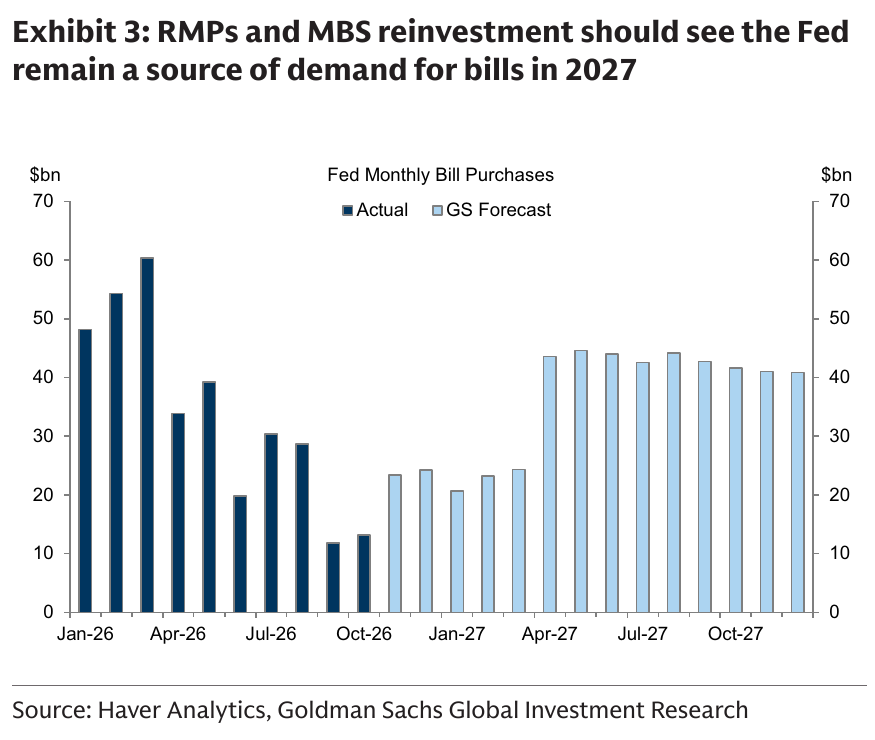
When the world's largest sovereign borrower begins planning its cash flow in 9-day increments, the weight carried by the phrase "ample reserves" may be far greater than the market had previously estimated.