Why Did Kraken Buy a Silicon Valley VC?


- Core Viewpoint: Kraken's parent company Payward plans to acquire Silicon Valley venture capital firm Tribe Capital, aiming to fill the gap in private asset discovery and investment capabilities and connect the full chain from project sourcing and on-chain issuance (xPO) to secondary trading.
- Key Elements:
- Payward has signed a definitive agreement to acquire Tribe Capital, with the deal expected to close in Q1 2027; the target's assets under management are approximately $2.7 billion.
- The two parties have deep ties: Tribe has cumulatively invested $120 million in Kraken, making it the second-largest institutional investor; founder Arjun Sethi concurrently serves as Kraken's co-CEO and Tribe's chairman.
- Tribe's portfolio covers star companies such as OpenAI, SpaceX, and Anduril, and it possesses project screening, due diligence, and fund management capabilities.
- The core pain point of the current Pre-IPO tokenization market is the scarcity of quality private assets, not issuance and trading channels.
- Payward has proposed the xPO on-chain primary issuance plan, allowing private company shares to be tokenized on xStocks and traded on the secondary market from day one.
- Issues such as equity transfer restrictions, securities regulation, and liquidity remain practical obstacles to the implementation of this model.
Original | Odaily (@OdailyChina)
Author | Azuma (@azuma_eth)

Kraken's parent company Payward is brewing something big.
On November 19, Payward officially announced that it has signed a definitive agreement to acquire Tribe Capital, a venture capital and asset management firm headquartered in Silicon Valley, California. The deal is expected to close in the first quarter of 2027, with the amount undisclosed. Based on the committed capital figures disclosed by Tribe Capital as of September 30, 2026, the fund currently manages approximately $2.7 billion in assets.
Why would an exchange buy a VC? Although the business lines may seem quite disparate, considering Payward's continuously expanding business footprint over the past year and its ongoing stock tokenization plans, the strategic significance of this deal isn't hard to guess — Payward is trying to extend its reach into the private market, building a complete chain from early-stage project investment to primary issuance and secondary trading.
An Acquisition with Deep-Rooted Ties
The connection between Tribe Capital and Payward runs deep.
The firm was founded in 2018 by Arjun Sethi, Jonathan Hsu, and Ted Maidenberg, with Arjun Sethi currently serving as both co-CEO of Kraken and chairman of Tribe Capital.
The capital ties between the two parties are also quite close. As early as late 2020, Tribe Capital began investing in Kraken equity through both primary and secondary markets. By May 2021, cumulative investment had reached $120 million, making it Kraken's second-largest institutional investor, and Sethi joined Kraken's board that same month. Tribe later also participated in Kraken's $800 million funding round in 2025.
As such, this acquisition is more like the two parties further integrating two sets of businesses that already had close capital and management ties.
What Exactly Does Tribe Capital Have?
As a well-known data-driven VC in Silicon Valley, Tribe Capital's investment strategy emphasizes using AI, data science, and data on enterprise operations and product engagement to identify companies with long-term competitive advantages. Its investment stages cover both early and late-stage private companies, deploying capital through funds and co-investment vehicles.
From its public portfolio, it's clear that Tribe Capital's reach spans multiple hot sectors, including companies such as OpenAI, SpaceX, Applied Intuition, Anduril, Mercury, and Apollo.io — covering AI and frontier technology as well as financial infrastructure and enterprise software.
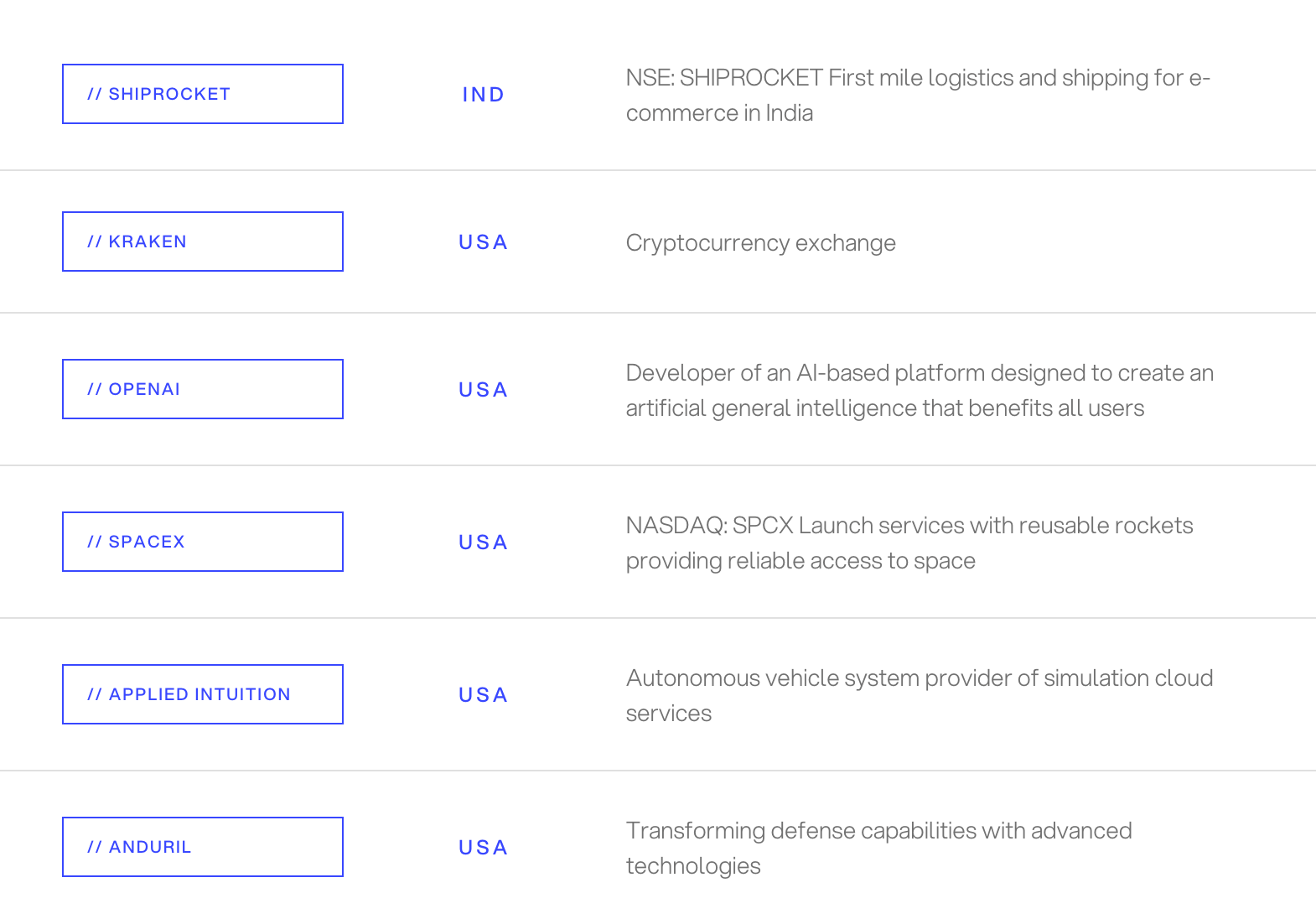
This means what Payward wants to acquire is not just Tribe Capital's $2.7 billion in assets under management, but more importantly the project screening, investment research, due diligence, deal sourcing, and fund management capabilities that Tribe has already built up.
And these capabilities may be exactly what's most scarce for Payward and the current Pre-IPO asset tokenization market.
Pre-Market Stock Tokenization: What's Missing Isn't Channels, But Good Assets
Currently, there are already many tokenized products in the crypto market targeting private companies, but assets that can truly provide private market exposure remain quite limited, with market attention highly concentrated on a handful of star companies.
Take platforms like PreStocks as an example — such pre-IPO tokenized products currently mainly revolve around a few projects like Anthropic, OpenAI, Kalshi, and Polymarket — among which Anthropic was once the most heavily traded major target, but it's officially listing on Nasdaq tonight.
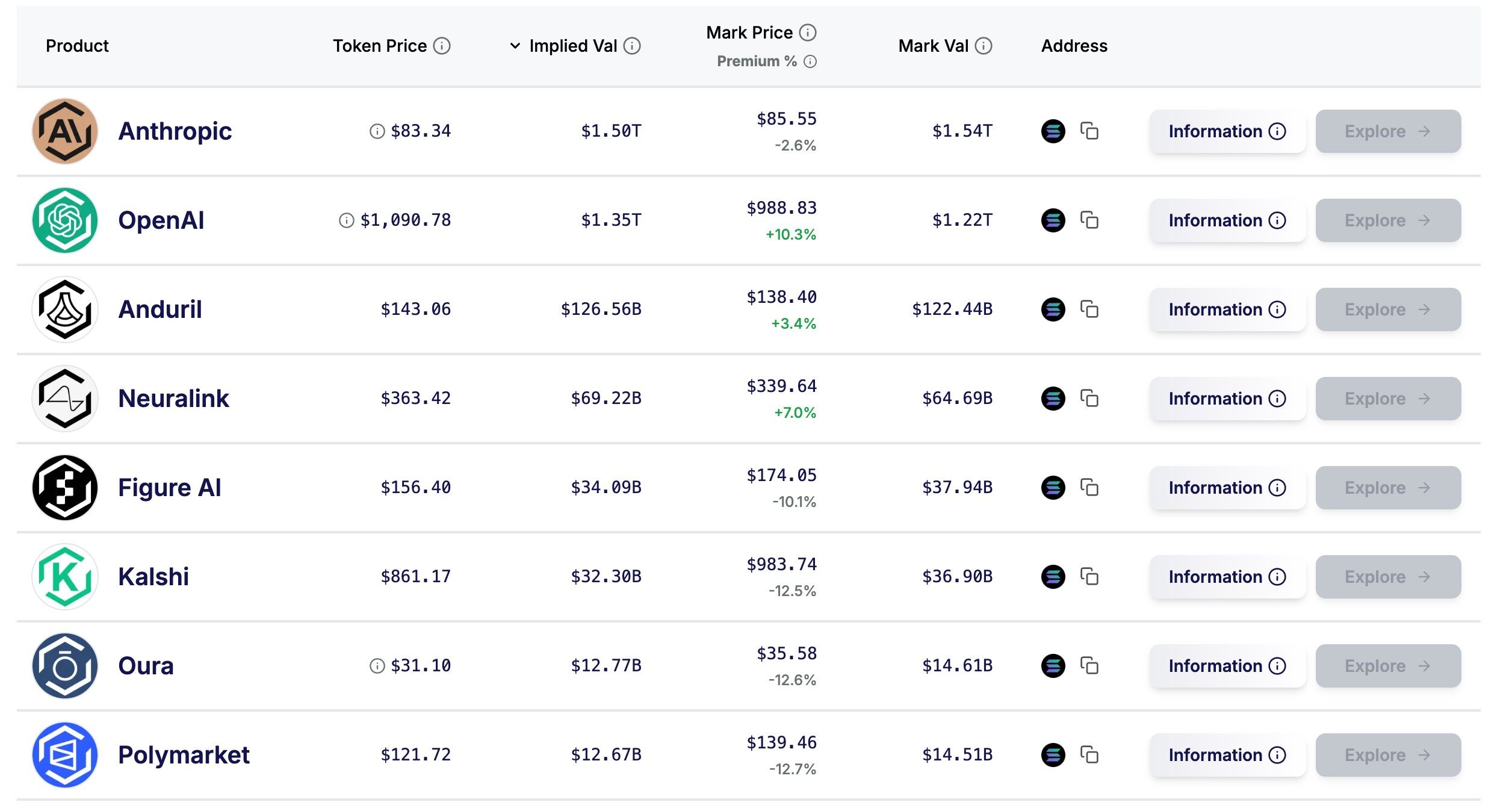
The market's problem is clear — tokenization technology and trading channels aren't hard to find; what's truly scarce is high-quality private assets worth tokenizing.
Even if a platform has already built its issuance and trading infrastructure, if it can only ever bring in a handful of star companies, the product's asset diversity and long-term growth potential will still be limited. High-quality private assets don't automatically appear on exchanges — they need someone to continuously discover, screen, and evaluate them, and they require relationships between investment institutions and companies to gain access to financing and equity trading opportunities.
This is precisely where Tribe Capital can play a role.
From Asset Discovery to Issuance and Trading, Payward Wants to Build the Complete Chain
Combined with the product plans Payward has already disclosed, the strategic significance of this acquisition becomes even clearer.
Over the past year, Payward has gradually shed its singular identity as Kraken's parent company, with its business now spanning five major segments — Trading, Banking, Asset Management, Payward Services, and AI — and encompassing multiple products and businesses including NinjaTrader, Breakout, xStocks, and CF Benchmarks.
Among these, the one most directly relevant to Tribe is clearly Asset Management. In its acquisition announcement, Payward also explicitly stated that Tribe will supplement its private market project sourcing, investment underwriting, portfolio construction, and fund management capabilities, and help it develop new private market investment products.
On November 13, Payward formally proposed in its Q3 earnings report an onchain primary market issuance program called "xPO (Onchain Primary Offering)." xPO allows private, unlisted companies to directly tokenize their shares on xStocks and complete primary market fundraising onchain. Unlike the long lock-up periods of traditional private equity, tokenized shares issued through xPO can be traded on the secondary market from day one of issuance.
This concept and Tribe Capital's capabilities form an almost perfect complement — Tribe Capital is responsible for finding companies worth investing in, screening assets, evaluating enterprise value, and leveraging its investment network to access high-quality projects; Payward provides financial infrastructure including custody, trading, collateral management, tokenization, and global distribution.
Combined, the two could theoretically form a complete business chain from project discovery and asset investment to onchain issuance and secondary circulation.
The Future of Onchain Assets Goes Far Beyond Listed Stocks
If this model can work, Payward's imagination space will no longer be limited to putting traditional listed company stocks like Apple and Nvidia onchain. More pre-IPO AI companies, fintech firms, robotics companies, and even unicorns not yet in the public eye could all become potential asset sources for xStocks.
For private companies, this offers a new channel for financing and equity circulation; for investors, it means future opportunities to access more private market assets that have traditionally been difficult to participate in through onchain financial infrastructure.
Of course, this doesn't mean all companies in Tribe Capital's portfolio will immediately appear on xStocks. Equity transfer restrictions, issuer willingness, securities regulation, investor accreditation, and liquidity remain unavoidable practical obstacles. But at least from a strategic direction perspective, Payward is trying to capture not just the trading gateway for assets, but also the supply gateway for assets.
Exchanges are responsible for making assets liquid, while a VC may be able to help it find the next batch of assets worth trading.