ChatGPT Wallet Joins Forces with Visa and Others: Does the Agent Economy Still Need Stablecoins?


- Core Viewpoint: ChatGPT Wallet's integration with traditional card networks does not negate the value of stablecoins, but rather distinguishes between two phases: "Agentic Commerce under human authorization" and "Agentic Economy driven by autonomous machine collaboration." Stablecoins are not the only option for Agent payments, but programmable trust infrastructure is a prerequisite for scaling.
- Key Elements:
- OpenAI launched ChatGPT Wallet and integrated with American Express, Mastercard, and Visa, reusing mature merchant networks and dispute protection mechanisms, adopting tokenized credentials while still requiring user biometric authorization for each transaction.
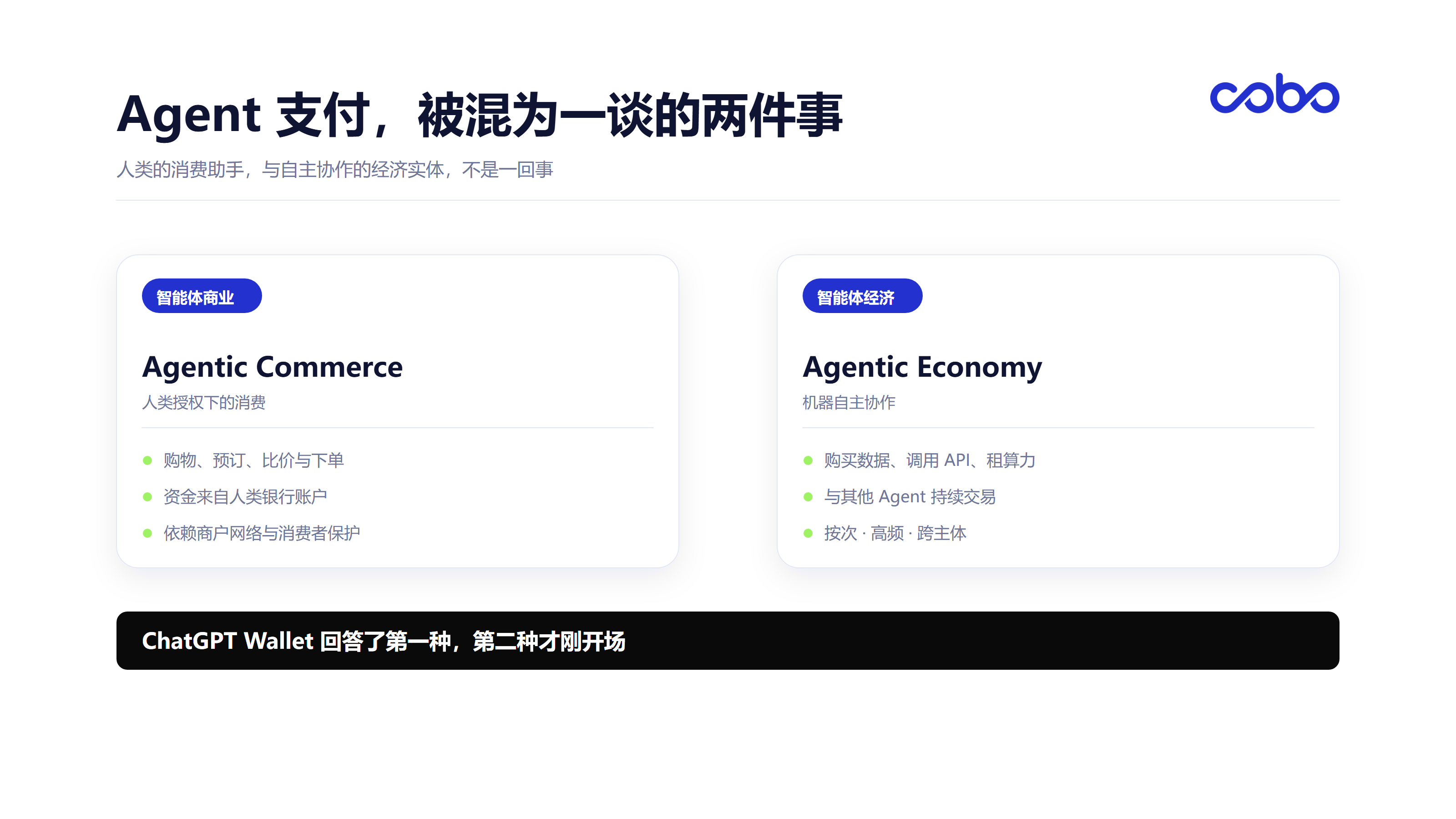
- Agentic Commerce is primarily focused on shopping and consumption, with funds sourced from human bank accounts; Agentic Economy involves API calls, data purchases, compute leasing, and continuous transactions between Agents, exhibiting characteristics of small amounts, high frequency, and cross-entity interactions.
- Cobo's sampling research shows that among over 6 million AI-related transactions on the Base and Solana networks, more than 90% were valued at only a few cents or even less than 1 cent, highlighting the micro-payment trend in machine payments.
- The industry has developed protocol routes including x402, Stripe and Tempo's MPP, and Google AP2; Visa and Mastercard are also advancing stablecoin settlement pilots and machine payment standards, presenting a dual-track integration landscape.
- The core security challenge lies in permission boundaries: Cobo Agentic Wallet separates signing authority through MPC, constrains budgets and objects via Pact task contracts, and encapsulates execution templates through Recipes, implementing security rules as hard preconditions for transactions.
- Enterprises adopting stablecoin payments can modularly combine two dimensions—asset management approach (custodial/self-custodial) and system integration approach (standard pages/API, SDK)—retaining existing payment systems while integrating on-chain capabilities.
The convergence of AI Agents and Web3 is sparking a debate.
On November 13, OpenAI announced the launch of ChatGPT Wallet and partnered with American Express, Mastercard, and Visa to enable Agents to complete product purchases and payments on behalf of users.
Previously, AI Agents had been viewed as the most promising emerging use case for stablecoins, yet OpenAI chose to connect to traditional card networks in its first step toward implementation, leading many to question: "If even ChatGPT has integrated with the Visas of the world, do Agents really still need stablecoins?"
This skepticism is not entirely unfounded, but it actually conflates two different concepts: "Agentic Commerce under human authorization" and "Agentic Economy with autonomous machine collaboration."
- For current Agent applications focused on shopping, bookings, and daily consumption, funds still come from human users' bank accounts, and transactions rely heavily on the mature merchant networks, identity verification, and consumer protection mechanisms of the card system—traditional payment networks clearly possess more mature commercial infrastructure;
- But the boundaries of the Agentic Economy extend far beyond this. When AI begins autonomously purchasing data, calling APIs, renting computing power, and even engaging in continuous value exchange with other Agents, payment demands may no longer be confined to traditional consumption scenarios;
So the key question is this: the Agentic Economy is not the same as Agentic Commerce—especially when AI transitions from a human consumption assistant to a participant in economic activity, what kind of payment and financial infrastructure is actually needed?
1. Why Is Traditional Finance the First Stop for Agent Payments?
To understand why OpenAI chose Visa and Mastercard, we first need to clarify two concepts that are often conflated: Agentic Commerce and Agentic Economy.
The former mainly refers to AI completing consumption behaviors such as product discovery, price comparison, order placement, and payment on behalf of humans; the latter is a broader concept, meaning AI Agents can not only execute tasks assigned by humans but may also operate beyond human instruction on a per-transaction basis, conducting continuous transactions with other Agents, enterprises, and service providers.
Judging from current implementation progress, Agentic Commerce is clearly leading the way, and traditional card organizations still hold an unshakeable advantage in this domain.
Take the design of ChatGPT Wallet as an example—it is actually quite restrained and pragmatic.
Users pre-bind an eligible bank card. When the Agent finds the target product and is ready to pay, the user reviews the product, total price, and selected bank card, and confirms the transaction through security verification such as Face ID or fingerprint.
The payment network then provides a set of payment credentials (Payment Tokens) that replace real bank card information to complete the transaction. Merchants and Agents do not need to directly access real bank card information, and users can continue to enjoy their original card rewards and eligible transaction dispute protection.
The biggest advantage of this design is that it does not require users to change their existing payment habits, nor does it require merchants to rebuild an entirely new payment system.
After all, for AI products targeting mass consumers like this, directly reusing Visa and Mastercard's global merchant acceptance networks, acquiring systems, and anti-fraud risk controls is far more realistic than educating ordinary users to "first buy stablecoins, then set up an on-chain wallet, and finally manage Gas fees."
More importantly, the traditional payment system is not only responsible for fund transfers but also provides a complete set of commercial dispute resolution mechanisms—when product quality issues arise, consumers can initiate chargeback disputes, and merchants can follow existing refund and customer service processes. This is a capability that on-chain payments currently do not widely possess at the global retail level.
However, there is an easily overlooked detail: ChatGPT Wallet has not yet achieved fully unsupervised autonomous payments—users still need to manually review and verify before each transaction.
According to the first-phase design announced by OpenAI, users still need to confirm the product, total price, and bank card before each purchase, and complete authorization through biometric verification. Only in the future does it plan to further open up pre-authorization capabilities, allowing users to set spending limits, purchase categories, and validity periods in advance so that Agents can autonomously complete transactions within defined boundaries.
This precisely shows that consumer-grade Agents are still in the early stage of "human-led, AI-assisted"—AI only helps humans purchase products, so the existing bank card system can already solve most problems.
But if an Agent needs to call APIs thousands of times a day, purchase real-time data, rent GPU computing power, and also pay service fees to other Agents, then what it faces is no longer a simple shopping problem.
2. Penetrating the Agentic Economy: Where Are the Opportunities for Stablecoins and New Protocols?
When AI Agents evolve from "assistants that help people buy things" into "economic entities that autonomously conduct business," the transaction structure will undergo a qualitative change.
Imagine an enterprise deploying an AI research Agent. To complete an in-depth analysis task, it may need to execute a series of actions in parallel within minutes: purchasing real-time market data from data service providers, renting GPU computing power from cloud computing platforms, calling third-party AI models to complete analysis, purchasing specialized data processing services from other Agents, and finally delivering the results.
Throughout this process, the Agent needs to conduct payment relationships with multiple different service providers. Compared with traditional consumer payments, these transactions exhibit several distinct characteristics:
- Smaller transaction granularity: In the past, enterprises purchasing APIs, data, and computing resources typically used subscriptions, prepayments, or package models. But when Agents can dynamically call different services based on task requirements, per-use billing and per-call billing become more natural;
- Higher transaction frequency: An Agent can run continuously for hours, or even be online long-term, transacting with multiple service providers. It cannot wait for humans to manually input payment information every time it calls a service;
- More open transaction relationships: Different Agents may run on different enterprises, in different countries, and on different technical platforms, with no traditional account relationships between them, and they may not share the same bank or payment service provider;
Lucas, Head of Sales and Solutions at Cobo, previously shared a sampling study of the Base and Solana networks at the 4th Cross-Border Digital Finance Compliance Conference: in a sample covering 35 days and over 6 million transactions, more than 90% of AI-related payment amounts were only a few cents, or even less than 1 cent.
This data reflects that some early machine payments have already shown a clear micro-transaction characteristic.
Similar practices are also emerging: on the Solana network, there are already weather query APIs charging less than 1 cent per call, and token security screening services charging a few cents per use; on the internet content side, infrastructure giants like Cloudflare are also promoting pay-per-use mechanisms based on the x402 protocol, allowing AI crawlers to settle with content providers in real time for each web page scrape.
Traditional bank cards are not incapable of handling micro-transactions, but when payments shift from occasional consumption behaviors to high-frequency, automated API calls, the costs generated by per-transaction authorization, payment processing, and settlement may become a bottleneck for business efficiency. In other words, blockchain networks and stablecoins are what make this high-concurrency, extremely small-value machine-to-machine (M2M) settlement economically viable.
In addition, stablecoins also provide a programmable settlement method better suited to the Agentic Economy.
In this model, payments can be directly embedded into Agents' automated task flows through smart contracts and APIs. Agents can hold stablecoins through wallets, pay to designated addresses after obtaining authorization, and also interact with smart contracts to complete more complex fund management operations, without requiring every machine-to-machine transaction to depend on traditional bank card accounts and merchant acquiring processes.
For example, in per-second billing scenarios for computing power or APIs, stablecoins support 24/7 round-the-clock circulation. Enterprises can also combine payment streaming protocols (such as Superfluid) to achieve per-use, scheduled, or per-second continuous settlement, without having to wait until the end of the month for unified reconciliation.
Of course, this does not mean that stablecoins are cheaper and more efficient than bank cards in all scenarios. On-chain transactions still involve issues such as network fees, liquidity, fiat on/off ramps, compliance screening, and merchant acceptance.
What truly matters is that stablecoins provide an internet-native programmable value transfer method, enabling payments to integrate more naturally into automated collaboration between machines.
Overall, around autonomous machine payments, the industry has recently developed several clear protocol routes, and even traditional card organizations themselves are actively embracing this dual-track landscape, including x402 promoted by Coinbase, the Machine Payments Protocol (MPP) jointly launched by Stripe and Tempo, and Google's AP2.
Their focuses are not entirely the same, but they are all attempting to solve a common problem: how to enable Agents to autonomously initiate and complete payments just like calling an API.
Since the beginning of this year, there have also been several noteworthy developments:
- On March 18, Visa released dedicated payment specifications and SDKs, enabling Agents to use tokenized bank card credentials in machine payment flows, meaning traditional card payments are also beginning to adapt to API calls and machine-to-machine transactions;
- On June 3, Mastercard announced the addition of on-chain settlement options using regulated stablecoins to its existing global payment network, involving assets such as USDC, PYUSD, USDG, USDP, and RLUSD, as well as multiple networks including Ethereum, Solana, and Base;
- On June 10, Visa released AI commerce infrastructure including Agent Score and Agentic Directory at its Payments Forum, while expanding its stablecoin settlement pilot;
- On October 15, Visa Direct and Mastercard respectively advanced stablecoin commercialization—Visa moved USDC pre-funding capabilities from pilot to commercial deployment for cross-border payments; Mastercard and its acquired stablecoin infrastructure company BVNK launched the Global Money Platform, integrating fiat and stablecoin accounts, real-time exchange, stablecoin-linked bank cards, and local bank withdrawals through a single API;
- On October 19-20, Mastercard further entered stablecoin risk control and machine payments, launching Stablecoin Security, which combines payment data with blockchain analytics to provide financial institutions with pre-transaction risk identification, and showcased Agent Pay for Machines, enabling Agents to purchase digital services based on x402, with digital signature payment credentials enabling authorization first, execution second, and consolidated settlement afterward;
From these actions, it is clear that traditional payment networks and blockchain are not in a simple competitive relationship.
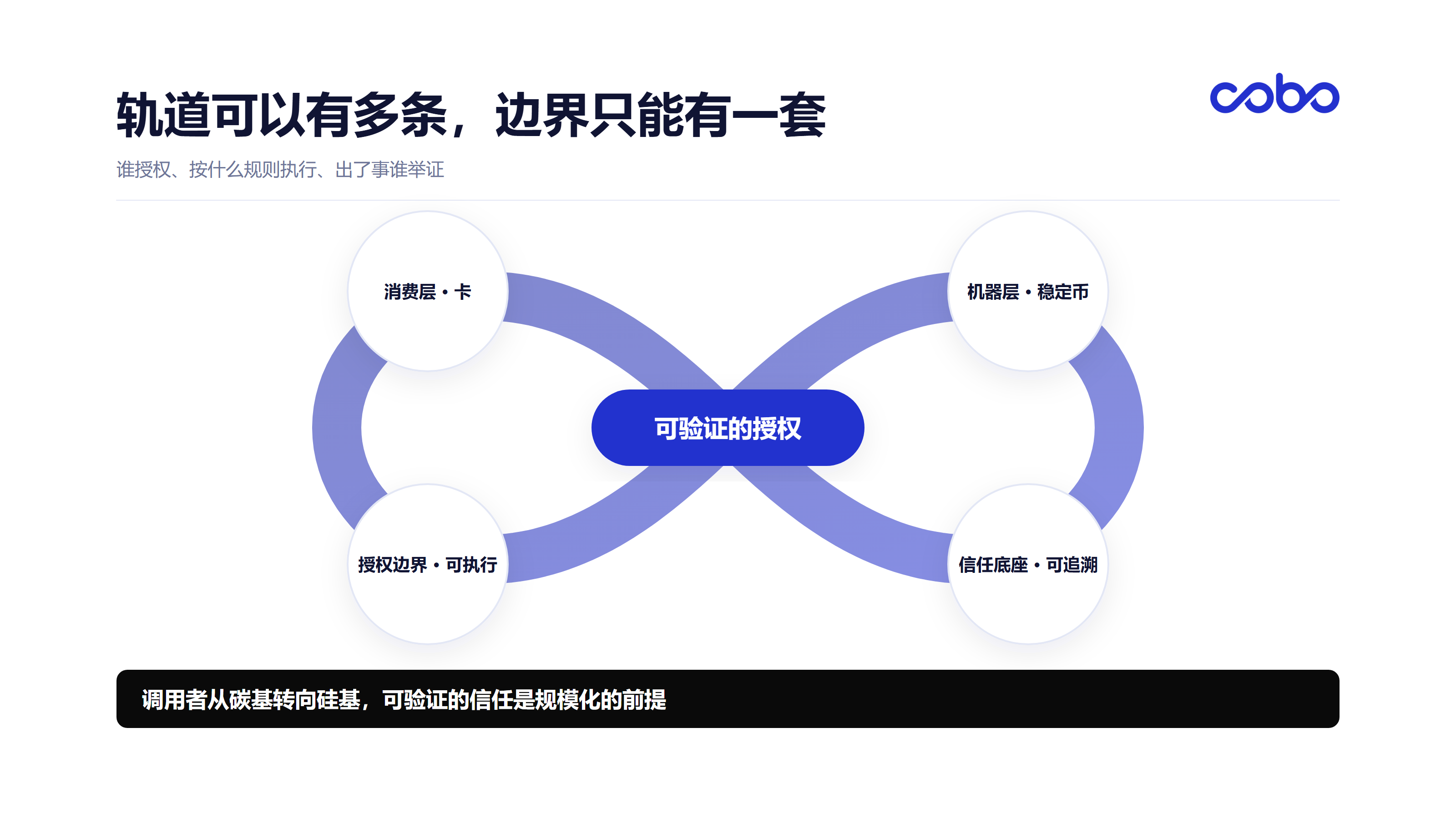
At the 2026 Payments Forum, Visa summarized this trend in one sentence: AI is changing the front end of commercial transactions, while stablecoins are reshaping the back end of fund flows.
The future of the Agentic Economy is likely not one payment method replacing another, but rather the gradual convergence of different payment instruments, protocols, and settlement networks.
3. Stablecoins Are Not the Only Choice, but Programmable Trust Infrastructure Is Essential
Returning to the debate from the opening: Do Agents really still need stablecoins?
The answer is actually very clear: Stablecoins are not the "only" way for Agents to make payments, but when transactions move toward openness, high frequency, and cross-entity collaboration, they provide a programmable settlement option suited to the Agentic Economy.
And the more fundamental question than payment methods is: when AI gains the ability to use funds, who ensures it does not exceed its authorized scope?
This may be more important than choosing which payment method to use.
Ordinary consumers using bank cards only need to manage their own accounts and spending behavior, but future enterprises may deploy multiple Agents simultaneously, responsible for procurement, trading, fund scheduling, supplier payments, and risk management respectively.
If every Agent has unrestricted wallet permissions, the enterprise is effectively distributing fund control to multiple automated programs. More complex still, even if servers are not breached and private keys themselves are not leaked, an Agent influenced by erroneous information or malicious instructions may still initiate payments exceeding the user's true intent within a legitimate transaction call flow.
Therefore, the core of Agentic Wallet is not simply assigning a wallet or a bank card to AI, but rather separating AI's autonomous execution capabilities from the enterprise's fund control.
Take the design of Cobo Agentic Wallet as an example. To enable multiple Agents to autonomously use funds within controllable boundaries, a layered mechanism from key management to transaction authorization needs to be established.
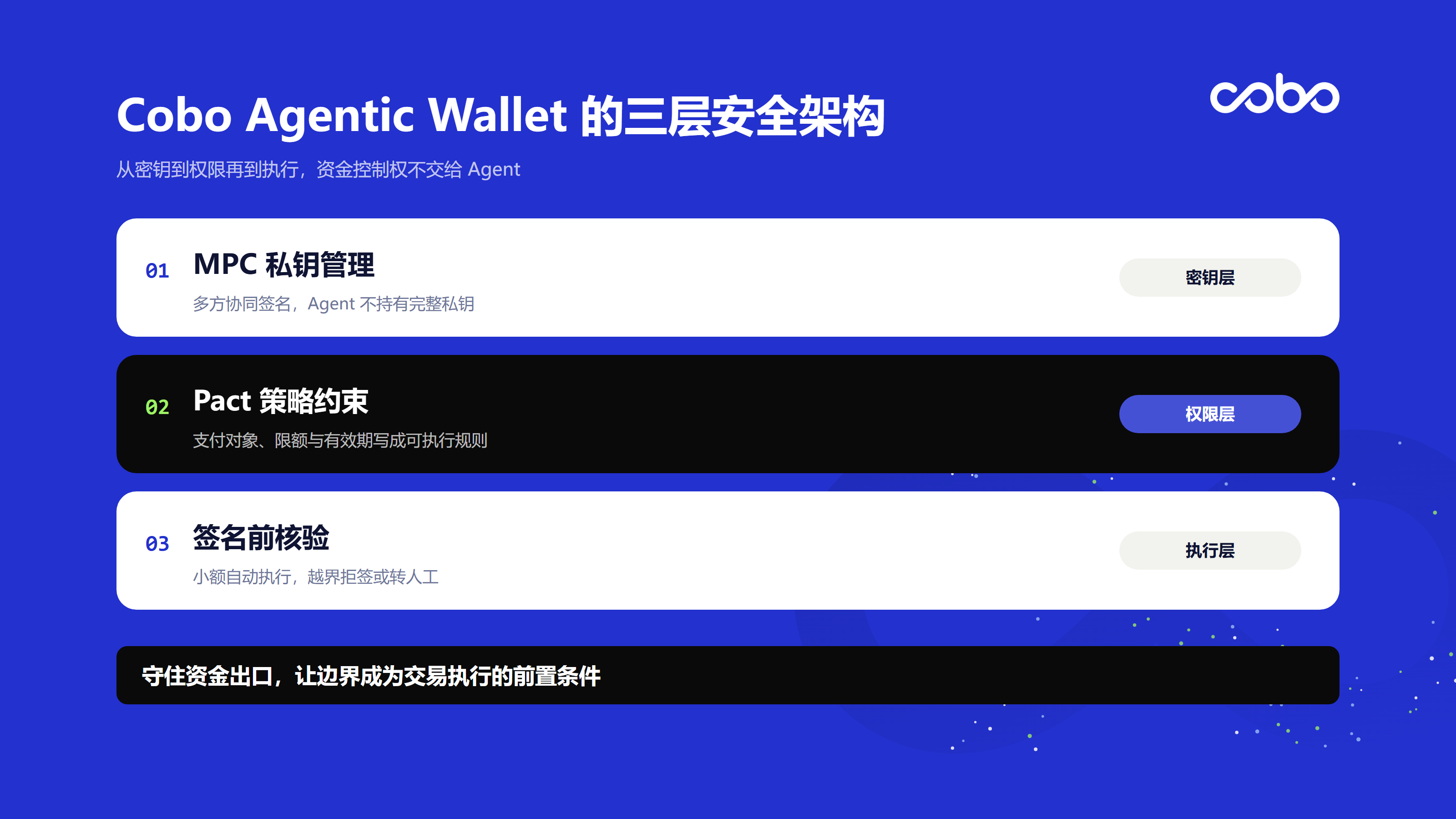
The first is MPC (Multi-Party Computation) to separate signing rights and avoid single points of control. Cobo Agentic Wallet further designed two sets of signing participation mechanisms: Agent + Cobo handles automated transactions within the authorized scope, while Human + Cobo handles high-value approvals and governance operations. No single participant can independently complete a signature.
The second is Pact, which delineates the Agent's action boundaries through task contracts. The Pact authorization framework introduced by Cobo transforms each task into an authorization protocol with executable constraints at the underlying infrastructure level, primarily containing four elements:
- Operation intent: what goal the Agent is authorized to accomplish;
- Execution plan: through which steps the Agent plans to complete the task;
- Policy constraints: permitted budgets, transaction counterparties, chains, tokens, contracts, and approval rules;
- Completion conditions: when the task is completed, the budget is exhausted, or the validity period ends, authorization automatically terminates.
The Agent first generates a Pact draft based on user instructions, which is then reviewed and approved by the user. After the task is initiated, each transaction is verified against the rules in the Pact, and only operations fully compliant with the authorized scope will trigger the Cobo co-signing node to approve.
This fundamentally changes the way traditional AI security relies on natural language instructions. In the past, we were accustomed to using Prompts to tell AI what it can and cannot do, but large models' understanding of natural language always carries uncertainty. By implementing permission constraints at the wallet and signing infrastructure level, security rules are no longer just "suggestions AI should follow" but become hard prerequisites for transactions to be executed.
Finally, beyond key management and permission constraints, Agents also need reliable execution paths. Cobo encapsulates common on-chain tasks into predefined execution templates through Recipes, covering contract interactions, parameter limits, and operational flows—for example, Agents can use corresponding Recipes to complete Uniswap trades, Aave deposits, Superfluid streaming payments, and call paid APIs that support x402.
If MPC addresses who can sign, and Pact addresses what the Agent can do, then Recipe addresses how the Agent should reliably complete tasks. These three correspond respectively to key security, permission control, and execution reliability, together forming the foundational security framework for Agents using funds.
Of course, from Agent wallets to enterprise payments, a complete financial operations system is actually also needed. Lucas also proposed a rather practical enterprise onboarding approach—enterprises can choose stablecoin payment infrastructure from two dimensions.
One dimension is the asset management method, i.e., third-party custody or self-custody; the other dimension is the system integration method, i.e., standardized payment pages, or embedding into existing business systems through APIs and SDKs. The two sets of choices can be flexibly combined based on the enterprise's business needs, technical capabilities, and compliance requirements.
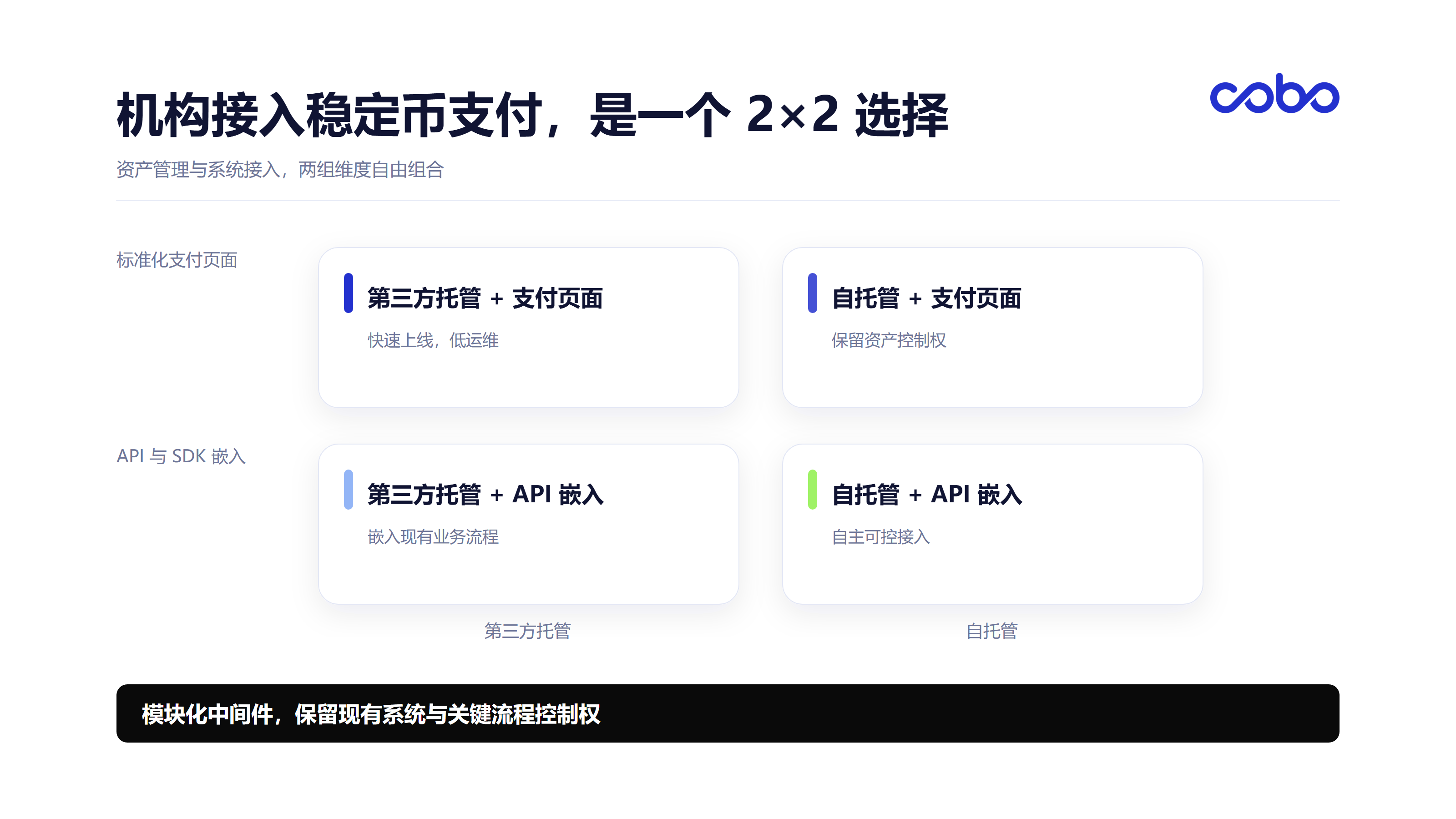
This modular approach means that traditional payment institutions do not have to choose between fully relying on third-party service providers and building on-chain systems from scratch. Instead, they can retain existing payment systems and key business processes while integrating the required on-chain asset management and payment capabilities.
From this perspective, the financial infrastructure required by the Agentic Economy is no longer just a wallet or payment channel, but a system composed of key management, permission control, payment protocols, fund settlement, compliance screening, and financial operations.
Final Thoughts
The emergence of ChatGPT Wallet is instead a signal that the Agentic Economy is beginning to enter the real commercial system.
On the mass consumer side, bank cards and mature card organizations still hold irreplaceable experience and trust advantages; for API calls, data purchases, computing power leasing, and machine-to-machine transactions, stablecoins and other programmable payment methods offer new possibilities.
Future Agents will not be limited to a single payment instrument—they may complete consumption through bank cards, use stablecoins to purchase on-chain services, and complete enterprise settlements based on bank accounts.
So stablecoins may not necessarily replace Visa, and the Visas of the world may not necessarily take over everything—but as long as Agents begin to become participants in economic activity, the programmable capabilities offered by blockchain will become an optimal settlement choice beyond Visa's existing system.
However, regardless of which channel funds flow through, when the callers of assets shift on a large scale from "carbon-based humans" to "silicon-based intelligent agents," verifiable identity authorization, programmable risk control boundaries, and a traceable trust foundation will always be the prerequisites for whether the Agentic Economy can achieve scale.