US Stocks Daily | US healthcare stocks hit hard by policy, UnitedHealth plunges 10%, Anthropic's record-breaking IPO lists tonight (November 19)


- Core View: The Fed's hawkish rate-hike signal has pushed the 10-year Treasury yield above 5%, becoming the dominant variable weighing on growth stocks and crypto asset valuations. Its impact has overshadowed geopolitical risks, with the market exhibiting a "rates > geopolitics" pricing logic.
- Key Elements:
- The 10-year Treasury yield stands at 5.064%, having remained above 5% for 27 consecutive trading days; Waller said a 50-basis-point "market-shocking" rate hike may be needed, with a December FOMC hike expected.
- Healthcare stocks were hit by CMS's new anti-fraud audit rules, with UnitedHealth falling 10.21%, dragging the Dow down 561.25 points; policy risk has expanded from drug pricing to claims auditing.
- Nvidia's Q3 revenue of $115.8 billion, up 106% year-over-year, beat expectations, yet the stock still fell 2.90% to near its 52-week low, signaling that AI trade crowding has peaked.
- Anthropic prices at $83, raising approximately $81.3 billion, and lists on Nasdaq today — potentially the largest IPO in history, while also acting as a liquidity siphon.
- Of 25 major crypto treasury companies, 24 have mNAV<1; the share-issuance-to-buy-BTC model has failed, creating a negative feedback loop; MSCI will remove Strategy from its indexes, and passive fund outflow pressure is emerging.
- BTC has fallen for six consecutive weeks, breaking below its 200-week moving average and down about 50% from its all-time high; spot Bitcoin ETFs saw a single-day net outflow of $239.9 million.
1. Top Headlines
- Health insurance stocks hit by policy blow; a single stock drags down the Dow: CMS proposed new anti-fraud audit rules for Medicare Advantage (the market calls it the "CRUSH" rule). UnitedHealth (UNH) closed down 10.21% at $349.91, while Humana and Elevance also fell sharply; the Dow closed down 561.25 points. Interpretation: Health insurance is one of the highest-weighted sectors in the Dow. The policy risk has expanded from "drug pricing" to "claims auditing"—a structural valuation shock rather than a one-off event.
- Nvidia's earnings beat but fail to lift its own stock: Q3 revenue of $115.8 billion, up 106% year-over-year, with Q4 guidance of about $130 billion—both above market expectations. Yet NVDA closed down 2.90% at $150.96, approaching its 52-week low of $148.80. Interpretation: This is the first earnings report since Jensen Huang stepped down as CEO. "Good results but no stock gains" is a classic signal that AI trade crowding has peaked.
- Anthropic prices at $83, raising about $81.3 billion: 980 million shares issued, consistent with price × share count; if the fundraising size is accurate, it would be the largest IPO in history, listing on Nasdaq today (11-19) under the ticker ANT. The $1.51 trillion total valuation figure cited by media has not been independently verified against the prospectus, and this publication does not adopt it. Interpretation: This is both a repricing of the AI capex narrative and a short-term liquidity siphon—the market is using "crypto capital flowing to Anthropic" as one explanation for BTC's weakness.
- Fed signals "another rate hike": Waller said a "shock the market" 50-basis-point hike may be needed, and the October meeting minutes show "almost all officials expect further rate hikes." The 10-year Treasury yield is 5.064%, having stayed above 5% for 27 consecutive trading days. Why it matters: Pressure on the discount-rate side remains unresolved, capping valuations for growth stocks and crypto assets.
- Iran attacks Kuwait and Bahrain; Hormuz tensions escalate: The U.S. expanded its blockade of Iranian oil to offshore transshipment, and Trump said a "dirty bomb" plot targeting Washington is under investigation. Interpretation: Risk premiums for energy and shipping remain, but gold prices and energy stocks fell that day, indicating that the dominant variable is currently interest rates rather than geopolitics.
2. U.S. Stock Market and Macro
2.1 The Three Major Indexes (U.S. Eastern Time, 2026-11-18 Close)
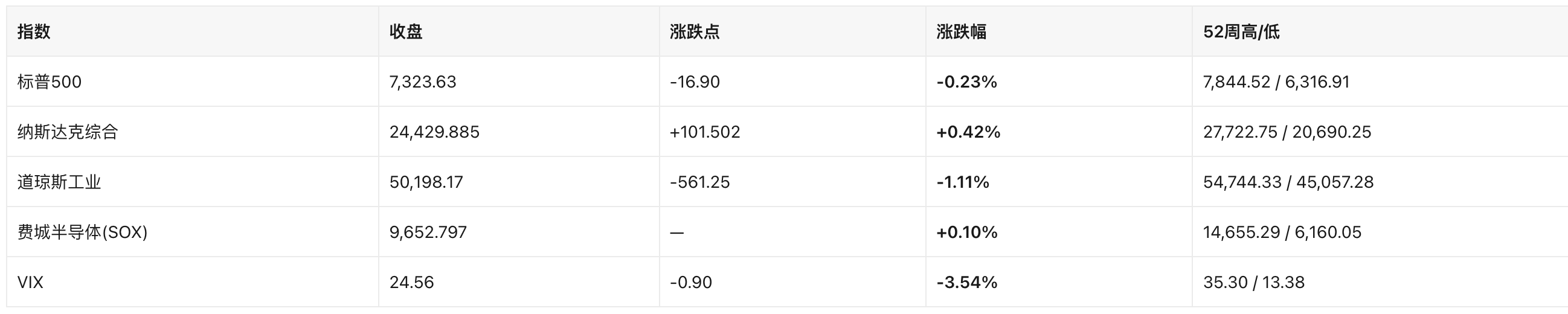
- Core driver: Divergence rather than a broad selloff. Drags came from health insurance (XLV -2.20%) and energy (XLE -3.27%); support came from consumer discretionary (XLY +1.79%), technology (XLK +0.34%), and communications (XLC +0.30%). Russell 2000 (IWM) +0.40%, and the Nasdaq ended a four-day losing streak.
- Sector overview: XLY +1.79%, XLK +0.34%, XLC +0.30%, XLU +0.30%, XLRE +0.07% / XLI -0.06%, XLP -0.31%, XLB -0.75%, XLF -1.14%, XLV -2.20%, XLE -3.27%.
- The S&P 500 has fallen 6.6% from its October 6 high of 7,844.52; the Philadelphia Semiconductor Index is down about 34% from its 52-week high, with AI hardware being the deepest-hit area in this correction.
2.2 Macro Data and the Fed
- October retail sales: +0.2% month-over-month, in line with expectations (prior revisions vary), and +6.8% year-over-year. Consumer resilience remains but momentum is slowing.
- Inflation backdrop: October CPI 3.7% year-over-year; October PPI +0.3% month-over-month and 6.5% year-over-year, the highest in nearly four years.
- Fed: Minutes from the October 27-28 meeting (released 11-18) show "almost all participants expected further rate hikes"; Governor Waller said that day "we may need to shock the market with 50 basis points" and noted risks of inflation expectations becoming unanchored.
- Next meeting: FOMC on December 8-9 (including the Summary of Economic Projections); the market broadly expects a rate hike.
- Treasuries: 2Y 4.796%, 5Y 4.882%, 10Y 5.064%, 30Y 5.409%, with the curve steepening slightly. The 20-year Treasury auction cleared at 5.459% with solid demand, giving the long end some breathing room.
- Dollar: DXY 103.863, essentially flat, just a step away from its 52-week high of 103.864; media called it a 19-month high.
- Commodities: WTI December contract (expiring 11/20) settled at $83.26, down 2.87% from $85.72 on 11/17; Brent January contract settled at $91.95, down 0.53%. Note: Yahoo's WTI continuous contract has rolled to January ($82.44, +0.16%), which carries a roll spread versus the December contract and should not be treated as a single-day move. Gold (December) $3,751.40, +0.25%, near its 52-week low of $3,727.40, having hit a 14-month low at one point this week.
3. Hot Stocks and Sectors
1. UnitedHealth (UNH) — $349.91, -10.21%
CMS's proposed anti-fraud rule would require more intensive third-party audits of Medicare Advantage claims, and the market fears both higher loss ratios and compliance costs; Senator Warren also publicly criticized large insurers for "taking a cut at every step." UNH has fallen more than 10% over two days, and at $349.91 it is now well below its 52-week high of $461.62.
Transmission: Policy risk has expanded from "drug prices" to "audits," pulling down the valuation center of the health insurance sector; the impact on the Dow is especially large (one of the highest-priced components in the price-weighted index).
2. Nvidia (NVDA) — $150.96, -2.90%
Q3 revenue of $115.8 billion (+106% year-over-year) and Q4 guidance of about $130 billion both beat expectations; this is the first earnings report since Jensen Huang stepped down as CEO, and the board has made clear it does not intend to bring him back. The stock surged intraday before pulling back to close near its 52-week low (52-week low $148.80, high $243.37).
Market expectations: The earnings have proven that demand has not collapsed, but "results delivered ≠ stock rises" shows that capital is repricing the discount rate for AI hardware (a direct consequence of a 10Y above 5%).
3. Advanced Micro Devices (AMD) +5.31%, Broadcom (AVGO) +3.65%, Amazon (AMZN) +3.82%
After Nvidia's earnings confirmed AI demand, capital rotated into "non-Nvidia" beneficiaries: AMD closed at $530.14, AVGO at $354.05. Another driver for AMZN was the revaluation of its stake—its $18 billion Anthropic investment is worth about $159 billion at the IPO price; after the IPO, Amazon and Google together hold about 28% of Anthropic.
Transmission: The AI narrative is spreading from "selling shovels" to "holding platforms," but it relies heavily on private-market valuation anchors.
4. Energy Sector (XLE -3.27%): ExxonMobil -3.97%, Chevron -3.95%, Occidental -4.88%
Although crude oil fell less than energy stocks (Brent -0.53%, WTI -2.87%), energy stocks were still the weakest sector of the day; the combination of rising EIA weekly inventories and the Iran situation "striking without breaking" cooled the market's pricing of a sustained supply disruption.
Uncertainty: If the geopolitical premium is repriced, this sector has the most upside elasticity; it is currently a "two-way, event-driven risk."
5. Walmart (WMT) — $127.36, -0.13% (pre-earnings)
Q3 earnings will be released before the market opens today (11-19), with the market expecting revenue to grow about 5% year-over-year. This is one of the key readings this week for gauging U.S. consumer resilience, and it also corroborates yesterday's +0.2% retail sales. Also reporting pre-market the same day are Alibaba (BABA, $84.37, -2.63%), Pinduoduo (PDD), and NetEase.
6. Anthropic (ANT) — First Day of Trading on Nasdaq Today
$83 per share, 980 million shares, corresponding to about $81.3 billion raised (consistent with price × share count); the $1.51 trillion total valuation figure cited by media has not been independently verified against the prospectus, and this publication does not adopt it; if the fundraising size is accurate, it would be the largest IPO in history.
Market expectations: First-day performance will directly determine short-term risk appetite and will also spill over into sentiment for Nvidia, AMD, AMZN, and GOOGL; the reverse risk is that the massive fundraising drains liquidity from the secondary market.
4. Crypto-Related U.S. Stocks
4.1 DAT Leader: Strategy (MSTR)

- Key change: The company has shifted from "issuing shares to buy coins" to "issuing shares to buy back preferred stock"—STRC perpetual preferred has fallen below its $100 par value (at one point trading at $95), and maintaining the preferred price has become the top priority. This means common shareholders face higher dilution costs, while the pace of coin purchases has slowed significantly (weekly purchases down about 59% from the previous round).
- Index event: MSCI's November index review will remove Strategy from its global investable market indexes, effective after the close on November 30, 2026 (under the new "non-operating company" rule), with Metaplanet also removed. Passive fund outflow pressure will be concentrated in the two-week window before the effective date.
- Analyst divergence: Cantor Fitzgerald has a long-term target of $208; a technical analyst warns the stock could fall to $23 (-75%). The nearly 9x gap shows that the valuation anchor has shifted from "holdings premium" to "financing sustainability."
- Another signal: The New York State pension fund increased its MSTR stake by more than 10% in Q3, and BlackRock holds 123,056 shares (as of before the MSCI removal).
4.2 Other DAT / Corporate Treasury Developments

- Industry-level signal: According to statistics from multiple media outlets, 24 of the 25 large crypto treasury companies now have market caps below the value of their holdings (mNAV < 1). The financing window closes → the model of issuing shares to buy coins fails → the only options are selling coins to repay debt or buying back preferred stock. This negative feedback loop is the core mechanism behind the valuation selloff in the DAT sector this round.
- No new watchlist names: As of this briefing, no new U.S.-listed company has announced the establishment of a BTC/ETH treasury in the past 24-48 hours; the only related new face recently is Super League (SLE, $3.64, -5.94%)—Metaplanet plans to take a 93.7% controlling stake to transform it into a U.S. version of a Bitcoin treasury platform ("Superplanet"). The company has hired Jesse Myers as Chief Investment Officer and increased its holdings to 39 BTC. This transaction is an advancement of a matter announced in October, not a new addition to the list.
4.3 Broad Crypto U.S. Stocks
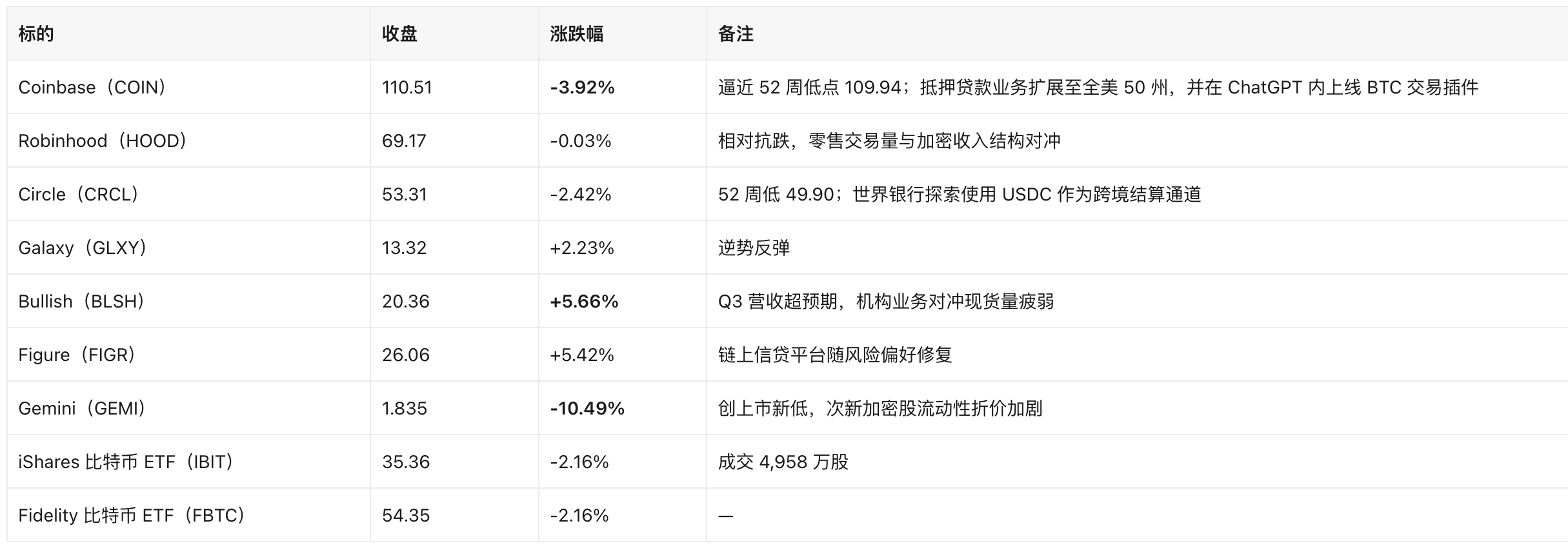
ETF flows: U.S. spot Bitcoin ETFs saw combined net outflows of $239.9 million on November 17, with IBIT alone seeing $209 million in single-day net outflows. Official flow data for November 18 has not yet been released and is therefore not cited. ETF buyers who built positions in Q3 are currently sitting on losses of about 20%.
4.4 Miners and AI/HPC Transformation (Strongest Sub-Sector of the Day)

Logic: With both coin prices and hash-rate revenue weak, miners' valuation anchor has shifted from "Bitcoin beta" to "power and rack assets." The fact that RIOT/MARA/CIFR rose on the same day BTC fell is direct evidence of this divergence.
4.5 Regulatory and Accounting Drivers
- Legislation: The CLARITY Act is stalled in the Senate (not scheduled on the lame-duck agenda), and Bernstein judges that the SEC and CFTC will pivot to rulemaking; the confirmation hearing for the new SEC commissioner is pending.
- Index rules: MSCI's restriction on "non-operating companies" is the most important accounting/index-level change this month, directly triggering passive selling in Strategy and Metaplanet.
- Stablecoins: The World Bank is exploring a USDC cross-border settlement channel; Zelle is testing ZelleUSD private transfers on Solana.
5. Crypto Market

- Technical levels: BTC has fallen for six consecutive weeks, breaking below its 200-week moving average (weekly declines reached 12%-14% at one point), down about 50% from its all-time high; the top 25 crypto treasury companies by market cap are broadly trading at discounts, and CryptoQuant says the market has entered a "value zone" but has not confirmed a reversal.
- Sentiment and liquidity: Glassnode notes that capitulation selling and realized losses are rising in tandem; Kalshi traders price about a 21% chance of "falling below $50,000 this year." The market cites the liquidity drain from the Anthropic IPO as one explanation, but analysts quoted by CoinDesk argue that this attribution is "easy to believe but does not hold up."
6. Geopolitical Impact
1. U.S.-Iran Conflict and Hormuz (Escalating)
- Facts: Iran attacked targets in Kuwait and Bahrain (WSJ, 11-18); the U.S. expanded its blockade of Iranian oil to offshore ship-to-ship transfers (Oil & Gas 360); Trump said a "dirty bomb" plot targeting Washington is under investigation (as relayed by TradingView, related details have not been independently confirmed); the closure of Iraq's border threatens regional trade (OilPrice).
- Transmission: Conflict → crude risk premium → inflation expectations → steeper rate-hike path → higher long-end rates and a stronger dollar → pressure on growth stocks and crypto. The current anomaly: On 11-18, oil prices rose only slightly, energy stocks fell sharply, and gold stayed near a one-year low, indicating that the market's priority is "rates > geopolitics." If Hormuz transit is materially disrupted, that ranking would quickly reverse, and