US Stock Market Daily | Philadelphia Semiconductor Index Plunges 5.28%, Nvidia Falls Another 4.12% on the Eve of Q3 Earnings, Tomorrow's Pre-Dawn Hours Will Decide the AI Sector's "Fate" (November 17)

This article is about 5969 words, reading the full article takes about 9 minutes
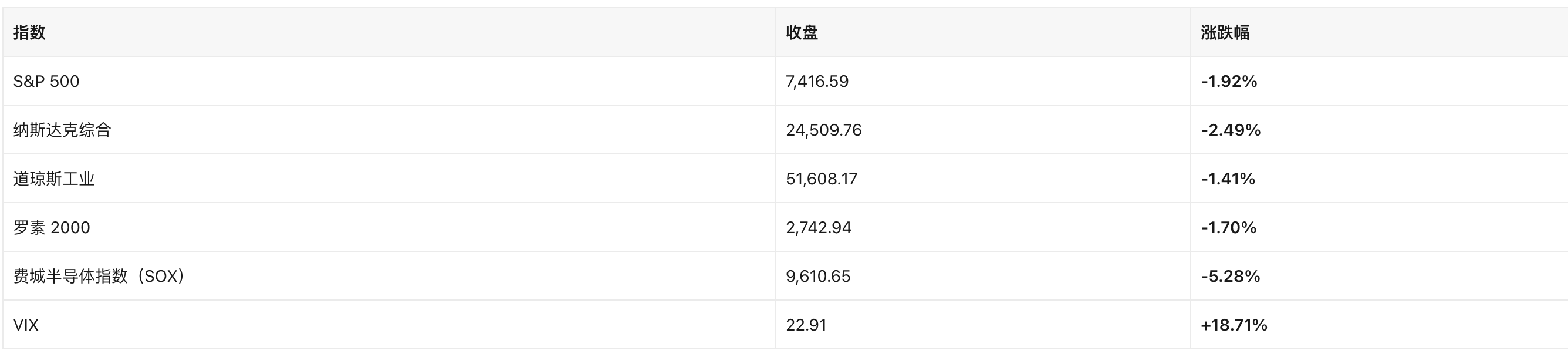
All three major indices fell together, with the Nasdaq down 2.49%, the Philadelphia Semiconductor Index down 5.28%, and Nvidia down 4.12%, as the market continued to reduce positions ahead of the first earnings report since Jensen Huang's departure; PPI at 6.5% year-over-year pushed December rate hike expectations above 90%, and the 10-year Treasury yield stood at 5.121%. Crypto-related US stocks came under pressure: Strategy added 485 BTC to reach 850,849, MSTR fell 7.70%, and Bitcoin ETFs saw net outflows of $1.07 billion. Watch for Nvidia's earnings and October retail sales data the next day.

AI Summary
- Key Takeaways: Nvidia CEO's departure triggers a governance crisis, compounded by CPI/PPI beating expectations and pushing December rate hike probability above 90%; the AI capex narrative and risk asset pricing simultaneously enter an earnings verification period, weighing on Bitcoin and crypto-related US stocks.
- Key Elements:
- Nvidia releases its first post-departure earnings report after market close on November 17, with market expectations of $108 billion in revenue; the Treasury Secretary has called for hiring an external CEO and questioned sales to China—the results will determine the direction of the AI sector.
- October CPI rose 0.4% month-over-month and core CPI rose 0.3%, both beating expectations; PPI at 6.5% year-over-year hit a near four-year high; the dollar index touched a 19-month high, and gold fell to a one-year low.
- Anthropic priced its IPO on November 18, with Altimeter planning to invest $5 billion; the market worries that new share issuance will drain liquidity from the secondary market.
- BTC fell 14.8% for the week and ETH dropped 18.7%; $2 billion in forced liquidations occurred over the weekend, with BTC briefly dipping to $62,100.
- Strategy's holdings show an unrealized loss of $9.32 billion (-14.5%), with mNAV at approximately 0.79x—a 21% discount; MSCI removal forces passive funds to sell before November 30.
- The CLARITY Act failed to advance, with rulemaking authority returning to the SEC/CFTC, dashing expectations for a compliance premium for DAT companies.
- US spot Bitcoin ETFs saw net outflows for two consecutive weeks, totaling $1.91 billion over seven days; stablecoin market cap experienced its largest contraction since the Terra-Luna collapse.
1. Top Stories
- NVIDIA's leadership crisis enters the earnings verification period. The company announced a CEO transition on November 12, with Jensen Huang departing; Treasury Secretary Bessent publicly called for an outside hire as CEO and questioned whether China sales "propped up" results. NVIDIA will release its first post-departure earnings report after the bell on November 17, with market expectations of $108 billion in revenue (Yahoo Finance/StoneX). Interpretation: This is the single-point risk to whether the AI capex narrative can continue, and it is also the current pricing anchor for risk assets such as Bitcoin.
- US Treasury yields and rate-hike expectations rise in tandem, pressuring risk-asset valuations. Last week's October CPI came in at +0.4% MoM and +0.3% core (both above expectations; due to the data gap caused by the 2025 shutdown, BLS did not release YoY readings), while PPI rose 6.5% YoY (the highest in nearly four years). The market has priced the probability of a December rate hike above 90%; the dollar index hit a 19-month high, and gold fell to a one-year low.
- AI primary-market liquidity drain adds to the pressure. The Anthropic IPO is scheduled to price on Wednesday (November 18), with Altimeter planning to invest $5 billion. The market worries that the massive new share issuance will siphon liquidity from the secondary market, with the Nasdaq and crypto assets weakening simultaneously.
- Strategy continues "small" Bitcoin purchases, but capital is prioritized for preferred stock. It bought 485 BTC between November 9-15 ($33.4 million, average price $68,887), while repurchasing $228.1 million of STRC preferred stock over the same period; MSTR fell 7.70%.
- The CLARITY Act failed to advance. Trump's former crypto advisor said the bill "lost to time," with rulemaking authority returning to the SEC/CFTC; the Senate-level battle continues.
2. US Stock Market and Macro
2.1 Closing Levels of the Three Major Indices (US Eastern Time 2026-11-16 16:00)
2.2 Macro Data and the Fed
- October CPI: +0.4% MoM and +0.3% core, both above expectations; due to the data gap caused by the October 2025 government shutdown, BLS did not release YoY readings (the prior September YoY figure was 3.7%).
- October PPI rose +0.3% MoM and 6.5% YoY, the highest in nearly four years, with price increases spreading across a wider range of categories.
- Market pricing for a December rate hike has risen above 90%, with some institutions saying it is "fully priced." A Reuters October survey already showed that "the vast majority of economists expect the Fed to hold in October and hike in December."
- Fed Chair Warsh said Fed staff are studying three AI scenarios, including a sharp productivity boost, rising unemployment, and a "painful correction" in tech stocks; on November 16 he also warned that AI could "disappoint."
- Several officials will speak this week: 11-17 Barr, Williams, Warsh, Barkin; 11-18 Waller, Williams.
2.3 Rates, the Dollar, and Commodities

- Yields edged lower on Monday, but had surged to 5.17% the previous week; "the bond selloff is not over" remains the mainstream view.
- Reuters said the dollar hit a 19-month peak; Reuters also reported that gold fell to a one-year low and was set for its worst annual performance since 2015.
- Oil prices fell mainly because Trump said a new round of strikes on Iran was "unlikely," combined with recovering Middle East exports. This weakened energy stocks' inflation-hedge appeal.
2.4 Events and Uncertainties
- NVIDIA governance crisis → semiconductors → valuation discount: the CEO vacancy + China sales compliance review + the US Commerce Department tightening remote computing export rules have turned "AI hardware" from a certainty premium into a policy discount. The uncertainty lies in whether the earnings themselves can beat expectations, and who the new CEO will be.
- Sticky inflation → long-end rates → high-duration assets: a 10-year yield above 5% directly compresses the valuation denominator for growth stocks, while also squeezing the high-premium financing model of DAT companies.
- New share supply → liquidity → small caps and crypto: ahead of the Anthropic pricing, capital withdrew from high-beta assets, with the Russell 2000 and crypto-linked US stocks among the biggest decliners.
3. Hot Stocks and Sectors
3.1 NVIDIA (NVDA): $156.14, -4.12%
- Event chain: 11-12 company announces CEO transition → Treasury Secretary Bessent calls for an outside CEO and questions China sales → board reportedly rules out Jensen Huang's return → earnings released after the bell on 11-17.
- Market expectations: revenue of $108 billion; Fortune noted that rebuilding confidence requires "six things to go right at once," starting with $109 billion in revenue.
- Impact: NVDA has a market cap of $3.92 trillion and is one of the highest-weighted stocks in the S&P 500; its earnings results will determine the direction of the AI sector in the latter half of this week.
3.2 Semiconductor Sector: SOX -5.28%, SMH -5.11%
- Micron (MU) $719.02, -7.62%; Intel (INTC) $55.47, -7.02%; TSMC (TSM) $373.45, -6.34%.
- Additional bad news for Intel: NVIDIA reduced its stake, and shareholders filed a class-action lawsuit over "a 29% single-day drop caused by declining PC demand."
- TSMC's decline is related to "NVIDIA financing concerns."
- Transmission: cracks are appearing in the AI capex financing chain (customer financing → orders → foundry capacity), which is the core reason why semiconductors fell much more than the broader market this time.
3.3 AI Primary Market: Anthropic IPO
- Pricing on Wednesday (11-18); the founders' stakes are each worth $18 billion at the offering price; Altimeter plans to invest $5 billion.
- Impact: it is both a "confidence vote" for the AI narrative and a short-term liquidity drain; it creates a two-way disturbance for secondary-market AI stocks, with both a "relative valuation effect" and a "liquidity siphon effect."
3.4 Energy Sector: XLE -1.96%
- WTI settled down 3.21% at $85.72, mainly because Trump played down expectations of military action against Iran and Middle East exports recovered.
- Impact: energy stocks have lost short-term support from the "geopolitical premium"; if the Iran situation escalates again, this sector is the most direct beneficiary of a reversal.
3.5 Financials: JPMorgan (JPM) $338.21, -2.31%
- Software defects caused trading delays and a surge in outage reports. Even though a steeper yield curve should benefit banks, operational risk events are weighing on valuations.
3.6 Single-Stock Risk: Summit Therapeutics (SMMT) $11.82, -16.47%
- The biggest decliner among S&P components on the day. Single-stock biotech volatility is unrelated to the broader market, but it highlights how quickly the market is currently pricing in bad news.
Sector level: XLK -3.24%, XLF -0.85%, XLE -1.96%; tech significantly underperformed, while defensive sectors were relatively resilient.
4. Crypto-Linked US Stocks
4.1 DAT Leader: Strategy (MSTR) $103.03, -7.70%
SEC 8-K original text verification (filed 11-16, reporting period 11-14):
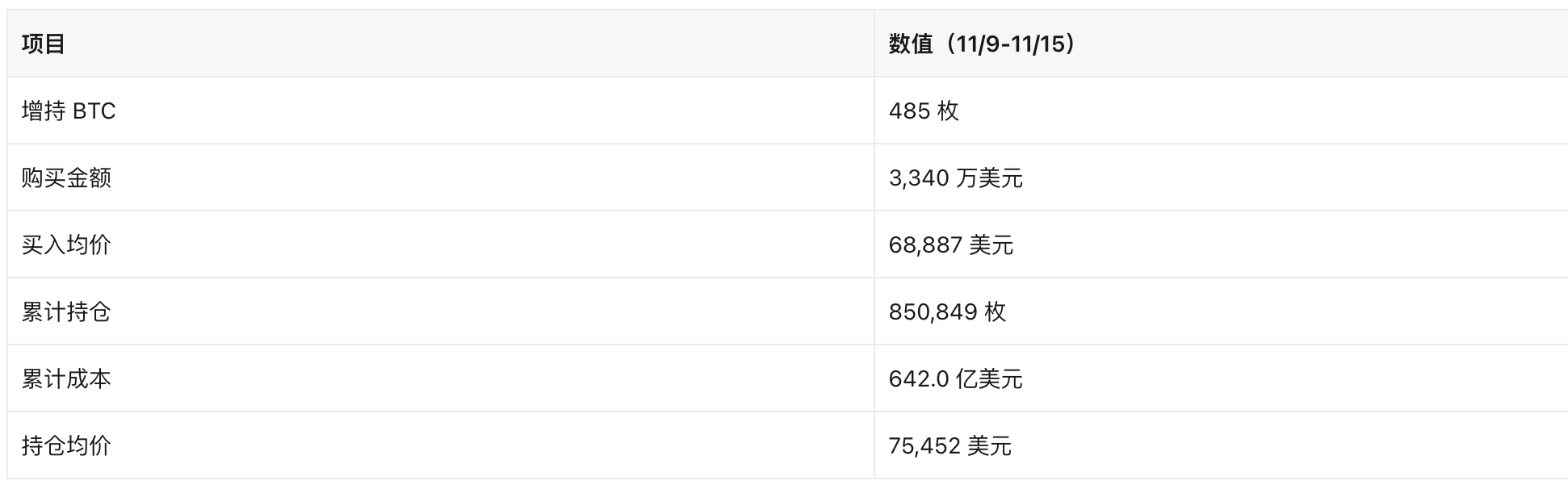
- Unrealized loss on holdings: based on BTC's latest price of $64,499, the holdings are worth $54.88 billion, $9.32 billion below the $64.20 billion cost basis (-14.5%). The average price of $75,452 is now clearly above the current price; this is the biggest mark-to-market pressure on the "buy more as it falls" model right now.
- mNAV (market cap / BTC holdings value) at about 0.79x: the Nasdaq interface's market cap field is stuck at 11-13 ($47.14 billion / $111.62, about 422.3 million shares); converted at that share count, the 11-16 close of $103.03 corresponds to a market cap of about $43.51 billion; 43.51 ÷ 54.88 = 0.79, a discount of about 21% (this measure excludes debt and preferred stock and is not standard EV/NAV).
- Financing structure shift: this week the ATM sold only 2,087,040 MSTR shares for net proceeds of $244.7 million; of that, $206.3 million was used to repurchase STRC preferred stock, only $33.4 million was used to buy Bitcoin, and $5 million was retained as cash. Over the same period it repurchased 2,282,510 STRC shares for $228.1 million. STRC's December dividend rate remains at 12%.
- Structural headwind: MSCI has confirmed that MSTR will be removed from its indices, and passive funds must sell by November 30; Metaplanet was removed in the same batch. This technical selling pressure, combined with the fundamental discount, is the main reason MSTR underperformed BTC this week.
4.2 Other DAT and Treasury Companies
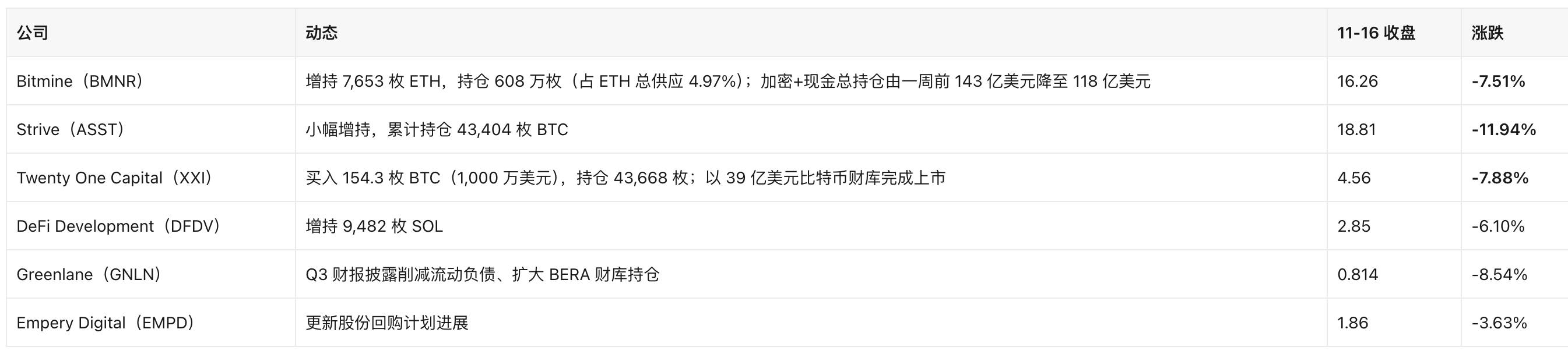
- XXI's accounting characteristics are worth noting: the vast majority of its Q3 net income of $1.087 billion came from BTC fair-value changes rather than operations; the stock price has already given back most of those gains from its high. This confirms how "fair value accounting standards" amplify the income statement volatility of DAT companies.
4.3 Crypto US Stock Watchlist Additions
- Twenty One Capital (XXI): led by Jack Mallers, it listed via a SPAC path with a $3.9 billion BTC treasury, making it the largest new DAT listing this period. Its lock-up arrangements and follow-on financing tools need to be tracked.
- Super League Enterprise (SLE, $4.09, +0.74%): announced the appointment of Bitcoin treasury operator Jesse Myers as incoming CIO, in conjunction with the previously announced Metaplanet deal to advance its "Bitcoin treasury" transformation; over the same period it raised $600,000 at $4 per share. This is a typical "small-cap transformation + backdoor-style partnership" path, with very small scale and high dilution risk.
- Greenlane (GNLN): a treasury strategy centered on BERA (Berachain), a differentiated sample of a non-BTC treasury; its sustainability needs to be watched.
4.4 Broad Crypto US Stocks
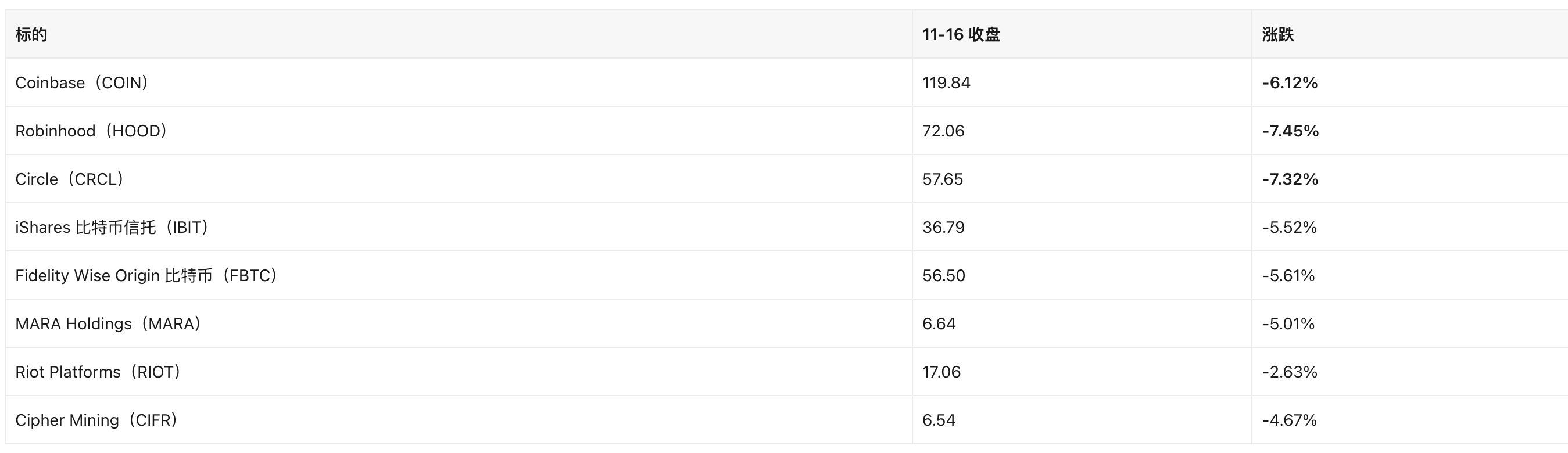
- ETF flows: last week (11/9-11/13), US spot Bitcoin ETFs saw net outflows of $1.07 billion, the second consecutive week of net outflows; as of 11/13 they had seen 7 consecutive trading days of net outflows, totaling $1.91 billion over the 7 days. IBIT saw cumulative outflows of $2.35 billion over two weeks, but remains net positive year-to-date. The 11-16 single-day data is disclosed on a T+1 basis and had not been published at the time of writing.
- Stablecoins: total stablecoin market cap saw its largest contraction since the 2022 Terra-Luna collapse; traders redeemed stablecoins as Bitcoin fell to a four-month low. Circle fell 7.32% on the day, consistent with its dual "rate-sensitive + shrinking scale" characteristics.
- Miners: NVIDIA's turmoil is testing miners' AI/HPC transformation financing plans. RIOT had the smallest decline (-2.63%); its relative resilience may be related to the share of its HPC business.
4.5 Regulatory and Accounting Drivers
- The CLARITY Act is stalled: the Senate failed to advance it during the session, and Trump's former crypto advisor Patrick Witt said it "lost to time," with rulemaking authority returning to the SEC/CFTC; Trump plans to meet senators on Thursday to try to break the deadlock. For DAT companies, this means expectations of a "compliance premium" have been dashed.
- Custodia loses its case: the Supreme Court rejected its request for direct access to a Fed master account, further narrowing the path connecting crypto institutions to the traditional banking system.
- Regulatory gap for tokenized stocks: several Democratic senators warned that the SEC's exemption for tokenized stocks poses illicit-finance risks.
- Exchange compliance progress: the CFTC supports blockchain-based derivatives infrastructure, and Backpack and tZERO received approval, among the few positive regulatory signals this week.
5. Crypto Market
- Weekly decline: BTC is down 14.8% cumulatively from its 11-06 close of $75,746.93; ETH is down 18.7% cumulatively from $2,235.05 on 11-06. ETH has fallen 28% over two weeks.
- Weekend deleveraging: the crypto market saw $2 billion in forced liquidations over the weekend, with BTC briefly dipping to $62,100 as traders began watching the $60,000 level.
- Attribution: Tom Lee attributed ETH's decline to the NVIDIA turmoil and cash-raising ahead of the Anthropic IPO, rather than deteriorating on-chain fundamentals.
- Security incidents: Binance was attacked (the specific scale has not been authoritatively confirmed; marked "unverified"); Trezor's shipping partner again leaked data on 27,000 orders; Luxor said mining pool hashpower was redirected by an AI attack. Such incidents will reinforce institutions' preference for "self-custody / external custody."
6. Geopolitical Impact
6.1 Russia-Ukraine: Escalation and Negotiation in Parallel
- Ukraine launched its largest drone attack on Russia since the war began; Russia said it intercepted more than 1,300; Ukraine hit the Kerch Bridge in Crimea.
- The EU accused Russia of delaying peace talks to strike Ukraine's power facilities, raising winter energy risks.
- Transmission: upside risk to European natural gas and electricity prices → US LNG exports and energy stocks benefit; safe-haven flows go to the dollar and short-end Treasuries, which is negative for long-duration growth stocks. The current pullback in oil prices shows the market has not yet priced in a "winter energy shock."
6.2 Iran: Military Deployment and "Dirty Bomb" Intelligence
- A third aircraft carrier arrived in the Middle East, and the Trump administration is evaluating options on Iran.
- CNN exclusively reported that US intelligence shows Iran is planning a potential "dirty bomb" operation — single source, unverified.
- But Trump publicly said a new round of strikes was "unlikely," so oil prices fell. Directional judgment: the geopolitical premium is being actively suppressed in the short term; once the rhetoric reverses, crude oil and defense sectors will reprice quickly.
6.3 US Tightens Chip Controls on China Again
- The Commerce Department closed the "remote access" loophole, restricting China from using top US AI chips through overseas data centers, and added Singapore and Malaysia as key focus areas.
- For NVIDIA, this means China revenue recognition will
US stocks
Welcome to Join Odaily Official Community


Recommended Articles