AI Infrastructure Stocks Shed $4.2 Trillion: Is the "Shovel-Selling Feast" Over?


- Core Viewpoint: The AI "shovel-selling" trade has reversed sharply, with global manufacturing, utilities, and mining companies shedding $4.2 trillion in market value since June, as capital markets undertake a systematic repricing of the "everything is a growth stock" narrative.
- Key Elements:
- The industrial sector has become the second-worst performing S&P 500 sector since this summer, with the more closely a company is tied to data centers, the steeper its decline.
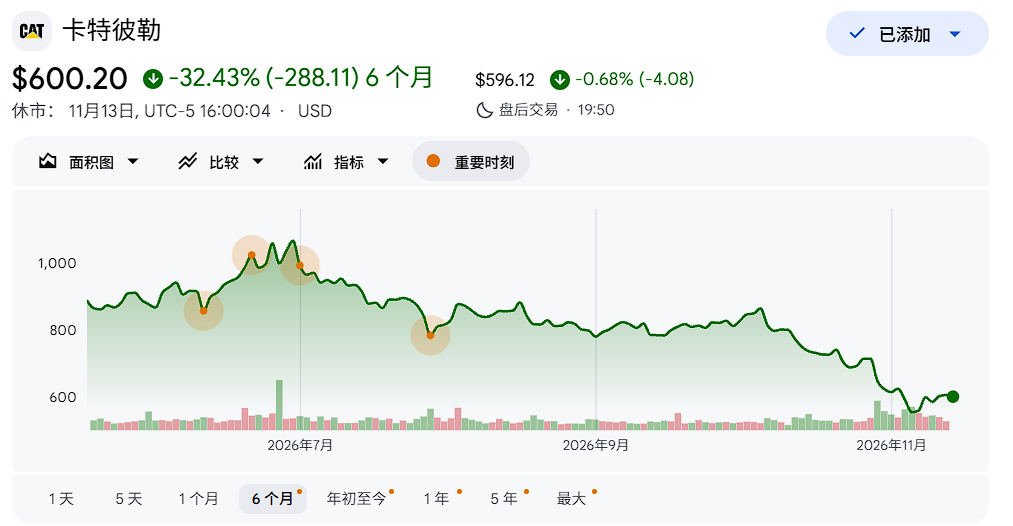
- Caterpillar shares are down 44% from their June high, erasing $214 billion in market value; Oklo, Corning, and others have each lost roughly half their market value.
- Institutional capital "flooding in blindly" pushed valuations higher, and the stock market is now converging with risk signals the credit market had already flagged.
- Fundamentals remain solid: annual U.S. data center construction spending reaches $96 billion, and Caterpillar's backlog hit a record $78 billion.
- Post-midterm-election regulatory uncertainty has heightened volatility, but broad restrictions on construction are unlikely, and demand may shift to more permissive regions.
Author: Dong Jing
Source: Wallstreetcn
Global manufacturing, utility, and mining companies have collectively shed $4.2 trillion in market value since June of this year. This sell-off has erased nearly half of the $9.4 trillion in gains these companies accumulated over the previous 12 months, and the once-favored AI "pick-and-shovel" trade is rapidly reversing.
According to an analysis by the Financial Times, the more closely a company is linked to data center construction in media coverage, the more brutal the hit it has taken. Investor confidence in the AI boom is wavering—from gas turbine makers supplying hyperscale data centers to high-end fiber optic companies needed to connect AI server racks, former market darlings are now being sold off across the board. The industrials sector has become the second-worst performer in the S&P 500 since this summer, trailing only technology.
The market shift reflects broader concerns: hyperscale cloud companies continue to ramp up capital expenditures funded by debt, compounded by growing political resistance to data center construction within the US, leaving investors questioning whether the buildout boom can be sustained.
Market Caps of Industry Leaders Halved
Caterpillar, a major supplier of gas turbines for data centers, has fallen more than 30% over the past six months. Since its stock hit an all-time high on June 30, its market value has shrunk by $214 billion, a decline of 44%.
In addition, nuclear power company Oklo, despite signing a power supply contract with Meta in January of this year, has seen its stock plunge 49%. HVAC system manufacturer Comfort Systems and fiber optic maker Corning both lost roughly half their market value over the same period.
According to the Financial Times, Brett Ryan, senior US economist at Deutsche Bank, said a flood of institutional money had "blindly piled into" these trades, "which may have contributed to overly optimistic valuations for some companies." He also noted that the stock market is now "catching up to signals the credit market had already sent"—the latter having long warned about the growth of riskier financing in data center construction.
Venture capitalist and MIT researcher Paul Kedrosky was blunt: investors treating traditional industrial companies like semiconductor stocks is a mistake in itself.
"In discussions with hedge funds and family offices, the 'everything is a growth stock' narrative is everywhere—which is, of course, absurd."
Yet despite the stock price pressure, the operating fundamentals of many companies remain solid. The latest US government data shows that in the 12 months through September, US data center construction spending (excluding IT equipment and chips) reached $96 billion.
Third-quarter results also confirmed the resilience of demand. Caterpillar reported a record backlog of $78 billion, with its power generation business sales up 75% year-over-year, driven primarily by data center demand. Siemens' electrical equipment backlog from data centers grew 60% in 2026 to €7 billion; Eaton's comparable orders doubled year-over-year. Several gas turbine manufacturers said they had secured billions of dollars in orders in the first nine months of 2026.
Alex Cordovil, an analyst at Dell'Oro Group, said, "In terms of revenue fundamentals and underlying earnings prospects for these companies, we still see very strong expectations." He added that broader macro trends such as electrification and supply chain restructuring continue to underpin the core businesses of many industrial companies. "Construction has not slowed... backlogs are at historic highs, which means revenue growth is essentially locked in through at least 2027."
Richard S Warzala, CEO of industrial control equipment manufacturer Allient, said on the November 5 earnings call that demand for AI will not decline.
"Even if a moratorium is imposed on new data center construction, projects already underway must be completed."
Kedrosky, however, is skeptical of the backlog data, viewing it as a lagging indicator that reflects past expectations rather than current real demand. He noted that companies are "double- and triple-ordering"—stockpiling excess inventory to secure a place in line amid perceived supply shortages.
Brett Ryan's assessment is more direct: the stock market is completing a delayed valuation correction, aligning with risk signals the credit market had already transmitted. This months-long adjustment, which has wiped out more than $4 trillion in market value, is essentially a systemic repricing by capital markets of the "everything is a growth stock" narrative.
Regulatory Uncertainty After the Midterms
Another important backdrop to this sell-off is the uncertain direction of data center regulation following the US midterm elections. In this month's midterms, proposals to restrict data center construction won broad support from US voters, though their practical impact remains unclear.
Citi Research noted in a post-election report that while stricter regulation is expected to bring more volatility to the data center industry, the likelihood of widespread construction restrictions remains low.
Joseph Dominguez, CEO of Constellation Energy, said the post-election market reaction is an "overreaction," emphasizing that Democrats "care deeply" about protecting blue-collar jobs at data centers.
Deutsche Bank's Ryan believes that even if some regions impose bans, it would only shift construction demand to areas with looser regulation.
"Ultimately, if there is market demand for these facilities, they will be built somewhere."