US Stocks Daily | Jensen Huang Resigns as NVIDIA CEO, NVDA Plunges 14.4% Intraday, Nasdaq Falls 0.39%, US Treasuries See Weak Demand as Long-End Yields Stay Elevated (November 13)


- Key Takeaways: Jensen Huang's resignation as NVIDIA CEO triggered the first instance of "key-person risk" in the AI trade being directly priced in by the market. Combined with CPI beating expectations, which pushed the probability of a December rate hike to 87%, and MSCI's removal of Strategy taking effect, global risk assets deleveraged in unison, leaving the crypto market short of marginal buyers.
- Key Elements:
- Jensen Huang resigned immediately, with CFO Kress serving as interim CEO. NVDA fell as much as 14.4% intraday and closed down 4.34%, while AMD rose 5.86% and AVGO rose 5.54%, reflecting intra-sector share revaluation rather than aggregate position additions.
- October CPI rose 0.4% MoM and core CPI rose 0.3%, both beating expectations. The probability of a 25bp rate hike in December rose to 87%, the 10-year US Treasury yield climbed to 5.10%, and demand at the 30-year auction was weak.
- MSCI removed Strategy, which holds 850,000 BTC, under its "non-operating company" rule, effective November 30. JPMorgan estimates this could trigger $2.8 billion in passive selling. MSTR fell 6.49%, a larger decline than BTC.
- US spot Bitcoin ETFs saw five consecutive days of net outflows totaling $1.44 billion, while IBIT saw nine consecutive days of outflows totaling $2 billion, with passive buying absent.
- Strategy's average cost basis of $79,054 has been breached by the current price of $70,174, and the flywheel of issuing shares at a premium to buy Bitcoin is now running in reverse under a discount.
- The Strait of Hormuz remains closed, Brent crude has solidified at a high of $95.50, and energy stocks have become a safe-haven destination, while also driving up inflation expectations and reinforcing the hawkish rate stance.
- Nebius cut its 2026 revenue guidance and raised capital expenditure, falling 16.84%. Under high financing costs, the debt-driven compute leasing model is the first to be repriced.
1. Top Stories
- Jensen Huang Resigns as NVIDIA CEO; Company Launches Search for Permanent Successor. The board announced that Jensen Huang has resigned as President, CEO, and Director, effective immediately; CFO Colette Kress has been appointed Interim CEO; Harvey C. Jones has been appointed the company's first-ever Board Chairman; and the Q3 earnings report remains scheduled for release after the close on November 17. This was the core driver of global risk asset pricing on the day—the "key person risk" of the AI thesis was priced in by the market head-on for the first time.
- NVDA Fell as Much as 14.4% Intraday; AMD and Broadcom Surged Against the Trend. NVDA closed at $166.19, down 4.34%, with an intraday low of $148.80 and volume of 747.7 million shares; AMD rose 5.86% and AVGO rose 5.54%. The market is repricing second-tier AI chips on the question of "whether customers will shift orders and whether the ecosystem will loosen."
- Weak Demand at the 30-Year Treasury Auction; Long-End Rates Remain Elevated. The 30-year auction cleared at 5.441%, with a tail; the official close saw the 10-year rise to 5.10% (up 12bp from 4.98% on 11/10), the 30-year at 5.43% (+8bp), and the 2-year at 4.86% (+13bp).
- December Rate Hike Bets Rise to 87%; Inflation Trade Reasserts Dominance. October CPI rose +0.4% MoM and core +0.3%, both above expectations (YoY figures were not published due to last year's government shutdown); Kalshi shows traders pricing an 87% probability of a 25bp hike in December, and Williams said on the day that inflation is "stubbornly high and policy still has work to do."
- MSCI Confirms Removal of Strategy; Structural Bearish Catalyst for Crypto Equities Lands. Under its new "non-operating company" rule, MSCI will remove Strategy—which holds 850,364 BTC—from its global investable market indexes, effective November 30; JPMorgan estimates this could trigger $2.8 billion in passive selling.
2. U.S. Equity Market and Macro
2.1 The Three Major Indexes and Volatility (U.S. Eastern Close, 11/12)
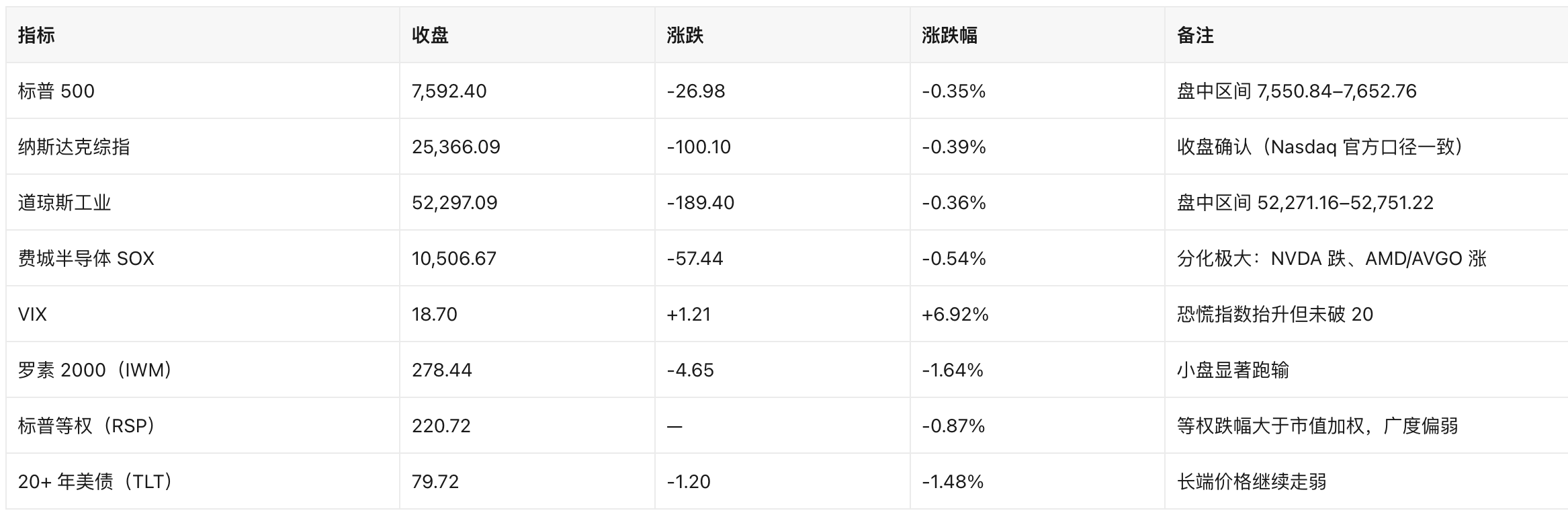
Core Driver: Index declines were modest but the structure was dramatic. Market-cap-weighted indexes were partially offset by a handful of heavyweight stocks (GOOGL +1.79%, TSLA +1.69%, MSFT +0.36%), while equal-weight and small-cap indexes were notably weaker—this was a rotation day of "calm indexes, violent single stocks" rather than a broad collapse in risk appetite.
2.2 Macro Data and the Fed
- October CPI (released 11/10): +0.4% MoM, core +0.3% MoM, both above expectations; YoY figures were not published due to last year's government shutdown. Subsequently, Reuters reported that "Fed officials open the door to a faster round of rate hikes," and Goldman Sachs raised its rate hike path expectations.
- Initial Jobless Claims for Early October (11/12): 200,000, versus 194,000 expected and 191,000 prior; continuing claims 1.697 million (versus 1.710 million expected).
- October Existing Home Sales (11/12): 3.75 million annualized, -5.5% MoM (versus -3.5% expected), prior 3.97 million. The 7.21% 30-year mortgage rate is suppressing transactions.
- 30-Year Treasury Auction (11/12): cleared at 5.441%, with weak demand and a tail—the second poor long-end auction this week.
- Officials' Remarks: Williams (after the close on 11/12) said inflation is "stubbornly high and policy still has work to do"; Barr, Goolsbee, Daly, and Schmid also spoke on the day.
- Rate Expectations: Kalshi shows an 87% probability of a 25bp hike in December (11/12); earlier, BeInCrypto cited market data showing the probability briefly touched 84%.
2.3 Rates, the Dollar, and Commodities (as of 22:05 U.S. Eastern, 11/12)
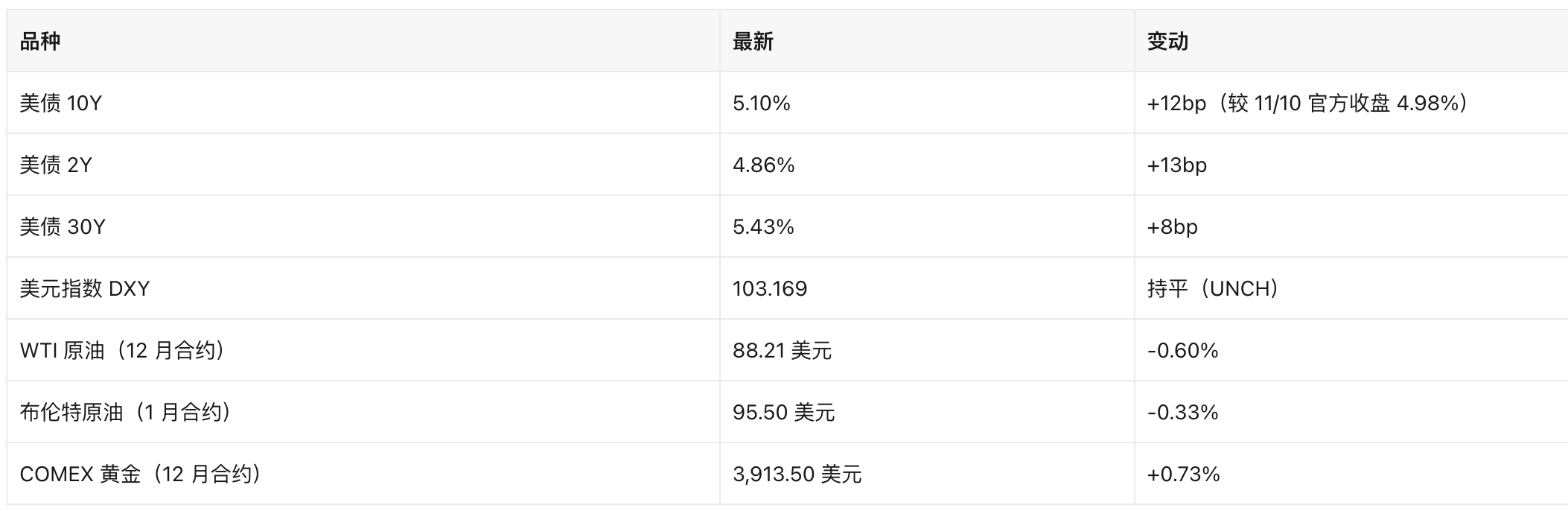
Transmission Logic:
CPI beats expectations → 87% probability of a December hike → weak demand at long-end auctions → 10Y tops 5.10% → discount rates rise for high-valuation growth stocks (NVDA, ASML -2.43%, TSM -1.90% under pressure).
The dollar index was flat on the day, indicating this round is "rate-driven" rather than "dollar-driven"; gold's rise reflects both real rates and geopolitical risk premium.
3. Hot Stocks and Sectors
3.1 NVIDIA (NVDA, $166.19, -4.34%): A Governance Shock, Not an Earnings Shock
The official announcement explicitly states that "Jensen Huang's resignation is effective immediately, Kress will serve as Interim CEO concurrently, the board has launched an internal and external search, and the Q3 earnings report remains scheduled for after the close on November 17." The price action was characterized by: an opening at $151.005 (a 13.1% gap down from the prior close of $173.73), an intraday low of $148.80, a high of $167.14, and a close at $166.19, on volume of 747.7 million shares.Gapping down and closing higher + massive turnover indicates selling pressure was concentrated at the open, with capital stepping in afterward; however, the close was still down 4.34%, meaning the market has not yet priced in "governance risk fully digested."
- Three things to watch: whether the Interim CEO can stabilize major customer orders and the GTC roadmap; the board's search timeline (Axios listed 11 candidates); and who will host the earnings call on November 17.
- Risk note: reports from multiple media outlets differ regarding the investigation into the reasons for Huang's departure and personnel details, some of which are unverified; this brief only uses the company announcement and board appointment facts.
3.2 AMD ($585.30, +5.86%) and Broadcom (AVGO, $364.36, +5.54%): The Substitution Trade
Competitors surging while the leader falls is a classic "share repricing" trade. But note that the SOX index closed down 0.54% and SMH fell 1.03%—the sector as a whole did not follow higher, indicating capital is rotating within the sector rather than adding aggregate exposure to AI chips. On the same trading day, TSM -1.90% and ASML -2.43%, reflecting caution in the supply chain about "whether customer strategy is changing."
3.3 AI Neoclouds: Nebius (NBIS, $128.64, -16.84%), CoreWeave (CRWV, $56.60, -6.86%)
Nebius cut its 2026 revenue guidance (capacity delivery delays) while raising 2026 capex, and the market is concerned about the combination of "$45 billion-scale AI investment + rising financing costs" (sources: WSJ, CNBC, Bloomberg). This thread is more worth tracking over the medium term than the NVIDIA personnel shakeup: when financing rates rise above 5%, compute rental models supported by debt and equity issuance are the first to be repriced. CRWV fell 6.86% in tandem, confirming this is a sector-wide rather than idiosyncratic issue.
3.4 Cerebras (CBRS, $97.75, -3.29%; after-hours $115.68, +18.34%): Earnings + Microsoft Partnership
After the close, the company reported quarterly revenue above expectations and announced a partnership with Microsoft, sending shares up 18.34% after hours (source: CNBC 11/13). At a moment of governance turmoil at NVIDIA, a non-GPU approach gaining endorsement from a major customer is a plus for the "alternative supply" narrative; however, note that the stock has fallen sharply from its post-IPO high of $386.34, and valuation elasticity is extreme.
3.5 Energy and AI Power: XOM +1.84%, CVX +1.44%, XLE +1.51%; CEG +2.79%, VRT +1.52%
The Strait of Hormuz remains closed, oil prices remain elevated (Brent $95.50), and energy stocks were one of the few certain gainers on the day. Meanwhile, the AI power chain (nuclear CEG, liquid cooling/power VRT) continued to attract capital, indicating that the "AI capex" narrative has not collapsed wholesale due to the NVIDIA personnel shakeup—it is merely being redistributed across the supply chain.
Other Key Focus:
Microsoft (MSFT, $523.00, +0.36%) experienced a widespread outage of its 365 services intraday, but the impact on the stock was limited;
Cisco (CSCO, $102.01, +1.24%) said after the close that AI infrastructure revenue will double this fiscal year, but fell 0.50% after hours;
Applied Materials (AMAT, $380.95, -3.58%) rose 0.69% after hours; Nu Holdings (NU, $11.83, -3.98%) rebounded 3.14% after hours.
4. Crypto-Related U.S. Equities (Crypto-Equity)
4.1 DAT Companies: MSCI Removal Lands, Strategy Discount Deepens

MSCI Event Details: Under its newly implemented "non-operating company" rule, MSCI will remove Strategy from the MSCI Global Investable Market Indexes, effective November 30; reports indicate a total of 25 securities are affected this round (sources: Reuters, WSJ, investingLive). JPMorgan estimates passive funds may be forced to sell $2.8 billion of MSTR (source: 24/7 Wall St. citing JPMorgan; this is a sell-side estimate, not official data). The market is also watching whether the Nasdaq 100 will follow suit (IBD raised this question; it has not happened yet).
Holdings and Valuation Basis:
- Strategy holds 850,364 BTC; its most recent purchase was 1,036 BTC for $81.9 million on November 9, implying an average purchase price of $79,054 per BTC ($81.9 million ÷ 1,036, consistent with the disclosed amount).
- At Kraken's latest price of $70,174, the holdings are worth $59.67 billion (850,364 × 70,174).
- Based on Nasdaq's disclosed market cap of $48.32 billion (corresponding to the prior close of $122.35), implied shares outstanding are 394.9 million; on that basis, at the 11/12 close of $114.41, the common equity market cap is $45.19 billion, below the value of the holdings; the simple measure (common equity market cap ÷ holdings value) = 0.76, meaning it is already in discount territory (this measure excludes debt and preferred stock and is not equivalent to standard mNAV).
- After the November 9 purchase, multiple media outlets noted that Strategy's average cost basis has been breached (source: Bitcoin Magazine 11/9). Implication: the flywheel of "issue shares at a premium → buy BTC → increase BTC per share" now runs in reverse in a discount state; issuing shares to buy BTC dilutes shareholders, which is also the deeper backdrop for the MSCI rule change.
4.2 New Entrants and Transformations: No Additions Today
As of this search (covering overseas mainstream sources from 11/11–11/12), no U.S.-listed company was found to have announced for the first time on the day a purchase of BTC/ETH as a reserve asset, or announced a restructuring/renaming to transform into a crypto DAT. The "Crypto Equity Watchlist" remains unchanged today, with no new names.
A reverse dynamic worth noting: the contraction of the DAT model continues—CoinDesk reported in July that several Bitcoin treasury companies had begun reducing holdings, and during this round of BTC's pullback from $74,000 to $70,174, discounted DATs lack the momentum to issue shares.
4.3 Broad Crypto Equities

Spot ETF Flows: U.S. spot Bitcoin ETFs have seen net outflows for five consecutive trading days, totaling $1.44 billion; BlackRock's IBIT alone has seen net outflows for 9 consecutive trading days, totaling $2 billion (sources: Decrypt 11/12, CoinDesk 11/12, Bitcoin Magazine 11/12; data as of 11/11). On price: IBIT $40.36, -4.45%; FBTC $62.03, -4.39%.
Payments and Tokenization: DTCC announced it will bring tokenized securities to Solana in the second half of 2027; Visa will integrate Western Union's USDPT stablecoin into its settlement network (in partnership with Anchorage); Securitize and Ethena's $100 million BlackRock BUIDL liquidity tool went live. These are incremental steps in "traditional financial infrastructure connecting to chains," which will not change stock price direction in the short term but will define the medium-term narrative.
4.4 Regulation and Rule-Driven Developments
- Personnel: Trump nominated 4 candidates for SEC and CFTC commissioner positions, including Democrats, the first such move in about a year (sources: Bloomberg 11/12, CoinDesk 11/12). A full commission will help advance crypto market structure legislation and rulemaking.
- Enforcement: The U.S. Department of Justice is seeking forfeiture of $1.2 billion in the Binance hack case and disclosed a plan to counter North Korea-related deepfakes (sources: CoinDesk, The Block 11/12).
- State-level: The New York State Department of Financial Services (NYDFS) issued new advertising standards for crypto companies; Louisiana sued prediction market platforms including Kalshi and Robinhood.
- Index Rules (Most Important Today): MSCI's "non-operating company" rule is the second institutional tightening after accounting standards—the first was fair value accounting, which made corporate BTC purchases "measurable"; this time it is index rules that remove the passive capital support for the business model of "buying BTC with premium financing."
4.5 Same-Day Stock-Crypto Linkage Signals
- MSTR fell 6.49%, more than BTC's 5.60% (24-hour), the stock fell more than the coin, indicating the MSCI event was priced separately.
- COIN -4.11%, HOOD -3.82%, declines smaller than BTC; trading platform stocks did not see panic discounting.
- CIFR rose +0.56% against the trend, the only crypto-related name to gain on the day, reflecting how the "mining → AI data center" transformation is changing its pricing anchor.
5. Crypto Market Background (Brief)

(Price source: Kraken, as of 11:05 Beijing time on 11/13; 24-hour changes are calculated by tracing back to the same time point on the hourly chart.)
Drivers: ① The NVIDIA governance shock triggered synchronized deleveraging across risk assets; ② spot ETFs saw net outflows of $1.44 billion for 5 consecutive days, with passive buying absent; ③ an 87% probability of a December rate hike, with rising real rates suppressing non-cash-flow assets; ④ MSCI's removal of Strategy weakens the structural demand of "DAT premium buying." All four threads point to the same conclusion: the crypto market currently lacks marginal buyers, while the sources of marginal selling pressure are clear.
On the news front: CoinDesk