The GENIUS Act Countdown: Of the Top Ten USD Stablecoins, Only USDC and PYUSD Make the Cut


- Key Takeaway: BPI research shows that among the top ten USD stablecoins by circulating supply, only USDC and PYUSD meet the reserve requirements of the GENIUS Act taking effect in 2027, accounting for 26% of global circulating supply; the remaining 72% are unconstrained due to offshore issuance or crypto collateral, and hold riskier reserve portfolios.
- Key Elements:
- The GENIUS Act requires payment stablecoins to maintain full reserves in high-quality liquid assets such as Treasuries maturing within 93 days, Treasury-backed overnight reverse repos, and bank deposits, effective January 18, 2027.
- The top ten stablecoins together account for 97% of market circulating supply; compliant USDC (over $73 billion) and PYUSD already meet the standards, while USD1 and Ripple's USD are temporarily non-compliant due to their holdings of money market funds.
- Offshore stablecoins account for 65% of the non-compliant portion: USDT's operating entity is based in El Salvador, with 29% of its reserves in risky assets such as gold, equities, and Bitcoin; USDG's reserves include 53% government money market funds, which do not meet the maturity requirements.
- Crypto-collateralized stablecoins account for 7%: USDS and DAI together total nearly $14 billion, with 42% of reserves in crypto-collateralized loans; USDe, at about $4 billion, adjusted its strategy after a severe depeg in October 2025.
- USDC's reserve structure was reshaped by the 2023 Silicon Valley Bank crisis, shifting from 85% Treasury bills to approximately 70% Treasury-backed reverse repos to improve liquidity.
- Report conclusion: Compliant reserve requirements help reduce the probability of depegging, but both compliant and non-compliant stablecoins have historically depegged—compliance does not equal risk-free.
Original article from theBank Policy Institute (BPI, Bank Policy Institute of the United States; authors Laurence Bristow and Eva Funaki)

Editor's note: This article is compiled from a BPI research note. BPI is a research institution representing the U.S. banking industry, and its conclusions are unfavorable to offshore stablecoins and crypto-collateralized stablecoins; readers should be aware of this stance. Data is as of June 30, 2026, sourced from issuer disclosures and Dune Analytics.
On January 18, 2027, the GENIUS Act officially takes effect. Under the Act, "payment stablecoins" issued in the United States or offered to U.S. users must be fully reserved with highly liquid assets—U.S. Treasury securities with a remaining maturity of no more than 93 days, overnight reverse repurchase agreements collateralized by Treasuries, bank deposits, and other qualifying assets.
However, by circulating supply, of the ten largest U.S. dollar stablecoins, only two currently have reserve structures that match GENIUS requirements, accounting for 26% of total circulating supply. Another two are expected to qualify soon, accounting for 2%. The remaining 72% do not qualify: 65% are offshore-issued stablecoins, and 7% are crypto-collateralized.
These are the conclusions of BPI's latest research note.
Sample and Methodology
BPI selected the ten largest U.S. dollar stablecoins by circulating supply, which together accounted for 97% of total market circulating supply as of June 30, 2026. Reserve composition data typically comes from issuers' monthly disclosures, with the largest, USDT, disclosing only quarterly; crypto-collateralized USDS and DAI data is sourced on-chain via Dune Analytics.
These ten are divided into three groups: those subject to GENIUS after the Act takes effect, those not subject to it because they are issued offshore, and those not subject to it because they use crypto-collateralized loans as reserves.
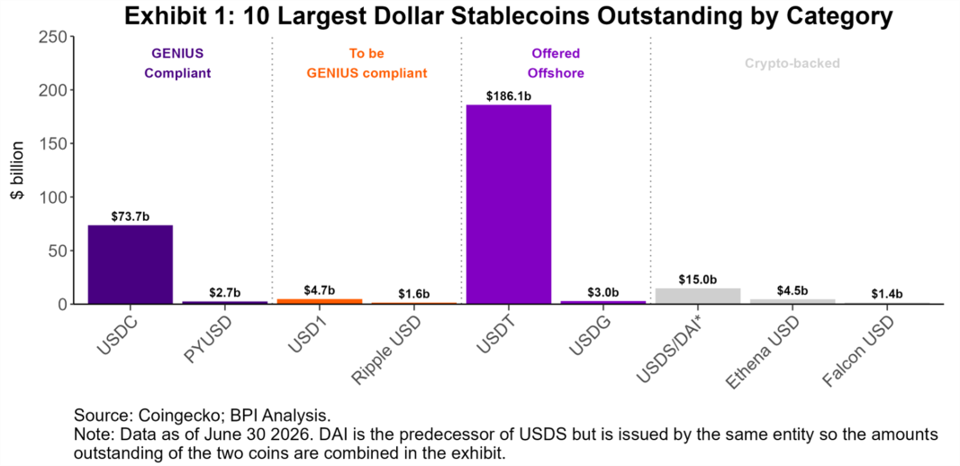
The ten largest dollar stablecoins grouped by category (circulating supply and compliance status)
The Compliant 26%: USDC and PYUSD
Four of the ten are issued within the United States and will be subject to GENIUS after the Act takes effect. As of June 2026, Circle's USDC and Paxos's PYUSD already meet reserve asset requirements; World Liberty's USD1 and Ripple's USD do not—both hold money market funds, which contain agency debt and longer-dated U.S. Treasuries.
USDC is the largest domestic stablecoin, with circulating supply exceeding $73 billion. As of July 2026, approximately 70% of its reserve assets were reverse repurchase agreements collateralized by Treasuries, with the remaining 30% split roughly evenly between uninsured bank deposits and Treasury bills.
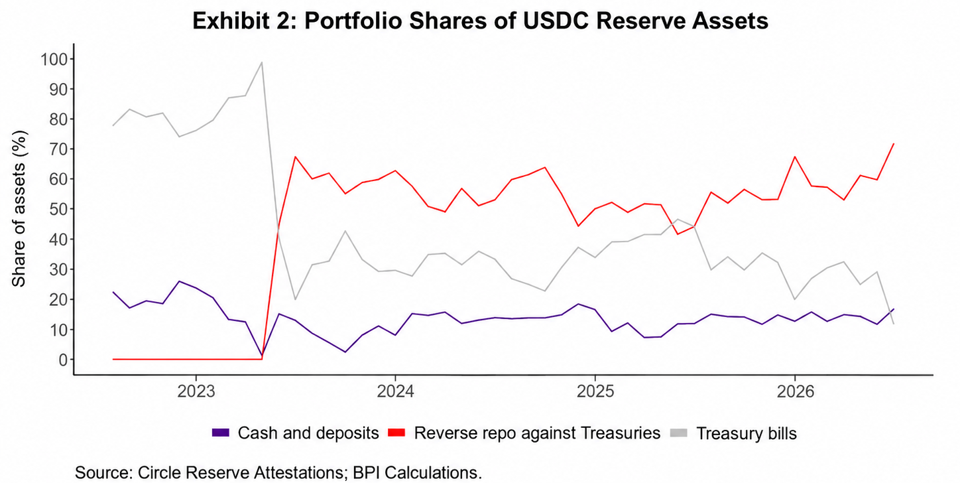
Time series of USDC reserve asset composition (annotated with changes around the Silicon Valley Bank event in 2023)
USDC's reserve structure was reshaped by the Silicon Valley Bank crisis in early 2023. Initially its reserves were 85% Treasury bills plus 15% uninsured bank deposits, with more than half of the deposits held at Silicon Valley Bank. After the bank ran into trouble, USDC holders began to question its solvency, the coin price depegged, falling as low as 87 cents. Circle subsequently reduced the Treasury bill proportion and shifted to investing in reverse repurchase agreements collateralized by Treasuries to improve liquidity.
The Non-Compliant Majority: The Offshore 65%
Major offshore-issued stablecoins fall outside GENIUS jurisdiction, and their reserve structures do not match the Act's requirements.
The largest is USDT, currently the top stablecoin by circulating supply, operated by an entity based in El Salvador. As of June 30, 2026, 61% of USDT reserves were U.S. Treasury bills, 10% were overnight reverse repos collateralized by Treasuries, and bank deposits accounted for a very small portion. The remaining reserve assets consist of gold, listed equities, Bitcoin, secured loans, term reverse repo loans, and other investments, which have risen to 29% and these proportions are slowly increasing over time.
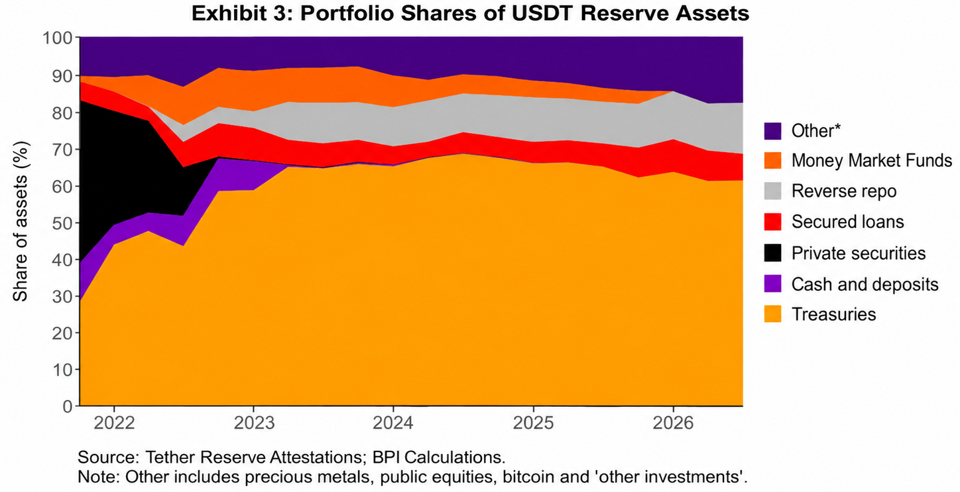
Changes in USDT reserve asset composition
USDT has depegged multiple times: in October 2018, it fell below par when the market questioned its reserve assets; in November 2022, it depegged again amid the FTX collapse and contagion concerns; in August 2023 during the "crypto winter," exchange liquidity declined and redemptions on Tether's side were impeded, causing the coin price to depeg once more.
The second-largest offshore stablecoin, Global Dollar (USDG), is issued by Paxos's Singapore and Europe entities. As of June 30, 2026, its reserves comprised 53% government money market funds, 42% Treasury bills, and 5% bank deposits. These assets are not inherently high-risk, but government money market funds invest in Treasury bills and federal agency securities with maturities exceeding 93 days, and therefore do not meet GENIUS requirements. Shortly after launch, USDG depegged in November 2024 due to insufficient trading liquidity.
The GENIUS Act also leaves a pathway for foreign payment stablecoin issuers: they may offer payment stablecoins to U.S. users provided that the U.S. Treasury determines their home country's regulatory regime is comparable to that of the United States and the issuer demonstrates its ability to comply with U.S. legal orders.
The Crypto-Collateralized 7%: USDS, DAI, and USDe
Crypto-collateralized stablecoins have riskier reserve portfolios, primarily crypto-collateralized loans, which are not qualifying reserve assets under GENIUS and are therefore not expected to become payment stablecoins under the Act.
Most notable are USDS and DAI, both issued by Sky Protocol, which together constitute the third-largest stablecoin at nearly $14 billion.
Unlike payment stablecoins backed 1:1 by real assets, USDS has three minting paths: directly exchanging 1 USDC for 1 USDS; borrowing USDS against crypto collateral through Sky's DeFi lending protocol; and minting by Sky's affiliated entities—Sky provides USDS credit lines to affiliates for strategies such as crypto-collateralized loans or tokenized real-world assets.
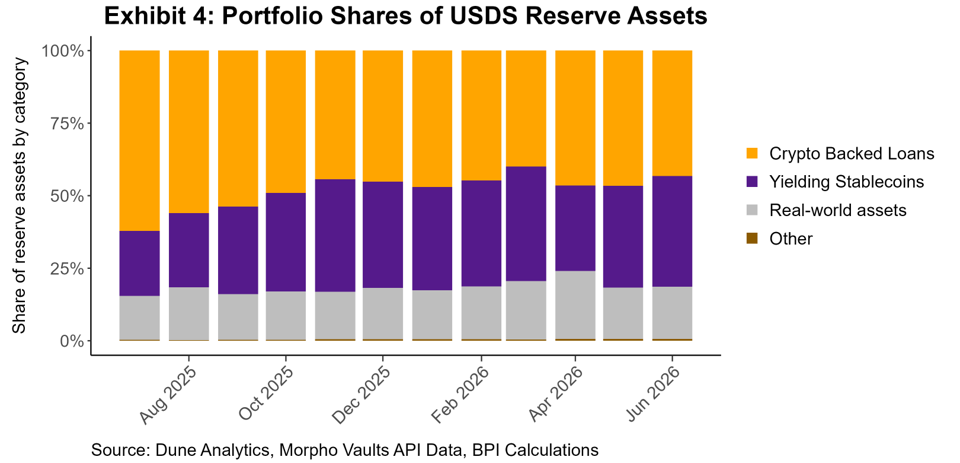
USDS reserve asset composition (July 2025 to June 2026)
As of June 2026, USDS reserves comprised 42% crypto-collateralized loans, 38% stablecoins, and 20% tokenized real-world assets. Nearly 90% of the real-world assets are tokenized funds investing in short-term U.S. Treasuries, reverse repurchase agreements, and AAA-rated collateralized loan obligations.
Another crypto-collateralized stablecoin is Ethena Lab's USDe, approximately $4 billion as of June 2026. USDe started with a hedge-fund-style basis trade strategy but adjusted its approach after declining basis trade profitability and a severe depeg in October 2025; it is currently backed by a combination of tokenized real-world assets, yield-bearing stablecoins, and crypto-collateralized loans on DeFi protocols.
Conclusion: Compliance Does Not Equal No Depegging
GENIUS reserve asset requirements are intended to improve the stability of payment stablecoins and reduce the probability of depegging. But as things stand, only two of the ten largest dollar stablecoins—26% of global circulating supply—have reserves consistent with the Act's requirements. The offshore stablecoins and crypto-collateralized stablecoins that make up the majority remain outside the new legal framework, holding significantly riskier reserve portfolios.
Of course, meeting GENIUS reserve requirements does not mean a stablecoin will necessarily maintain its value—both compliant and non-compliant stablecoins have depegged before, and may depeg again in the future.