AI Storm's Main Event: Stock Prices Near Halved, "AI Cloud Duo" CoreWeave and Nebius Earnings Are Coming


- Key Takeaways: The AI infrastructure investment boom is colliding with rising debt costs. CoreWeave and Nebius shares have plunged 44% and 36% respectively over the past month, with the market focused on the upcoming earnings calls to judge whether the sell-off is an overreaction or rational pricing.
- Key Elements:
- Meta CDS spreads hit an all-time high in late October as investors sold off the most highly leveraged "neocloud" companies in the AI infrastructure chain.
- CoreWeave carries approximately $50 billion in debt, with yields on its 2031 maturing bonds once approaching 16%, and CDS spreads widening to about 1,200 basis points.
- Revenue growth remains strong for both companies: CoreWeave's 2027 revenue forecast doubled to $26.47 billion, while Nebius grew more than twofold to $11.98 billion.
- CoreWeave raised its capital expenditure to $35-39 billion, roughly three times its expected 2026 revenue; Nebius's $3.5 billion financing has a term of only 364 days, highlighting the risk of short-term debt funding long-term investments.
- CoreWeave trades at 14.6x EV/EBITDA, while Nebius's forward EV/EBITDA compressed from 191.4x to 6.4x; analyst price targets imply 183% and 121% upside respectively.
- The market is watching for signals from earnings calls regarding financing conditions, free cash flow timelines, customer diversification, and margin stability.
Author: Long Yue
Source: Wallstreetcn
Under the dual pressure of rising debt costs amid an AI infrastructure investment boom, shares of two emerging cloud computing companies, CoreWeave and Nebius, have both nearly halved in just one month.
This week, the two companies will release their third-quarter earnings on November 10 and November 12, respectively. The timing is rather delicate—the market is waiting for an answer: Is this selloff an overreaction or reasonable pricing?
Looking at fundamental data, both companies' revenue growth trajectories remain strong. Analysts expect CoreWeave's revenue to double by 2027 and Nebius's revenue to grow more than threefold. But the crux of the problem is not revenue—it's the massive debt burden taken on to support that growth.
Why the Stock Prices Nearly Halved in a Month
According to a column by Chris Beauchamp, Chief Market Analyst at IG, Meta's credit default swap (CDS) spreads hit a record high in late October—after Meta once again raised its capital expenditure guidance, investors promptly shifted to selling off the most leveraged end of the AI infrastructure chain, namely "neocloud" companies. These companies' data center spending is often several times their annual revenue.
CoreWeave bore the brunt. The company carries approximately $50 billion in debt. In mid-October, the yield on its 2031 bonds approached 16%, and CDS spreads widened to about 1,200 basis points—a level credit markets typically reserve for borrowers with questionable solvency.
Nebius's debt scale is relatively smaller, and it has just signed a $3.5 billion financing arrangement, yet its stock decline was almost on par with CoreWeave's. This suggests that investors did not make much distinction in this round of selling.
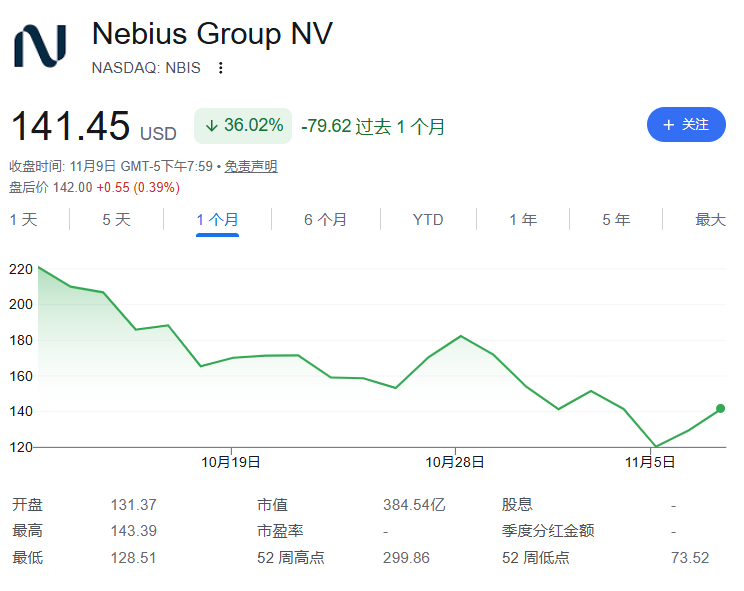
CoreWeave and Nebius shares plunged 44% and 36% respectively over the past month.

Earnings Expectations: Revenue Growth Still Strong, but Losses Persist
For CoreWeave, the market consensus expects third-quarter revenue of $3.55 billion, with the StarMine SmartEstimate at $3.54 billion—essentially flat, implying a beat of only about 0.06%. By comparison, the beat was 5.73% in the first quarter and narrowed to 0.59% in the second quarter, indicating that analyst forecasts have gradually caught up with its growth pace. EBITDA is expected at $2.05 billion, corresponding to a margin of about 58%, but the company is still expected to report a loss of $1.16 per share, which is expected to narrow to $0.55 in the fourth quarter.
For Nebius, revenue is expected at $908 million, with the SmartEstimate slightly higher at $916 million, implying a positive surprise of about 0.96%. The beats in the first and second quarters were 7.43% and 1.67% respectively, also showing a narrowing trend. EBITDA is expected at $353 million, corresponding to a margin of about 39%, with an expected loss of $0.69 per share, potentially widening to $0.95 in the fourth quarter before gradually improving.
The Bull Case: Has the Decline Overly Reflected Pessimistic Expectations?
From a pure numbers perspective, both companies' growth stories remain compelling.
According to consensus data cited by IG, CoreWeave's revenue is expected at $12.86 billion this year and could rise to $26.47 billion by 2027, a gain of about 106%; Nebius's revenue is expected at $3.37 billion this year and could jump to $11.98 billion by 2027, a gain of about 255%. Supporting these forecasts are CoreWeave's backlog of over $129 billion in revenue and Nebius's long-term contracts exceeding $40 billion.
On valuation, CoreWeave's current EV/EBITDA is 14.6x (based on trailing twelve months), while Nebius's forward EV/EBITDA has compressed sharply from 191.4x on a trailing twelve-month basis to 6.4x. Analysts' average price target for CoreWeave is $131.41 and for Nebius is $286.53, implying upside of about 183% and 121% respectively from current prices.
There has also been positive progress on the business front. Palantir has listed Nebius as a preferred partner for sovereign AI infrastructure, potentially opening up government-side revenue; Nebius completed its acquisition of Inferize in October, strengthening its inference business capabilities. CoreWeave, meanwhile, is expanding in Denmark and plans to build a global AI network backbone covering the UAE, India, Indonesia, Singapore, Australia, South Korea, and Japan starting from the fourth quarter.
The Bear Case: Debt Problems May Matter More Than Revenue
However, the appeal of debt-driven growth depends on whether the debt can be refinanced on reasonable terms.
CoreWeave raised its capital expenditure guidance to $35 billion to $39 billion in August this year, roughly three times its expected 2026 revenue. With bond yields near distress levels, the market's core question is no longer whether customers need computing power, but whether lenders are still willing to keep buying in. Once there are signs of a passive narrowing of the capex range, the market may interpret it as financing being blocked rather than a proactive adjustment.
Nebius's financing situation is relatively healthy, but it is not invulnerable. Its $3.5 billion senior secured financing arrangement with Citibank has a term of only 364 days, with an interest rate of SOFR plus 275 to 350 basis points—meaning it is using short-term funds to finance long-term assets. Management plans to pursue asset-backed financing based on contracted orders, which needs to be executed in a market that has clearly tightened.
In addition, CoreWeave's customer concentration risk cannot be ignored, with its main customers including Microsoft, OpenAI, and Meta. CEO Michael Intrator has cumulatively sold nearly $1 billion in shares through pre-arranged trading plans since the IPO, an issue that could raise governance questions at the current juncture. Nebius, meanwhile, may face questions about its former parent company Yandex—which withdrew its 2026 performance guidance after its Russian data center was attacked, even though the two companies are now independent entities.
The Earnings Call Is the Real Key
In an ordinary quarter, a slight beat plus stable guidance would be enough. But this is not an ordinary quarter.
Since both companies' revenue expectations are close to consensus, the numbers themselves may be less important than what management says on the earnings call. What investors are most focused on is the latest progress on financing conditions, the timeline for achieving free cash flow, and the degree of customer base diversification. The market is particularly looking forward to CoreWeave providing a free cash flow roadmap extending to 2030.
Margin performance is equally pivotal. CoreWeave's roughly 58% EBITDA margin is the core pillar of its debt-servicing argument, while Nebius's roughly 39% margin, though rising rapidly from a lower base, could reinforce the judgment that "the economics of the GPU rental business are not as attractive as the growth rate suggests" if either company's margin slips.
According to IG analysis, the following signals could mark a turning point in market sentiment: CoreWeave clearly defining its $35 billion to $39 billion capex range and clearly explaining the funding sources; providing a credible free cash flow positive timeline, preferably covering through 2030; new orders showing a customer base beyond the existing few hyperscalers and AI labs; Nebius providing specific details on asset-backed financing arrangements for its $40 billion in contracted orders and explaining the refinancing plan for its 364-day financing arrangement; evidence of inference business growth following the Inferize acquisition; and a narrowing of CoreWeave's bond yields and CDS spreads after the earnings release—which may be more telling than the stock price reaction.
Chris Beauchamp wrote in the article: "If the two companies can demonstrate that funding is in place and margins remain stable, the market may conclude that a decline of more than 40% has already priced in excessive pessimism. If the earnings call is instead dominated by refinancing questions and vague answers, then the halving of the stock price may be reasonable pricing rather than an overreaction."