When Bitmine Stops Buying, How Much Net Buying Pressure Will ETH Lose?


- Core Viewpoint: Bitmine's ETH holdings have reached 4.97% of total supply, approaching the 5% strategic cap. Its rigid net buying pressure is about to disappear, but the "aggressive accumulation phase" ended long ago, and the market has already priced in this change in advance, so the actual impact will be limited.
- Key Elements:
- Bitmine holds a total of 6.07 million ETH, worth approximately $13.6 billion, accounting for 4.97% of Ethereum's total supply and completing 99% of its "5% alchemy" goal.
- The 5% target stems from the SEC 13D mandatory disclosure threshold. Chairman Tom Lee has explicitly stated that 5% is a hard cap and that the company will not continue to increase its holdings.
- Second-tier DATs (SharpLink at approximately 870,000 ETH, The Ether Machine at approximately 496,000 ETH) and spot ETFs are not incremental narratives and are unlikely to replace Bitmine's countercyclical dollar-cost averaging capacity.
- Bitmine's aggressive accumulation was concentrated in the second half of 2025, with more than 4.1 million ETH purchased in half a year; in the past two months, weekly increases have been only 8,000 to 15,000 ETH, equivalent to approximately $20 million to $30 million.
- ETH's current daily trading volume reaches tens of billions of dollars, and ETF single-day fund flows can exceed $100 million. Bitmine's marginal buying pressure has very limited ability to move prices.
- Once the remaining gap of approximately 35,000 ETH is filled, the 6.07 million ETH in tokens will be locked long-term in the treasury and staking nodes, completing the historical mission of the token lock-up experiment.
Original | Odaily (@OdailyChina)
Author | Azuma (@azuma_eth)

Bitmine is just one last step away from completing its 5% ETH holdings target.
On November 10, digital asset treasury company Bitmine (NYSE: BMNR) disclosed its latest holdings report. Over the past week, the company once again increased its position by 9,587 ETH, bringing total holdings to 6,070,092 ETH, worth approximately $13.6 billion, accounting for 4.97% of Ethereum's current total supply.According to the company's official statement, this ratio has reached 99% of its strategic goal of "holding 5% of total ETH supply."

The 5% holdings target is a long-term plan proposed by Bitmine when it launched its ETH treasury strategy on June 30, 2025. Bitmine officially calls it "The Alchemy of 5%" — the reason for choosing this number is that in traditional U.S. equity markets, 5% is the "stakeholder line" that triggers mandatory SEC 13D disclosure, representing the point at which a single shareholder begins to have substantive say.
At the Token2049 conference in October this year, Bitmine Chairman Tom Lee once again emphasized that 5% will be the hard cap for Bitmine's ETH holdings, and the company will not continue to increase its ETH position beyond this ratio.In other words, once the final 1% purchase is completed, Bitmine's ETH buying activity that has lasted for over a year will be put on pause.
Net buying will inevitably decline — no one can replace Bitmine
As Bitmine gradually approaches its holdings cap, the market has been continuously searching for potential "successors" — for example, hoping that second-tier Ethereum treasuries (DATs) such as SharpLink (holding approximately 870,000 ETH) and The Ether Machine (holding approximately 496,000 ETH) will expand their balance sheets, or expecting spot ETF funds to flow in on a large scale.
But objectively speaking,it is unrealistic to expect these forces to "replace" Bitmine. The reason is simple: second-tier DATs and spot ETFs are not incremental narratives — they are already on the table at this very moment.
Over the past year or so, every price battle for ETH has already factored in the combined force of Bitmine, second-tier DAT treasuries, and ETF funds. Moreover, ETF funds are highly procyclical (chasing highs when prices rise, redeeming when prices fall), while second-tier treasuries are constrained by their own market cap and mNAV discounts, making it difficult for them to replicate Bitmine's early countercyclical dollar-cost averaging ability of buying relentlessly every week regardless of bull or bear markets.
Therefore, there is no need to seek psychological comfort by helping ETH find "other forces that can step up."Once Bitmine touches the 5% cap and stops increasing its holdings, on an arithmetic level, it objectively means that the market has lost a persistent, rigid source of net buying.
The core question truly worth discussing is: how significant is the real impact of this net buying disappearing on ETH?
Despite the massive 6 million ETH position, the "aggressive buying phase" is long gone
If we look only at the total, 6.07 million ETH and a holdings scale of up to $13.6 billion will inevitably have a massive impact on ETH. As the world's second-largest crypto asset treasury after Strategy (formerly MicroStrategy), Bitmine alone has swallowed nearly 5% of all ETH tokens in circulation, and has locked over 80% of that ETH in staking nodes. A buyer of this magnitude exiting the secondary market does sound like a "blood-cutting bearish signal."
However, if we look back at Bitmine's actual accumulation curve over the past 16 months, we will discover a fact that is closer to the current situation —Bitmine's "aggressive accumulation phase" is long gone; the closer it gets to the 5% target, the slower its accumulation pace becomes.
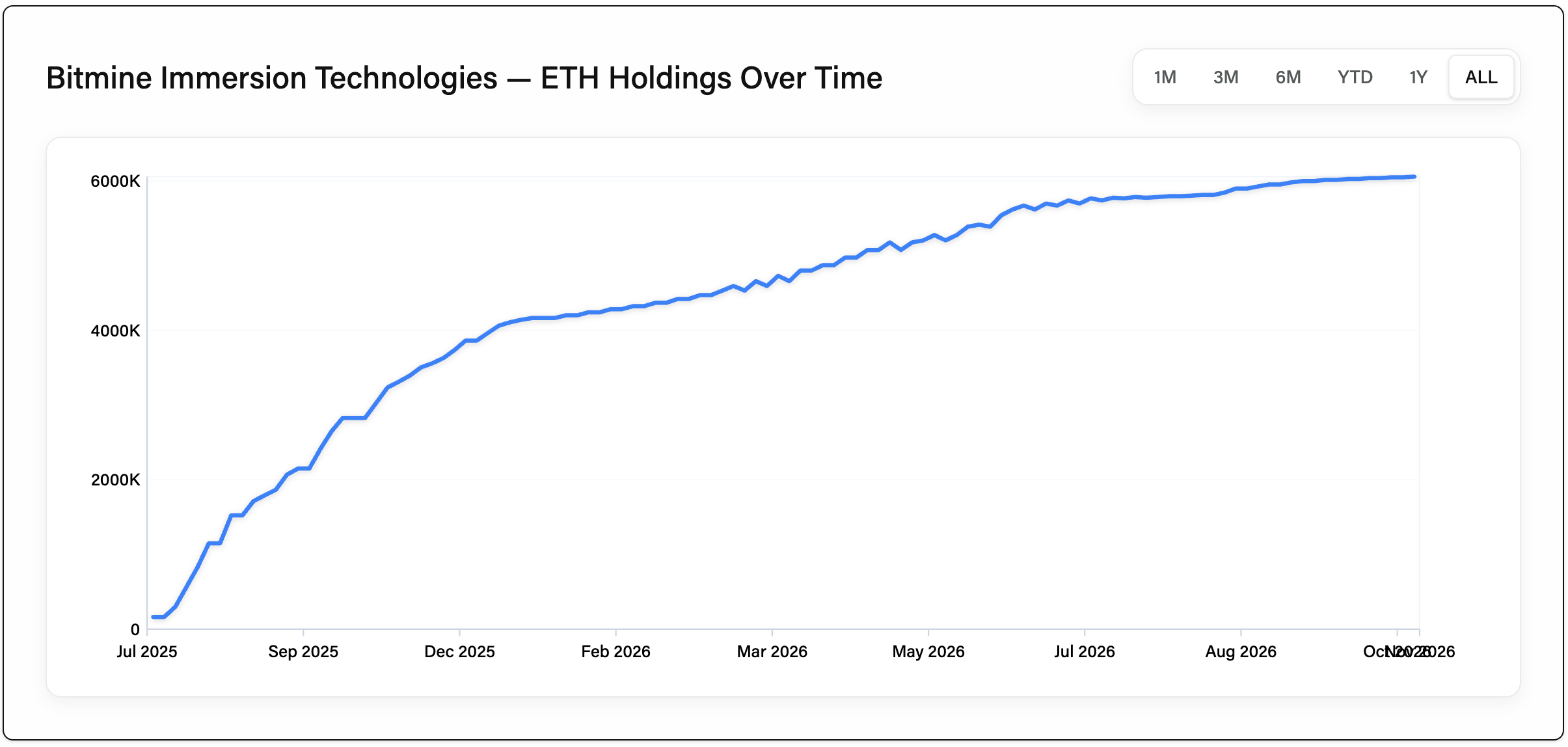
Combining The Block's treasury tracking data and Bitmine's historical holdings disclosures, we can intuitively see the changes in Bitmine's buying slope each quarter.
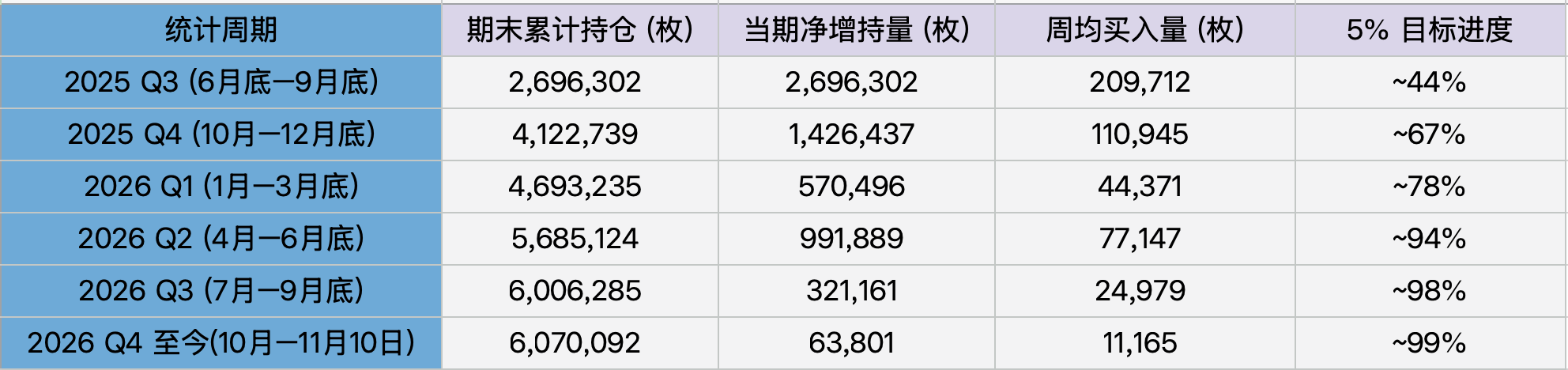
The data clearly shows that Bitmine's true "aggressive accumulation" was almost entirely concentrated in the second half of 2025 — at that time, it was acquiring over 4.1 million ETH in half a year at an astonishing pace of 100,000 to 200,000 ETH per week.
However, entering the second half of 2026, especially since the third quarter, as holdings approached the 5% target and BMNR's own stock price entered a discount range, its accumulation pace has slowed significantly.Over the past two months, Bitmine's weekly net ETH accumulation has only been in the range of 8,000 to 15,000 ETH, equivalent to just $20 million to $30 million per week.
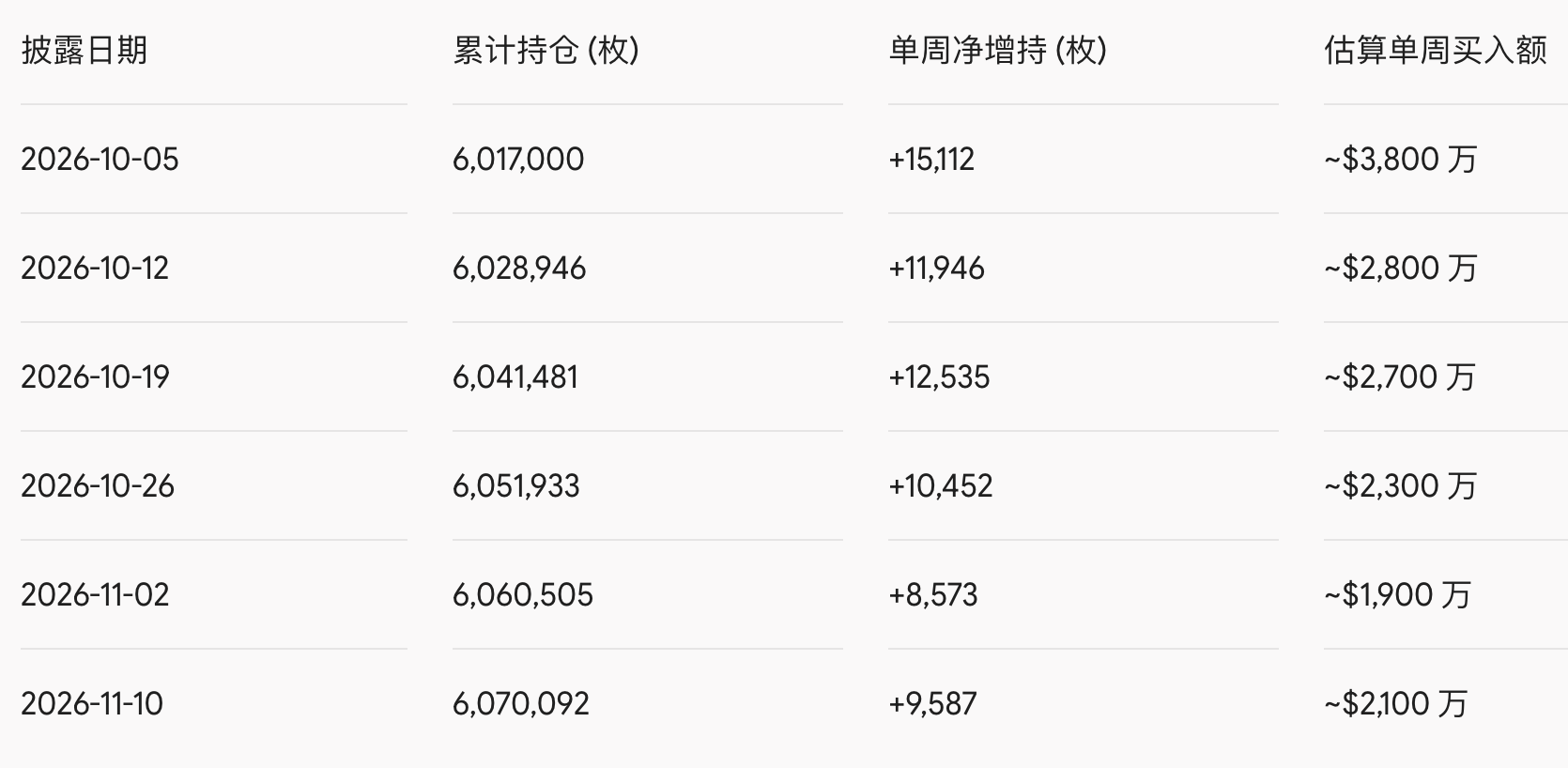
For the ETH market, which now sees daily trading volumes in the tens of billions of dollars and spot ETF single-day net inflows/outflows that can easily exceed $100 million, buying at the level of $20 million per week has had very limited actual impact on ETH prices in recent months.
No need to panic — the market has long adapted to life without Bitmine
In summary, Bitmine is about to complete the final progress bar of "The Alchemy of 5%," which indeed means ETH has lost an iconic off-exchange net buyer on paper. But the market need not fall into panic over a "buying gap" — because the most intense incremental buying had already receded half a year ago, and the secondary market, through the volatility of recent months, has actually already adapted to and digested life without Bitmine's net buying in advance.
When the final gap of approximately 35,000 ETH is filled, what disappears is only a weak marginal buy of about 10,000 ETH per week; what remains for Ethereum is 6.07 million ETH in dormant tokens locked long-term in treasuries and staking nodes.
Bitmine's narrative as a "buyer engine" may be about to turn the page, but this token-locking experiment that took a year and a half has already completed its historical mission.
Related Reading
Vitalik "Exposes" the Limitations of Burn Mechanism, ETH Value Narrative Shifts
Tom Lee: Vitalik Positioning ETH as a Store of Value Is an "Earthquake-Level Shift"