US Stocks Daily | Chip stocks lead the rally, all three major indices up over 2%, Nvidia bucks the trend with a 4% drop (November 10)


- Key Takeaways: US stocks rebounded sharply, driven by a plunge in oil prices and oversold buying, but Nvidia fell alone against the trend due to a CEO governance investigation, with the AI narrative now facing a dual discount from governance and supply chain compliance; in crypto markets, BTC fell below Strategy's cost basis, the DAT financing arbitrage window has disappeared and incremental inflows have stalled, with non-yielding assets and DAT valuations both under pressure in a high-rate environment.
- Key Elements:
- S&P +2.35%, Nasdaq +2.74%, Philadelphia Semiconductor Index +6.86%, VIX down 22.31%; Brent crude fell 5.85% to $92.57, a "decline repair" rather than a new high.
- Nvidia -4.27% as the board investigates whether Jensen Huang was approached by Chinese intelligence agencies, its underperformance versus the broader market the largest since the DeepSeek shock; AMD +13.26% on securing a Google order, signaling multi-vendor procurement in AI compute.
- BTC at $74,853.97 fell below Strategy's average holding cost of $75,456, marking its first overall unrealized loss of about $510 million; of $283.8 million in net proceeds, only 28.9% went to buying BTC and 66.3% to repurchasing STRC.
- US spot Bitcoin ETFs saw $1.282 billion in net outflows for the week (IBIT -$1.209 billion), the largest since June; total market ETF net assets fell to about $96 billion.
- October nonfarm payrolls added 165,000, far exceeding the expected 65,000, with unemployment at 4.1%; December rate hike probability rose to about 77%, the 10-year Treasury yield stood at 4.864%, and the discount rate is unlikely to decline.
- Coinbase obtained a final OCC trust bank charter; the Treasury Department/OFAC cut off MEXC's US dollar clearing channel over approximately $16 billion in involved funds; new MSCI rules could trigger about $2.8 billion in passive selling pressure on DATs.
- China extended the suspension of its 24% tariff on US goods to January next year while retaining the 10% rate; Democrats won both chambers of Congress, raising uncertainty over trade and AI regulatory paths.
1. Top Stories
- US stocks rebounded sharply in a single day, led by chip stocks. S&P 500 +2.35%, Nasdaq +2.74%, Philadelphia Semiconductor Index +6.86%, recovering most of last week's AI selloff losses; VIX fell from 25.64 to 19.92 (-22.31%). The drivers were falling oil prices + oversold rebound buying, rather than new fundamental positives.
- Brent crude fell 5.85% in a single day to $92.57. Trump said that if negotiations make progress, resuming strikes on Iran is "extremely unlikely," and he prefers to maintain the status quo; the market heard that an approximately $8 billion Strait of Hormuz arrangement is awaiting his sign-off. The geopolitical risk premium rapidly unwound.
- Nvidia was the only mega-cap to fall against the trend: -4.27%. The board of directors opened an investigation into CEO Jensen Huang, and the company issued a board statement; analysts called this "a risk to the entire AI industry, not just one CEO." Nvidia's underperformance versus the broad market was the largest since the DeepSeek shock.
- October CPI will be released today at 21:30 (Beijing time), but without year-over-year readings. Due to the data gap caused by the 43-day government shutdown in 2025, BLS will not publish October CPI year-over-year or core year-over-year figures, only month-over-month. The market expects falling gasoline prices to drive an overall inflation slowdown.
- China extended the suspension period for its 24% tariffs on the US by another two months to January next year, retaining the 10% rate. This temporarily eases trade friction, but after Democrats won both chambers of Congress, uncertainty over the trade policy path has increased.
- Crypto: BTC fell below $75,000, Strategy bought against the trend. BTC was at $74,853.97 (-0.4% over 24 hours); Strategy added 1,036 BTC during 11/2–11/8 (average price $79,012), holding 850,364 BTC at an average price of $75,456 — the coin price has fallen below its cost basis.
2. US Stock Market and Macro
2.1 Index Closes (US Eastern 2026-11-09 16:00)
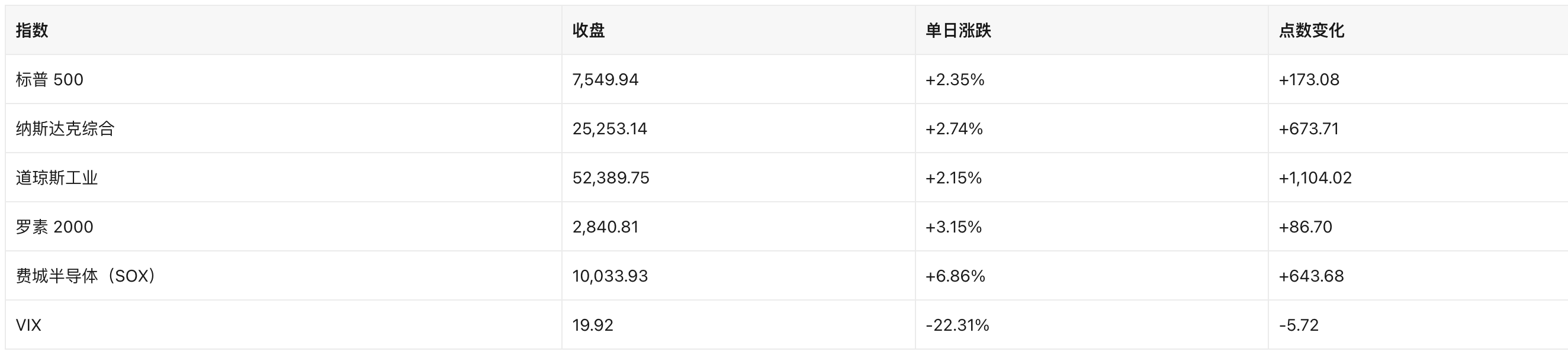
Core drivers: ① Oil prices fell nearly 6% in a single day, easing expectations for inflation and cost pressure; ② After the Philadelphia Semiconductor Index plunged 12.2% in a single day last Thursday and the Nasdaq entered a technical correction, concentrated rebound buying emerged; ③ China extended the tariff suspension period, marginally repairing risk appetite. Note: This is a "drawdown recovery," not a new high — the S&P closed at 7,688.62 on 11/4, 1.84% above the current level.
2.2 Macro Data and the Fed
- October nonfarm payrolls (released 11/6): +165,000, far exceeding the market expectation of 65,000; the unemployment rate fell to 4.1%. After the data release, yields rose and expectations for a December rate hike intensified. (CNBC, Reuters, Bloomberg)
- The probability of a December rate hike rose to about 77% (market pricing on 11/7, 24/7 Wall St citing Kalshi/futures). The current policy direction is "skip in October, possible hike in December," opposite to the 2025 rate-cutting cycle.
- September CPI was 3.7% year-over-year (released 10/14; the surge in gasoline prices due to the Iran war was the main driver). October CPI will be released today, but without year-over-year and core year-over-year figures; the month-over-month reading is more critical for judging "whether falling oil prices are transmitting to inflation."
- US Treasuries and the dollar (11/9): The 10-year Treasury yield was 4.864%, essentially flat versus last Friday's 4.859% (+0.5bp); the dollar index was 101.68, down 0.61% from last Friday's close of 102.30.
- Precious metals and crude oil (11/9 settlement): COMEX gold $4,114.50/oz, +0.97% (latest electronic session $4,132.60); Brent $92.57/barrel, -5.85%; WTI $86.85/barrel, -4.38%.
3. Hot Stocks and Sectors
3.1 Semiconductor Equipment: AMAT +11.37%, LRCX +10.41%, KLAC +9.31%, ASML +6.21%
Equipment stocks were the strongest main line of Monday's rebound, directly benefiting from the memory shortage narrative and AI capex expectations. Applied Materials closed at $370.55, +11.37% for the day, and will report earnings after the close on 11/12 (market EPS expectation $4.06); the stock move is "front-running ahead of earnings." Implication: The market views last week's selloff as a "valuation correction" rather than an "order cut," and is willing to re-add positions before earnings; if the 11/12 guidance falls short of expectations, the pullback risk from this rebound is concentrated in this sector.
3.2 AMD +13.26% to $508.58: Winning a Google Order + Rating Upgrade
Double catalyst: Google Cloud adopted AMD chips in a new AI system; Oppenheimer upgraded the rating. After last week's AI trade crash, AMD became the biggest beneficiary of the "alternative to Nvidia" narrative. Implication: AI compute procurement is showing signs of "multi-sourcing," which is medium-term pressure on Nvidia's monopoly premium.
3.3 Nvidia -4.27% to $178.67: Governance Risk Priced Separately for the First Time
The board opened an investigation into CEO Jensen Huang and issued a statement, and Trump publicly defended him. Volume was 457 million shares, making it one of the most active stocks in the entire market. Implication: This is not a demand-side issue, but key-person risk + China compliance risk being priced simultaneously — if the investigation uncovers export-control-related issues, the impact will spread from "corporate governance" to "AI chip supply chain compliance," which is why it fell alone while the broad market rallied.
3.4 Mega-Cap Tech and Financials: Oversold Rebound, No Stock-Specific Catalysts
Meta +5.12% to $641.37, Tesla +5.54% to $378.05, Palantir +5.50% to $169.20, Goldman Sachs +4.67% to $906.22. No company announcements sufficient to explain the gains were seen for these names on the day; they belong to "last week's oversold + risk appetite repair"; bank stocks such as Goldman also have a net interest margin logic from rising December rate-hike expectations, but there were no stock-specific catalysts on the day, so excessive attribution is inappropriate.
3.5 Energy: Dragged Down by Oil Prices, Defensive Underperformance
ExxonMobil $164.73 (-0.69%), Chevron $210.78 (-0.86%), among the few weighted sectors that fell amid the broad market rally. Implication: If the Iran situation continues to cool, energy stocks will shift from "war premium beneficiaries" back to "oil price decline victims," a reversal of the logic since September.
4. Crypto-Related US Stocks
4.1 DAT Dynamics: Strategy Added Against the Trend, but Holdings Have Fallen Below Cost Basis
Strategy (MSTR, $125.59, -2.59%, market cap $53.04 billion)
First-hand data from the SEC EDGAR 8-K original filing (2026-11-09):
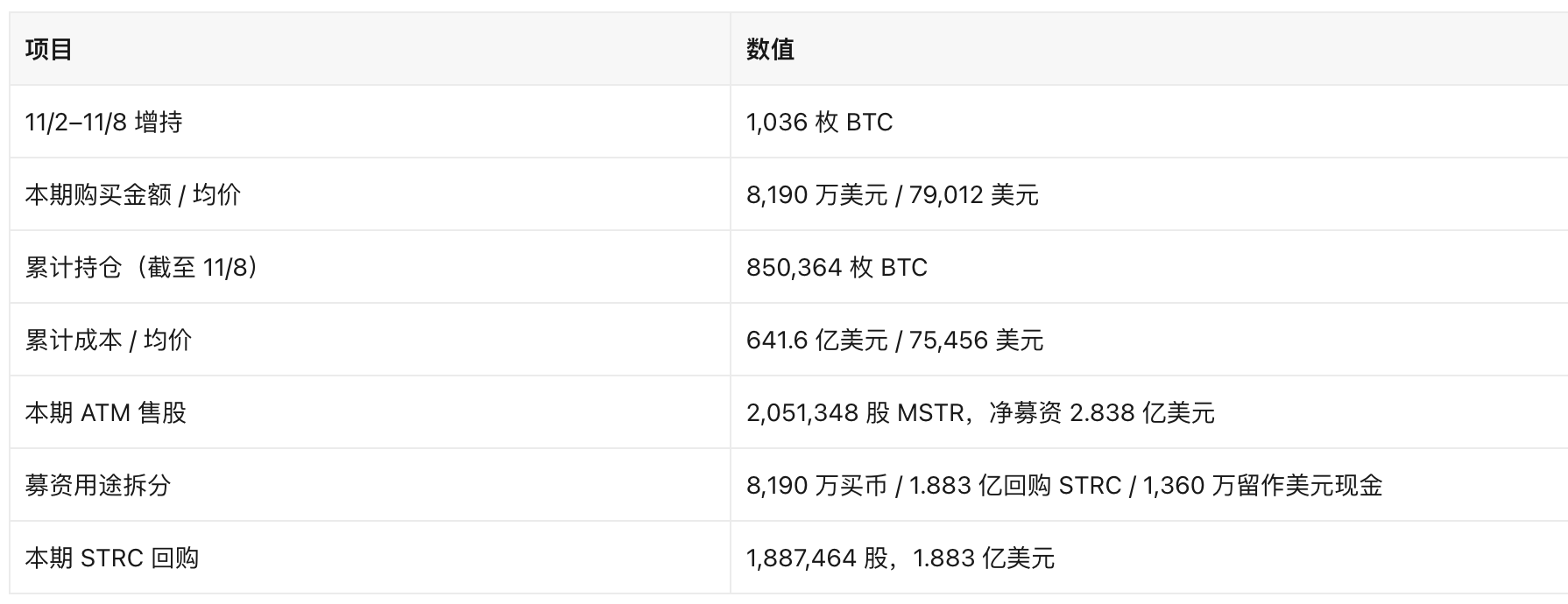
- Key signal one: Coin price fell below cost basis. Based on BTC at $74,853.97 as of 11/9 21:21 (US Eastern), the holdings' market value is approximately $63.65 billion, below the $64.16 billion cost, with an unrealized loss of approximately $510 million (-0.8%). This is the first time in this downturn that Strategy has turned to an overall unrealized loss.
- Key signal two: Financing still relies on ATM, but nearly 60% of proceeds were used to repurchase preferred stock rather than buy coins. Of the $283.8 million in net proceeds, only 28.9% was used to buy coins, and 66.3% was used to repurchase STRC — continuing the "capital structure repair first" strategy since October.
- Key signal three: Valuation discount. Market cap $53.04 billion / holdings market value $63.65 billion = 0.83x (this measure does not include total liabilities and preferred stock, and is not equal to a complete EV/NAV).
- Remaining issuance capacity: MSTR $18.34 billion, STRC $17.51 billion, STRF $1.62 billion, STRK $2.10 billion, STRD $4.01 billion — ample issuance ammunition remains, which is a source of continuous dilution pressure during a coin price downturn.
Other DATs
- BitMine (BMNR, $18.61, -0.80%, market cap $11.22 billion): ETH holdings of 6.07 million coins, crypto assets + cash totaling $14.3 billion, still the world's largest Ethereum treasury company; the pace of additions slowed this week.
- Strive (ASST, $21.46, +0.05%, market cap $2.73 billion): No new purchases this week, with the pace of additions slowing in tandem; holdings of 43,124 BTC at an October average purchase price of $83,310, with unrealized losses widening as the coin price falls.
- SharpLink (SBET, $6.13, -1.76%, market cap $1.33 billion): An ETH treasury name, following the decline.
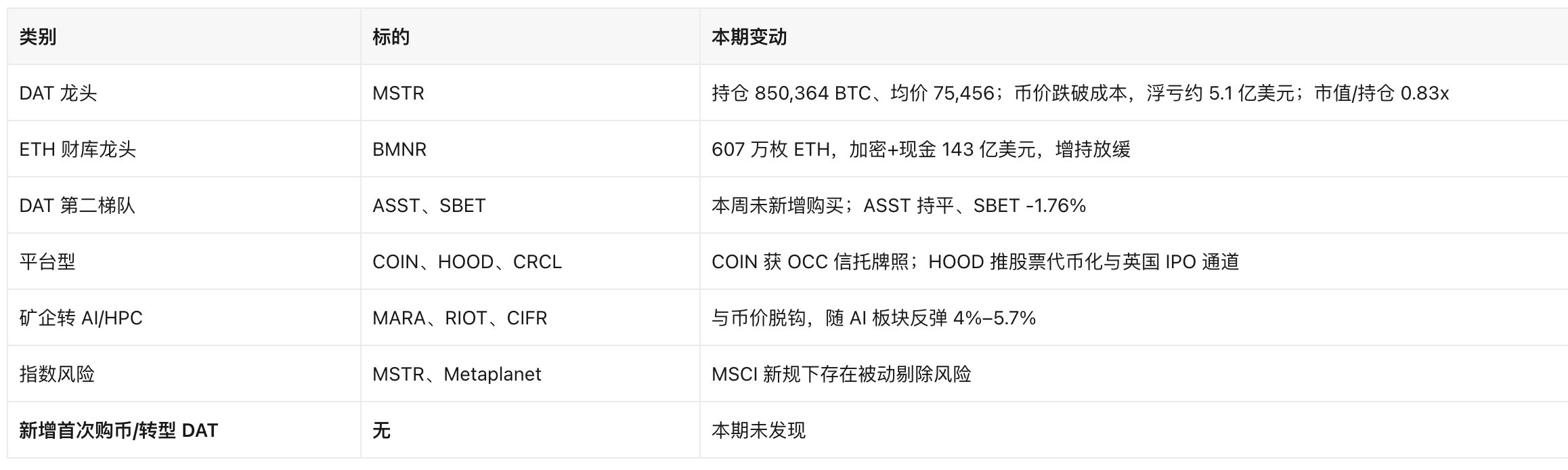
4.2 New Entrants and Transformations: No New Additions This Period
Crypto US Stock Watchlist additions: No US-listed company was found to have announced a first-time purchase of BTC/ETH or a transformation into a crypto DAT during this period (11/7–11/10). This "blank" is itself a signal: when BTC falls below the average DAT cost basis and mNAV is generally below 1, the financing arbitrage space for new entrants disappears, and incremental entry naturally stalls. The reverse trend continues — miners keep shifting capex from mining to AI/HPC hosting (RIOT's $2.8 billion AI lease at Corsicana, IREN/CORZ planning to exit mining by year-end).
4.3 Broad Crypto US Stocks and ETFs
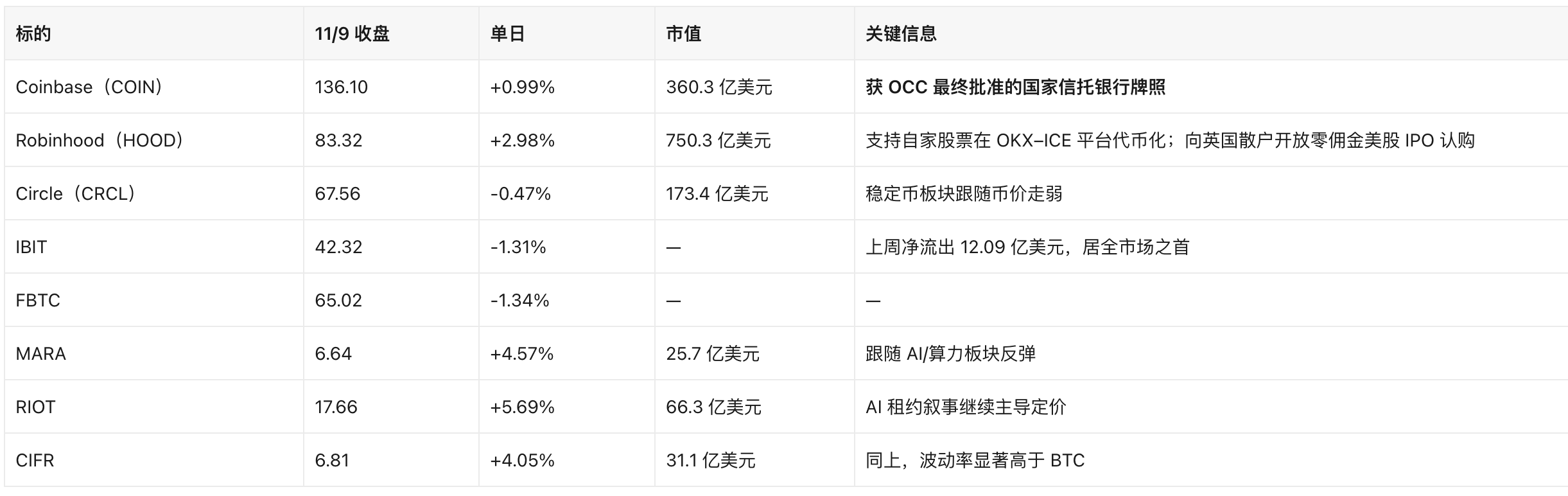
- Miners decoupled from the coin price. On Monday BTC fell 1.18% (versus last Friday's close), but MARA/RIOT/CIFR rose 4%–5.7%; on 11/8 there were also reports that "Bitdeer and Riot rose 13% in a single day while BTC fell below $75,000." The pricing anchor has shifted from "hashrate/coin price" to "power and AI rack leases."
- ETF fund flows: US spot Bitcoin ETFs saw combined net outflows of $1.282 billion during 11/2–11/6 (IBIT -$1.209 billion), the largest weekly outflow since June, with the year-to-date cumulative flow turning to net outflow in 2026; total market ETF net assets fell to approximately $96 billion. The single-day flow data for 11/9 has not yet been released (Farside/The Block usually update on the next US Eastern day), and was not obtained for this period.
4.4 Regulatory and Accounting Drivers
- Coinbase obtained a final OCC trust bank charter (11/9): It can hold a federal trust charter alongside Circle, Ripple, and others, meaning its custody business gains federal-level certainty and can expand under a more unified regulatory framework. This is the most important structural positive for crypto US stocks on the day — explaining why COIN still closed higher while BTC fell.
- Treasury/OFAC cut off MEXC's channel (11/6–11/7): Citing suspected involvement of approximately $16 billion in Iran-, North Korea-, and Russia-related funds, it cut off its USD clearing path. This is relatively positive for compliant platforms (COIN) and a persistent discount factor for offshore exchanges.
- MSCI index rules (finalized 10/15): Companies with excessively high digital asset proportions face removal risk, with Strategy and Metaplanet on the list; some institutions estimate potential passive selling pressure of approximately $2.8 billion (this figure is a third-party estimate, not confirmed by MSCI). This is a non-fundamental risk for DAT leaders, which will be amplified during periods of coin price weakness.
- Accounting treatment: ASU 2023-08 fair value measurement directly ties DAT income statements to the coin price. BTC falling below the average price means the coins bought at high levels in Q4 will directly create book losses, in turn suppressing their willingness to continue issuing — this is precisely the financial backdrop for Strategy prioritizing proceeds for STRC repurchases.
4.5 Crypto US Stock Watchlist (Changes This Period)
5. Geopolitical Impact
5.1 Iran: From "War Premium" to "Ceasefire Discount"
- Trump said that if negotiations make progress, resuming strikes on Iran is "extremely unlikely," and he prefers to maintain the status quo; Defense Secretary Hegseth said "the Iran war has been won"; Secretary of State Rubio criticized Iran's demands. The market heard that an approximately $8 billion Strait of Hormuz arrangement is awaiting Trump's sign-off. After the close on 11/8, oil prices at one point fell more than $7/barrel. (CNBC, WSJ, Reuters, Bloomberg, Washington Post)
- Transmission path: Oil prices↓ → inflation expectations↓ → long-end rate pressure eases → growth stock valuations recover; at the same time, energy sector earnings expectations are revised down.
- Direction and uncertainty: This is an "expectation trade," not a "deal landing." If negotiations break down, oil prices could recover the entire decline within a day; the specific terms of the Hormuz-related arrangement (transit fees, sanctions exemptions) have not been made public, and it is inappropriate to price in "peace has arrived."
5.2 Midterm Elections: Divided Government = Rising Policy Uncertainty
- Democrats won control of both chambers of Congress (NYT, Reuters, 11/4). The market first rallied on "lower political uncertainty" (the Dow rose 1,500 points on 11/4), then turned to an AI selloff over the next two days, with the Nasdaq entering a correction (11/5–11/6), as geopolitical/policy factors overlapped: AI regulatory path, tariff authority, fiscal policy, and the debt ceiling all entered repricing. (BBC, NBC, AP)
- Transmission: A divided government is usually bearish for fiscal expansion and bullish for the continuation of the status quo under "policy gridlock"; but what is special this time is that it occurred at the most fragile point for the AI capex narrative, so the market read it as a double discount of "AI policy risk + earnings realization risk."
- Trump said he will use the veto extensively and attributed the $3 trillion market value wipeout to the election results — political noise will continue to amplify volatility.
5.3 US-China Trade: Tariff Suspension Period Extended by Two Months
- China extended the suspension period for its 24% tariffs on the US to January next year, retaining the 10% rate, and the port fee truce was extended in tandem. (Reuters, Bloomberg, Quartz)
- Transmission: Short-term positive for risk appetite in semiconductor equipment and the consumer electronics supply chain; however, "Democrats controlling Congress" makes the subsequent trade legislative path more unpredictable, which is "deferred uncertainty" rather than elimination.
5.4 Debt and Rates: Tail Risk Resurfaced
- The 10-year at 4.864%, a December rate