Goldman Sachs: The U.S. Stock Market Bull Run Has One "Last Push" Left in 2027, but What Follows Resembles the Eve of the 2000 Bubble Burst


- Core View: Goldman Sachs warns that while the primary trend of the U.S. stock market bull run has not broken, it has entered its countdown. The S&P 500 may complete one final leg up, and 2027 will face the largest net equity supply shock since 2000, with the three major variables driving the market—earnings, capital flows, and the AI narrative—deteriorating in tandem.
- Key Elements:
- S&P 500 earnings growth reached 33% in Q2 and is projected at 35% in Q3, the fastest pace for a non-recession recovery period in 30 years, but a slowdown in growth has become a high-probability event.
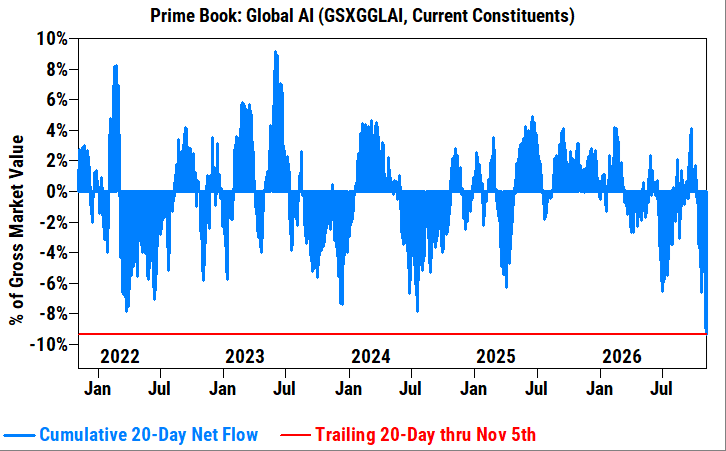
- Hedge funds have sold global AI stocks over the past 20 trading days at the fastest pace in more than five years, deviating from the mean by more than 3 standard deviations; weakening corporate buybacks, contracting overseas buying, and mechanical selling by CTAs have formed a "buyers' strike."
- Net equity supply additions in the U.S. market in 2027 are expected to hit the highest level since 2000, with large IPOs such as SpaceX and Anthropic and cash flows shifting toward capital expenditures creating dual supply-demand pressure.
- Market consensus shows that capex growth for tech giants will slow from 96% this year to 44% next year, with hyperscale cloud providers' net free cash flow consumption reaching $31 billion in Q3.
- The Nasdaq 100 forward P/E ratio has fallen to 18.4x, the lowest since 2020, about 4 valuation multiples below pre-ChatGPT launch levels.
- The credit market has already begun pricing in construction financing concerns, with two veteran investors warning that the stock market is "overly complacent" relative to the credit market.
Original author: Xu Chao
Original source: Wallstreetcn
A market inflection point is approaching. Tony Pasquariello, Goldman Sachs' global head of hedge fund coverage, has issued a warning: while the primary uptrend of the US stock bull market remains intact, the countdown has begun. He expects the S&P 500 to complete one final leg higher, after which 2027 will face the largest net equity supply shock since the bursting of the dot-com bubble in 2000.
In his latest weekly note, Pasquariello pointed out that the three core variables that have driven the US stock market's strong performance over the past four years—earnings growth, capital flows, and the AI narrative—have all deteriorated in tandem at the margin. He explicitly stated, "I expect the S&P to complete one final push higher before the turn, but 2027 is destined to be a year of far more meager returns," and warned that the baseline level of index volatility will trend higher.
Notably, in the same week, another Goldman Sachs strategist, Rich Privorotsky, also invoked a comparison to the dot-com peak of this cycle in a report titled "1998 or 2000?"—meaning that within a single week, Goldman Sachs internally produced two implicit echoes of the 2000 tech stock crash. Meanwhile, this week the Nasdaq 100 Index saw a single-day decline of as much as 6.36%, the largest one-day drop since the COVID-19 pandemic, and hedge funds have given back nearly all of their year-to-date gains.
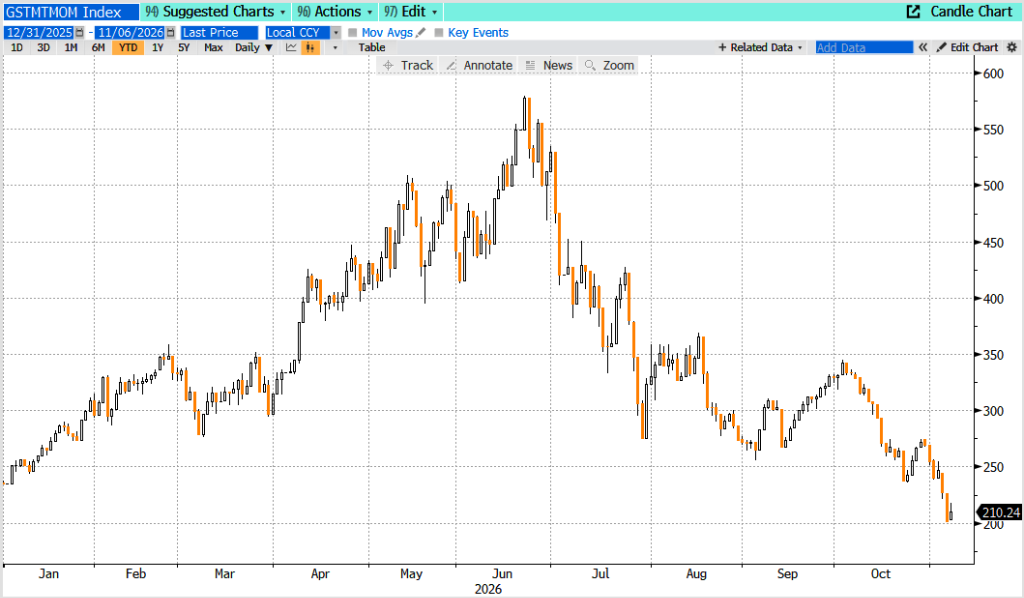
Earnings Growth Peaks, Upside Momentum Unsustainable
On the earnings side, S&P 500 earnings growth reached 33% in the second quarter and is expected to hit 35% in the third quarter. He noted that "this is the fastest earnings growth in 30 years outside of post-recession recovery periods."
However, a slowdown in growth has become a high-probability event. Pasquariello acknowledged that the market is highly sensitive to rates of change: "The tension between the second derivative and the first derivative is precisely the core contradiction I have been weighing repeatedly, and this contradiction is becoming increasingly complex." Although Goldman Sachs forecasts that S&P EPS can still achieve approximately 18% growth next year, and historical data shows that the odds still favor the bulls, he explicitly stated: "It is increasingly difficult to imagine earnings once again providing the kind of upside convexity we have enjoyed in recent years."
He also specifically noted that Goldman Sachs' earnings forecast is "extremely sensitive to AI capital expenditure," and that this week's developments have significantly raised the downside risks to that forecast.
Deteriorating Capital Flows, 2027 Net Supply to Hit Highest Since 2000
The signals on the capital flows front are even more severe. Pasquariello wrote that over the past three months the market has continued to absorb broad and deep selling pressure, and this week's selling has entered a "full-blown" state. According to Goldman Sachs prime brokerage data, on a trailing 20-trading-day basis, hedge funds have sold global AI stocks at the fastest pace in over five years, more than 3 standard deviations from the mean.
Buyers have also collectively pulled back. Weakening corporate buybacks, shrinking purchases by overseas investors, and mechanical follow-on selling by quantitative strategies such as CTAs have together created a "buyers' strike."
Even more alarming is the supply pressure in 2027: Pasquariello explicitly pointed out that the net increase in US equity supply in 2027 is expected to hit the highest level since 2000. The confluence of a large IPO pipeline including SpaceX and Anthropic, and a shift in corporate cash flow (prioritizing capital expenditure over buybacks), will create pressure on both the supply and demand sides simultaneously. While he holds a relatively optimistic view on liquidity in the final eight weeks of the year and noted that buyback volumes have recovered to about $5 billion per day, this short-term support cannot mask the structural pressures of 2027.
Cracks in the AI Narrative, Left-Tail Risk Expands
Pasquariello listed the AI narrative as the "most difficult variable to clarify." As the market entered this week, there was already a broad consensus that capital expenditure growth at tech giants has peaked—market consensus shows related growth slowing from 96% this year to 44% next year; at the same time, hyperscale cloud providers consumed $31 billion in net free cash flow in the third quarter, and unease over their continued "negative free cash flow" has been building.
He summarized this week's developments' impact on the AI outlook in four points: First, AI capital expenditure was previously the market's "rocket fuel," but the market is now forced to seriously examine whether the buildout intensity can be sustained; second, the AI capex outlook has broadened the distribution of possible outcomes, "introducing more left-tail risk to a market that had previously chased almost exclusively the right tail"; third, if the buildout pace cools somewhat, the cycle may lengthen, and cautious optimism can still be maintained over the medium term; fourth, the upside convexity of AI infrastructure "picks and shovels" names will be hard pressed not to compress.
As for the optimistic Rich Privorotsky, he tends to analogize this correction to 1998 rather than 2000, viewing it as a liquidity event rather than the end of a cycle—"delaying data center construction does not equal destroying compute demand." But he also acknowledged that "the unsettling similarity to 2000 lies in the sheer scale of spending and the uncertainty of returns"—which precisely echoes Pasquariello's 2000 supply warning.
Valuation Reset Provides a Buffer, but Credit Markets Are Already Flashing Warnings
Pasquariello did not shy away from the bulls' core argument: after this round of de-rating, "the market is now at a reasonable valuation level." He noted that the forward price-to-earnings ratios of the Nasdaq 100 and the Philadelphia Semiconductor Index are both below their levels prior to the release of ChatGPT in November 2022, roughly 4 valuation multiples cheaper, with the Nasdaq 100's forward P/E falling to 18.4x, the lowest since 2020.
However, at the end of the report he disclosed a deeper concern: two investors he deeply respects recently told him that "the equity market is too complacent relative to the credit market." Combined with the triple overlay of rate hikes being brought back into discussion in December, pressure on AI-related high-yield bonds, and the largest net supply pressure in 2027, the credit market is the first to price the financing problem of the buildout—and whether the equity market has fully reflected this remains the core unresolved question.
Pasquariello's final conclusion is clear and prudent: the primary bull trend remains, and there may be one last push higher at year-end, but the "inflection point" has now been written into the outlook in so many words, and 2027 will be a trading environment that "requires even greater agility."