Bank of America: Chip Stock Selloff May Bottom in Early 2027, Stock Prices Typically Lead Fundamentals by 6-9 Months


- Key Takeaway: BofA believes the current "indiscriminate selloff" in the SOX semiconductor index has exceeded the historical average in magnitude but lasted less than half as long, and may bottom in early 2027, with genuine earnings downgrades being the key to market clearing.
- Key Points:
- The SOX index has fallen 38% (from 14,634 to 9,011 points) since its June 2026 peak over 136 days; the four historical downturns averaged a 32% decline lasting 253 days.
- The current forward P/E is 13.7x, a 22% discount to the S&P 500, versus a 15% premium during the AI boom; the historical bottom was around 12x, implying roughly 12% further downside.
- U.S. cloud computing capex is running at an annualized ~$1.2 trillion, about 23% below the 2027 consensus of $1.555 trillion, corresponding to roughly 30 GW of compute deployment.
- If 2027 capex is cut by 20%, AI semiconductor revenue faces over 20% downside pressure, with EPS risk of 35-40%.
- The SOX index typically leads semiconductor sales declines by 6-9 months, and has rallied an average of about 42% after historical cycles.
- Potential catalysts include policy clarity, buybacks by leading players (Lam Research's $25 billion, Nvidia, Micron), and a capex slowdown that extends the upcycle.
Author: Long Yue
Source: Wallstreetcn
The US SOX semiconductor index has fallen 38% cumulatively from its June 22, 2026 high through November 5, dropping from 14,634 points to 9,011 points over 136 days.
By comparison, BofA analysts including Vivek Arya, in their latest research report, tallied the past four major semiconductor downturns—2011, 2015, 2018, and 2022—which lasted an average of 253 days with an average peak-to-trough decline of 32%.
In other words, the magnitude of this decline has already exceeded the historical average, but its duration is less than half the historical mean.
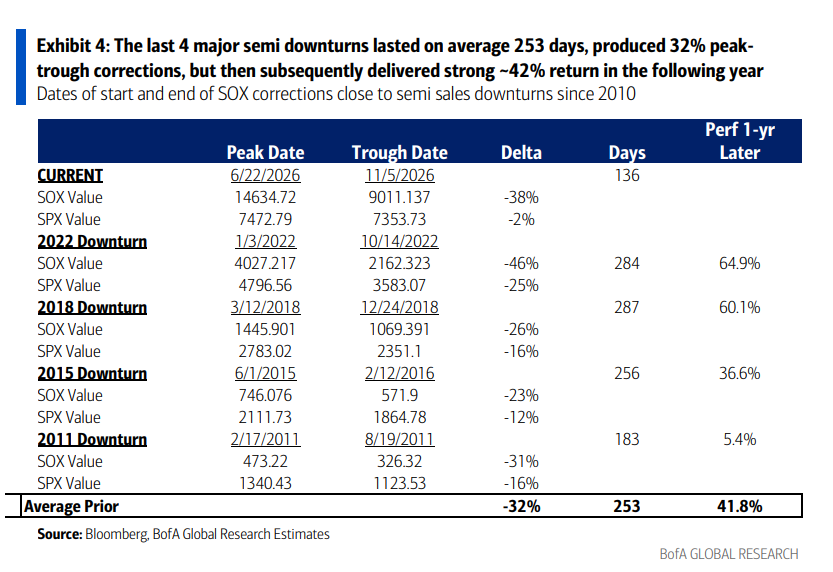
According to Zhufeng Trading Desk, analysts including Vivek Arya believe that this "indiscriminate selling" could run its course by early 2027. They noted that the current selloff has a clear "indiscriminate" character—market concerns over slowing AI capital expenditures have led to chip stocks being sold off without distinction.
In past cycles, the SOX index's decline has typically led the actual downturn in semiconductor sales by 6-9 months, after which it rebounded by an average of about 42% once earnings expectations were fully priced in. The report wrote:
The peak in late June 2026 conceptually implies that EPS cuts may begin to materialize starting in Q1 2027, when policy changes will be reflected in capex cuts or slowdowns in the second half of 2027.
In other words, the real deterioration in fundamentals may not fully erupt until 2027—but stock prices may have already priced in this bad news in advance.
Valuation: How Far from the Historical Bottom?
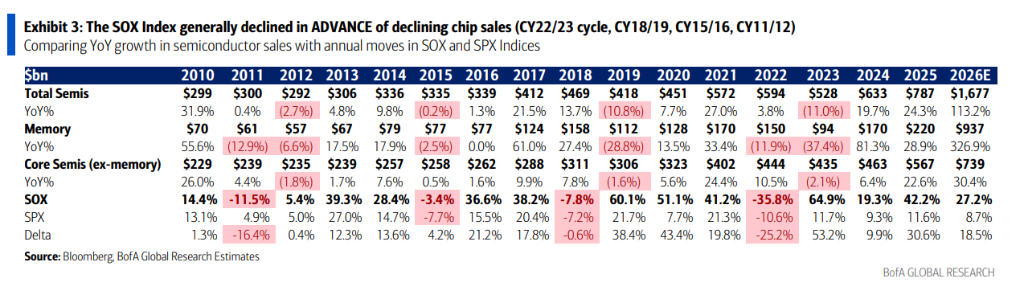
The US SOX semiconductor index currently trades at a forward P/E of 13.7x, versus 17.7x for the S&P 500, putting the semiconductor sector at a 22% discount to the broader market.
At the height of the AI rally, chip stocks traded at a 15% premium to the broader market. This shift from premium to discount represents a swing of nearly 37 percentage points.
Looking at historical trough valuations, the SOX's forward P/E at past cycle lows was approximately 12x. On that basis, the current valuation has only about 12% of downside left to the historical bottom.
Analyst Vivek Arya wrote:
The semiconductor sector is already trading at a 22% discount, and a considerable portion of earnings downgrade expectations may have been priced in. But we would note that actual EPS cuts—not just cheap valuations—are what would truly reassure investors, and that takes time.
Capex: How Real Is the Pressure?
The core concern behind this selloff is whether AI capital expenditures will contract significantly.
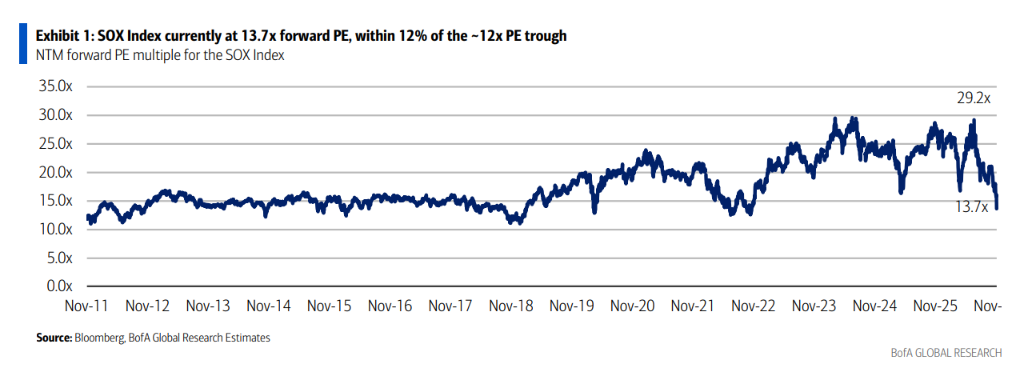
BofA data shows that US cloud capital spending is currently running at a quarterly rate of about $300 billion, or roughly $1.2 trillion annualized. The consensus forecast for full-year 2027 is $1.555 trillion.
In other words, if capex remains at the current rate, actual 2027 spending will be about 23% below expectations.
For traditional hyperscalers, expected 2027 capex is $1.221 trillion versus a current run rate of $982.5 billion—a gap of about 20%; for emerging cloud providers, the gap is even larger at about 35%.
Further calculation: $1.2 trillion in annualized capex, at an average cost of $40 billion per gigawatt, corresponds to about 30 GW of compute deployment—below BofA's baseline assumption of over 40 GW.
If Capex Is Cut by 20%, What Happens to Chip Companies' EPS?
The analyst conducted a high-level estimate:
If 2027 capex is cut by 20% versus expectations, AI semiconductor revenue would face over 20% downside pressure, with EPS facing 35-40% downside risk—broadly comparable to the EPS cuts seen in historical cycles.
However, the analyst also noted that actual capex cuts may be more focused on future land, power, and facility investments, while next-generation chips with higher compute efficiency (such as Nvidia's Vera Rubin) will remain priority purchases. In addition, demand headwinds in one region may drive demand higher in others, and AI capex has become an important driver of US GDP growth.
Three Scenarios: What to Buy?
The bank laid out a three-scenario investment framework:
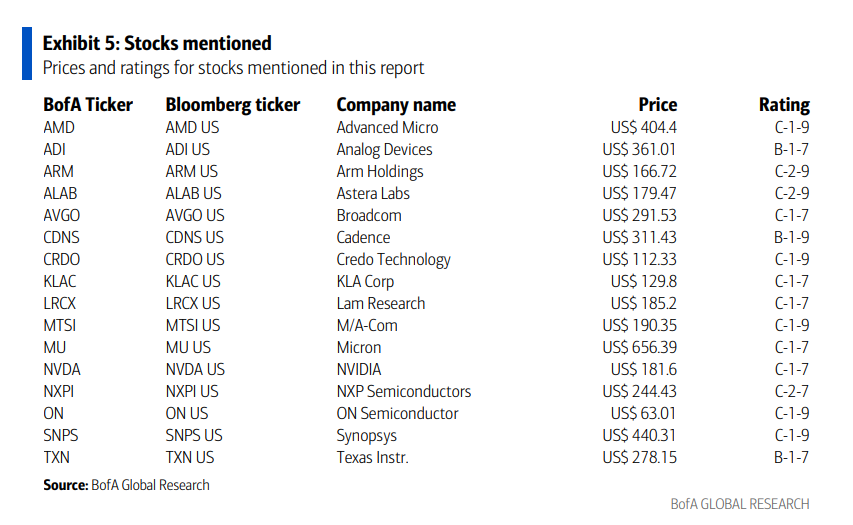
Base case (about 10% downside risk, bottoming in Q1 2027): Favor leaders in each sub-sector—compute chips, networking chips, semiconductor equipment, memory, and analog chips.
Bear case (downside extends into mid-2027, sustained pressure until capex clearly inflects): Defensive names are relatively favored, including EDA software, high free cash flow analog chips, and companies with less AI exposure.
Bull case (capex recovery exceeds expectations): High-beta names would lead, including memory, optics, quantum computing, and CPUs.
What Other Factors Could Help Stabilize the Market?
The bank mentioned several potential positive catalysts:
First, policy clarity. Policy clarity at the US Congressional level could help drive a recovery in market confidence in Q1 2027.
Second, buyback support. Lam Research announced a $25 billion buyback plan, Nvidia's buyback continues to advance, and Micron will initiate a buyback on December 9.
Third, the capex slowdown itself may also extend the duration of the semiconductor upcycle.
SOX Has Historically Always Led Semiconductor Sales Declines
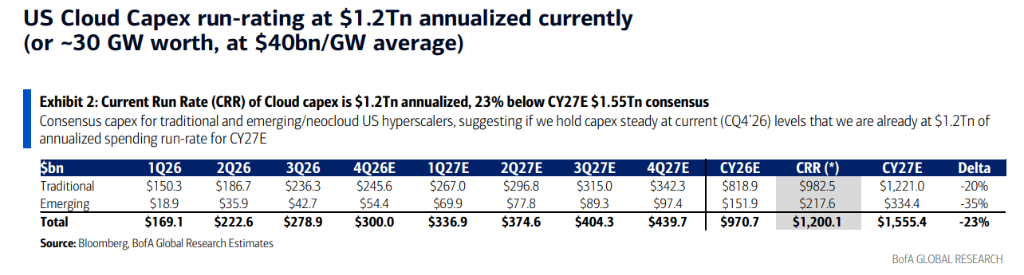
BofA's historical data also shows that the SOX index has almost always declined ahead of semiconductor sales downturns across past cycles—including 2022/23, 2018/19, 2015/16, and 2011/12.
According to the data, full-year 2026 semiconductor sales are expected to reach $1.677 trillion, up 113.2% year-over-year, with memory chips contributing significantly (estimated at $937 billion, up 326.9% year-over-year). Meanwhile, the SOX index is up about 27.2% year-to-date in 2026, still outperforming the S&P 500's 8.7%.