美联储加息,SGOV为什么不怎么跌?短期美债ETF的收益逻辑


1. Buying SGOV, BIL, and SHV: What Exactly Are You Buying?
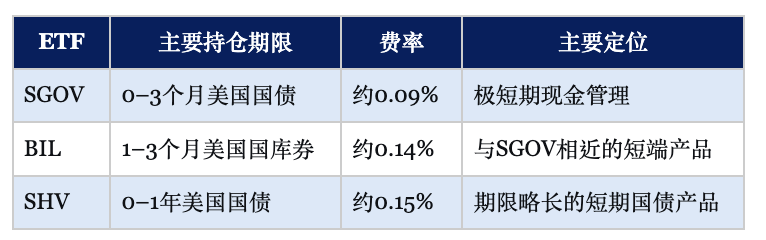
SGOV, BIL, and SHV are all ETFs that primarily invest in U.S. Treasury securities, but their holding maturities differ. SGOV mainly holds U.S. Treasuries with remaining maturities of 0 to 3 months, BIL mainly holds 1- to 3-month U.S. Treasury bills, and SHV covers short-term U.S. Treasuries with maturities of 0 to 1 year. What all three share is short duration—interest rate changes typically have a far smaller impact on their net asset value than on long-term Treasury ETFs—and their main differences lie in holding maturity, portfolio duration, and management fees.
To understand this type of product, one must first understand how U.S. Treasury bills generate returns. Unlike ordinary coupon-bearing Treasuries, T-bills generally do not pay coupon interest periodically; instead, they are issued at a price below face value and redeemed at face value at maturity, with the difference between the purchase price and the maturity redemption amount being the interest income the investor receives. For example, an investor buys a three-month T-bill with a face value of $100 for $99.5, receives $100 at maturity three months later, and the $0.5 difference is the return on this investment, which annualizes to roughly 2% (excluding transaction costs and other factors).
After the fund buys a basket of T-bills, it gradually earns the corresponding returns on these bonds during the holding period. Bond prices gradually approach face value as maturity nears, and the related returns are reflected in the fund's assets, which are then distributed to holders through the fund's distribution mechanism. Therefore, the goal of holding SGOV is to hold a basket of short-term T-bills through the fund and earn the interest income they generate during the holding period; waiting for the price of a particular bond to rise significantly is not a source of return for this type of product.
SGOV and BIL concentrate their holdings in short-term T-bills; after the bonds mature, the fund can quickly recover principal and reinvest in new bills. SHV covers a somewhat longer maturity range and is therefore typically more sensitive to interest rate changes. Two concepts also need to be distinguished here. The maturity range stated on the product does not represent the actual remaining maturity of every bond in the portfolio, nor does it equal the fund's effective duration. What truly measures the fund's sensitivity to interest rate changes is still metrics such as effective duration.
Take SGOV as an example. As of October 30, its total assets were approximately $116.8 billion, making it one of the larger ultra-short-term U.S. Treasury ETFs, and it distributes income monthly. By buying it, investors are effectively holding a basket of short-term U.S. Treasuries through an ETF and earning the interest income these bonds generate. For temporarily idle U.S. dollar funds, SGOV offers a way to participate in the returns of the short-term Treasury market; pursuing bond price appreciation is not its primary investment objective.
Compared with other common U.S. dollar cash instruments, SGOV's characteristics are also fairly clear. Buying T-bills directly allows you to hold a single bond until maturity and know its maturity redemption amount in advance, but you need to complete transactions through auctions or the secondary market and arrange reinvestment of maturing funds yourself. Bank deposit rates are quoted by the bank, and time deposits typically lock in the rate for an agreed term, but fund flexibility is relatively low. Money market funds may have similarities with short-term Treasury funds in their underlying assets and return mechanisms, but their specific holdings, subscription and redemption rules, and risks are not entirely the same. SGOV, by contrast, trades on an exchange as an ETF, allowing investors to buy and sell by the share without having to manage the maturity and rollover of T-bills one by one; the trade-off is that the fund's NAV still fluctuates with the market, and returns are not guaranteed to be fixed. Choosing this type of ETF is essentially exchanging market-based floating returns for convenience in trading and holdings management.
2. Why Doesn't SGOV's NAV Fall Much When the Fed Raises Rates?
SGOV's NAV is relatively stable mainly because its duration is very short. The shorter the duration, the smaller the impact of rising market interest rates on the prices of existing bonds tends to be. Bond prices and market interest rates usually move inversely, but how much prices fall depends not only on how much rates rise but also on the bond's duration. Long-term bonds have cash flows spread over a longer period and are more sensitive to interest rate changes. Short-term T-bills mature quickly, so their prices react far less to interest rate changes.
Take the long-term Treasury ETF TLT as an example; its effective duration is approximately 16 to 17 years. According to a Yahoo Finance analysis in September 2026, all else being equal, a 1 percentage point rise in long-term Treasury yields could cause TLT's price to fall by about 16%. By comparison, SGOV's effective duration is approximately 0.09 years. Assuming the same 1 percentage point rise in market yields, based on duration estimates, SGOV's price impact would be only about 0.09%. This is merely an approximate estimate of interest rate sensitivity and does not mean the fund's actual NAV will necessarily change by that magnitude.
The role of duration can be understood from bond cash flows. The principal of long-term bonds often is not repaid until more than a decade later, and investors must continue to wait for coupon income in the meantime. After market interest rates rise, these future cash flows must be recalculated at a higher discount rate, and the farther a cash flow is from the present, the larger the discounting impact usually is, so long-term bond prices fall significantly. The T-bills held by SGOV, by contrast, mature successively within a few months, allowing the fund to quickly recover principal and buy new bills at the then-current market rates. Although existing holdings are still affected by interest rate changes, the scope of impact is limited, and the fund can update its holdings quickly. By comparison, long-term Treasury ETFs hold bonds with longer maturities, and existing low-yield bonds cannot quickly mature and be replaced, so the market can only adjust their yields through price declines.
Market performance in 2022 illustrates the difference more intuitively. That year, the Fed rapidly raised the policy rate from near zero to above 4%, and the long-term Treasury ETF TLT posted a total return of -31.41% for the year. SGOV, BIL, and SHV posted total returns of 1.58%, 1.38%, and 0.94%, respectively, all positive.
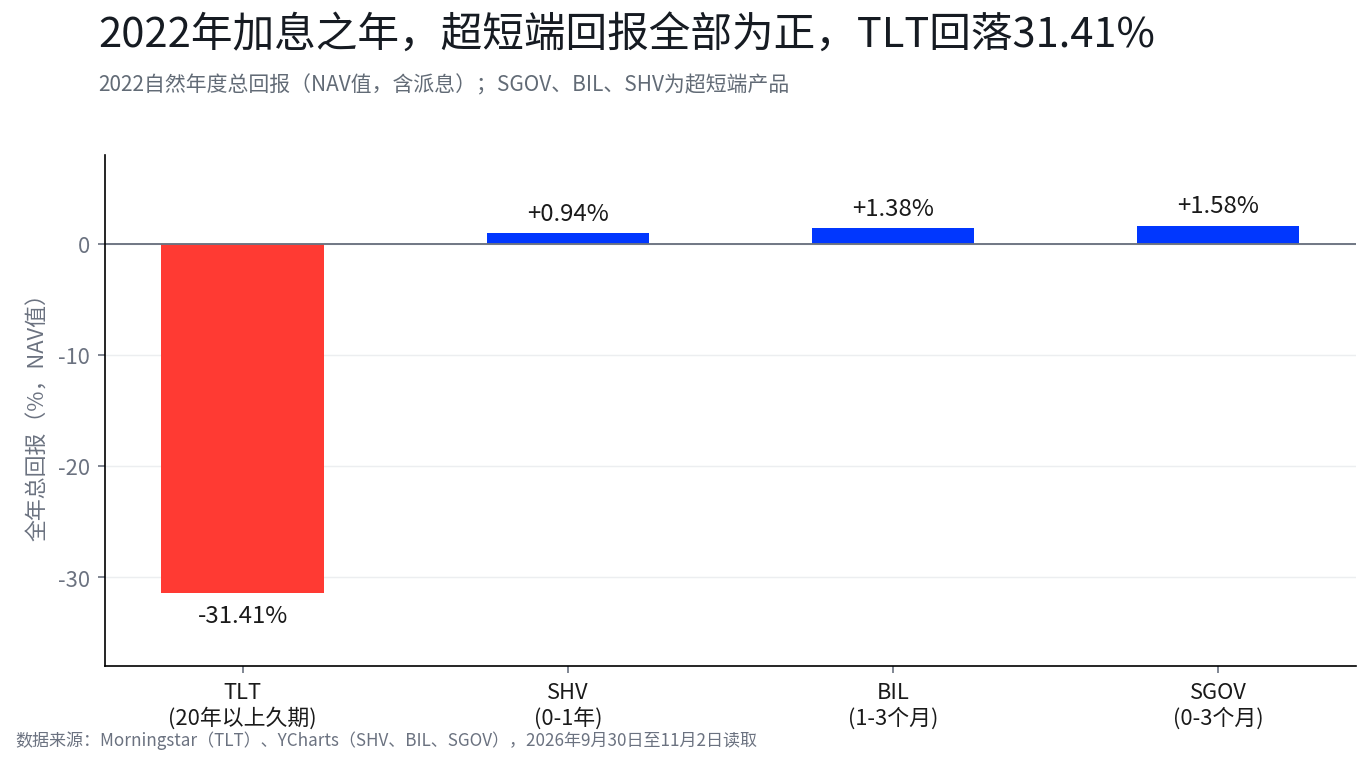
Data reflects total return (NAV, including distributions) for the 2022 calendar year. SGOV, BIL, and SHV are short-term Treasury products; TLT is a long-term Treasury ETF with a maturity of more than 20 years.
However, short duration does not mean the NAV has no volatility at all. SHV recorded a total return of -0.10% in 2021, showing that in a year when rates were near zero and yields changed, short-term Treasury ETFs could also post returns close to zero or even slightly negative. NAV volatility depends on the speed and magnitude of yield changes, but because duration is very short, the price impact is usually fairly limited. Taking SGOV's effective duration of about 0.09 years as an example, all else being equal, a 1 percentage point rise in yields corresponds to a price impact of about 0.09%. This is precisely the main difference between short-term Treasury ETFs and long-term Treasury ETFs. The former generally carries less price risk, but it is not free of price risk.
The 2022 data also should not be extrapolated to mean that short-term Treasury ETFs can achieve positive returns in any rate-hiking environment. What it shows is that short duration significantly reduces the price losses caused by rising rates. That year, short-term Treasury yields rose gradually as the Fed continued to hike, and the fund could invest maturing funds in new bills with higher yields; the increased interest income helped offset limited price volatility. Thereafter, SGOV's annual total returns in 2023 and 2024 were approximately 5.12% and 5.27%, respectively, further illustrating that returns for this type of product mainly come from continuously accumulated interest income, with a relatively limited contribution from NAV appreciation.
3. Where Does SGOV's Return Come From? The Answer Is Reinvestment at Maturity
SGOV's returns mainly come from the interest generated by the underlying T-bills and from the returns the fund earns by reinvesting maturing principal into new bills. Because the bonds held have very short maturities, the fund continuously recovers maturing principal and buys new short-term Treasuries at the then-current market rates. The U.S. Treasury regularly auctions T-bills with maturities ranging from a few weeks to half a year, and the fund can participate in primary market auctions or buy in the secondary market at the then-current market prices and yields. Short-term Treasury yields are determined jointly by market supply and demand for funds and interest rate expectations; Fed adjustments to the policy rate affect the short end of the market, but market yields do not necessarily wait until the Fed formally acts before changing.
Suppose short-term Treasury yields rise from 3% to 4%. As existing bonds mature successively, the fund has the opportunity to invest the recovered principal in new bills with higher yields, and the portfolio's overall yield level will gradually move toward the new market rate. This process does not happen overnight; it occurs gradually as holdings mature and the fund continues to buy new bills. SGOV mainly holds T-bills with maturities of 0 to 3 months, so its portfolio turns over relatively quickly, and changes in market rates can usually be reflected in portfolio income within a relatively short period.
A simplified example can help illustrate this process. Suppose the fund's existing portfolio yields 3%, and after market rates rise, newly purchased T-bills yield 4%. As existing holdings mature successively and the fund invests the proceeds in new bills, the portfolio yield will gradually move from 3% toward 4%. The specific pace of increase depends on the maturity distribution of existing bonds, the actual rollover ratio, and changes in market yields; it is not the case that for every fixed percentage of the portfolio rolled over, the portfolio yield will necessarily rise by the same proportion.
This differs from the return mechanism of long-term fixed-coupon bonds. The coupon on a long-term bond is basically set at purchase; even if market rates later rise, the existing bond does not automatically earn a higher coupon. If investors want to switch to new bonds with higher yields, they need to sell the existing bonds, and when market rates rise, the price of the old bonds has often already fallen. SGOV's holdings have short maturities and fast capital turnover, allowing it to adjust portfolio returns by continuously buying new bills, so it more easily tracks changes in short-end market rates.
Looking at SGOV's returns over several years together shows the impact of different rate environments on return levels. In 2022, during the early stage of rate hikes, short-term Treasury yields rose gradually from low levels, and SGOV's total return for the year was 1.58%. From 2023 to 2024, the policy rate was on a high plateau, short-term Treasury yields remained at relatively high levels, and SGOV's annual total returns were approximately 5.12% and 5.27%, respectively. After rate hikes restarted in September 2026, short-term rates rose again, and SGOV's year-to-date return was 3.04% (as of October 29). These data reflect that SGOV's return level is closely related to short-term Treasury market rates. In the early stage of rate hikes, yields take time to transmit gradually to the fund's holdings. When rates remain high, the fund can continuously earn relatively high interest income. When market rates change again, the fund's returns will also adjust as holdings are updated.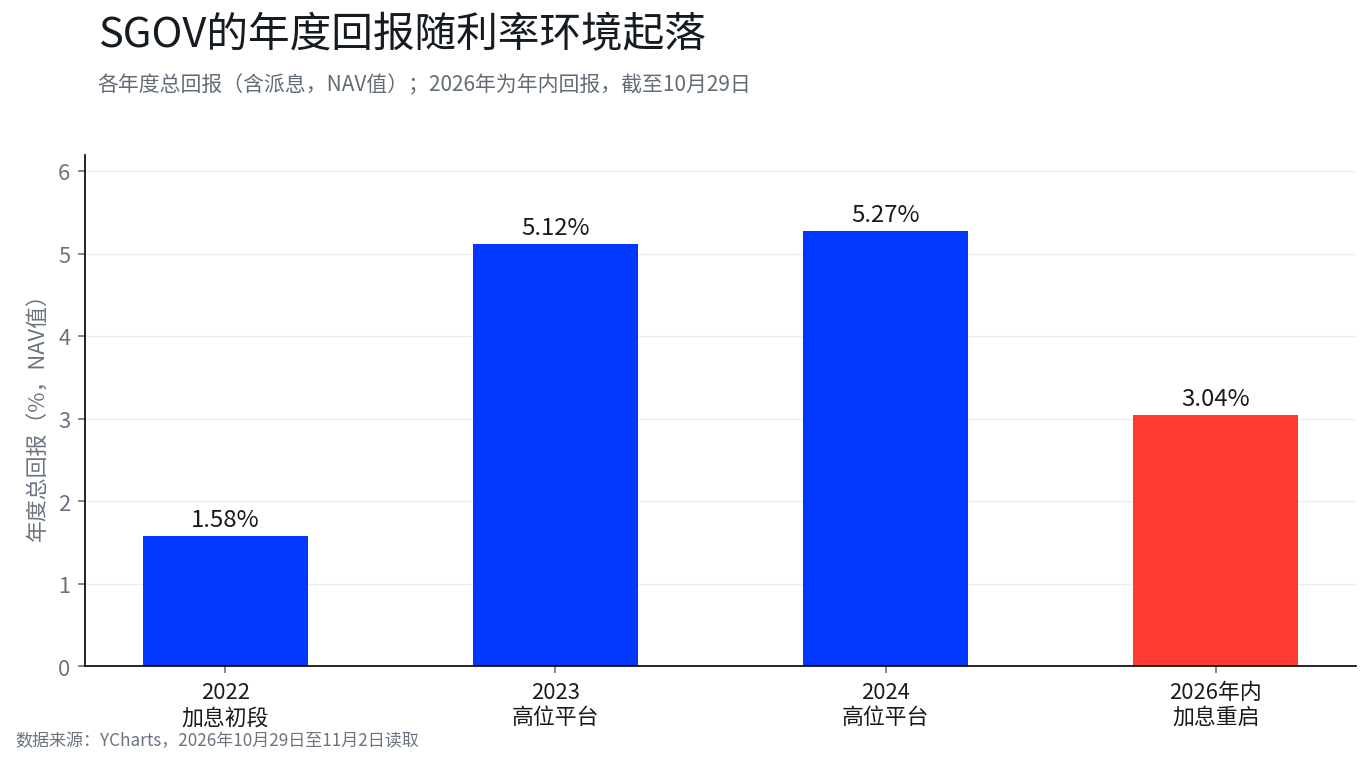
Data reflects SGOV's total return by year (including distributions, NAV), with 2026 being year-to-date return as of October 29. 2022 was a year of rate hikes, 2023 to 2024 saw the policy rate on a high plateau, and rate hikes restarted in September 2026.
However, SGOV's distributions do not rise immediately and proportionally with every Fed rate hike. Short-term Treasury yields are also affected by factors such as market supply and demand, future rate expectations, and funding conditions, and the market sometimes adjusts short-term Treasury yields in advance before the Fed formally raises rates. The fund's holdings turnover speed and management fees also affect final returns. Therefore, judging SGOV's current and future return levels cannot rely solely on whether the Fed raises rates; one must also observe short-term Treasury market yields and the fund's actual subsequent distributions.
As of October 29, 2026, SGOV's 30-day SEC yield was 3.79%, and its trailing 12-month distribution rate was 3.64%, a difference of about 0.15 percentage points. These two metrics are calculated differently and cannot be directly compared as the same yield. The 30-day SEC yield is calculated based on recent holdings income and annualized, mainly reflecting the fund's recent return level. The trailing 12-month distribution rate is calculated based on income actually distributed over the past year and includes distributions under different rate environments. Because the past year may include distributions from periods of lower rates, if current short-end rates remain at higher levels, as the low distributions from earlier months gradually roll out of the trailing 12-month statistical window, the trailing 12-month distribution rate has the opportunity to move closer to the recent return level. But this does not mean the two metrics will necessarily be equal in the end, because their calculation methods and statistical scopes differ.
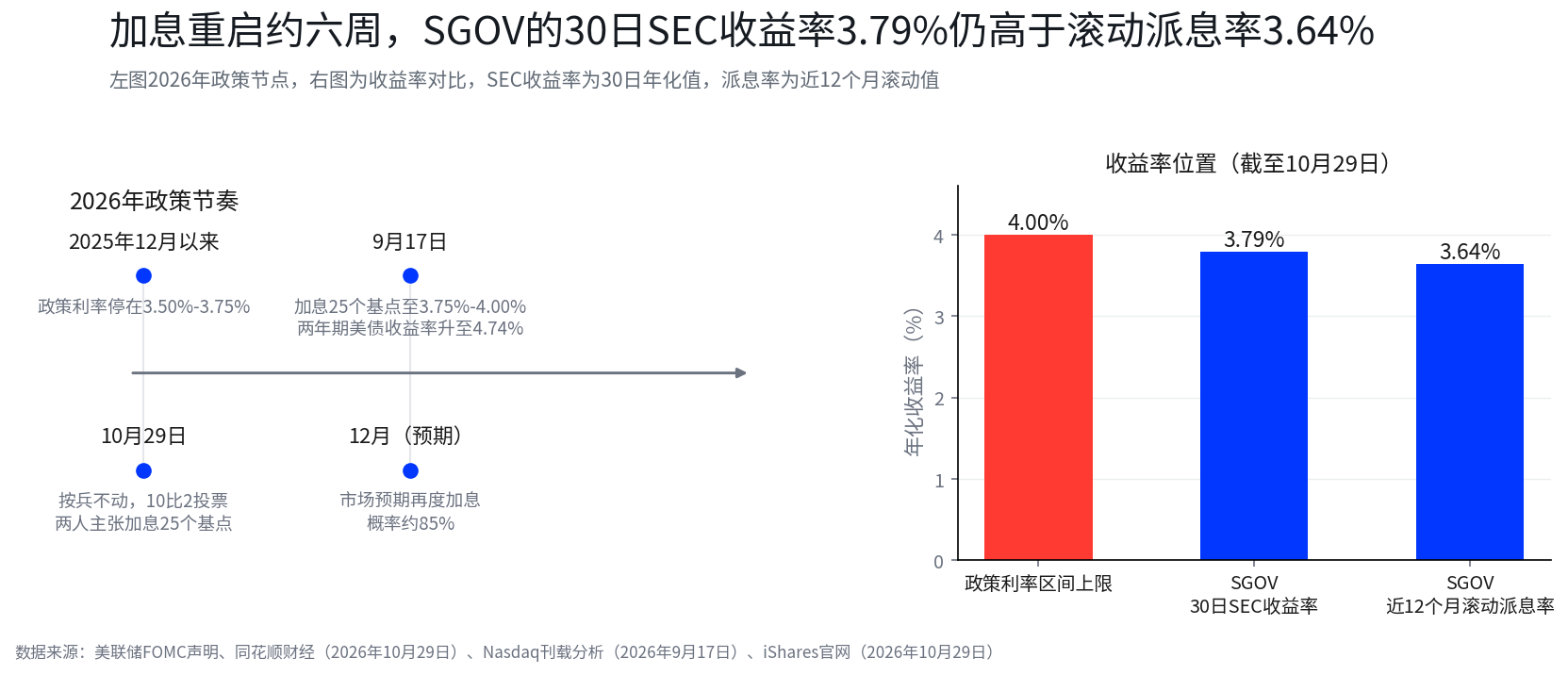
The left chart shows policy rate change points in 2026. The right chart shows SGOV yield data as of October 29, 2026. The 30-day SEC yield is an annualized metric, and the trailing 12-month distribution rate is calculated based on distributions over the past 12 months; the two have different calculation standards and cannot be directly regarded as the same yield.
For investors, the most worthwhile things to track are whether short-term Treasury yields have changed and whether such changes are gradually reflected in SGOV's subsequent monthly distributions. The NAV change on the day the Fed announces a rate hike does not directly indicate how much return the fund can earn in the future. Short-end market yields and actual distributions are more valuable reference indicators.
4. Does the NAV Drop After Monthly Distributions Mean a Loss?
No. The NAV reduction after a distribution is a normal ex-dividend change that occurs when the fund distributes accumulated income to holders. During the distribution cycle, income generated by the underlying bonds is gradually added to the fund's assets. On the distribution date, the fund pays a portion of accumulated income to holders in cash, and the fund's NAV is reduced accordingly. The cash investors receive corresponds to the reduction in NAV, so if one looks only at the price chart, it is easy to mistake normal ex-dividend changes for investment losses.
Taking an annualized yield level of 3.79% as an example, simply dividing by 12 gives a monthly return of about 0.32%. That is, if you hold $10,000 of SGOV, roughly converted at this return level, the corresponding pre-tax monthly income would be about $31.6. After the distribution is credited, the fund's NAV is adjusted accordingly; whatever amount the value of the fund assets held by the investor decreases, the corresponding cash distribution is received in the account. It should be noted that this is only a simple conversion to help understand the order of magnitude of returns; the actual distribution amount is determined by the fund based on the current period's holdings income and distribution arrangements and is not guaranteed to be exactly the same every month.
When evaluating SGOV, BIL, and SHV, one should look at total return including distributions; simply comparing the purchase price with the current NAV can easily lead to misinterpretation. Total return consists of two parts: NAV changes and distributions. If you choose to reinvest distributions, the returns generated by reinvestment also need to be included in the calculation. For products that distribute income monthly, investors can decide for themselves after the distribution is credited whether to continue buying. If they choose to reinvest, subsequent returns will also be affected by the market rates and purchase prices at the time of reinvestment. The periodic sawtooth pattern in the NAV chart does not mean the fund actually incurred a loss every month.
Taxes are also a factor to consider before holding. For U.S. tax residents, distributions from short-term Treasury ETFs generally need to be reported under the applicable tax rules; the specific tax classification and the treatment of state and local taxes depend on the fund's annual distribution composition and the investor's location. Non-U.S. tax residents need to make judgments based on their own tax status and applicable rules. Therefore, the yield shown on the product page is a pre-tax metric, and the actual after-tax return may differ depending on the investor's tax status.
5. Is Now a Suitable Time to Watch SGOV? Focus on Use of Funds and Short-End Rates
SGOV is suitable for temporarily parking U.S. dollars and earning short-term Treasury interest; it is not suitable for locking in rates or betting on bond price spreads from rate cuts.
First think clearly about two things: when the money will be used, and how high current returns are. As of October 29, 2026, SGOV's 30-day SEC yield was 3.79%, and its trailing 12-month distribution rate was 3.64%. The 3.79% can be used to observe the recent return level, but it is not a fixed return locked in after purchase. Roughly calculated at this annualized rate, $10,000 would earn about $379 pre-tax per year, with the actual amount