Over the next 12 months, which assets could benefit? Democrats take both chambers, but Trump still holds the steering wheel


- Core view: After the U.S. midterm elections, both chambers of Congress will be controlled by Democrats while the White House remains with Republicans, creating a divided-government policy landscape. The market's pricing focus should shift from the election results themselves to the actual pace of policy implementation, with opportunities over the next year coming more from sector divergence than from a broad-based rebound.
- Key elements:
- Democrats control the congressional agenda, appropriations, and oversight powers, but Trump retains executive authority and veto power over tariffs, immigration, and foreign affairs, narrowing the room for fiscal expansion, which is positive for long-end Treasuries.
- The temporary funding measure expires on December 11, coinciding with the renewal of Defense Production Act authorities. Healthcare subsidies and defense become bargaining chips, making this the first hard deadline before the transfer of power.
- Historically, a Republican president paired with Democratic control of both chambers has seen the S&P 500 average annual gains of about 4.9%, the lowest among such configurations. But the 2018 playbook showed a 11.7% gain in the 12 months after the election and a maximum drawdown of 14.7% in the first three months.
- Divergence in the AI hardware sector is pronounced: the Philadelphia Semiconductor Index fell 3.14%, Nvidia dropped 3.17%, while large cloud providers such as Microsoft and Amazon surged against the trend. The pricing logic is shifting toward scarcity of existing compute capacity and easing pressure on capital expenditure.
- Data center approval authority devolves to state governments. With gubernatorial changes in Texas and Georgia, about 45% of planned projects could be affected, and Texas accounts for roughly one-quarter of the nation's projected compute capacity by 2030.
- WTI crude fell 8.4% in a single day, pricing in easing Iran tensions and regulatory pressure on oil and gas. Exemptions from 178 Section 301 tariffs on Chinese goods were extended to November 10, giving the export chain its first policy answer.
- Key upcoming milestones: tariff exemptions on November 10, Nvidia earnings on November 17, the Fed meeting on December 8-9, the new Congress taking office on January 3, 2027, and the debt ceiling before next fall.
The results of the midterm elections have largely landed. For the market, after the power structure in Washington changes, which policies can still be pursued, which cannot, and where the president will redirect more policy space—these questions are more worth spending time on than the index's daily moves. Election-day trading provided only a footnote: on the same day the Dow rose 3.03% and the S&P 500 rose 1.65%, the Philadelphia Semiconductor Index fell 3.14% and WTI crude fell 8.4%. The seeds of divergence were planted before the election results were announced.
1. Both Chambers Go to the Democrats, but the Steering Wheel Is Still in Trump's Hands
What the Democrats Really Get from Congress: The Agenda, Appropriations, and Oversight
The new Congress will take office on January 3, 2027, at which point Democrats will decide which bills enter the deliberation process and will strengthen oversight of the executive branch through committee investigations and hearings. A Senate majority also means the president's nominees for senior officials and judicial positions will face stronger confirmation pressure (as relayed by SPDB International and multiple foreign media reports).
The governorships of Texas and Georgia changing hands at the same time transmits this shift directly to AI infrastructure. Both states are key regions for US data centers and power investment, and state governments hold actual decision-making power over land, energy, environmental protection, tax incentives, and project permits. Projects already in the construction phase are affected to a limited degree; for projects that have not yet locked in power supply, permits, and local tax incentives, policy uncertainty has risen markedly.
Trump Doesn't Have Congress, but Tariffs and Executive Power Remain in His Hands
Republicans still control the White House, and the Democrats' seats in both chambers are insufficient to override a veto. Executive powers such as tariffs, immigration enforcement, and foreign and military action are basically fully retained (as relayed by Axios and AP reports). Trump has publicly stated he will be "Mr. Veto" (as relayed by DW reports). Even with control of Congress, Democrats will find it very difficult to fully convert their agenda into law.
The Democrats got Congress, but not the full direction of policy. Trump lost Congress, but not executive power.
The First Hard Battle After the Election Is Set for December 11
Before the new Congress takes office, there is a lame-duck session that is easy to overlook. The old Congress will still be handling appropriations from November to December, and the expiration of temporary funding on December 11 is the first hard deadline before the transfer of power. The old Senate still needs Democratic votes, and a short-term funding extension to avoid a shutdown is highly likely (JPMorgan Asset Management analysis, as relayed by reports). This also means issues such as healthcare and defense will likely be packaged into the same negotiating package.
2. Congress Can't Control All Policies; Three Channels Determine Asset Direction
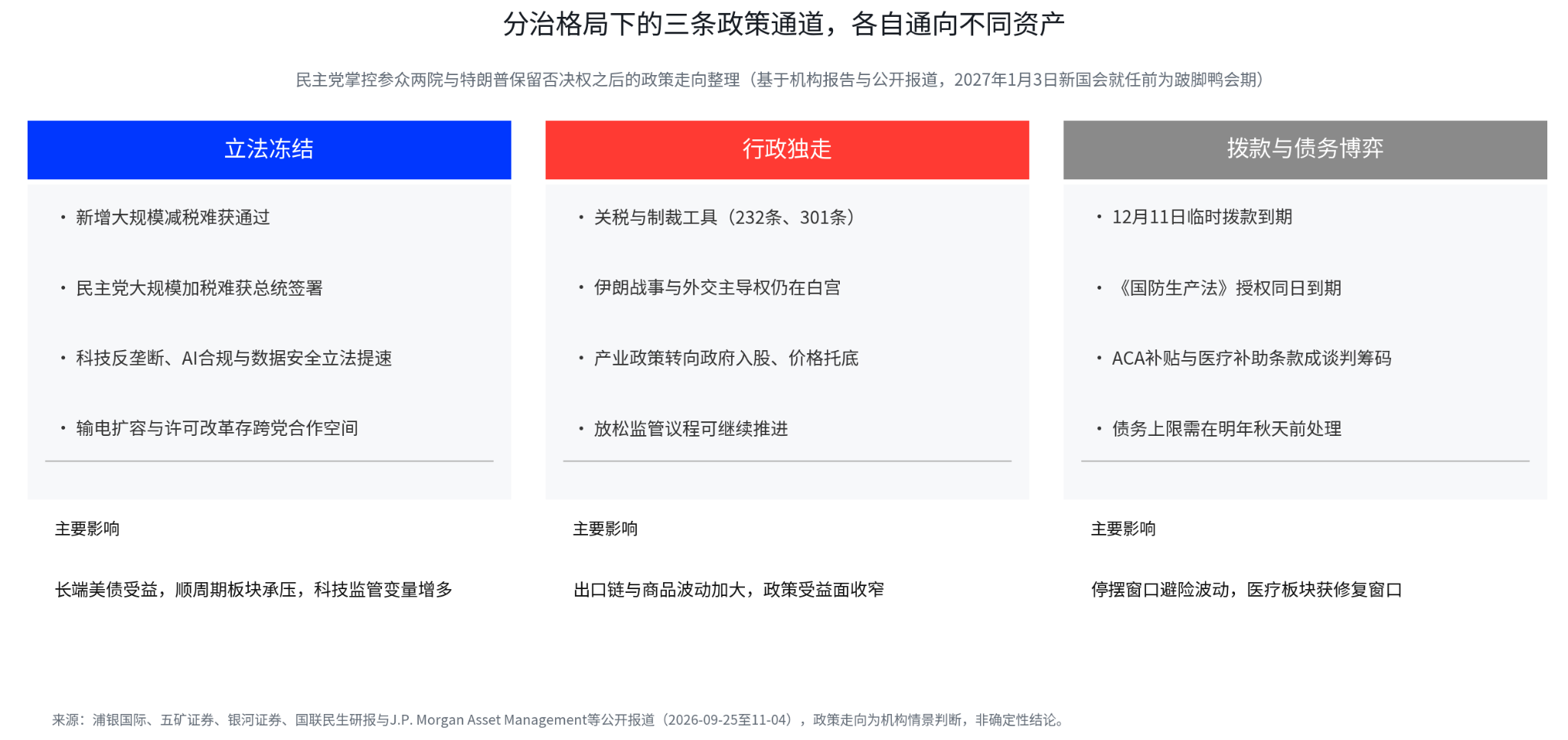
Legislative Freeze: Fiscal Stimulus Is Hard to Expand Further; Treasuries Benefit First
Democratic control of Congress does not mean the tax increases Democrats propose can be enacted—the president has veto power. Trump's desire to push a new round of large-scale tax cuts will also find it hard to replicate the passage efficiency of the unified government period. Judgments from institutions such as JPMorgan Asset Management point to the same place: divided government will compress the space for new fiscal expansion, while already-effective tax and spending arrangements will continue to be implemented (as relayed by reports). This is a relatively direct positive for long-end US Treasuries. Over the past few years, the biggest pressure on Treasuries has come from persistent increases in fiscal deficits and long-term Treasury supply; with Congress divided, the space for further expanding the deficit is constrained.
Tech regulation is another line on this channel. The pace of antitrust, AI compliance, and data security may accelerate (Guolian Minsheng scenario); what really needs to be watched is whether specific bills emerge and whether regulation moves from principle discussions into enforcement. Transmission expansion and permitting reform, meanwhile, have room for bipartisan cooperation (SPDB International). For US data centers, where power has already become a bottleneck, this is one of the few directions where policy consensus may form.
Executive Unilateralism: Tariffs and Industrial Policy—Trump Can Still Play His Own Cards
Under existing authorizations such as Section 232 and Section 301, the White House still has considerable room to adjust tariffs without needing to go through Congress each time. Over the next year, China policy may present a seemingly contradictory picture: congressional oversight is stronger, yet tariff policy can still be pushed forward quickly by the executive branch. SPDB International even suggests that it cannot be ruled out that Trump may increase the intensity of using tariff tools after losing control of Congress.
The administrative character of industrial policy is also strengthening. Over the past year, the White House exchanged $8.87 billion in CHIPS Act funding for roughly a 9.9% stake in Intel, invested $400 million in preferred shares in MP Materials and committed to a ten-year price floor, and provided a $2.23 billion loan to Lithium Americas (compiled by Minmetals Securities). Policy support is increasingly concentrated on a small number of strategic companies, while broad subsidies across entire industries are declining.
The Appropriations Game: December 11—Healthcare and Defense Become Bargaining Chips
Temporary funding expires on December 11, and on the same day the price-floor authorization under the Defense Production Act faces renewal; Democrats may attach oversight conditions (Minmetals Securities). Enhanced ACA premium tax credits and Medicaid restrictions are the two directions Democrats most want to put into negotiations (SPDB International). They may not be fully restored, but could enter the appropriations bill in the form of temporary extensions, partial adjustments, or attached provisions. The debt ceiling is a further tail risk that must be addressed before next autumn; whether congressional confrontation then escalates into a hard risk for financial markets depends on whether both sides truly use the debt ceiling as a negotiating tool.
3. Don't Be Scared by 4.9%: 2018 Is the More Useful Script
The 4.9% Historical Average Includes Recessions and Crises
Under the combination of a Republican president and Democratic control of both chambers, the S&P 500 has averaged annual gains of about 4.9%, the worst among all power combinations (Stock Trader's Almanac, as relayed by Bloomberg and other reports). This number cannot be used directly to forecast 2027. There are not many historical years matching this combination, and many of them coincided with recessions, financial crises, or cyclical downturns; low returns may come from political divided government or from the poor macroeconomic environment at the time.
What 2018 Tells Us: A Drop First, Then a Rally, Is Entirely Possible
2018 was also a year when a Republican president faced Democrats retaking the House, similarly compounded by Fed rate hikes and trade friction. According to Minmetals Securities statistics, the S&P 500 rose 11.7% in the 12 months after the election, with a maximum drawdown of 14.7% in the first three months, not bottoming until December 24. Across 20 midterm elections since 1946, the S&P 500 has averaged gains of about 14.4% in the 12 months after the election (Minmetals Securities statistics), indicating that the market environment after midterms is not pessimistic over the long run.
"A rally in the year after the election" and "a potentially large drawdown in the months after the election" can both hold true; history supports a bullish bias amid volatility.
4. Treasuries and Healthcare: The Two Asset Classes That First Reflect the Election Results
Treasuries: Fiscal Freeze Opens Room, the Fed Sets the Ceiling
The core formula for Treasuries is that fiscal expectations open up room, and the Fed determines how far that room can go. After the election, the 10-year Treasury yield fell from around 4.96% to around 4.88%, as the market began trading on expectations of constrained fiscal stimulus and reduced deficit expansion.
This logic cannot be separated from the Fed. Before the December 8-9 FOMC meeting, the market was still pricing about a 77% probability of a rate hike (CME data, as relayed by reports). Nonfarm payrolls on the evening of November 6 (market expectation of about 50,000 to 65,000) and mid-November CPI (September year-over-year 3.7%, core 2.6%) directly affect this expectation. If employment weakens and inflation falls back, the decline in yields will be supported by the rates side. If inflation rises again and the Fed stays hawkish, the benefits of the fiscal freeze may be offset by rate pressure. An analysis relayed by Morningstar adds another reminder: the government's high borrowing scale will continue, so don't expect too much downside room for long-end yields.
Healthcare: The Election Is Only the First Trade; December Appropriations Are the Real Test
Democrats need appropriations power to push ACA subsidies and Medicaid issues, while Republicans need to avoid a government shutdown; both sides have incentives to compromise. On November 4, the healthcare sector rose 3.06%, the biotech ETF rose 2.67%, and Moderna rose 13.11%.
The election-day gains are only the first layer of pricing; the next-stage catalyst lies in the specific provisions of the December appropriations negotiations. If the relevant subsidies are extended, insurance, biotech, and healthcare services may continue to benefit. If the final plan is clearly below expectations, the November 4 gains would instead face pressure to materialize. The verification point is the bill text around December 11.
5. The Biggest Variable for AI Hardware Has Moved from Washington to State Governments
Why AI Hardware Fell Sharply: From Who Buys GPUs to Who Makes Money
On the same day the S&P 500 rose 1.65%, the Philadelphia Semiconductor Index fell 3.14%, Nvidia fell 3.17%, Micron fell 7.00%, CoreWeave fell 9.90% to a record low since listing, IREN fell 11.24%, Hut 8 fell 23.23%, and Cipher Mining fell 19.95%. Microsoft, Amazon, and Apple rose 6.68%, 6.12%, and 5.31%, respectively; Google rose 3.18%, Meta rose 1.44%, and Duolingo rose 25.99%. The combined market value of the five major giants increased by about $850 billion in a single day. Power and equipment suppliers were sold off alongside: GE Vernova fell 9.30%, Constellation Energy fell 6.71%, and Vistra fell 13.83%. What the market is trading is no longer simply AI positives or negatives; it is distinguishing who still needs to keep spending heavily to build infrastructure and who has already begun to profit from AI investment.
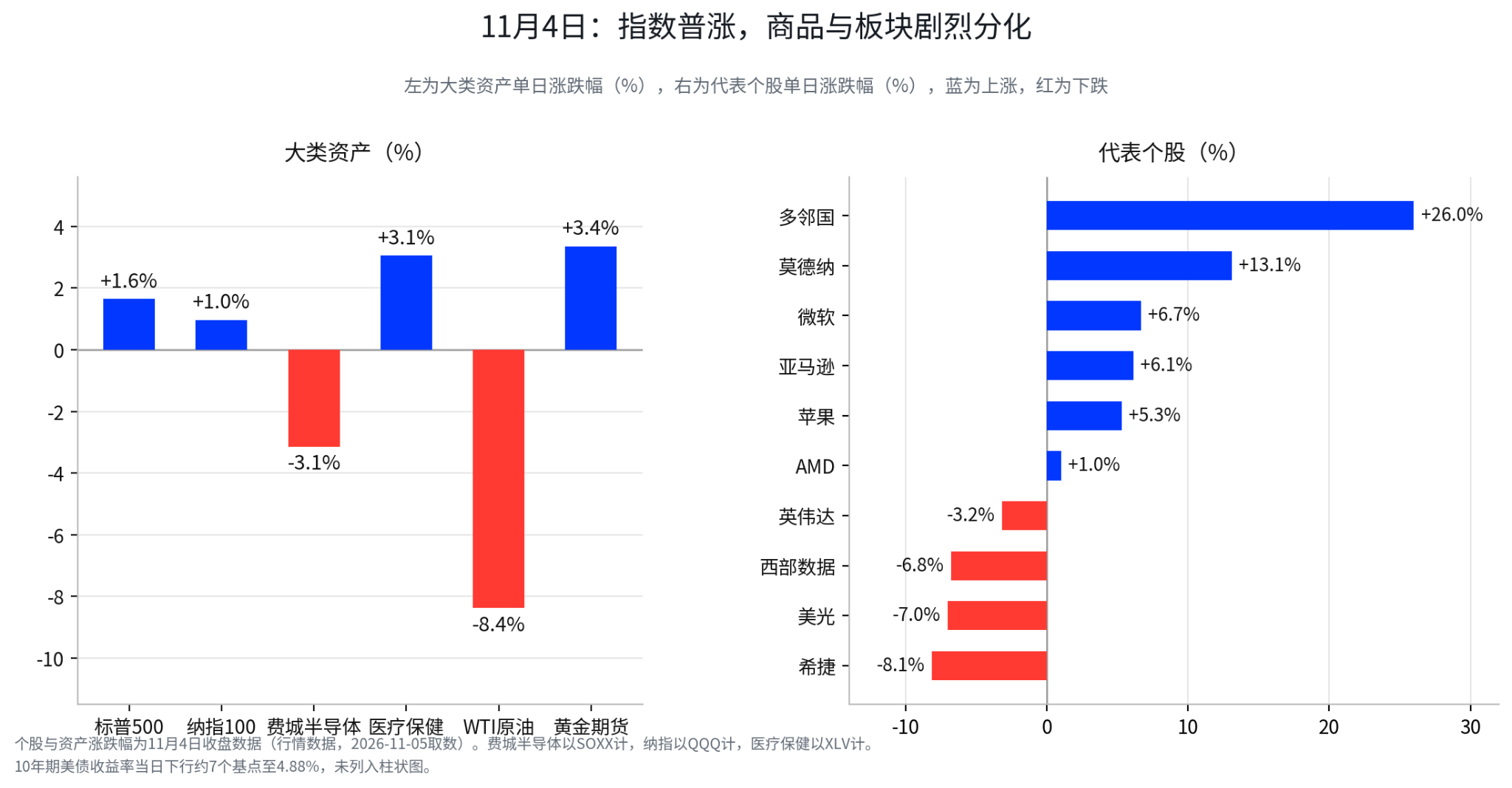
Compute Scarcity Is the Other Half of This Round of Divergence
The counter-trend rally in large platforms needs an explanation: they happen to be the market's biggest AI buyers. John Flood of Goldman Sachs' trading desk (as relayed by media) said the most prominent theme on the desk that day was buying large cloud and selling semiconductors: constrained new capacity means compute supply is scarcer, incumbent suppliers can sell services at higher prices, and slower construction spending frees up capital to resume buybacks. Art Hogan, chief market strategist at B. Riley Wealth, offered the other side of the same logic: large cloud providers' data centers are already built, the pace of new construction is slowing, existing assets are more valuable, and capex growth can decline accordingly.
Adding this logic makes the day's trading picture coherent. The rally in platforms priced a revaluation of the scarcity of existing compute, plus expectations of easing capex pressure. The original framework explained why Nvidia and Micron fell; the scarcity framework explained why Microsoft and Amazon rose. Together, the two frameworks form the complete pricing picture.

The cost-side story is equally clear. The investment director of Siebert Financial (as relayed by media) believes AI infrastructure will not disappear, but tax incentives may decrease, companies will have to bear more electricity and water costs, construction will become more expensive, returns will be compressed, and the most vulnerable are companies highly dependent on financing. This point corroborates the deep drawdowns in CoreWeave and IREN.
The opposing voices are also worth recording. Adam McCarthy of LO:TECH (as relayed by media) cautions that the sharp decline in data center concept stocks may be an overreaction; the Trump administration has consistently supported AI development, and administrative tools such as permitting and federal land remain in the White House's hands. The UBS strategy team's observation (as relayed by media) points to state governments: exit polls show voters strongly oppose building data centers in their communities, and the most impactful near-term variable is tighter regulation at the state level. Evercore ISI holds a similar view: a tighter development environment will further weigh on sentiment toward AI infrastructure-related shares.
The Next Hurdle for Data Centers: Power, Permits, Tax Incentives
Whether data centers can obtain power, land, tax incentives, and environmental permits is becoming increasingly important. The estimate by Goldman Sachs chief economist Jan Hatzius has been relayed by multiple media outlets: state and local election results could trigger pauses in data center construction, affecting about 45% of planned projects in the US, with Texas alone accounting for about 25% to 27%. Projects that have obtained permits, locked in power supply, and broken ground are affected to a limited degree by policy changes; projects that have not completed these steps face higher delay risk. SPDB International's judgment is consistent: data center projects that have not yet locked in power supply, permits, and tax incentives in 2027 are more likely to be delayed.
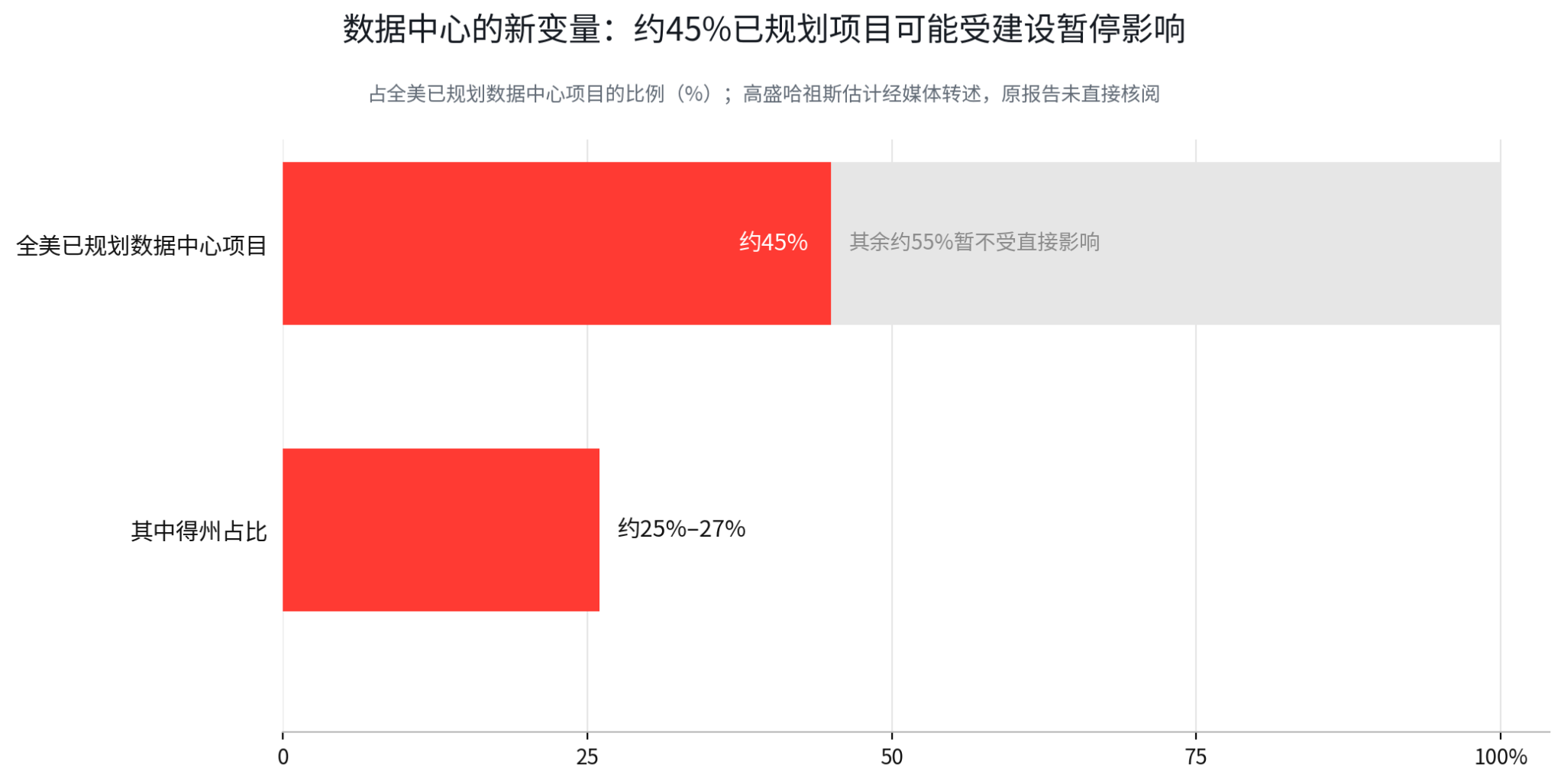

Two additional pieces of evidence make Texas's weight clearer. Research firm SemiAnalysis estimates (as relayed by media) that Texas accounts for about a quarter of the US compute expected to be operational by 2030, corroborating Hatzius's range. Voices calling for a pause have also emerged at the federal level: Democratic Representative Yassamin Ansari argued on social media that a pause on advanced AI development and a ban on artificial superintelligence should be placed on the party caucus's first-day agenda. This is currently only an individual lawmaker's statement with no legislative path, so it is sufficient to keep it on the watch list.
Watch Nvidia on November 17: The Market Wants More Than Revenue Growth
AMD previously reported third-quarter revenue of $13.377 billion, up 45% year-over-year, with data center revenue up 97% year-over-year and fourth-quarter revenue guidance of about $17 billion; the stock rose only 1.01% that day. The numbers remain strong; the stock reaction shows the market is demanding more than revenue growth itself, shifting to whether orders can be sustained, whether capex can be converted into cash flow, and whether infrastructure construction can proceed smoothly.
Evidence at the application layer is accumulating on the other side. Duolingo cut the cost per AI call from about $0.30 to about $0.01, with gross margin rising to about 73%; cost reduction has already entered corporate income statements. The market may gradually shift from who buys the most GPUs to who can use lower costs to create more revenue.
6. Two Executive-Power Trades: Crude Oil Looks to Iran, Export Chains Look to Tariffs
Crude Oil: The 8.4% Plunge Is Pricing a Cooling of Iran Tensions
After Democratic control of Congress, regulatory pressure on traditional oil and gas development may rise. If the Iran situation continues to cool, the geopolitical risk premium will continue to contract; the combination of these two factors explains WTI's single-day drop of 8.4%. Crude oil cannot simply be viewed bearishly: diplomatic and military initiative remains in the White House, and if negotiations fail or conflict escalates, oil prices may quickly trade in the opposite direction. Over the next few months, crude oil is better tracked as an event-driven asset, acting around Iran negotiation progress and inventory data.
The energy policy truly worth watching is, rather, the power grid. Transmission expansion and permitting reform have room for bipartisan cooperation (SPDB International), and traditional energy and grid equipment may receive completely different policy treatment.
Export Chains: November 10—178 Tariff Exemptions Provide the First Answer
The extension of 178 Section 301 tariff exemptions on China to November 10, with renewal, adjustment, or cancellation all decided by the White House (Galaxy Securities). Galaxy Securities' judgment is that after a Democratic sweep, Congress may push to constrain the president's broad tariff authority, but