Breaking Down Circle's Q3 Earnings: Accounting Magic Props Up a Record $865 Million Revenue—What Are the Real Fundamentals?


- Key Takeaways:Circle's record quarterly revenue in Q3 was primarily driven by a one-time $182 million ARC token presale. Excluding this, the core USDC business still faces declining reserve income and flat circulation, as the company undergoes a transition between old and new growth drivers.
- Key Elements:
- Total revenue and reserve income reached $865 million, up 17% year-over-year, but core reserve income of $658 million fell 8% year-over-year, with the reserve return rate dropping to 3.5%.
- Other revenue surged 627% year-over-year to $207 million, of which $182 million came from the ARC token presale. Excluding this, regular other revenue was only $25 million, a notable decline quarter-over-quarter.
- USDC's quarterly average circulation was $73.3 billion, down 4.2% quarter-over-quarter, with market share at 27%, down 1.83% year-over-year, still far below the 40% compound annual growth guidance.
- USDC on-chain transaction volume reached $13.9 trillion, up 49% year-over-year, with 7.3 million active wallets, up 16%, as usage efficiency continues to improve.
- USDC held on Circle's own platform reached $13.9 billion, up 36% year-over-year, with its share rising to 18.1%, driving net reserve margin up to 38%.
- Binance injected $100 million into Circle and expanded their strategic partnership, with CPN annualized payment volume reaching $41.3 billion, alongside a signed agreement to acquire Tazapay.
Original | Odaily (@OdailyChina)
Author | Azuma (@azuma_eth)
Before the U.S. market opened on November 4 (Beijing time), stablecoin issuer Circle (NYSE: CRCL) officially released its Q3 2026 financial results.
The report shows that Circle's Q3 total revenue and reserve income reached $865 million, up 17% year-over-year and a new quarterly high; net income from continuing operations was $226 million, up 5% year-over-year; diluted EPS was $0.84, up 31% from $0.64 in the same period last year; adjusted EBITDA came in at $317 million, up 85% year-over-year.
After the earnings release, driven by multiple record-breaking figures, CRCL rose as much as 3% in pre-market trading, but as the market carefully dissected the report, CRCL gradually pulled back. As of 20:55 Beijing time, it was down 3.35% in pre-market trading.

Core Operating Data: Behind the Record Highs Lies an "Accounting Trick"
At first glance, Circle did deliver a fairly solid scorecard in Q3. However, digging into the revenue structure reveals that a considerable portion of Circle's growth this quarter came from ARC token presale, while the USDC business itself still faces pressure from declining reserve yield and slowing circulation growth.
In Q3, Circle's total revenue and reserve income jumped to $865 million, continuing the recovery momentum of recent quarters ($740M ➡️ $770M ➡️ $694M ➡️ $701M ➡️ $865M).
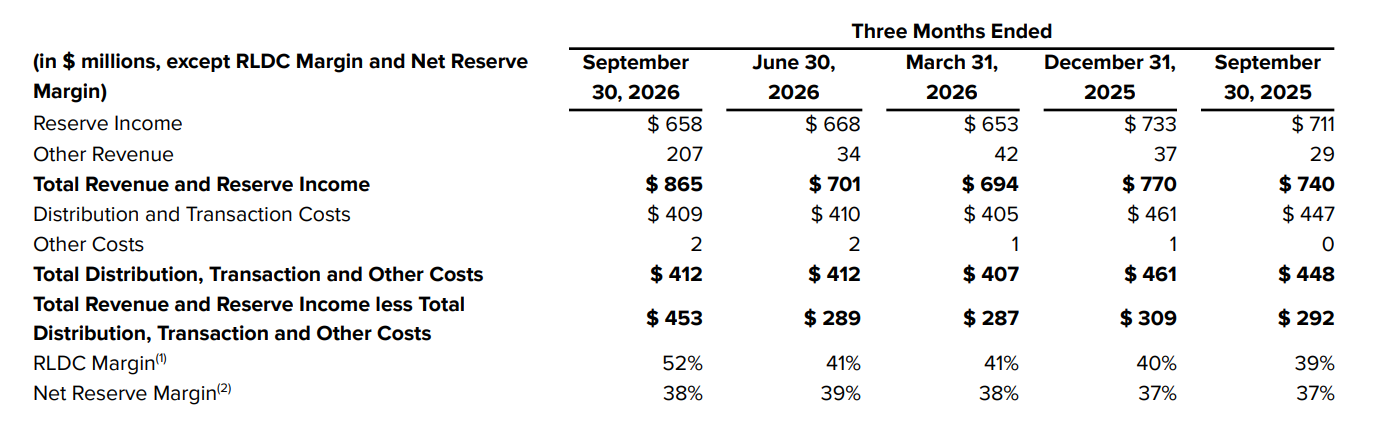
But breaking down the structure, core reserve income came in at $658 million this quarter, down 8% year-over-year and down 1.5% quarter-over-quarter (from $668 million last quarter). The year-over-year decline was mainly due to the reserve return rate falling 61 basis points from last year's high base to 3.5%; the slight quarter-over-quarter decline was primarily dragged down by a sequential drop in USDC average circulation during the quarter.
What really drove the quarterly revenue high was other revenue — which surged 627% year-over-year to $207 million this quarter. As we warned in our previous two earnings analyses (see Q1 and Q2 earnings breakdowns), this was mainly because the quarter formally recognized $182 million in ARC token presale revenue. It's worth noting that excluding this one-time token presale payment, regular other revenue this quarter was actually $25 million, a notable decline from Q1 ($42 million) and Q2 ($34 million) — the earnings notes also acknowledged that this decline stemmed from "a decrease in subscription and service revenue."
Similarly, the surge in RLDC and RLDC Margin in Q3 was largely because the $182 million in ARC revenue with zero distribution costs was directly counted in the numerator — the former reached $453 million this quarter, up 55% year-over-year, while the latter jumped from 41% in the previous two quarters to 52%. Excluding the ARC impact and looking solely at the true profitability of the reserve business, the net reserve margin disclosed in the report (i.e., the margin after deducting distribution costs from reserve income) was 38% this quarter, up 1 percentage point year-over-year and down 1 percentage point from Q2 (39%), remaining broadly stable.
- Odaily note: RLDC refers to revenue less distribution costs, and RLDC Margin refers to the margin after subtracting distribution costs from revenue. These two figures reflect the core business profitability after deducting distribution expenses and are widely regarded as Circle's most core profitability metrics.
Now let's look at expenses. Distribution and transaction costs remained Circle's largest expense item, at $412 million this quarter, down 8% year-over-year and flat compared to Q2 ($412 million).
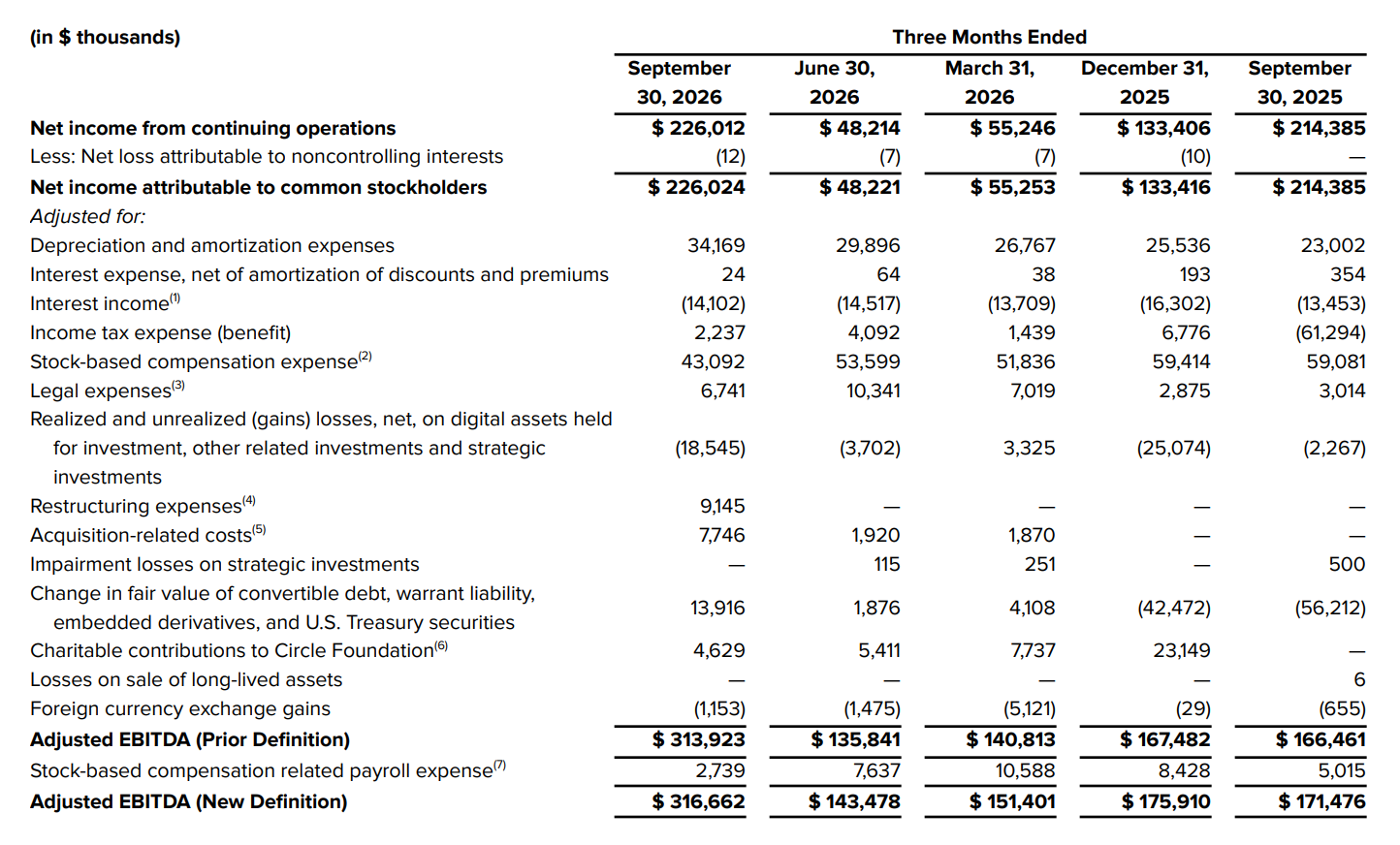
On operating expenses, under GAAP they were $245 million, up 16% year-over-year but down from Q2 ($254 million); the more informative adjusted operating expenses were $139 million, up 13% year-over-year and down 5.2% quarter-over-quarter (Q2 was $146 million).
Looking at the expense breakdown, IT infrastructure costs nearly doubled year-over-year to $17.92 million, marketing expenses (including the Chelsea FC jersey sponsorship, etc.) doubled year-over-year to $11.32 million; but compensation expenses fell 4% year-over-year to $124 million. The earnings notes disclosed that Circle carried out a roughly 5% workforce reduction in Q3, paying $9.15 million in cash severance and restructuring costs, while reversing $5.7 million in stock-based compensation due to forfeited unvested RSUs of departing employees; in addition, to advance the Tazapay acquisition, the quarter incurred $7.75 million in M&A-related legal and professional service fees.
USDC Circulation Enters a Plateau, but On-Chain Usage Continues to Rise
Looking at Circle's core USDC business, the quarter overall showed characteristics of "quarterly average decline, end-of-quarter stabilization, and high on-chain frequency."
As of the end of Q3, USDC's market share among USD stablecoins was 27%, flat quarter-over-quarter but down 1.83% year-over-year. Q3 USDC average circulation was $73.3 billion, up 8% year-over-year, but down about 4.2% from Q2's average circulation of $76.5 billion. The good news is that in Q3, USDC minting and redemption were exactly balanced, both at $104 billion, driving end-of-quarter circulation to edge up to $73.9 billion (flat year-over-year, up 0.8% quarter-over-quarter). This indicates that the outflow trend at the end of Q2 has stabilized, but overall scale remains in a sideways consolidation phase, still facing considerable challenges to reach management's unchanged guidance of "40% compound annual growth rate (CAGR) across cycles."
In sharp contrast to the sideways circulation, USDC usage frequency continues to accelerate. This quarter, USDC on-chain transaction volume reached $13.9 trillion, up 49% year-over-year; the number of active wallets holding more than $10 in USDC rose to 7.3 million, up 16% year-over-year. The growth rate of transaction volume and active wallets significantly outpacing circulation growth indicates that the turnover efficiency of existing USDC in payments, cross-border settlement, and on-chain transactions is further improving.
Distribution Structure Improves, Binance Becomes a New Channel
For a long time, high channel revenue sharing (especially interest sharing with partners like Coinbase) has been the biggest pain point suppressing Circle's valuation. In the Q3 report, distribution and transaction costs fell from $447 million in the same period last year to $409 million (down about 8% year-over-year).
It should be objectively noted that the year-over-year decline in the absolute value of distribution costs was primarily because the total reserve income pool shrank 8% year-over-year — as the interest pie got smaller, the absolute amount shared proportionally with external partners naturally decreased. But beyond this passive shrinkage, Circle also made two advances in its own retention and channel negotiations.
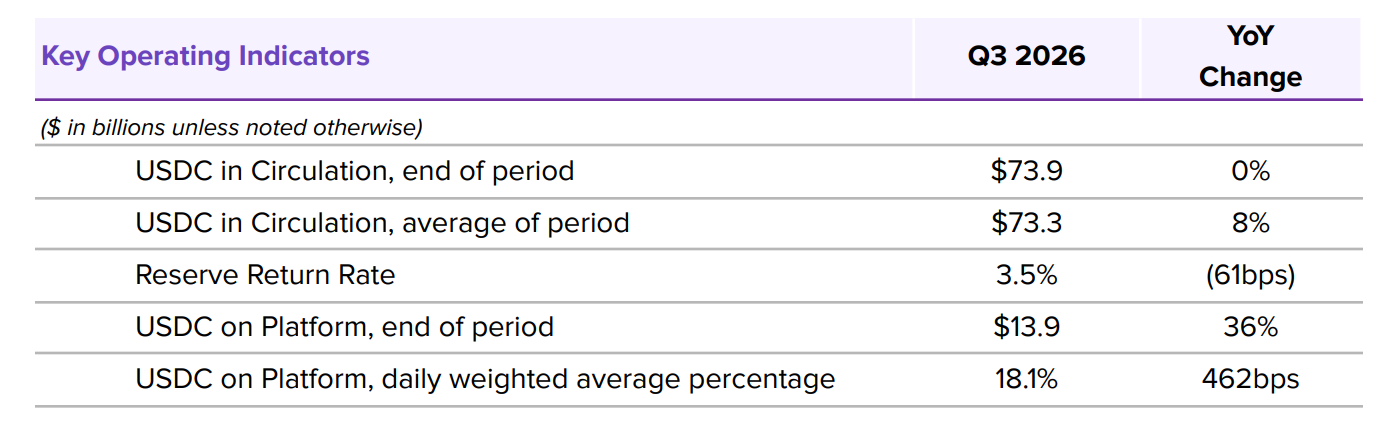
First, the growth of funds held on its own platform improved the platform retention ratio. The report shows that at the end of Q3, USDC held on Circle's own platform (USDC on Platform) climbed to $13.9 billion, up 36% year-over-year; the daily weighted average share also rose significantly by 4.62% year-over-year to 18.1%. Since USDC held on Circle's own platform requires no revenue sharing with external channels, this rising share helped Circle improve its net reserve margin from 37% in the same period last year to 38%.
Second, Binance made a strategic $100 million equity investment in Circle, binding a new distribution channel through equity ties. Following the renewal of its agreement with Coinbase in Q2, Circle announced this quarter that Binance had made a $100 million equity investment in Circle, and the two parties simultaneously renewed and expanded their strategic partnership, focusing on promoting USDC across Binance's massive global trading platform and emerging markets.
Arc Mainnet Launches — Is the $182 Million Revenue Just the Beginning?
The biggest new business development for Circle this quarter was undoubtedly Arc.
On September 16, the Arc public mainnet launched. Circle called it its most important product launch since USDC, with over 100 institutions and ecosystem builders participating on the first day, with native USDC integration. The report also mentioned that during the private mainnet phase, a developer community of over 75,000 Arc House members and 10,000 Architect ambassadors had built more than 1,200 projects on Arc.
On the token side, Circle completed the full initial genesis minting of 10 billion ARC tokens in Q3, officially becoming the world's first publicly listed company to mint a native network token for a new Layer 1 blockchain. The ARC token will assume network security, utility, and governance coordination functions, driving the network's formal transition to a proof-of-stake (PoS) mechanism in 2027. The $182 million in ARC presale revenue recognized this quarter also left Arc's first quite prominent mark on Circle's financial statements.
However, more than a month after the mainnet launch, the report still primarily discloses developer and ecosystem-building data, which is not yet sufficient to prove that Arc has formed large-scale real economic activity. Subsequent transaction volume, institutional usage, and network revenue will be the key to judging its commercial value.
Payment Network Continues to Expand
In addition to Arc, Circle's payments network CPN reached $41.3 billion in annualized payment volume this quarter, a notable acceleration from Q1 ($8.3 billion) and Q2 ($14.7 billion).
To further strengthen payment implementation capabilities, Circle has signed a definitive agreement to acquire Singapore-based B2B cross-border payment platform Tazapay (expected to close in 2027). Tazapay has over $25 billion in annualized payment volume (about 60% of which already includes stablecoin transactions), more than 60 banking and fintech partners, and local clearing channels covering over 100 markets. If integrated smoothly, this will further enhance Circle's payment network footprint in Asia-Pacific, Latin America, and emerging markets.
After Stripping Away the "Accounting Magic," How to Assess Circle's True Quality?
Overall, Circle's Q3 report clearly reflects the company's current "transition period between old and new growth drivers."
On one hand, the recognition of $182 million in ARC token presale revenue made this quarter's total revenue ($865 million), RLDC Margin (52%), and adjusted EBITDA ($317 million) look extremely impressive on paper; but if you strip away this "one-time token gain" filter, USDC circulation stagnating in the $73–74 billion range, reserve income declining 8% year-over-year, and the quarter-over-quarter decline in regular subscription and service revenue excluding ARC remain realities that Wall Street cannot avoid when scrutinizing its fundamentals.
On the other hand, Circle is also responding to market skepticism through concrete business actions — USDC held on its own platform surpassing 18%, Binance binding with a $100 million real-money equity stake, CPN annualized transaction volume surging to $41.3 billion, and the Tazapay acquisition closing the cross-border clearing loop... For investors, as the "one-time accounting bonus" from ARC presale revenue gradually fades over the coming quarters, whether the aforementioned payment network and public chain ecosystem can truly take over and contribute sustainable recurring non-interest income will determine the ultimate direction of Circle's valuation center in the secondary market.